
6 Stocks to Buy Right Now!
Periods of high market panic often create the best opportunities to buy incredible businesses at a steep discount!

The Iran War is sending shockwaves through global financial markets, causing panic and extreme volatility!
On Wednesday, I published an article on why investors should not stop investing during this war.
To navigate these turbulent times successfully, investors must establish a strict set of criteria to separate permanently damaged companies from those that will emerge stronger.
Periods of high market panic often create the best opportunities to buy incredible businesses at a steep discount!
Today, I will explain my 4 easy criteria for buying stocks now and give 6 of my picks.

1. Criteria for Buying Stocks during the Iran War
Investing during a War downturn requires being smart and selective.
The goal is to not only identify companies best positioned to benefit from the eventual recovery, but also to find long-term winners that will reach new highs.
I believe the following 4 criteria are crucial for this:
Not directly affected
Strong long-term prospects
Improving financials
Attractive valuation
1.1. Not Directly Affected
A significant problem during the current Iran War is a sharp increase in oil, gas, and other commodity prices!
When energy prices surge, the ripple effects move rapidly through the global economy. This creates long-term structural issues that can easily last for years, severely penalizing businesses that depend heavily on physical commodities or require vast amounts of power to operate.
Airlines are a classic example of an industry that is directly harmed by rising energy costs. Fuel typically accounts for a significant portion of an airline’s opex, sometimes exceeding 25%.
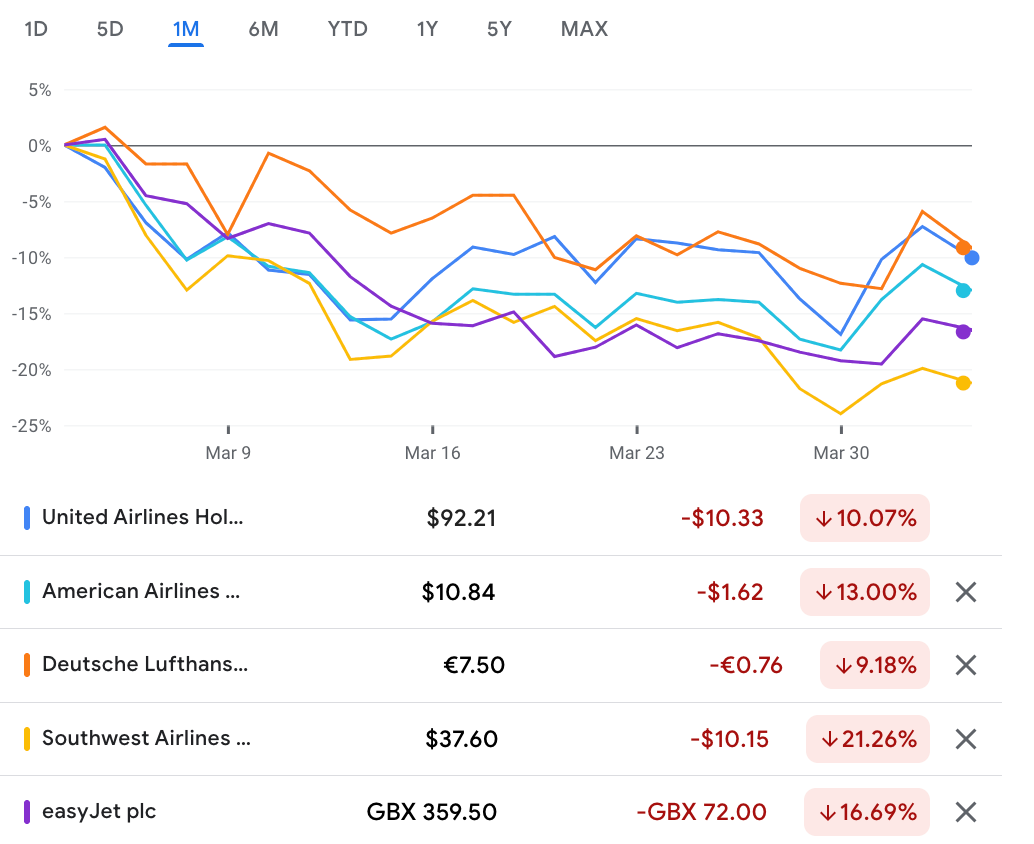
When crude oil price surges over $100 a barrel, the price of jet fuel rises even faster due to widening refinery profit margins. Because airlines operate on razor-thin margins, they are forced to raise ticket prices to cover these costs. This immediately reduces travel demand, leaving discount carriers that cannot pass on costs to customers at high risk of pausing operations or facing insolvency.
Cruise ships face similar structural headwinds. These massive vessels consume incredible amounts of heavy fuel oil and marine gas to transport passengers across the ocean.
General tourism and heavy manufacturing industries also suffer prolonged damage during energy crises.
High travel costs and fears regarding regional stability keep families at home, devastating local economies that depend on international visitors.
Meanwhile, manufacturing businesses that use a lot of raw commodities or high-temperature processing see their cost of goods sold rising rapidly. If consumer demand weakens at the exact same time that input costs are rising, these energy-intensive businesses can face structural profitability issues that last for years.
Thus, it is smart to avoid firms that see rapid cost spikes during an energy crisis.
1.2. Strong Long-Term Prospects
While avoiding damaged industries is a defensive move, growing wealth requires an offensive focus on companies with favorable long-term growth trends.
Businesses driven by secular shifts rather than cyclical economic patterns tend to outperform in the long run, regardless of short-term geopolitical issues.
When a broad market sell-off occurs due to a war, it often drags down the share prices of high-quality companies whose underlying business drivers remain completely unaffected.
Sectors like AI, digitization, e-commerce, semiconductors, renewables, and fintech are excellent examples of structural growth trends that will continue moving forward independently of Middle Eastern geopolitics.
The shift toward a digital economy is a global trend driven by the pursuit of convenience, speed, and cost reduction. Businesses adopt software and automation to lower overhead and improve productivity when labor and energy become more expensive.
At the same time, Fintech and e-commerce platforms continue to gain market share simply because they provide superior user experiences compared to legacy brick-and-mortar stores and traditional banks. In developing regions, where large portions of the population remain unbanked or underbanked, digital finance platforms provide the core infrastructure needed for modern commerce.
Because these digital platforms do not require massive physical branch networks or fleets of heavy delivery trucks to operate their core software, they are naturally shielded from the worst effects of an energy crisis.
1.3. Improving Financials
When investing during a macro crisis, it is crucial to ensure that the target company possesses a strong and improving internal engine of cash generation.
During a war, capital markets often freeze, interest rates may rise to combat energy-driven inflation, and securing external funding becomes incredibly difficult and expensive.
Therefore, businesses must demonstrate improving financials, particularly in terms of operating leverage and free cash flow generation.
When a company can grow its revenue while keeping its operating expenses flat or declining, its profitability expands exponentially. Investors should look for businesses that have already completed their heavy capital investment cycles and are now beginning to harvest the rewards.
High gross margins are particularly important because they give a company the flexibility to absorb minor cost increases without falling into losses. While a strong balance sheet with ample cash reserves ensures that the business can survive prolonged periods of economic uncertainty without needing to dilute shareholders or take on high-interest debt.
Most importantly, when investing in a company with improving margins, investors could see a significant share price appreciation as the multiple rises!
1.4. Attractive Valuation
The final and most important criterion for making an intelligent investment is ensuring an attractive entry valuation!
No matter how incredible a company’s growth prospects are, paying an excessive price for the stock can still result in poor investment returns. During periods of peace and economic expansion, investors are often willing to pay massive premiums for growth stocks.
However, when war breaks out, the market’s risk appetite shrinks, causing valuation multiples to compress drastically.
Buying shares at these lower multiples could end up being extremely profitable as the end of a military conflict brings higher multiples.
Simply put, buying stocks at a reasonable valuation protects the downside while maximizing the potential for upside returns when market conditions eventually normalize.
Metrics such as the price-to-sales ratio, enterprise value relative to net cash, and price-to-earnings must be evaluated carefully. Finding companies that are growing their top-line revenues at 20% or more per year while trading at multiples historically reserved for slow-growing legacy businesses represents the ideal scenario for a long-term investor.
2. 6 Companies that fit these criteria
Applying the 4 investment parameters detailed above yields a list of high-quality businesses not only capable of withstanding the current geopolitical storm but also coming out of it stronger.
These 6 companies operate in sectors not heavily affected by the energy price shocks, possess powerful long-term growth catalysts, are showing clear signs of financial improvement, and are trading at attractive prices.