
Broadcom Deep Dive: The Custom AI Chip Leader!
A very high quality business that is trading for a fair price.

The rise of AI has been fast and spectacular.
OpenAI’s ChatGPT grew from 0 to 900M weekly active users in 4 years.
Anthropic ARR grew from $9B in December 2025 to $44-47B by June 2026.
Google’s Cloud backlog grew from $92B in Q1 2025 to $468B in Q1 2026.
This unprecedented growth has created a massive demand for infrastructure that enables the AI to function, and I don’t just mean Nvidia.
There is a company whose AI products have been highly successful and are at the core of the AI infrastructure strategies of the aforementioned OpenAI, Anthropic, and Google.
That company is Broadcom.
Broadcom is a semiconductor company that designs networking chips capable of transferring data between AI servers at speeds demanded by these incredibly complicated AI models.
Furthermore, the company has partnerships with Google, OpenAI, and Anthropic to build custom AI chips capable of functioning better than Nvidia’s GPUs for very specific use cases.
In this Broadcom Deep Dive, I will explain all of the most important things a potential investor needs to know.
Key Products
Business Model
Business Strategy
Opportunities
Risks
Financials
Valuation
2030 Valuation Model
After reading this report, you should be fully up to speed on what Broadcom does and whether it could be a great investment opportunity for a patient long-term investor.
Let’s begin.

1. Semiconductor Solutions
A semiconductor is a tiny computer chip that manages the flow of electricity inside computers, routers, and phones to help them process information and complete tasks.
In this industry, there are many areas in which companies specialise, as no company can manufacture all the chips in the world.
So, Broadcom focuses on chips for:
Wireless systems
Broadband and telecommunications
Storage and server infrastructure
AI and data center chips
This division is the main driver of Broadcom’s success.
In 2025, the division brought in $36.9B in revenues, representing 57.7% of the company’s total revenue.
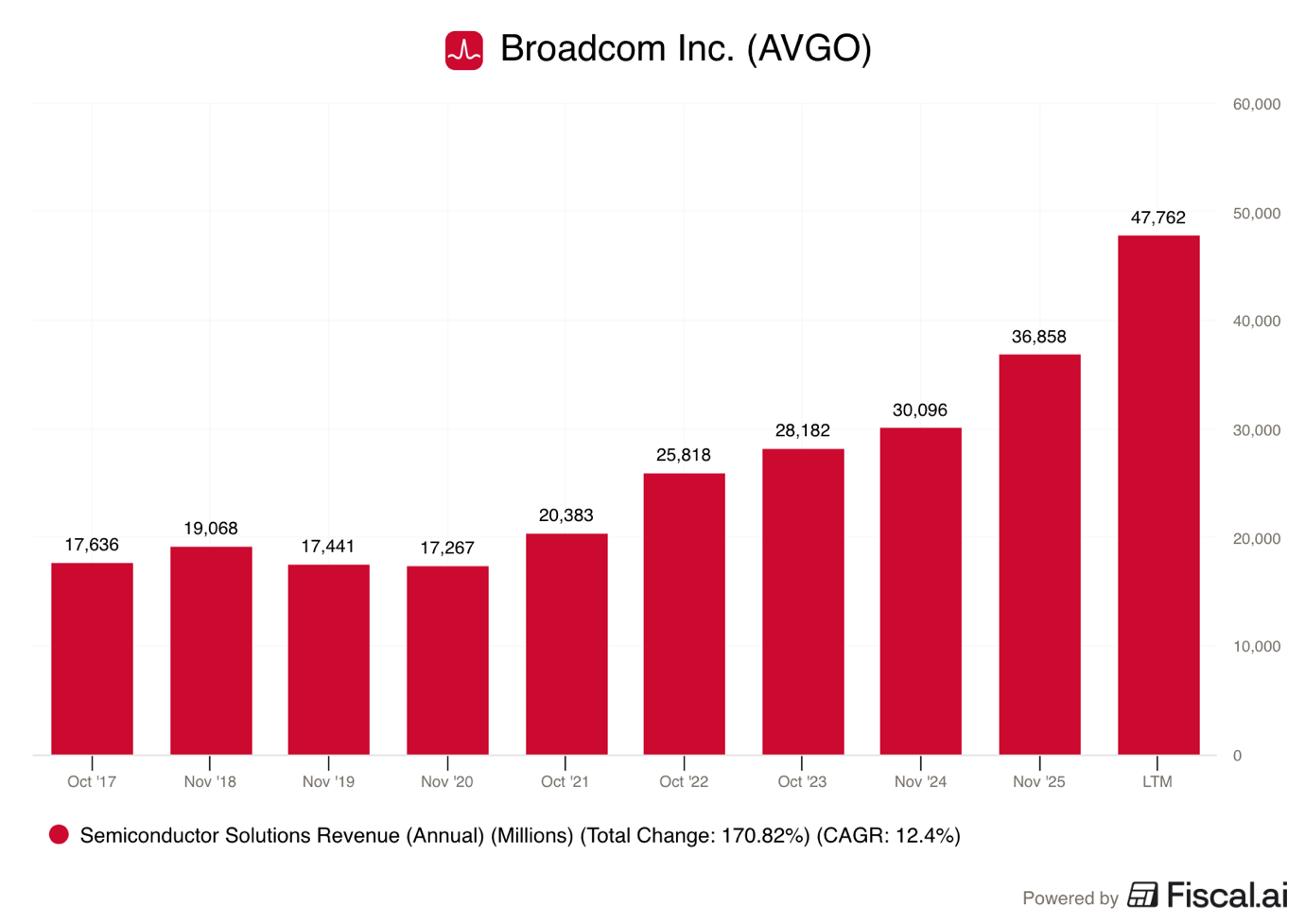
Since 2017, the semiconductor business has delivered a CAGR of 12.4%.
Let’s look deeper at the chips Broadcom makes.
1.1. Wireless
Wireless components are chips that let electronic devices transmit data to each other and connect to cellular networks or Wi-Fi without using physical wires.
Broadcom’s wireless division designs components like:
Bluetooth transceivers
Wi-Fi chips
GPS receivers
RF filters
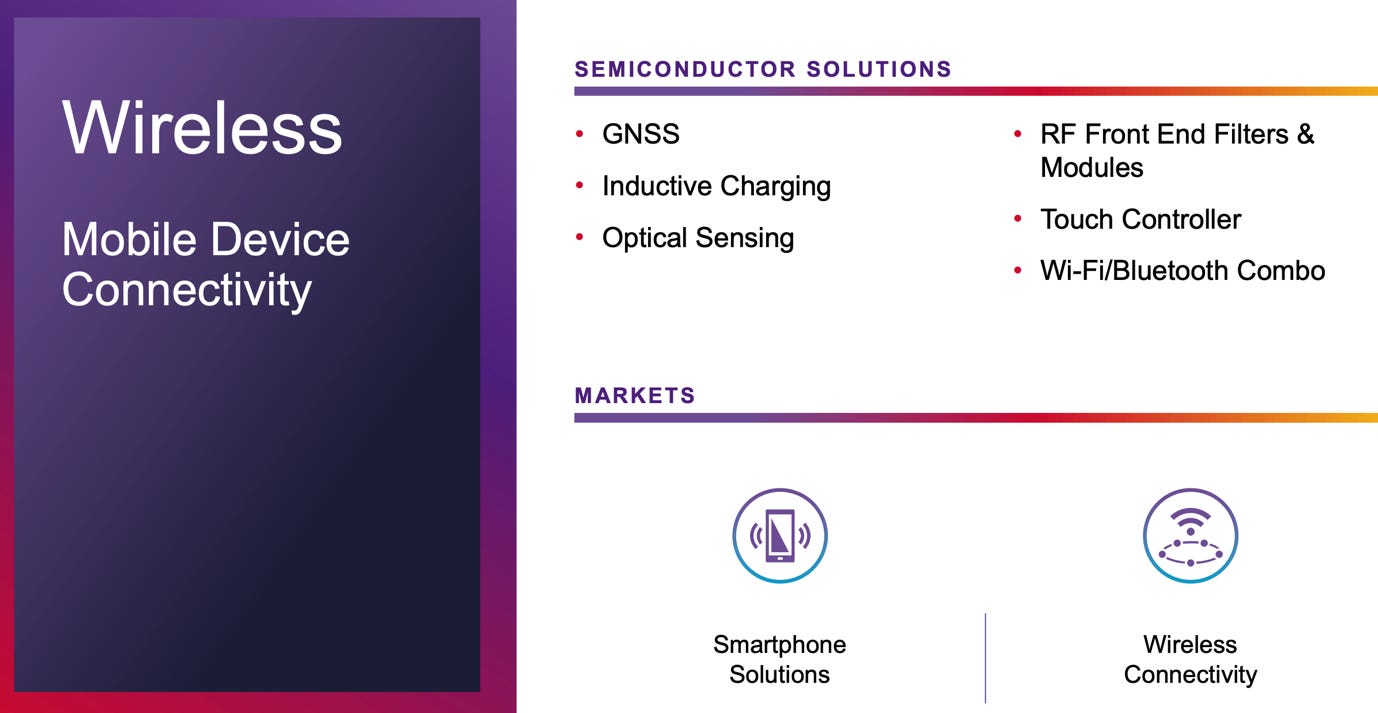
Broadcom’s Bluetooth chips enable devices such as smartphones, laptops, earbuds, and others to communicate wirelessly over short distances.
To support high-speed wireless networks, Broadcom offers several Wi-Fi chips.
These Wi-Fi chips inside devices such as smartphones provide the wireless networking functionality to connect to the internet.
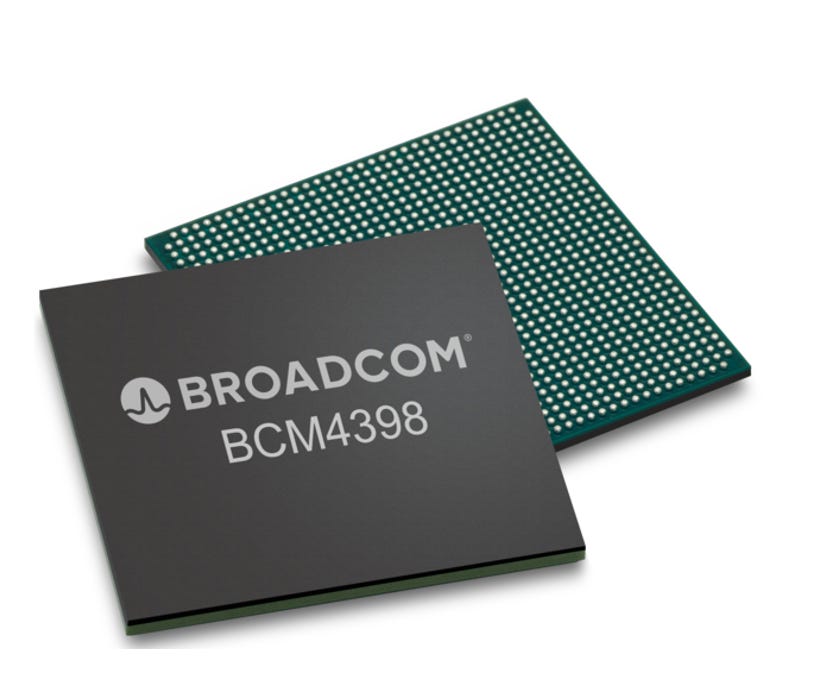
For instance, the BCM4398 chip is a highly integrated, low-power Wi-Fi and Bluetooth combo chip designed for mobile phones.
Meanwhile, Broadcom’s GPS/GNSS chips receive signals from satellite navigation systems.
They are needed to calculate a device’s precise location, speed, and time for navigation, mapping, tracking, and location-based services.
For automotive and industrial systems, the company designed the BCM47722, which combines Wi-Fi, dual IoT radios, and an integrated GPS/GNSS receiver on a single chip to assist with tracking and location data. Such integrated chips eliminate the need for multiple chips, reducing power consumption.
Furthermore, Broadcom designed the Wi-Fi combo chips for Android and Apple devices, such as the BCM4339 used in the Nexus 5 and the BCM4361 used in the Galaxy S8.
Today, the most important customer for these wireless products is Apple.
In May 2023, Apple signed a multi-year, multi-billion-dollar agreement with Broadcom to purchase 5G RF components and FBAR filters.
An FBAR filter is a tiny acoustic device inside a phone that acts like a highly precise screen. If someone walks into a noisy room where 100 people are shouting, an FBAR filter acts like a selective earplug that blocks out 99 of those voices so you can hear the single person speaking perfectly. In a phone, it blocks out thousands of surrounding radio signals and static noise, letting in only the exact 5G or Wi-Fi signal the phone needs.
This increases connection speed, prevents dropped calls, and drastically improves user experience.
1.2. Broadband and Telecom
Broadcom designs silicon platforms for wired broadband and telecommunication networks.
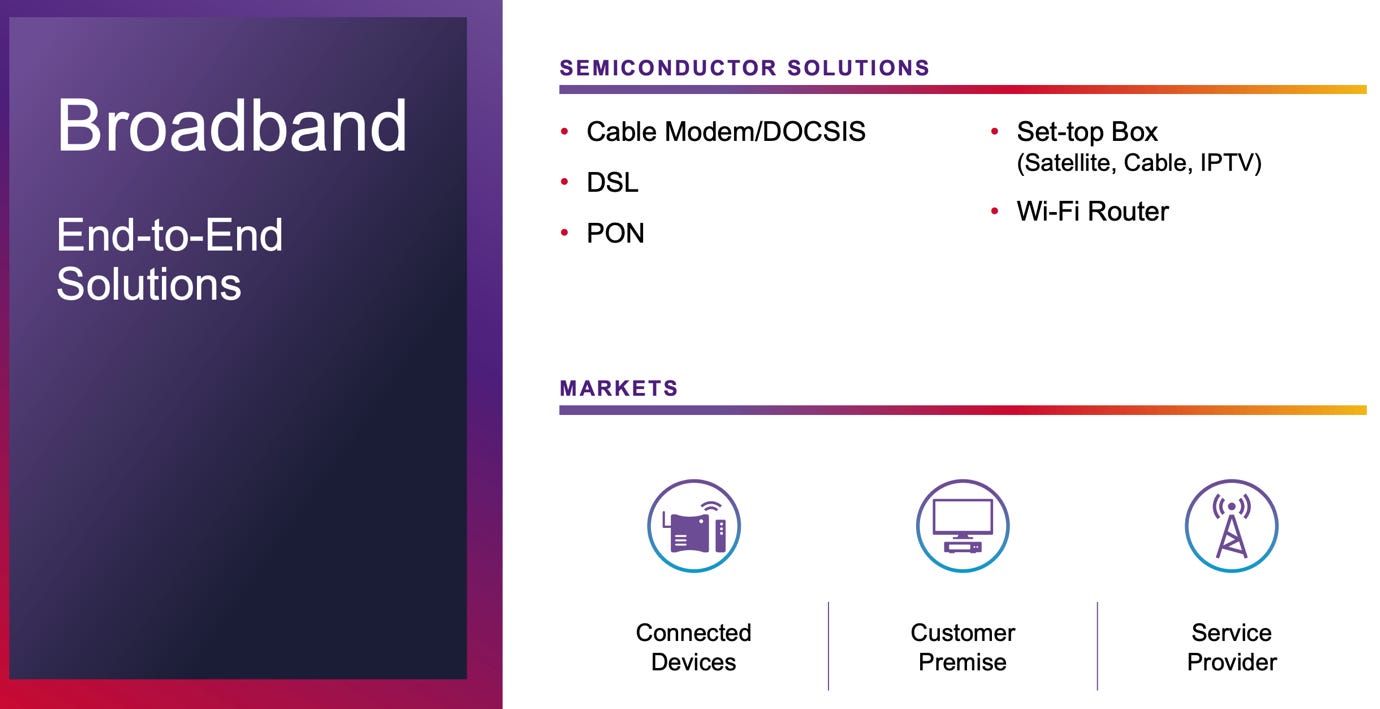
This includes chips for
Cable modems
Fiber gateways
Home routers
Cable boxes
Other equipment
Broadband is high-speed internet delivered to residential homes or corporate buildings via physical cables, like copper or fiber-optic lines. While telecom equipment includes the large computer switches that phone and internet companies use to route internet traffic.
Broadcom designs gateway chips and access point chips for fiber, cable, and DSL internet routers.
Fiber-optic networks send internet data as rapid pulses of light through thin glass cables. A gateway chip acts like a translator, turning those light pulses from outside the building into electrical signals that home routers and computers can understand.
Broadcom’s newest broadband chip, the BCM68850, is the 1st general-purpose 50G Passive Optical Network, or PON, home gateway chip.
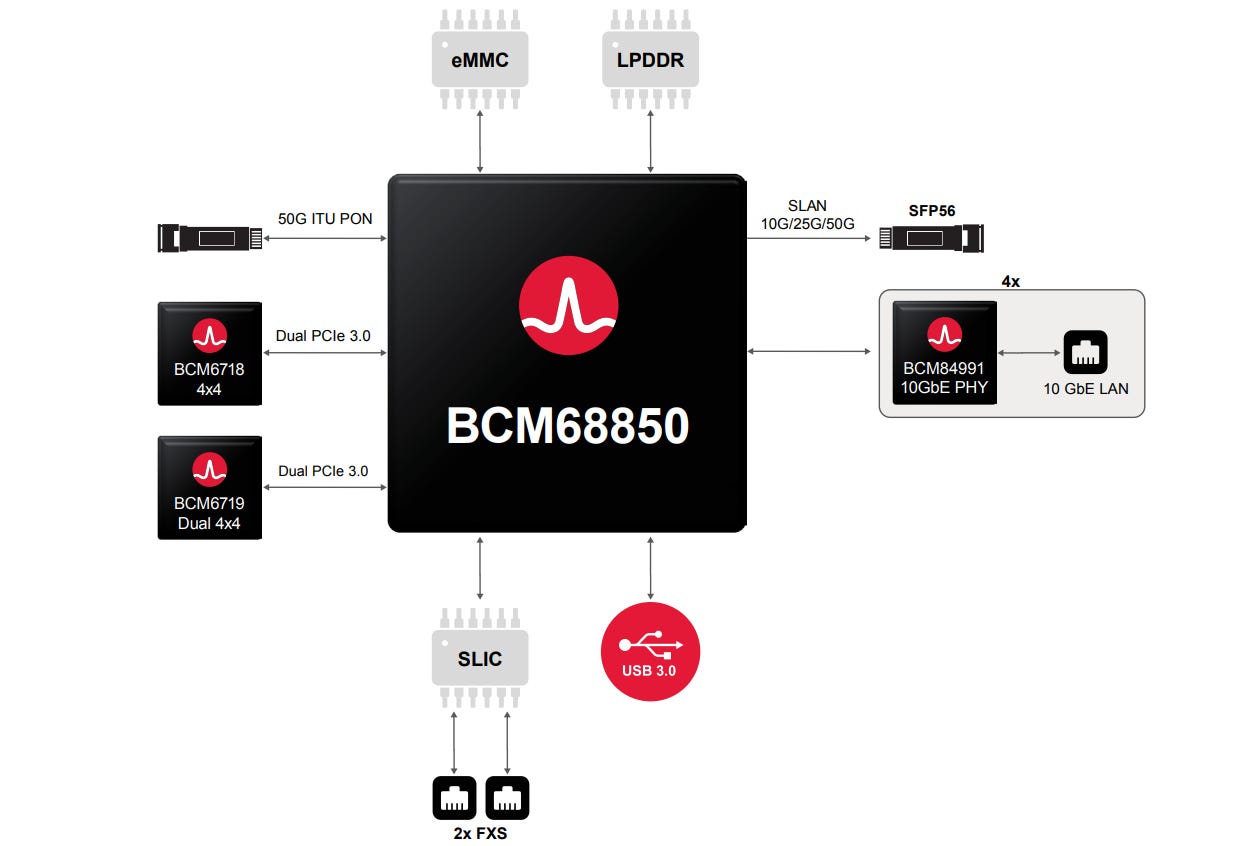
This chip supports download and upload speeds of up to 50Gbps, which is up to 50 times faster than current 1Gbps home internet connections.
It features an integrated neural processing unit, or NPU, which is a tiny AI chip that acts as an automated helper to predict internet demand, manage data flows, and detect cyber threats. It also uses post-quantum cryptography to encrypt internet data, protecting it from futuristic quantum computers that could hack standard encryption.
Broadcom has a complete 50G PON chip lineup, BCM55050 for devices inside subscriber homes, BCM68660 for telecom network facilities, and the BCM68850 for home gateways.
These chips are systems-on-chip, or SoCs.
This means they combine the CPU, the network routing engine, and the Wi-Fi radios onto one single piece of silicon.
This single-chip design cuts manufacturing costs and reduces router electricity use.
These chips support SMD roaming, which lets a mobile device connect to a new router in a large office before disconnecting from the old one, preventing internet dropouts. The chips also integrate power amplifiers, which strengthen the radio signals, and digital pre-distortion, which automatically fixes signal errors, to save costs for router makers.
1.3. Storage and Server Infrastructure
Data centers use thousands of servers to store massive files, run websites, applications, and manage company databases.
Storage infrastructure refers to the chips, cables, and boards that write, retrieve, and protect this stored data.
Broadcom designs products such as:
RAID controllers
PCIe switchers
Fibre Channel adapters
A RAID controller acts like an automated data backup manager. It splits data and writes it across multiple hard drives at the same time. If one hard drive fails or gets damaged, the RAID controller uses the backup pieces on the remaining drives to rebuild the lost files without any downtime.
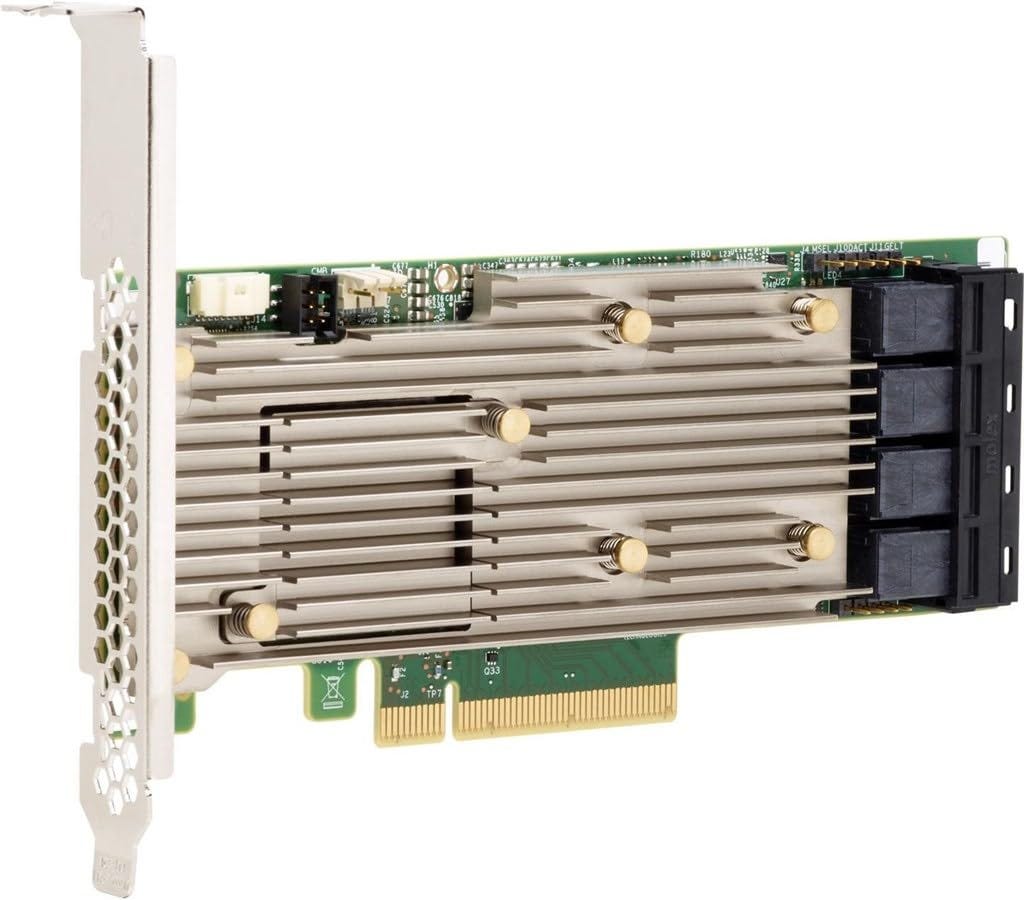
Whilst PCIe switches act like high-speed traffic controllers inside the server, routing data between the CPU, the storage drives, and the graphics chips.
Meanwhile, Fibre Channel adapters use high-speed optical connections to transfer data between storage drives and server computers at speeds up to 64Gbps with very low latency.
Broadcom’s newest RAID controller chip, the SAS5116W, delivers a 2-fold increase in random read speed and a 3-fold increase in random write speed over prior generations.
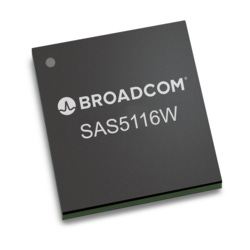
It features an integrated 2-core ARM design CPU, a hardware encryption engine, and a bandwidth optimizer that lets customers connect older drives to newer systems without losing performance.
Simply put, the SAS5116W lets data centers get significantly more performance, security, and storage efficiency from their drives while extending the useful life of existing storage hardware.
Key customers are server and storage manufacturers, system builders, and hyperscalers.
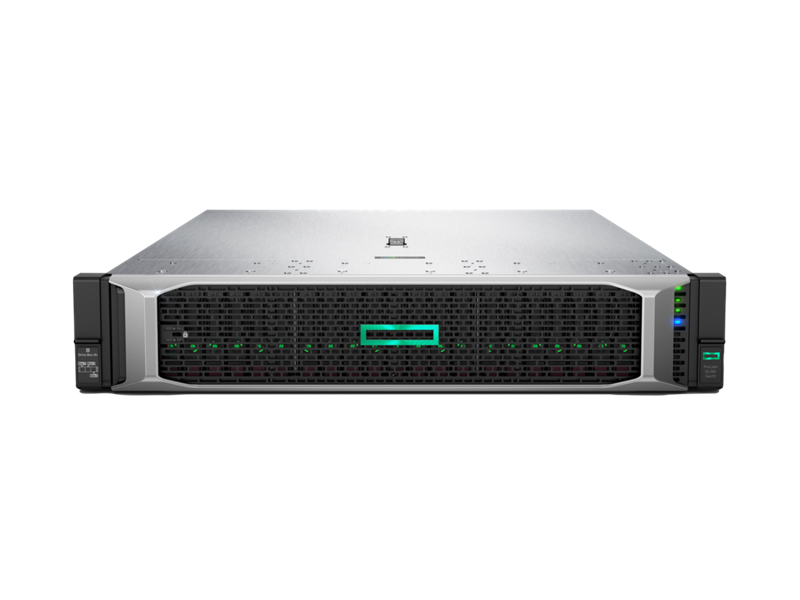
For instance, Broadcom collaborates closely with Hewlett Packard Enterprise to supply Smart Array controllers for its ProLiant Gen10 server, while Lenovo integrates the RAID controller chips into its servers.
1.4. AI and Data Centers
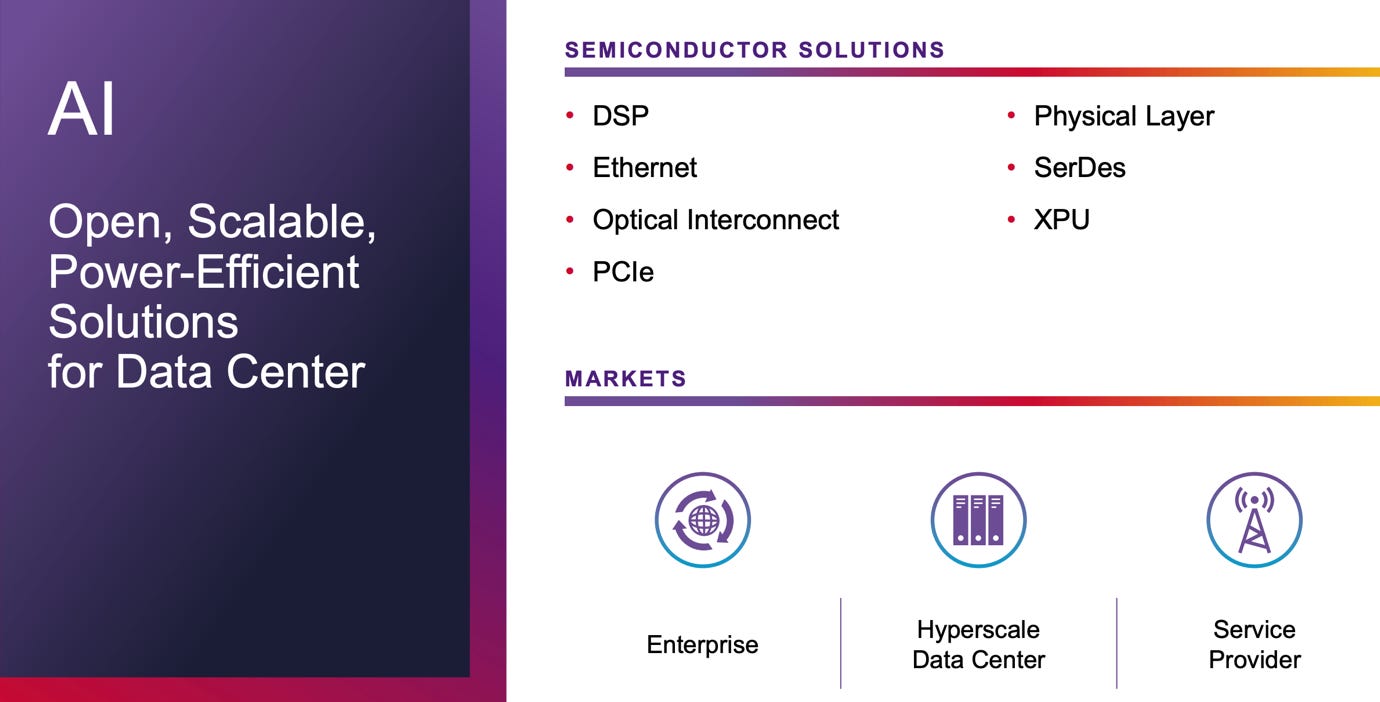
Broadcom AI and Data Center business is exploding and is really driving the whole company’s performance due to incredible AI demand.
Training and running AI systems require running huge parallel math calculations on a massive scale.
When the AI boom began, the demand for Nvidia’s GPUs exploded, as they are flexible chips built to handle many different types of parallel tasks.
However, because GPUs are built to be so flexible, they contain parts that AI models do not use, making them highly expensive and inefficient when used in certain ways.
To save money and energy, major tech companies are co-designing custom chips with Broadcom called custom accelerators or XPUs.
These are Application-Specific Integrated Circuits, or ASICs, which are custom chips designed to do only one specific job, like running a specific type of AI model extremely fast.
An ASIC is like a specialized tool built for a specific task, while a GPU is like a multi-tool pocketknife.
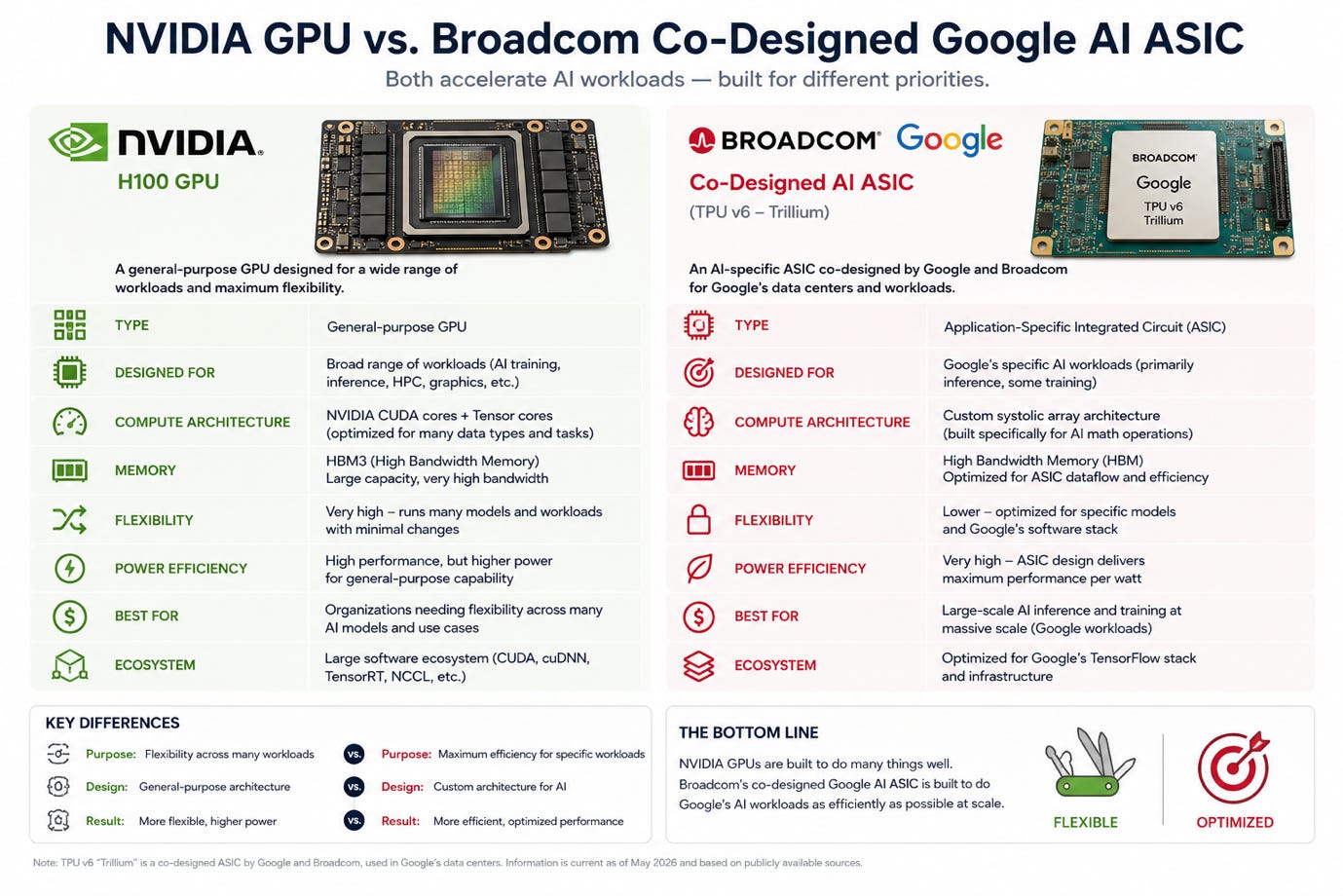
The ASIC is much more energy-efficient and cost-effective once a company is running millions of tasks a day.