
Mercado Libre: The Best Company in Latin America is Cheap!
Stock is down 34%, despite accelerating revenue growth and strengthening moat.

Welcome to Global Equity Briefing, my weekly investing newsletter.
I am Ray, a passionate investor and equity analyst. And today I am covering the Best Company in Latin America.
The Dutch East India Company became exceptionally wealthy trading goods between Europe and Asia.
Cornelius Vanderbilt was one of the US railroad pioneers during the late 1800s. His railroads enabled the transportation of goods from manufacturers to customers at a never-before-seen speed and efficiency!
John Pierpont Morgan empowered money to flow through the booming US banking system.
What if I told you that there is a single company doing all of these 3 things?
Facilitating trade of goods!
Enabling the transportation of goods!
Empowering the flow of money!
If you read the title of this report correctly, you know I am talking about Mercado Libre.
The company has ambitions to become the ultimate commerce and technology champion for the 670+ million people of Latin America.
In my opinion, Mercado Libre is one of the best long-term opportunities, because analysts perpetually underestimate its TAM!
Many investors mistakenly believe that because the economies of Latin America are weaker than those in the US or Europe, e-commerce will have a tougher time there.
Yet, in the last 5 years:
GMV has grown by 238%
Payment Volumes by 516%
Revenues by 700%
Operating profit by 2,282%
Despite that, the stock has increased only 15%!
In this Deep Dive, I will explain why Mercado Libre is the best company in Latin America and why it is currently significantly undervalued.
Let’s dig in.
1. Facilitating the Trade of Goods
2. Enabling the Transportation of Goods
3. Empowering the Money to Flow
4. Risks
5. Competition
6. Opportunities
7. Financial Analysis
8. Valuation
9. Valuation Model
10. Conclusion
1. Facilitating the trade of goods
Globalization has made us more connected than ever. No longer are we forced to be satisfied with local products. Goods from all over the world are now available with just a click of a button, quickly and cheaply.
That wasn’t always the case, and still isn’t the case in all parts of the world.
Mercado Libre is the company that’s making that a reality in Latin America.
1.1. Mercado Libre Marketplace
Marketplace is their flagship product, an online marketplace that facilitates the trade of products.
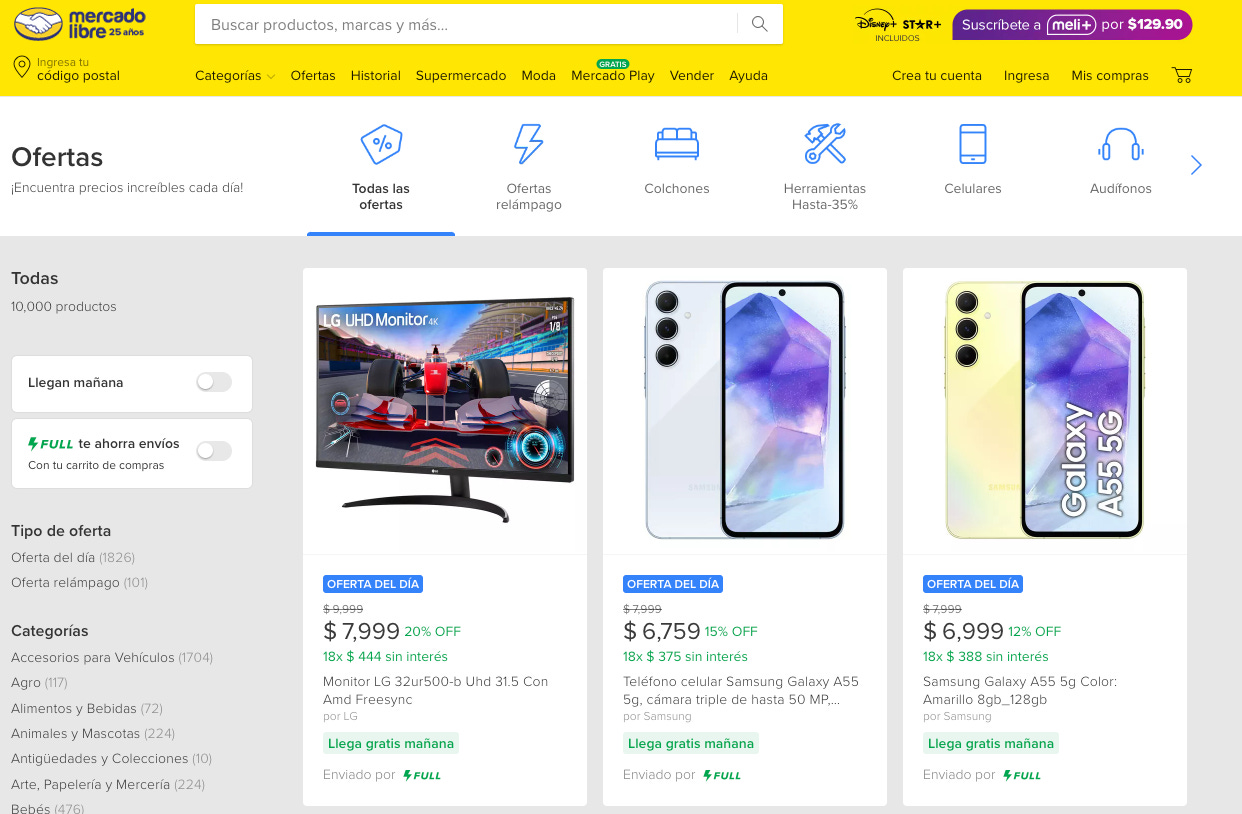
Customers can easily browse the marketplace for millions of products in thousands of categories. The platform has become extremely popular with sellers and customers alike.
The platform has all the features of a sophisticated e-commerce platform. Reviews from thousands of other customers, detailed product descriptions, pictures, videos, customer support, a broad set of payment options, delivery information, and more.
Mercado Libre is primarily a technology company that strives to deliver the best experiences for all its stakeholders.
“Our main focus is to serve people in Latin America by enabling wider access to retail, digital payments, and e-commerce services, and by providing compelling technology-based solutions that democratize commerce and money, thus contributing to the development of a large and growing digital economy in a region with a population of over 700 million people and one of the fastest-growing e-commerce and internet penetration rates in the world.” Mercado Libre 2025 10K
The technology-first approach has enabled the company to create one of the fastest-growing e-commerce platforms in the region.
Gross merchandise volume measures all sales on the company’s e-commerce platform.
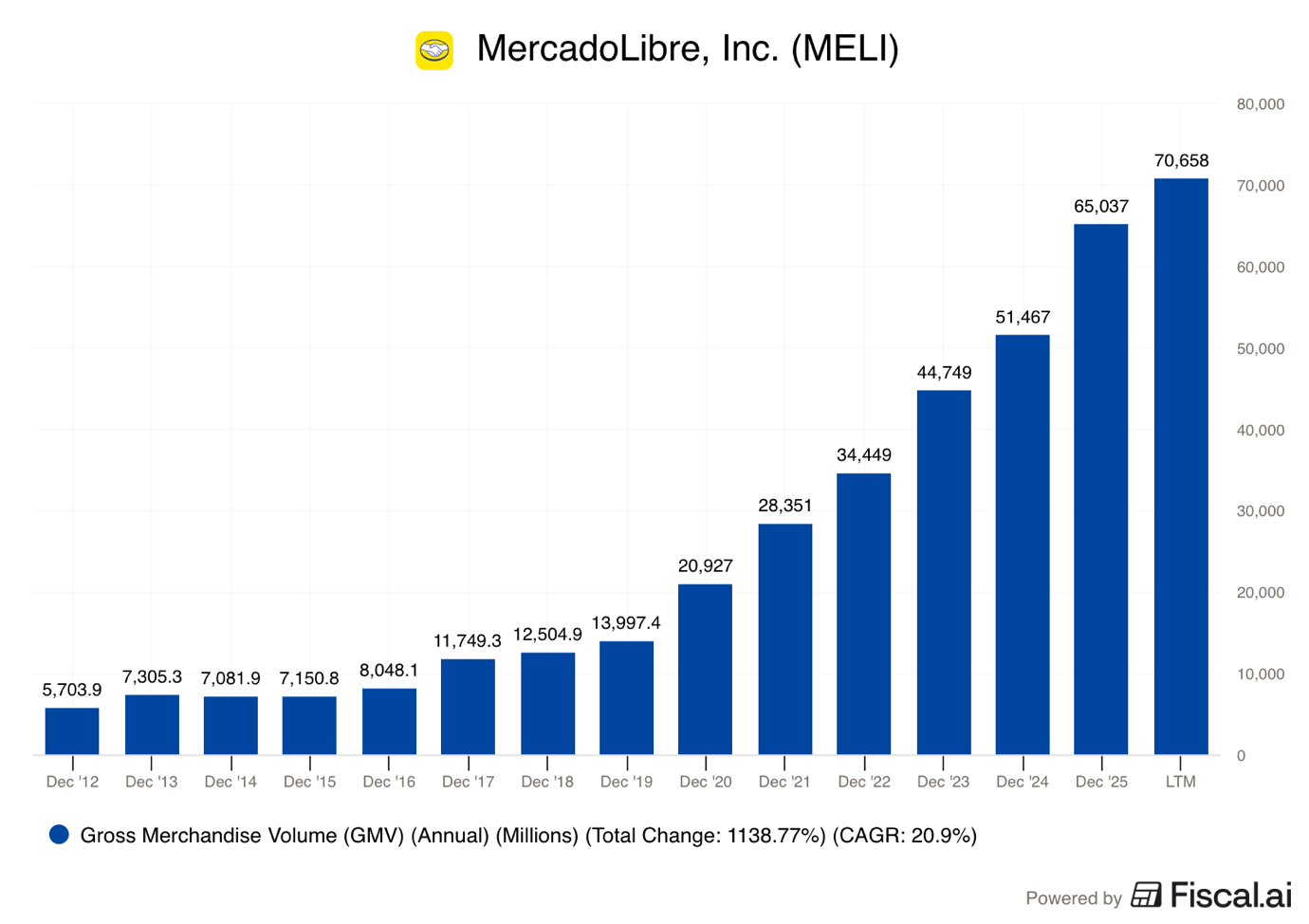
GMV growth has been parabolic. In Q1 2026, GMV grew by an impressive 42% Y/Y to $18.9B, the fastest growth rate in many years.
Since 2012, GMV has grown by 1,139%, a CAGR of 21%!
The marketplace is essentially the backbone of the company. The more it’s used for commerce, the easier it is for Mercado to upsell various other services, but we will get to that later.
Overall, GMV growth can be a great barometer for the growth of the company.
There are two main direct ways the company monetizes the marketplace:
First-party sales (1P)
Third-party sales (3P)
When Mercado sells products that it owns and holds in inventory to customers, it acts as a first-party seller. In this scenario, Mercado sources goods directly from the manufacturer or the distributor and handles the transportation and storage.
Most crucially, the company is in full control of pricing and recognizes the entire sale as revenue.
So, if they sell a blender for $60, they recognize the whole $60 as revenue.
Meanwhile, 3P is when a product purchased by the customer is sold by an independent merchant, not by Mercado Libre itself.
Mercado charges the merchant fees for using the platform and recognizes said fees as revenue.
All the shipping costs, insurance, warranty, returns, and COGS are paid by the seller. For instance, in Mexico, the fees range from 12.5% to 22.5% depending on the product category, and whether sellers use any extra services. In other countries, fees might be different.
The economics of these transactions are quite different.
1P depends on their ability to negotiate a favorable price with a supplier and the customer’s willingness to pay for the product. In 1P, gross margins are low, sometimes as low as 10%-20%.
However, remember that in a 3P sale, the independent merchant is responsible for his own expenses. Mercado incurs the costs of maintaining and managing the platform, but as the platform has a massive scale, Mercado can achieve a very high gross margin on its 3P sales.
In the $60 blender example, Mercado would keep about $9 in 80% gross margin platform fees and recognize those $9 in revenue.
As of LTM of Q1 2026, 2.66B items were sold on the marketplace.
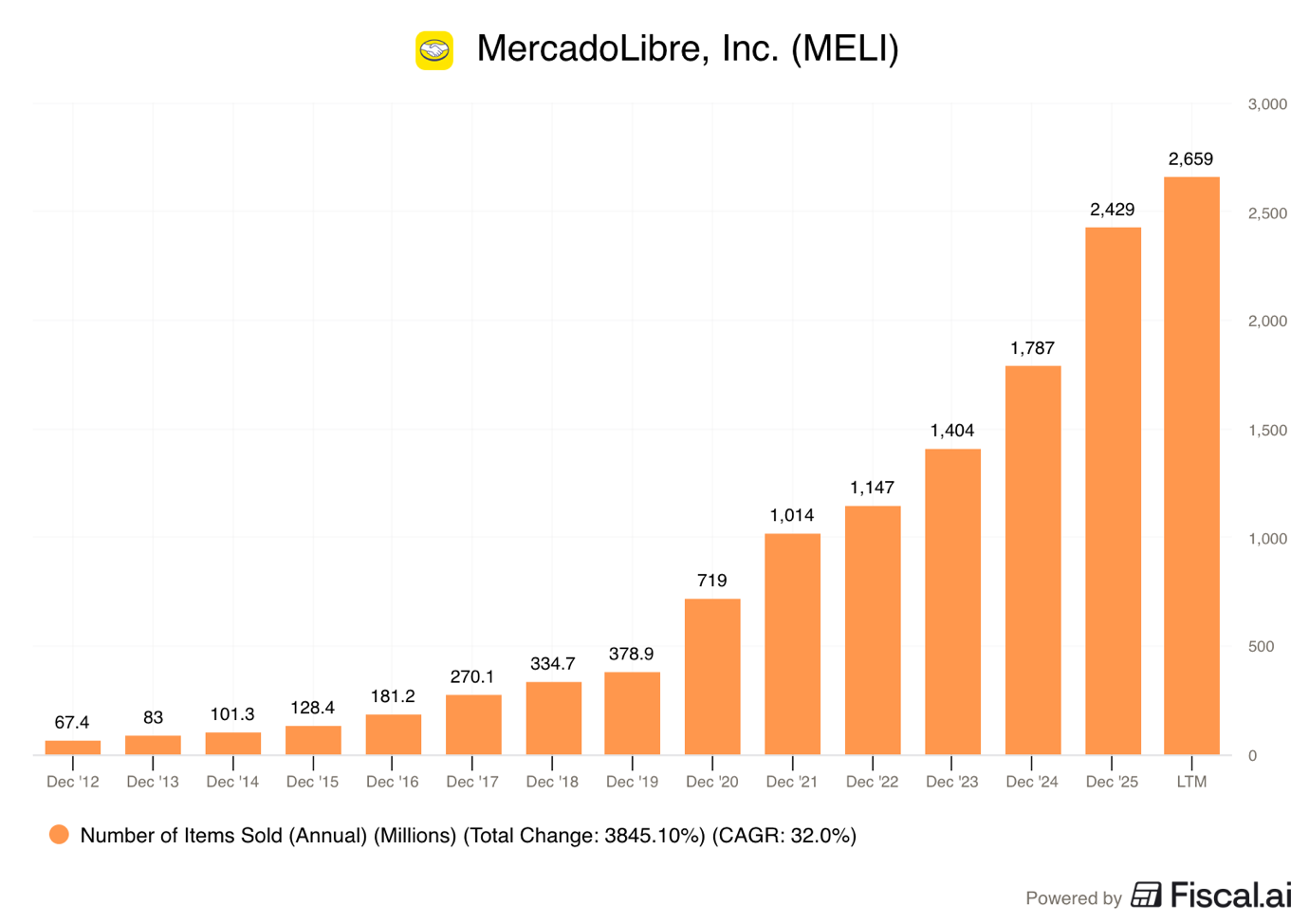
This is a 38x increase in 13 years, a CAGR of 32%!
1.2. Mercado Shops
Mercado Shops used to empower sellers to quickly, cheaply, and efficiently create an e-commerce website. This offering was similar to Shopify.
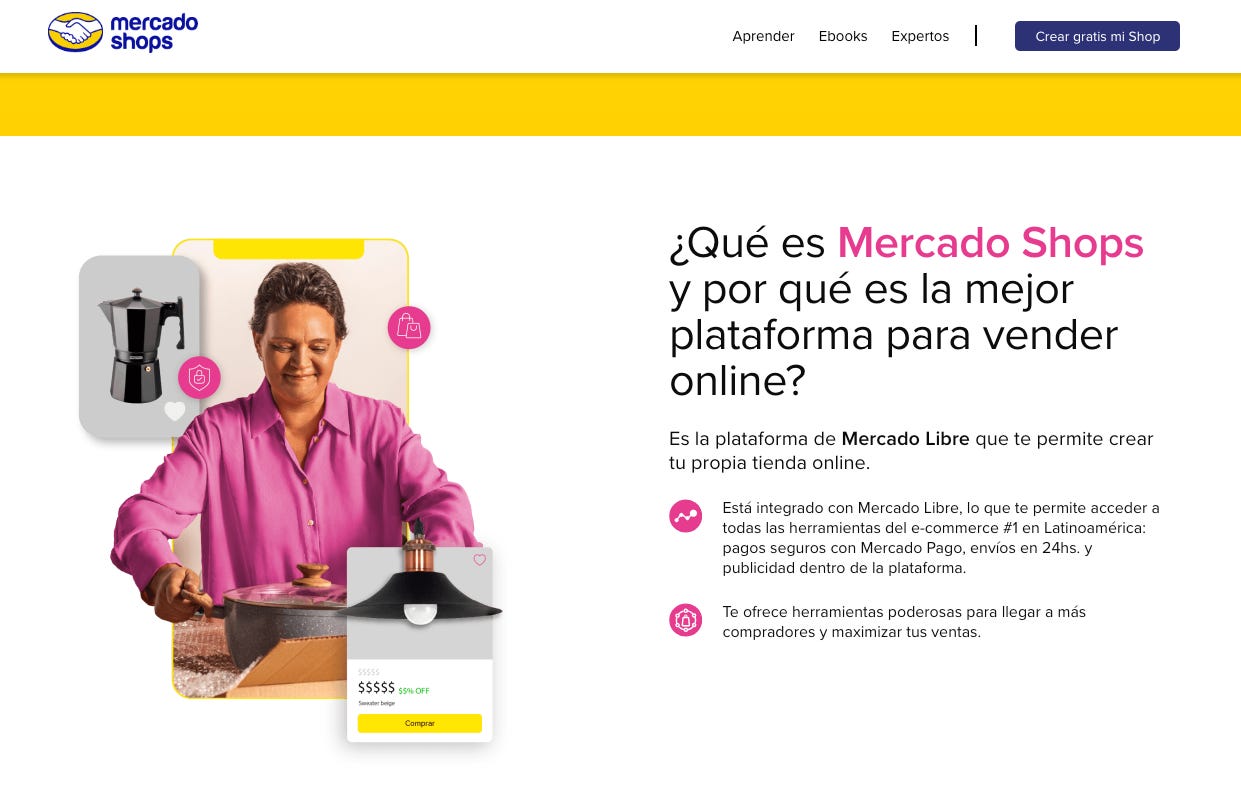
This was a platform with hundreds of different features and integrations, not only with all of Mercado’s services but also with various third-party apps. Shops had a website-building portal with lots of templates that enable people without technical skills to design their website.
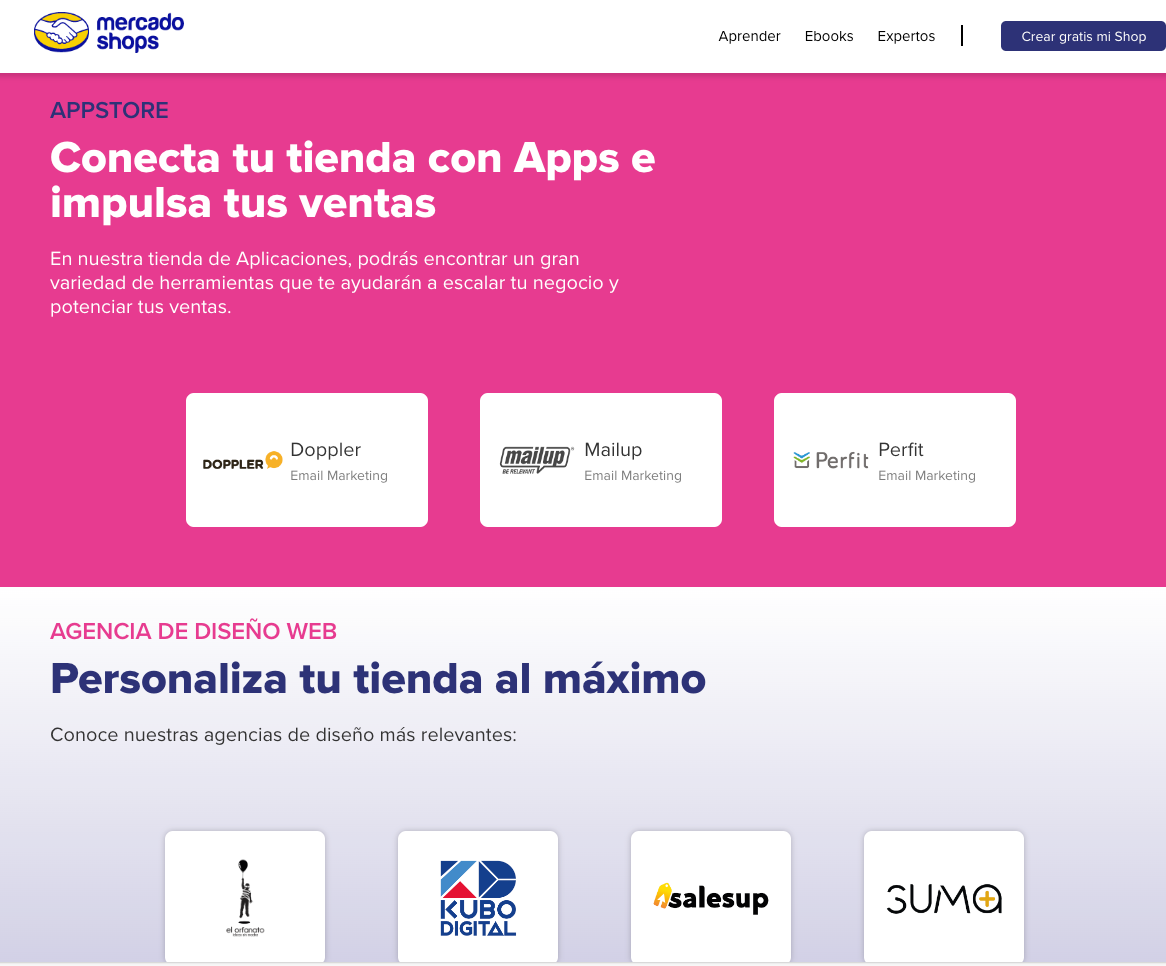
However, in stark contrast to Shopify, Mercado didn’t charge a fixed monthly subscription. For example, in Mexico, the use of the platform is free, and there was no cost per transaction. Later, however, the company introduced various transaction fees.
Mercado’s strategy was to monetize shops by feeding all their other business lines!
Clients used Mercado’s logistics to store and deliver products. Mercado advertising solutions are quite useful to increase sales. Various financial products can be used to finance inventory and other expenses.
Sellers could build their brand using social media and other channels outside of Mercado’s ecosystem. As they continue building a brand and increasing sales, Mercado benefits as the provider of services. At the same time, sellers are not excluded from Mercado’s massive marketplace.
However, ultimately, Mercado Shops was a leaky bucket for them.
They realized that merchants who grew large enough on Shops eventually migrated to Shopify anyway because Shops lacked all the advanced features that Shopify built over the years to specifically serve very large merchants.
So Mercado Shops was closed in 2026, and replaced with Mi Pagina. (My page in Spanish)

Instead of a separate website, Mi Pagina is a branded storefront hub within the Mercado Libre platform that lets merchants create a personalized business profile complete with their own logo, banners, and curated product collections.
Unlike Mercado Shops, which was a standalone e-commerce website with a custom external domain, Mi Pagina operates entirely within Mercado Libre’s ecosystem, utilizing standard marketplace fees and charging a small monthly maintenance fee after a free trial.
Mercado Libre made this pivot because it decided to stop competing with enterprise software e-commerce players such as Shopify. Instead, they consolidated their technology to focus heavily on their core strengths, locking small-to-medium sellers into their highly profitable platform.
1.3. Mercado Libre Classifieds
Classifieds is a separate service that allows people to list real estate, cars, and various other local goods and services. The platform is comparable to Craigslist and the Facebook marketplace.
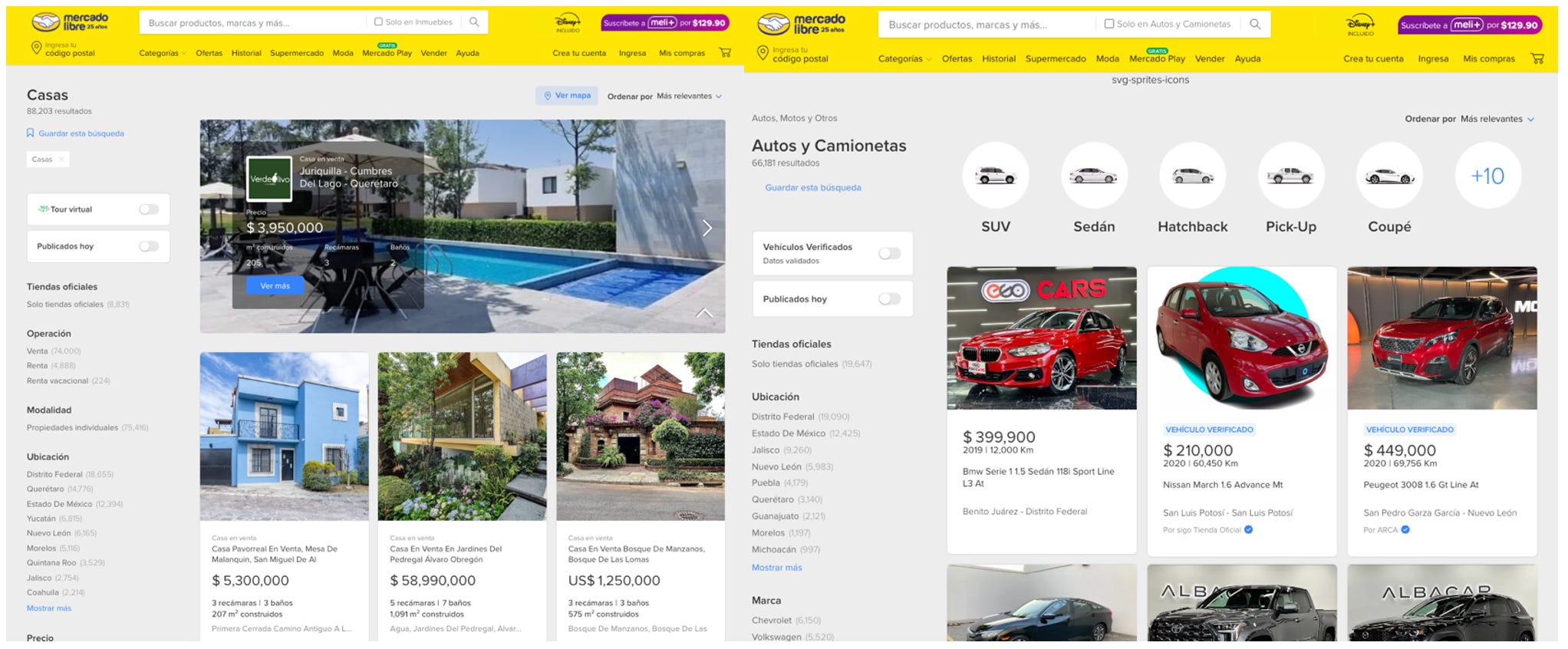
The platform is monetized by Mercado, charging real estate agents and car dealerships a placement fee for advertising on the platform.
Additionally, large merchants pay for subscriptions for advanced features.
The company itself doesn’t sell goods. Mercado wants to create an independent ecosystem for real estate agents, car dealerships, and other professionals, so they trust the platform.
Classifieds serve as a great way to further monetize its active client base!
The platform in itself is not a significant revenue driver, its main objective is to generate traffic for Mercado’s other businesses. A customer who purchased a vehicle is more likely to buy accessories such as a phone stand, a foot mat, an air refresher, and so on. Additionally, Mercado can upsell various financial services, such as a car loan and insurance. Similarly, with real estate, new houses require TVs, blenders, coffee machines, paintings, and other products.
Mercado Classifieds is leveraging technology, scale, and customer trust to offer a superior product at a lower cost!
2. Enabling the transportation of goods
Mercado Envios is the company’s logistics arm.

For any E-commerce company to gain scale, a sophisticated logistics network is a must. If one wants to buy sneakers, they are willing to wait if it’s cheaper, however, if the wait time is too long, they will just go to a brick-and-mortar store.
Simply put, people love convenience and are generally not very patient!
However, delivering packages is expensive and takes time.
If E-commerce is to take market share from brick-and-mortar stores, it must offer a superior customer experience.
Customers want quick and cheap delivery, however, there are too many middlemen in the process. Various distributors, warehouses, customs agents, trucking companies, cargo airlines, last-mile delivery providers, and so on. Each involved party delays the process and adds an additional cost.
E-commerce platforms realized that to deliver packages quickly and at a low price, they must take logistics in-house.
That is what Amazon did in the US, Alibaba in China, Coupang in Korea, and that is what Mercado Libre is doing in Latin America!