
Meridian Holdings Q2 2026: Strong Profits and a New CEO!
43% ADJ EBITDA growth in Q2 and Zoran Milošević was appointed group CEO of this $180M Online Casino Small Cap.

Welcome to Global Equity Briefing, my weekly investing newsletter.
I am Ray, a passionate investor and equity analyst. And today I am covering Meridian Holdings.
Meridian released a good Q2 earnings report last week, reporting GAAP net income of $2.2M, the second strong profit quarter in a row.
Despite this, the stock tanked 22%.
In my opinion, here are the factors driving this harsh reaction:
1. Slight revenue miss of $50M vs $51-53M guide.
2. Gross margin decline from 56.4% to 53.5%.
3. The change of the CFO.
4. H2 2026 guide of 8-10% revenue growth, barely in line with the analyst consensus estimate of 9.6%.
In this report, I will explain why the market has vastly overreacted to these developments.
If misinterpreted, these 4 developments might signal deteriorating business fundamentals.
However, if we analyse each point carefully and individually, we see clear reasons that indicate that the company is not in trouble, unlike what the initial share reaction suggested.
I suspect the initial reaction had more to do with the market environment at the time, related to the massive deleveraging happening in South Korea, causing the AI and the broader stock market sell-off that followed.
No wonder that the stock is back to where it was before the sell-off.
Let’s not forget that, after a complex merger and a major rebranding effort, in these 2 quarters the company has proven that its diverse business model can generate cash while expanding into some of the most valuable gaming markets in the world.
This report provides a detailed look at the results of Q2 2026, exploring the performance of individual business segments and the broader strategic moves that have strengthened the company’s position.
Disclosure: This is Issuer-Sponsored Research
Let’s begin.

1. Leadership Changes
So, Meridian announced three big changes to its management team.
Zoran Milošević, the CEO of Meridianbet subsidiary, becomes the CEO of the group.
William Scott, the previous interim CEO, becomes the CFO.
Rich Christensen, the previous CFO, is out.
Let’s unpack these leadership changes.
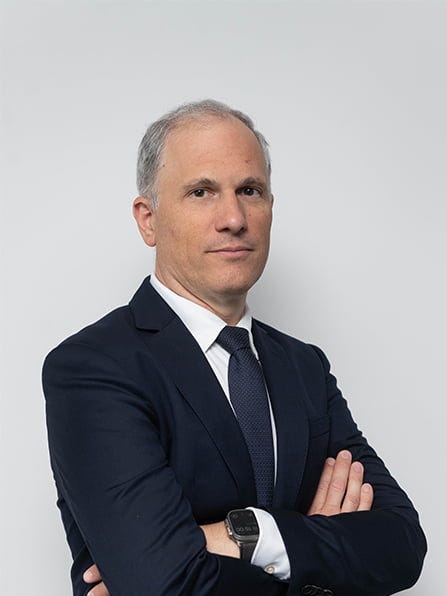
Zoran Milošević holds a background in industrial engineering, joining Meridian in 2003, where he gained experience across marketing, risk management, and business development before becoming Meridianbet’s CEO in 2008.
Under his leadership, he scaled Meridianbet into a global digital infrastructure and gaming enterprise, expanding operations across dozens of jurisdictions while building out proprietary, in-house tech platforms.
As the long-standing leader of Meridian’s core growth segment (which generates 71% of total revenue), his transition to Group CEO directly aligns overall strategy with proven operational execution.
He is an extremely competent manager with over 20 years of experience, Meridian shareholders and potential investors can be glad of his appointment.

William Scott is a South African Chartered Accountant with over 35 years of experience in financial management, capital markets, and regulated gaming, having held senior executive roles at various companies.
Serving as Executive Chairman and stepping into the Interim CEO role in late 2025, he focused on reinforcing the company’s financial discipline, streamlining operations, and strengthening the balance sheet.
Let’s remember that before the name change from Golden Matrix to Meridian Holdings, Golden Matrix was led by Mr. Goodman. On December 12, 2025, he was replaced by William Scott, who became interim CEO. Mr. Goodman was instrumental in building the legacy Golden Matrix Group into an $80M company, however, now the vision is completely different.
The scale and the core of the business of Meridian Holdings have shifted from a regional, majority B2B player to a global, majority B2C player. It makes perfect sense to have a new face with a different set of skills to execute on this new strategic vision.
Mr. Scott was a great temporary choice to reorganize the company in preparation for appointing Zoran Milošević to the CEO position.
With his extensive background in corporate finance, regulatory compliance, and capital markets, transitioning into the CFO role while remaining Chairman allows him to directly lead financial strategy, capital allocation, and investor engagement alongside the operational leadership of the CEO.
Rich Christensen, the previous CFO leaving, is also part of the course for a company that is still digesting the merger and preparing for the next leg of growth.
Overall, I find that these management team changes strengthen the company, not weaken it.
2. Overall Performance
Revenue: $50.2M +16.1% Y/Y
Gross Profit: $26.9M +10.2%, margin of 53.5%
ADJ EBITDA: $5.9M +43%, margin of 11.2%
EBIT: $2.4M vs -$2.3M last year
Net Income: $2.2M vs -$3.6M last year
EPS: $0.17 vs -$0.31 last year
OCF: $7.8M +228% Y/Y
The Q2 2026 results delivered growth, operating efficiency, and a successful continuation of profitability, despite lower gross margins.
2.1. Revenue
Meridian reported total revenue of $50.2M, which is a 16.1% increase from $43.3M in Q2 2025.
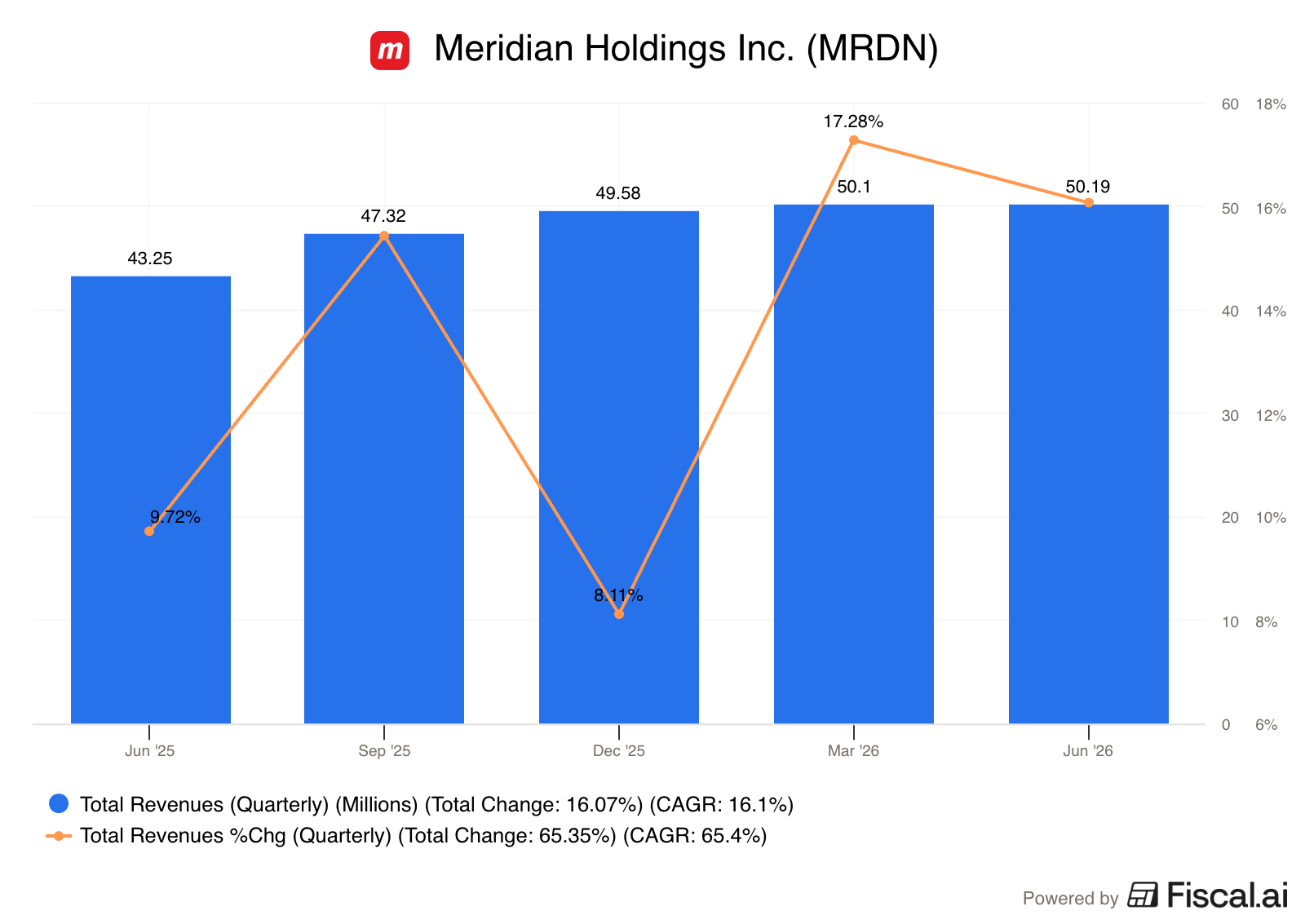
As you can see in the chart above, this is a slight deceleration from Q1 2026, but a significant improvement over 9.7% growth in Q2 2025.
The company benefited from the FIFA World Cup increasing volumes during what is a seasonally weak summer quarter. I will expand on which segments drove this growth a bit later in the report.
2.2. Profitability
To understand how the company makes money, we must look at its gross profit, which rose 10.2% to $26.9M.
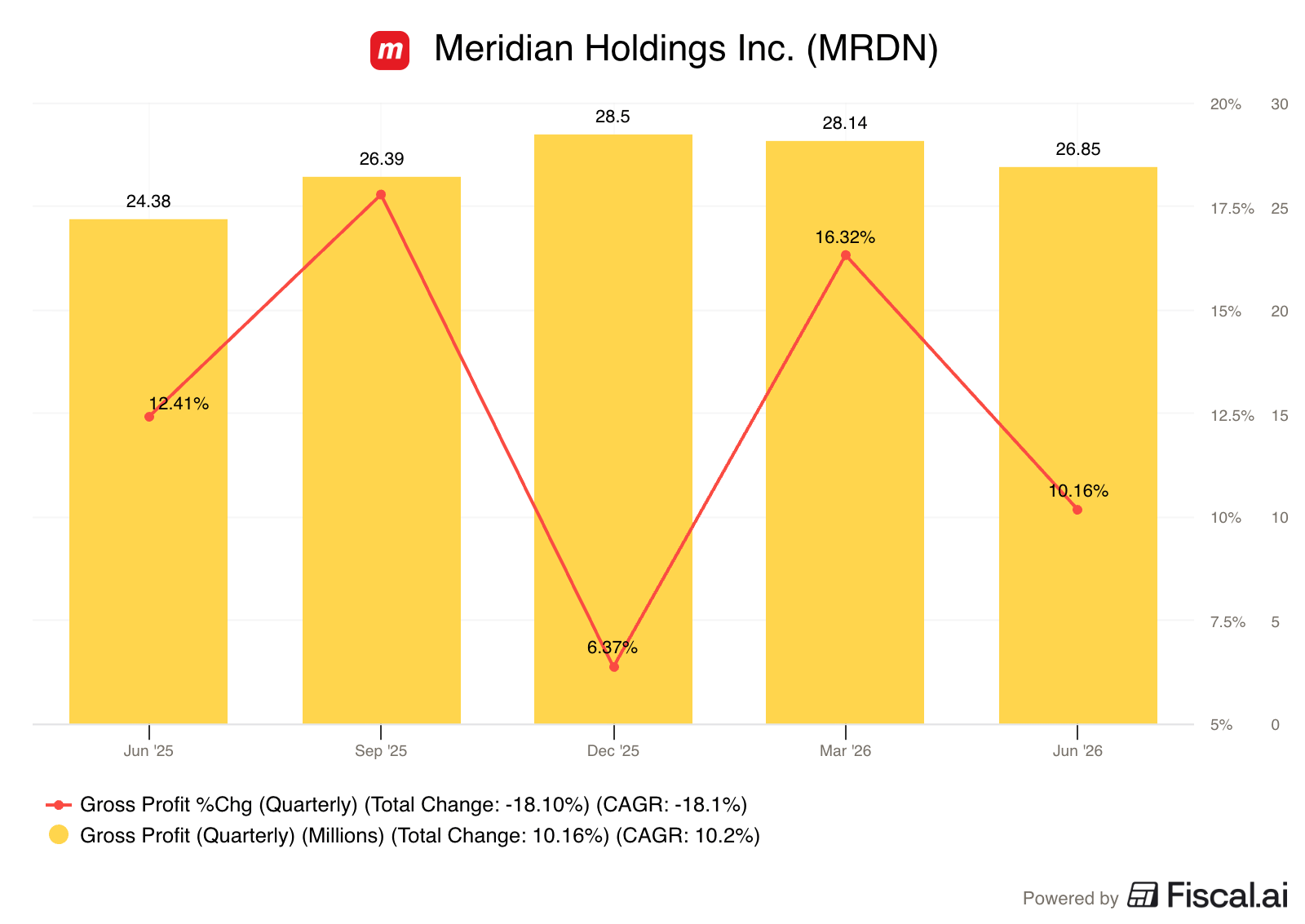
The 10.2% gross profit growth was below 16.1% total revenue growth, which led to gross margins declining from 56.4% in Q2 2025 to 53.5% this quarter.
For a company like Meridian, gross margin shows what’s left after paying the winnings and the direct costs of serving the games and bets.
Management noted in the earnings call that the gross margin landed modestly below expectations due to sportsbook margin compression and lower casino hold, attributing both strictly to sporting outcomes and game results rather than pricing.
The World Cup group stage featured high-scoring matches and frequent wins by favorite teams, which is the least favorable scenario for sportsbook operators. Later in the tournament, the win margin normalised.
“Our internal forecast was from 2%-4% margin. That was the best outcome. Actually, we achieved over 6%. It was 6.2% margin overall, which we are really happy. It is, of course, below what is regular football betting. Regular football betting is approximately 10%-11%, but it’s actually for the World Cup, better than we expected.” Zoran Milošević, CEO
Furthermore, they also said that the gross margin compression was impacted by two major casino player wins totaling over $1.2M in the quarter. These types of massive wins by players don’t happen every quarter.
If Meridian had achieved the same gross margin as in Q2 2025, gross profit would have been $1.46M larger. That means that the gap is almost entirely explained by those $1.2M major casino wins.
As we can see in the chart above, compared to Q2 2025, gross profit improved by $2.5M.
This stability demonstrates that the company is managing its costs well, even as it grows in new B2C markets like Brazil and Mexico, and B2B markets like the US and Canada, which incur very high startup costs.
Meridian reported an ADJ EBITDA of $5.9M for the quarter, a 43% Y/Y increase.
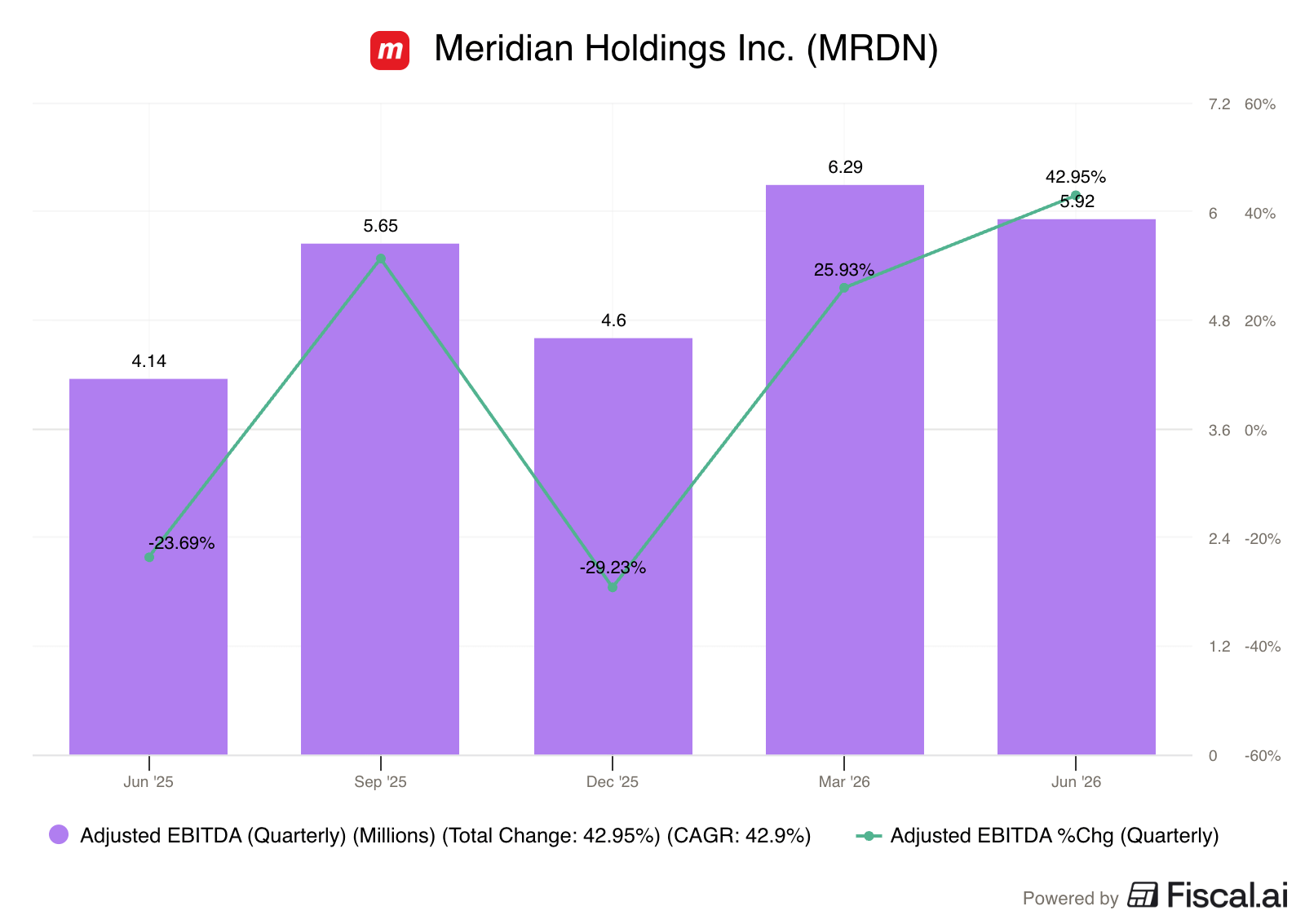
While this was impressive growth, this was a $500K miss over the $6.4M analyst consensus estimate, largely because of the lower gross margin.
Nevertheless, as you can see in the graph above, this was the best growth in 5 quarters!
The ADJ EBITDA margin rose to 11.8%, up from 8% in Q2 2025, but down from 12.6% in the prior quarter. This margin expansion is a clear indicator that the company is becoming more efficient and its growth strategy is delivering results.
However, the most important news is that GAAP net income reached $2.2M.
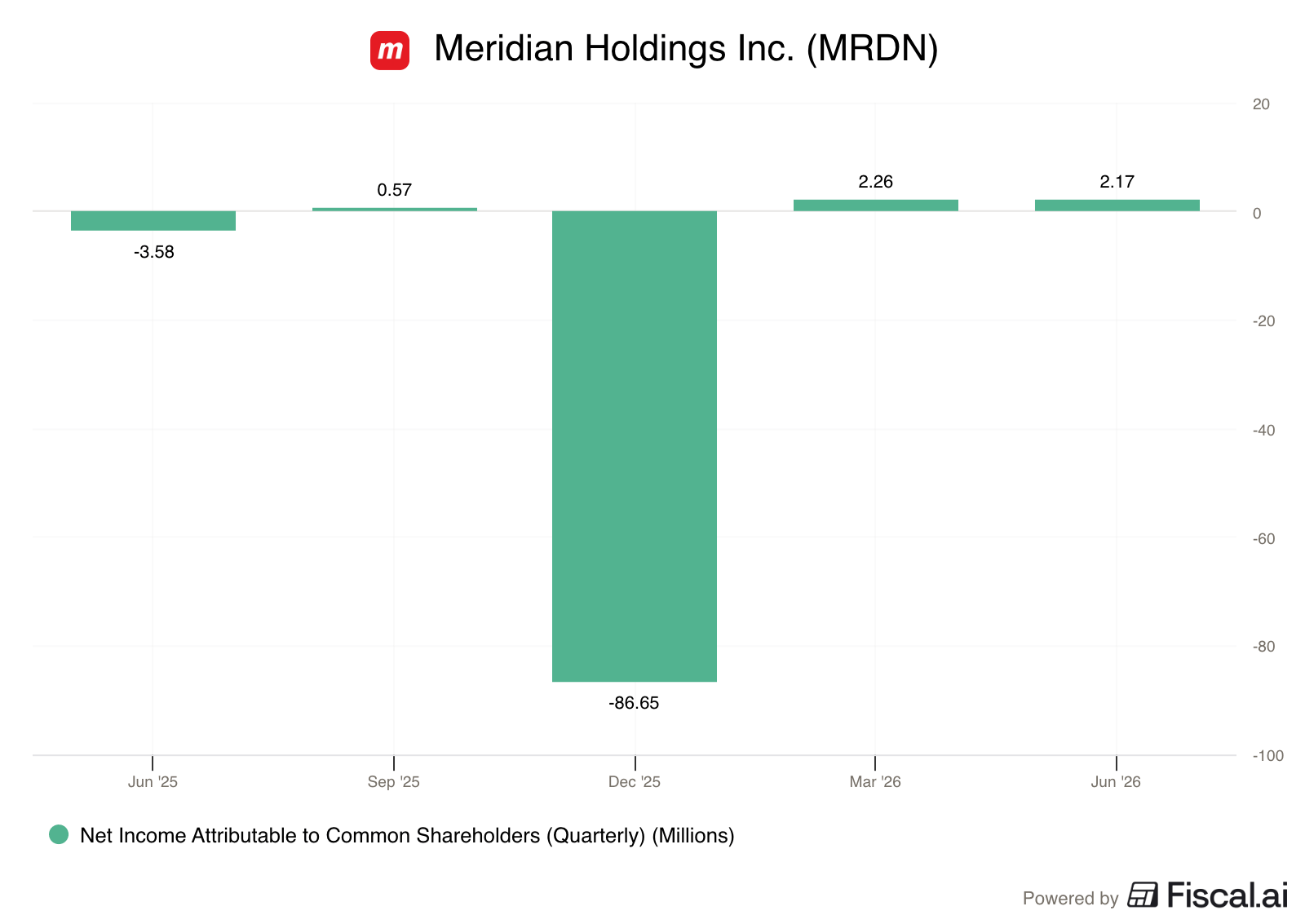
One year ago, the company recorded a net loss of $3.6M.
This is a welcome development and the second good profitability quarter in a row, after the large loss in Q4 2025, driven by goodwill and intangible asset impairment.
A reminder that in Q4 2025 Meridian recorded an impairment charge that reduced the balance sheet value of goodwill and intangible assets by $91.8M.
This was a non-cash accounting entry, meaning it does not impact the company’s actual bank balance or daily operations.
When a business gets acquired, it is usually for a premium to the accounting value of its net assets. In such situations, the acquirer records the difference between the purchase price and the net asset value of the acquired business as goodwill on the consolidated balance sheet.
Companies pay a premium to the accounting value of net assets because they expect the acquired business to grow earnings. And we are seeing that Meridian is now delivering strong earnings growth.
As of Q3 2025, Meridian had $129M of goodwill and other intangible assets on the balance sheet.
US GAAP requires yearly tests to assess whether that goodwill position is appropriate. Rules require that the goodwill position be reduced in certain situations when the share price goes down, interest rates increase, or some business units underperform. This reduction appears on the income statement as a loss.
These impairments, while unfortunate, don’t change the core investment thesis of the company.
We see that the company has reached a tipping point where revenue is growing faster than expenses, allowing more money to flow to the bottom line.
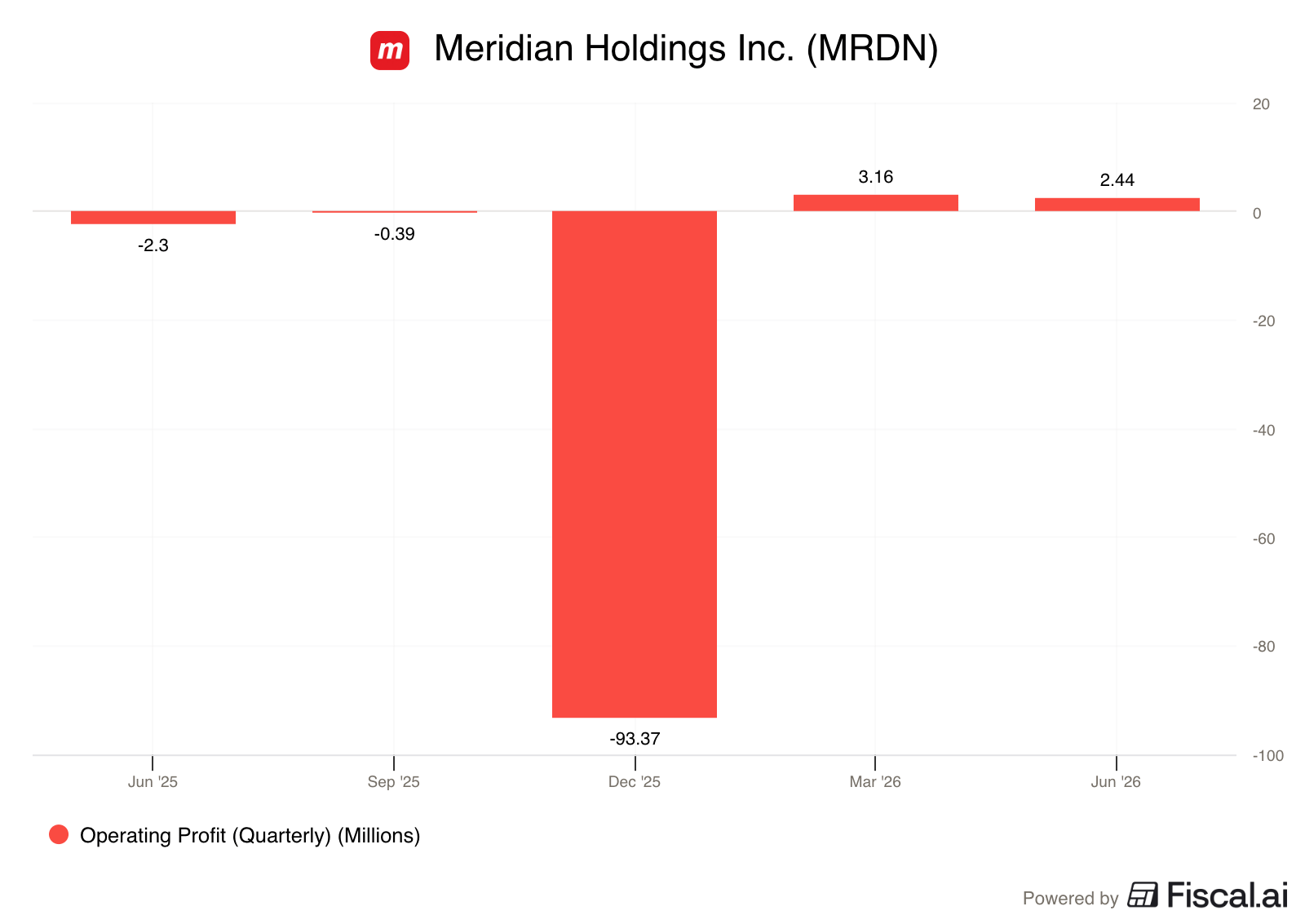
Moreover, the operating profit was $2.44M, a massive turnaround from the $2.3M operating loss seen in Q2 2025.
This improvement happened because the SG&A actually decreased by 8.5% to $24.4M, compared to the revenue growth of 16%.
This is a clear example of Meridian improving its operating leverage, as it uses its existing infrastructure, technology, and staff to handle more business without linear expense growth.
“When the volume is at record levels and margins temporarily below the trend, the business is getting stronger, and the margin follows the transactional volume over time. Beyond the quarter itself, the progression we committed to is on track. “ William Scott, CFO
If there were more favourable betting outcomes, and not that large $1.2M win, Meridian would have easily beat analyt estimates.
Let’s remember that in this business, while there are some periods of underperformance due to large wins, the house always wins in the long term.
2.3. Balance Sheet
Meridian significantly improved its balance sheet stability, countering a key bear narrative of excessive debt.
The company has been aggressively paying down the debt it took on to merge Meridianbet with Golden Matrix.
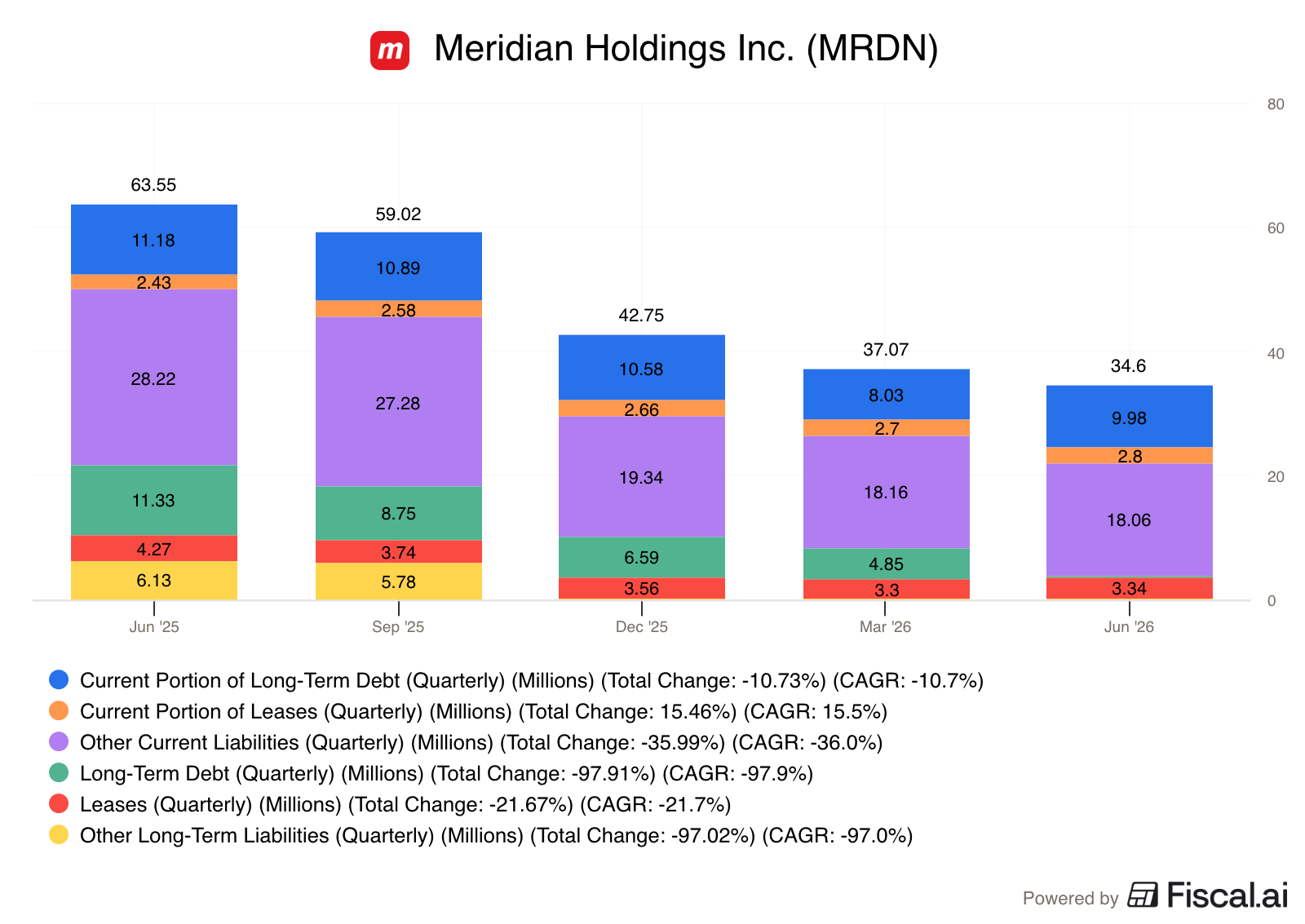
As of Q2 2026, the company’s key debt positions were $34.6M, down 46% from $63.6M in Q2 2025.
If we look at net debt, which is the total debt minus the cash the company has in the bank, the figure fell by 65% to just $9.4M.
Meridian now has a net debt leverage ratio of 0.39x, which is very healthy.
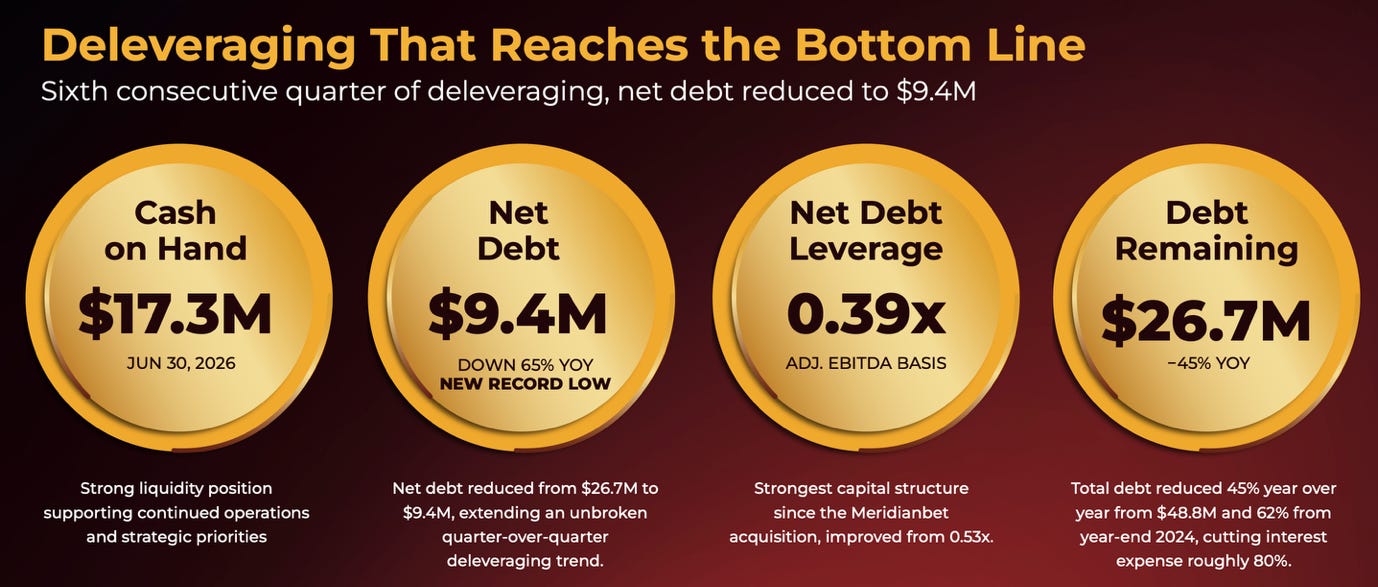
Simply put, the company is generating more than enough income to cover debt obligations, giving it meaningful financial flexibility to invest in its business or new M&A.
The company ended the quarter with $17.3M in cash, which is down 21.8% Y/Y as it pays down debt, but up $1.1M Q/Q.
2.4. Cash Flow
Meanwhile, operating cash flow grew by $5.4M, 228% Y/Y, to $7.8M.
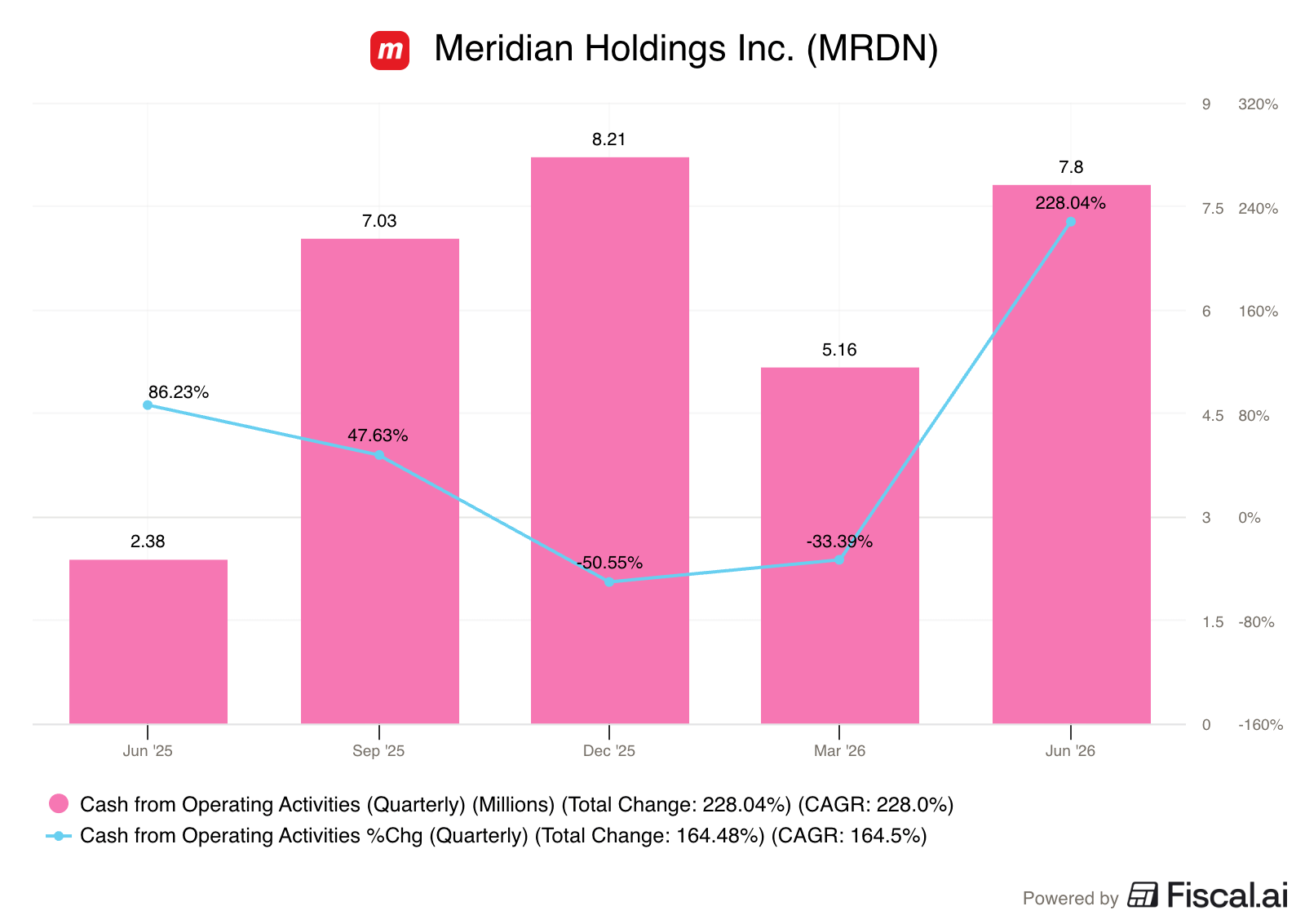
As you can see in the chart above, OCF is a very lumpy metric that fluctuates a lot depending on profitability and cash outflow.
In the prior quarter, net income grew by $2M, Meridian paid $1.72M in accounts payable compared to last year, when it built up $4.3M in additional accounts payable during the quarter. This is why OCF declined by 33% in Q1 2026.
This quarter, net income increased by $5.75M Y/Y, which largely explains the OCF jump.
ADJ EBITDA is a great proxy for OCF, as it essentially shows what OCF would be if we ignored the timing of receivables and payables, making the metric less lumpy from quarter to quarter.
2.5. Guidance
Based on this strong performance, the company has issued positive guidance for H2 2026.
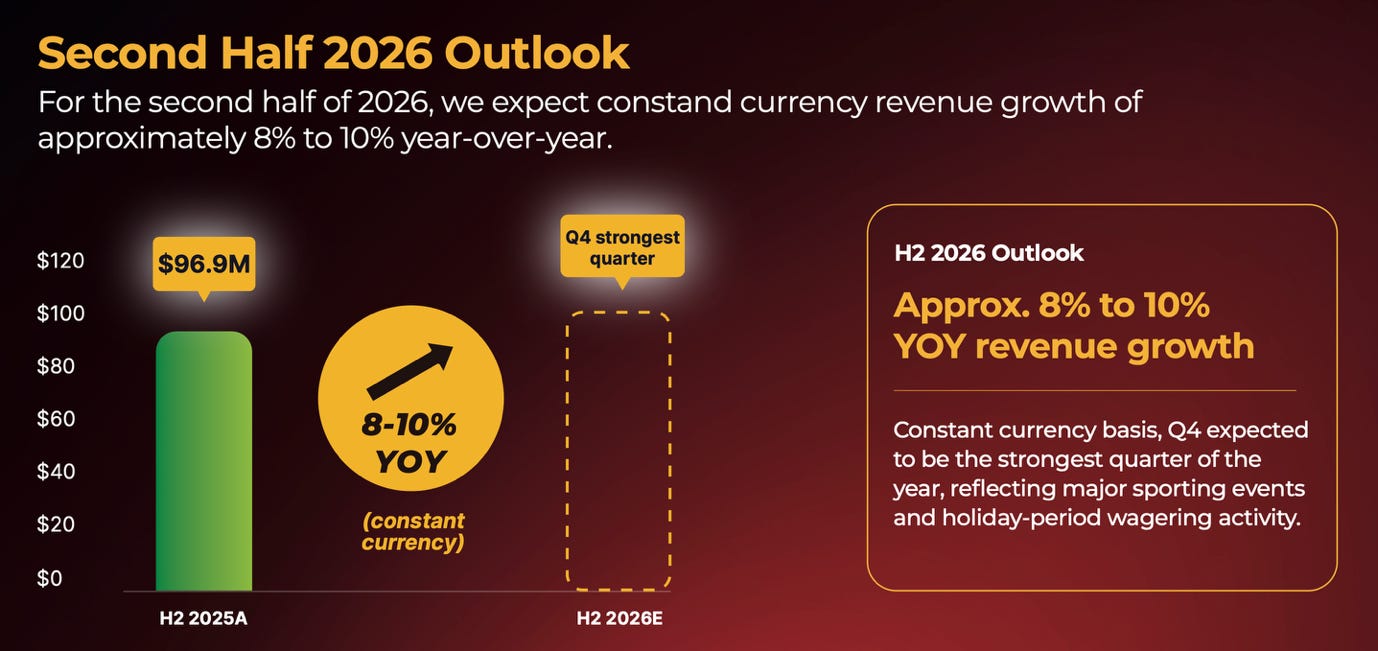
The company expects revenues to grow by 8-10% in constant currency in the second half of the year.
This is barely in line with the analyst estimates of $106.5M, growth of 9.6%.
Considering Meridian just missed its Q2 revenue guidance, and the fact that this guidance is in constant currency, which excludes losses from currency fluctuations, investors believe it is highly likely that this guidance will be missed.
I interpret this guidance as the team giving a more conservative outlook in light of the recent miss, so it would be easier to deliver upon. Especially with the new group CEO and CFO likely wanting to finish the year on a high note.
The second half of the year is packed with major sporting events, such as the Champions League group stages and the UEFA Nations League. Meridian just acquired a lot of new users from the World Cup (which I will expand on in a bit), which could drive stronger revenues in the second half of the year.
3. Meridianbet
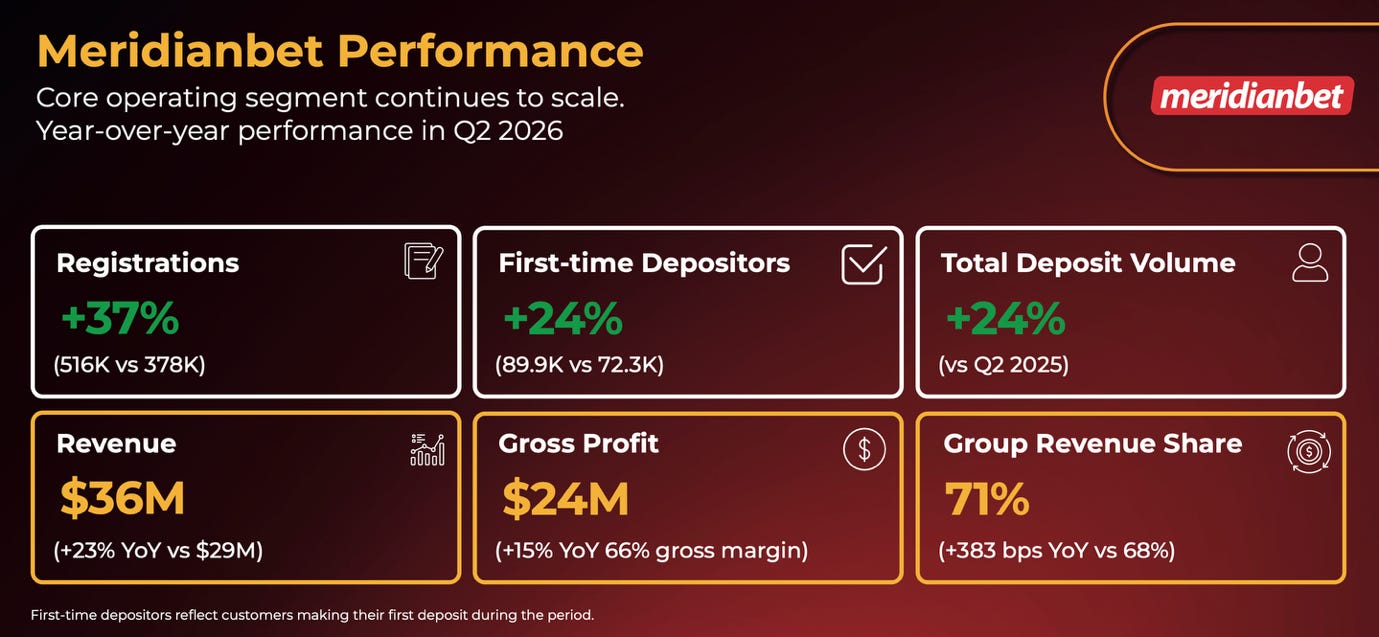
Meridianbet segment is the core engine of the company, accounting for 71% of total group revenue.
This segment runs online sports betting and casino games across more than 18 regulated countries in Europe, Africa, and South America.
In Q2 2026, Meridianbet generated $36M in revenue, +23% Y/Y!
This growth is coming from both the online side of the business and the company’s network of over 740 betting shops.
The success of Meridianbet is driven by a massive increase in the number of people using the platform.
During this FIFA World Cup quarter, the brand signed up 516K new customers, a 37% increase compared to the same quarter in 2025.
This is a clear sign that the company’s marketing efforts in Brazil are working well.
More importantly, these new users are becoming active players, with the number of first-time depositors rising by 24% to 89.9K, and the total deposit volume growing by 24%.
This segment is also highly profitable, with a gross margin of 66% and an operating income of $6.1M, an increase of 91% Y/Y.
In the previous interview, CFO William Scott said that the FIFA World Cup is an amazing customer acquisition vehicle.
516K players joined Meridianbet to make a few bets during the World Cup. While many joined only to bet on the event, a meaningful share will remain Meridianbet customers in the long term. This is where the real profit potential lies, especially in high-growth regions such as Mexico and Brazil.
4. Expanse Studios
Expanse Studios is the creative core of the company. While Meridianbet focuses on letting people bet, Expanse Studios focuses on building the actual online casino games.
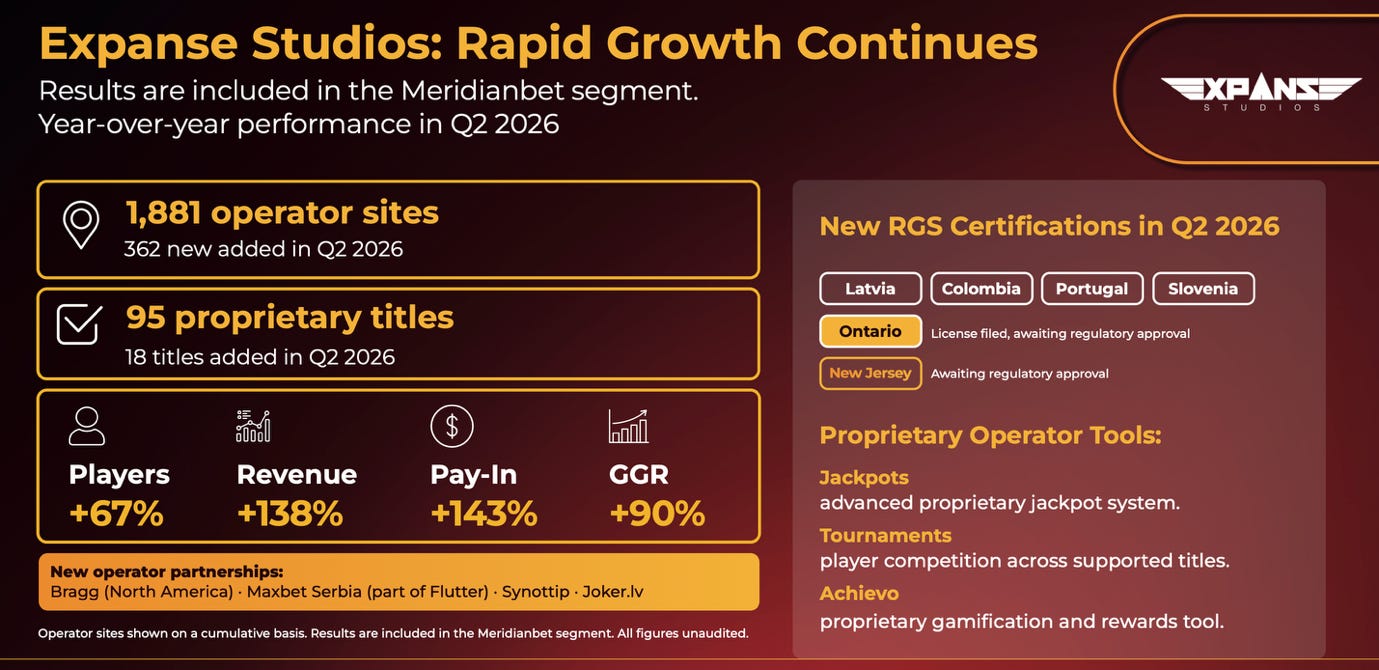
In Q2 2026, Expanse continued to grow its global presence.
Its games are now available on 1,881 different operator sites, which is 362 more than at the end of last quarter.
The studio launched 18 new proprietary games this quarter, bringing its total collection of titles to 95.
Additionally:
The number of players grew by 67%
Revenue grew by 138%
Pay-ins grew by 143%
Gross gaming revenues grew by 90%
It is clear that this segment is delivering explosive growth. The revenues of Expanse are included in the Meridiabet segment revenues.
Furthermore, one of the most important moves this quarter was a new partnership with Bragg, a leading distributor in North America, and a deal with Flutter’s Serbian subsidiary Max Bet. This deal allows Expanse’s games to be offered to millions of new players in the Americas, where online gaming is just starting to take off, and in Serbia.
To sell games in new regions, a studio must have its software tested and certified by the local government.
Expanse has been very successful in getting these stamps of approval.
During Q2, the studio secured new certifications in:
Latvia
Colombia
Portugal
Slovenia
Furthermore, it is also waiting for certification in Ontario, Canada, and New Jersey, US, which are some of the biggest gaming markets in the world.
This business is very scalable, as by obtaining these certificates, Expanse can grow its revenue with limited capital investment.
Once scaled, the studio could become a potentially high-margin part of the business.
5. RKings and Classics
The RKings and Classics for a Cause segments are focused on prize competitions.
This is a unique type of e-commerce where people pay a small fee to enter contests to win luxury items like sports cars, houses, or vacations.
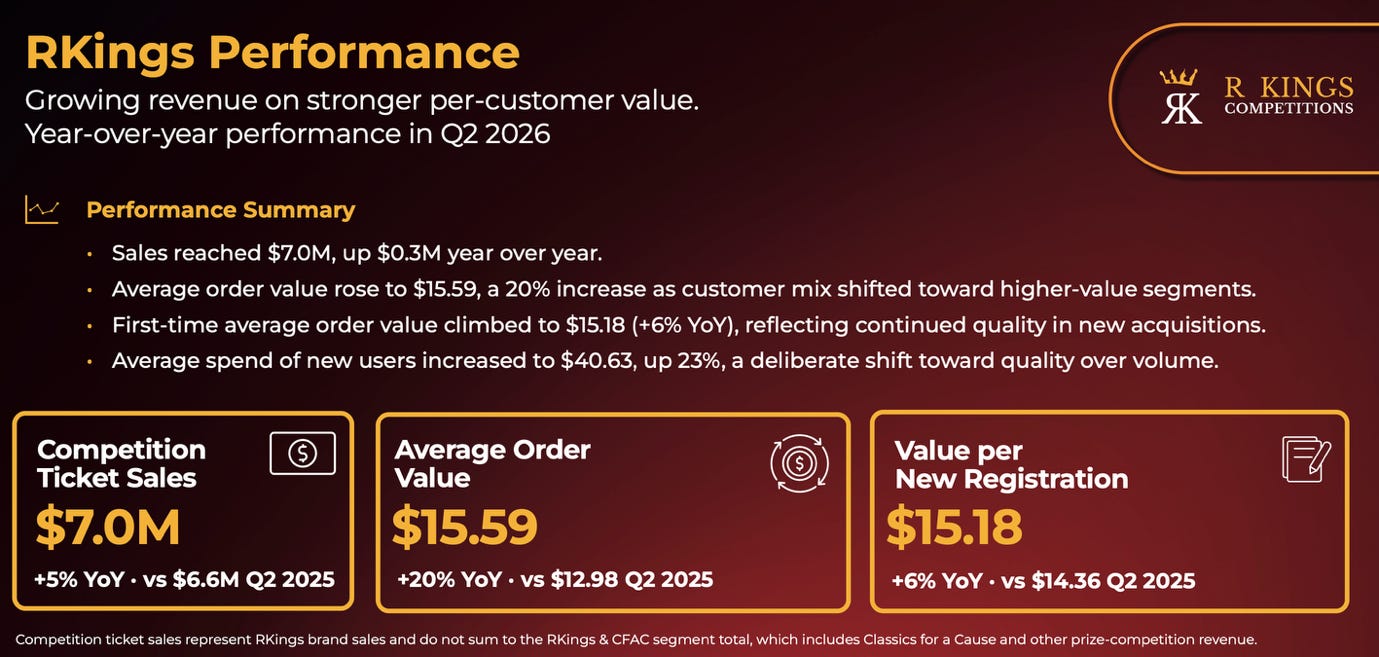
RKings is Meridian’s competition business based in the United Kingdom.
In Q2 2026, it generated $7M in revenue, a 4.5% increase over the previous year.
This was driven by the average order value, rising 20% to $15.59.
Furthermore, the value the company gets from each new person who registers went up by 6% to $15.18.
This segment is undergoing a transition in strategy, where they focus on attracting fewer but higher-value customers.
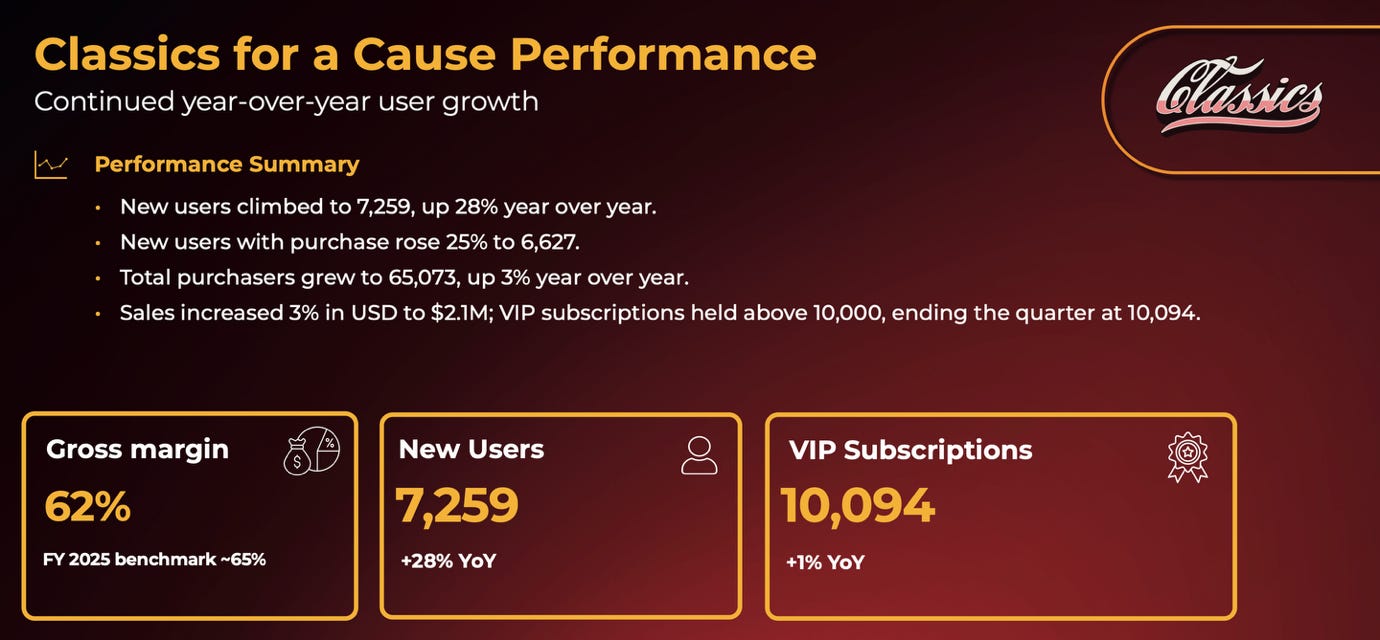
Classics for a Cause is an Australian business that focuses on car raffles.
Unlike RKings, which mostly sells single tickets, Classics for a Cause has built a promising subscription model.
People pay a monthly fee to be VIP members, which gives them regular entries into prize draws.
During Q2 2026, the number of VIP subscribers stayed at 10K.
Meanwhile, the number of new users rose 28% to nearly 7,259.
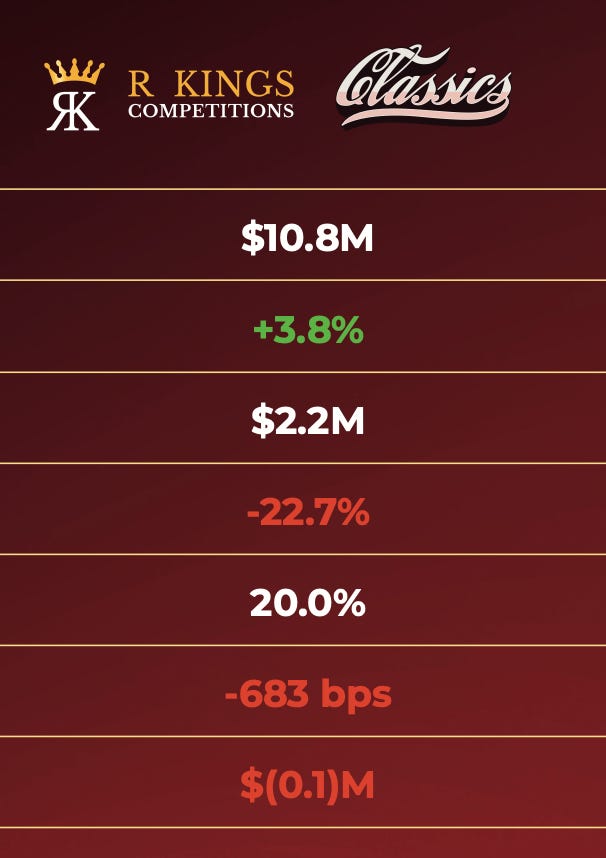
Overall, these segments are underperforming, with revenues growing only by 3.8%, while gross profit declined by 22.7%, leading to a 683-basis-point decline in the gross margin to 20%.
This compares unfavourably to the 65.6% gross margin of the Meridianbet segment.
I am curious to see what the new CEO, Zoran, will do with these segments, as such performance is not satisfactory.
6. GMAG
GMAG is the company’s casino game aggregator business focused on Asia, which has been underperforming lately.
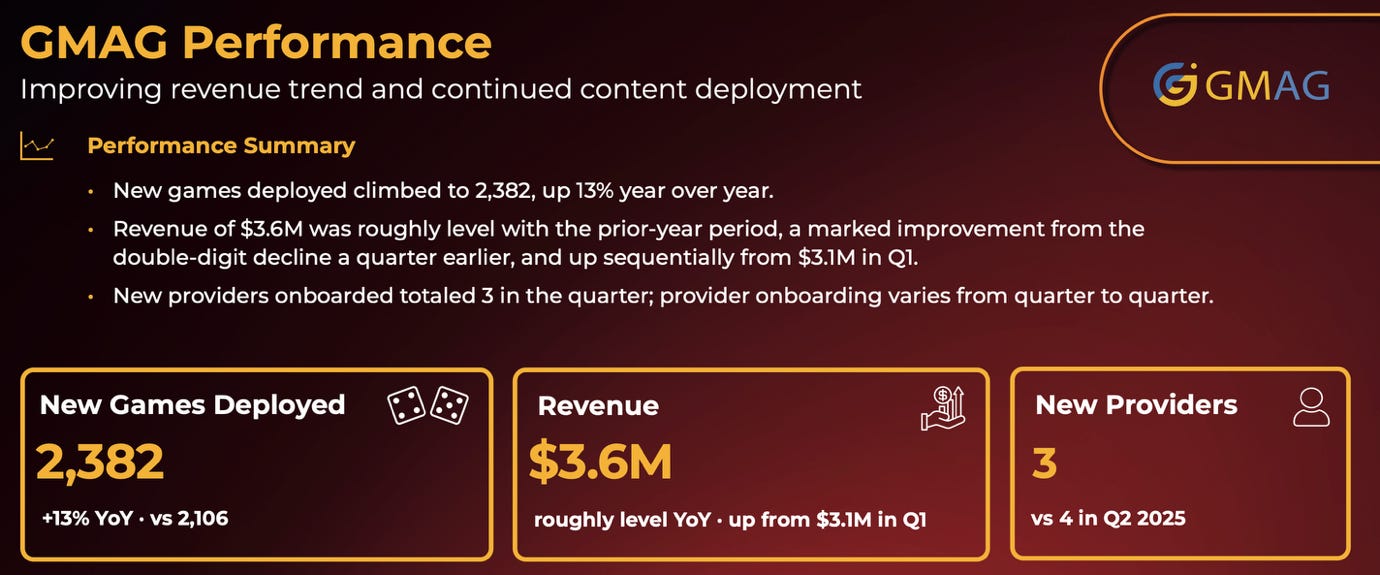
In Q2, the GMAG segment reported revenue of $3.6M, which is down 1.6% Y/Y.
This segment is not only a drag on the group’s revenue growth, but also on profitability. Gross margin is 33.5%, and the segment was at break-even on EBIT margin.
To counter this slump, the company is focused on improving the GMAG offering.
During the quarter, the segment added 3 new game providers, which is a decrease from adding 4 providers in the same period last year.
It also added 2,382 new games to its platform.
By adding more providers and more games, GMAG is aiming to become more valuable to casino operators.
7. Mexplay
Mexplay is the company’s Mexican online casino and sports betting brand.
While it is currently a small part of the overall group, it is growing at an incredibly fast pace.
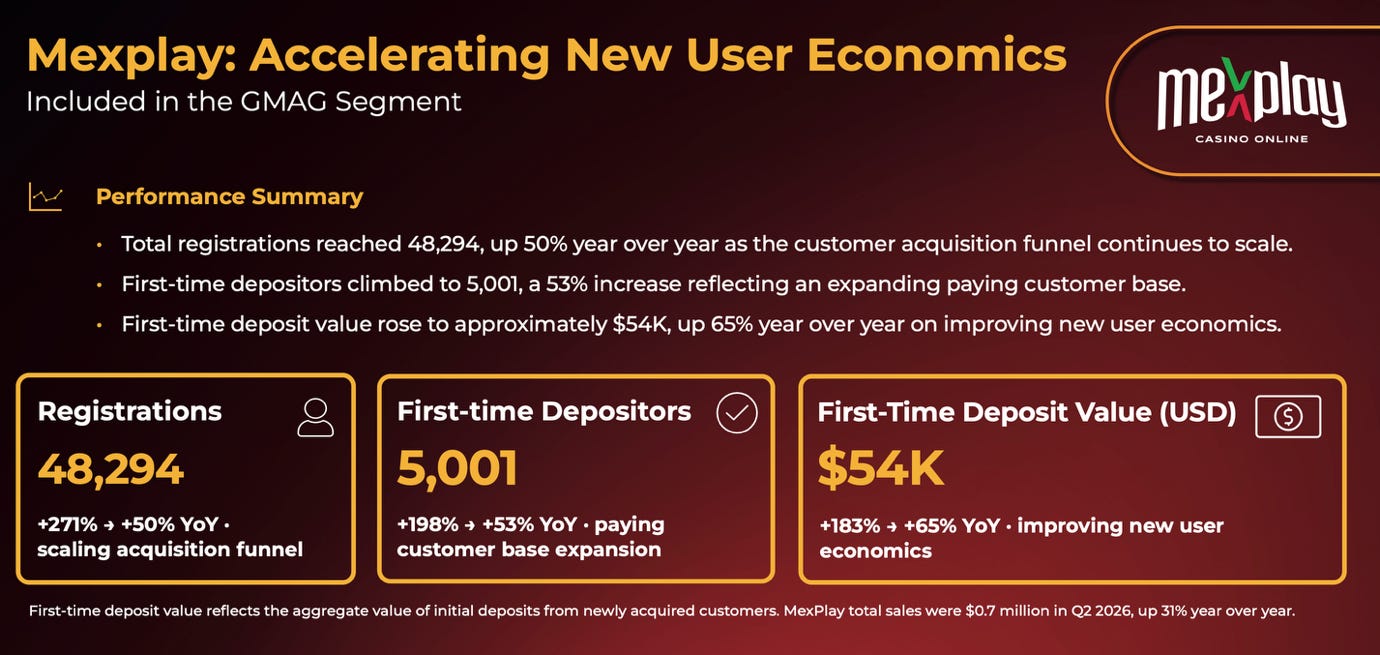
The number of people signing up for Mexplay grew by a staggering 271%, reaching a total of 48,294 registered users.
Even more important is that the number of first-time depositors rose by nearly 200% to 5,001 people, while first-time deposit value grew by 183% to $54K.
This shows that Mexplay is successfully converting people into paying customers.
The success of Mexplay is not just about the money it makes in Mexico, it is a test case for how the company can enter other Spanish-speaking countries.
By learning how to market to Mexican players and follow the local rules, the company is building a playbook that it can use as it expands across Central and South America.
8. Valuation
A market cap of $182M, TTM revenues of $197M, and adjusted EBITDA of $22.5M implies that the company is trading for 0.9x P/S and 8x EV/ADJ EBITDA.
That compares favorably to competitors.
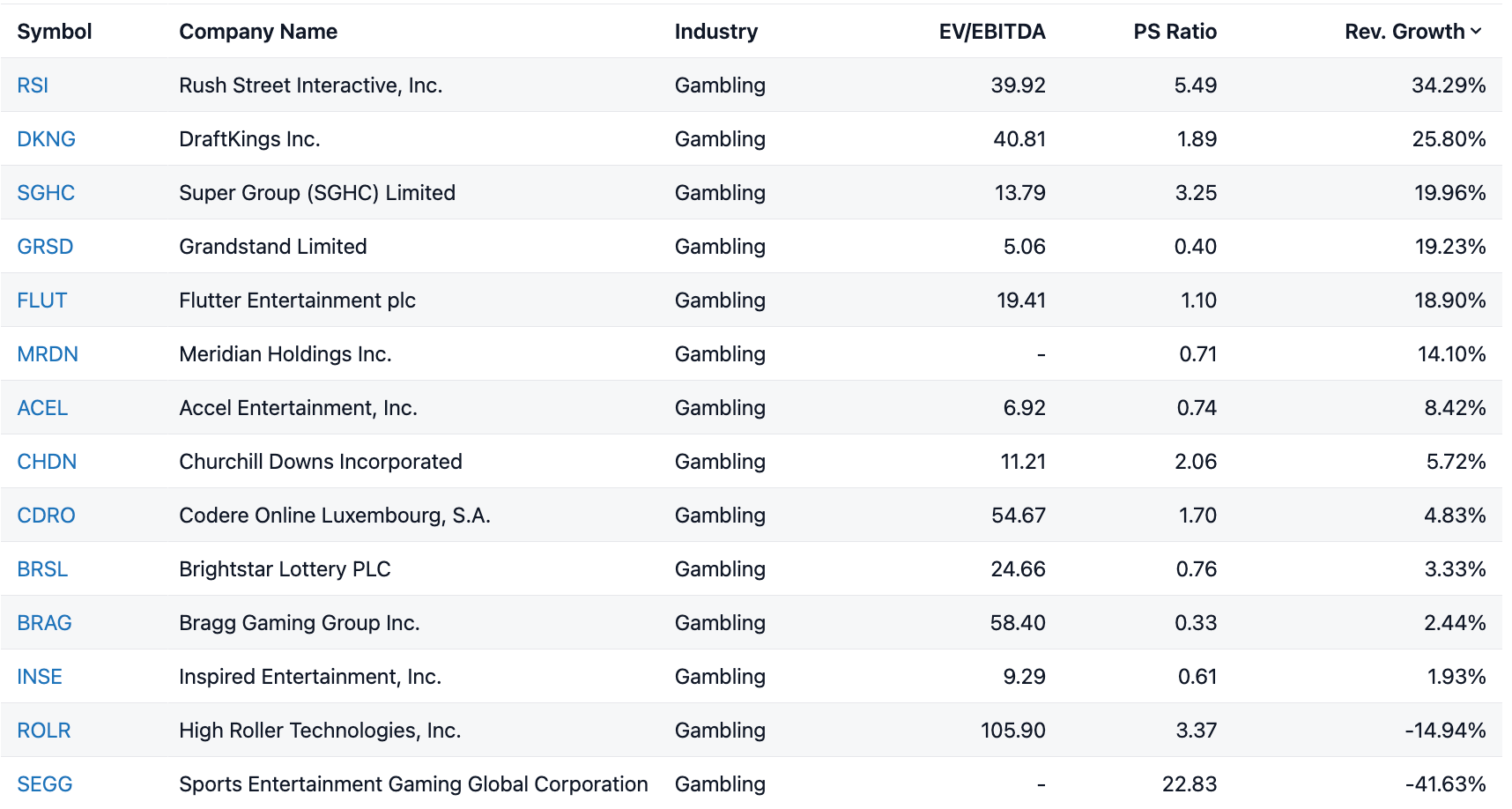
In the above picture, you see the P/S, EV/EBITDA, and revenue growth of some key gambling companies.
Flutter trades for about double Meridian’s P/S multiple and 3x the EV/EBITDA multiple, despite comparable revenue growth.
Meanwhile, Draftkings are signficiantly more expensive than Meridian, despite growing top-line only slightly faster.
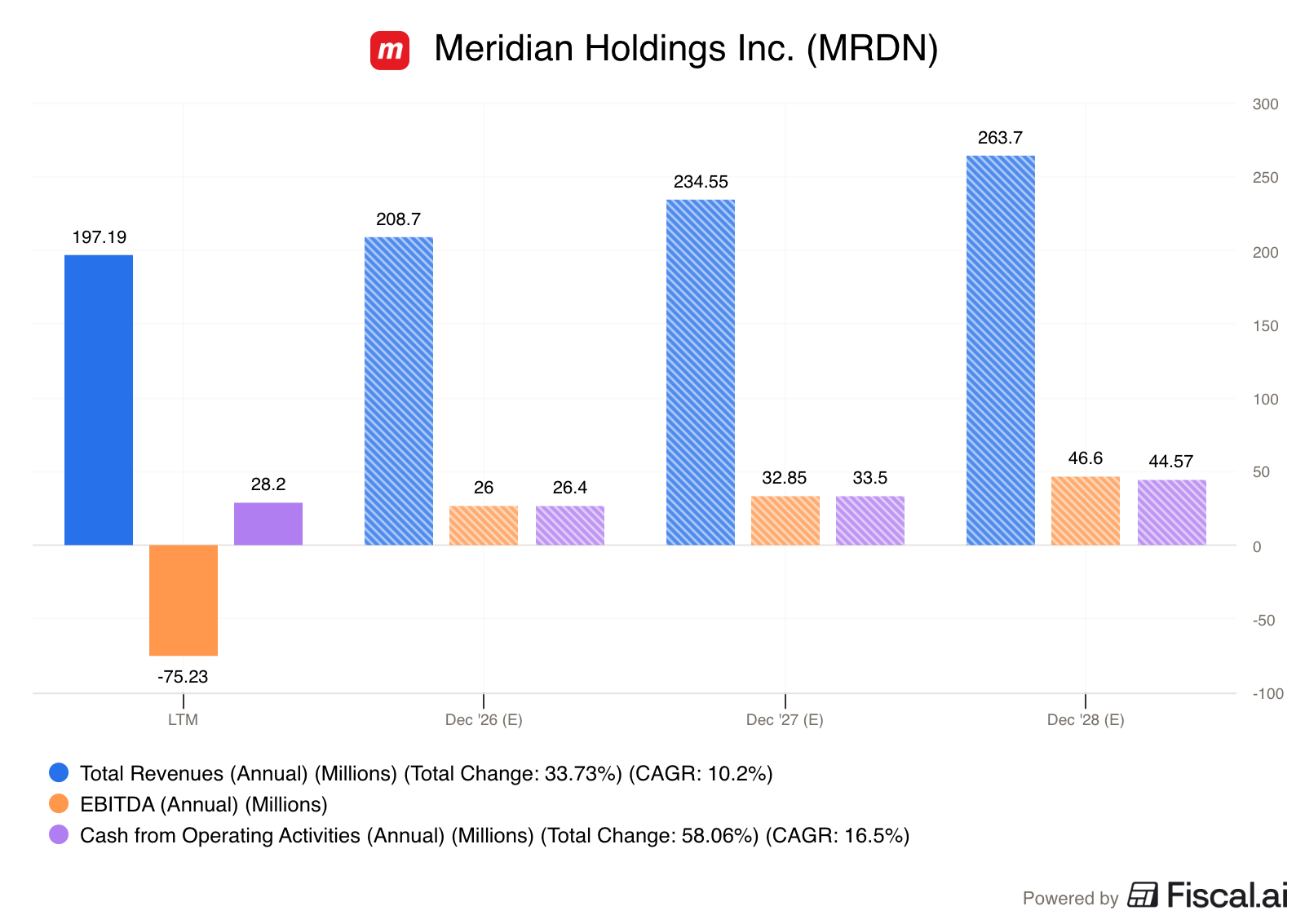
Looking at a few years in the future, the analyst consensus 2028 estimate revenue sits at $264M, EBITDA at $46.6M, and OCF at $44.6M.
Implying a 2028 P/S of 0.5, EV/EBITDA of 4, and EV/OCF of 3.
A key catalyst that could bridge the valuation gap between peers is full-year GAAP net profitability. Once that is reached, Meridian will begin to appear in stock screeners that demand it.
As a small-cap with a market cap just above $100M, the company is hard to discover in a sea of thousands of publicly traded companies. Screeners are a crucial tool that investors use to discover such companies.
If the current financial trajectory continues, that could happen after Q4 2026 results.
And institutions are front-running this possible catalyst.
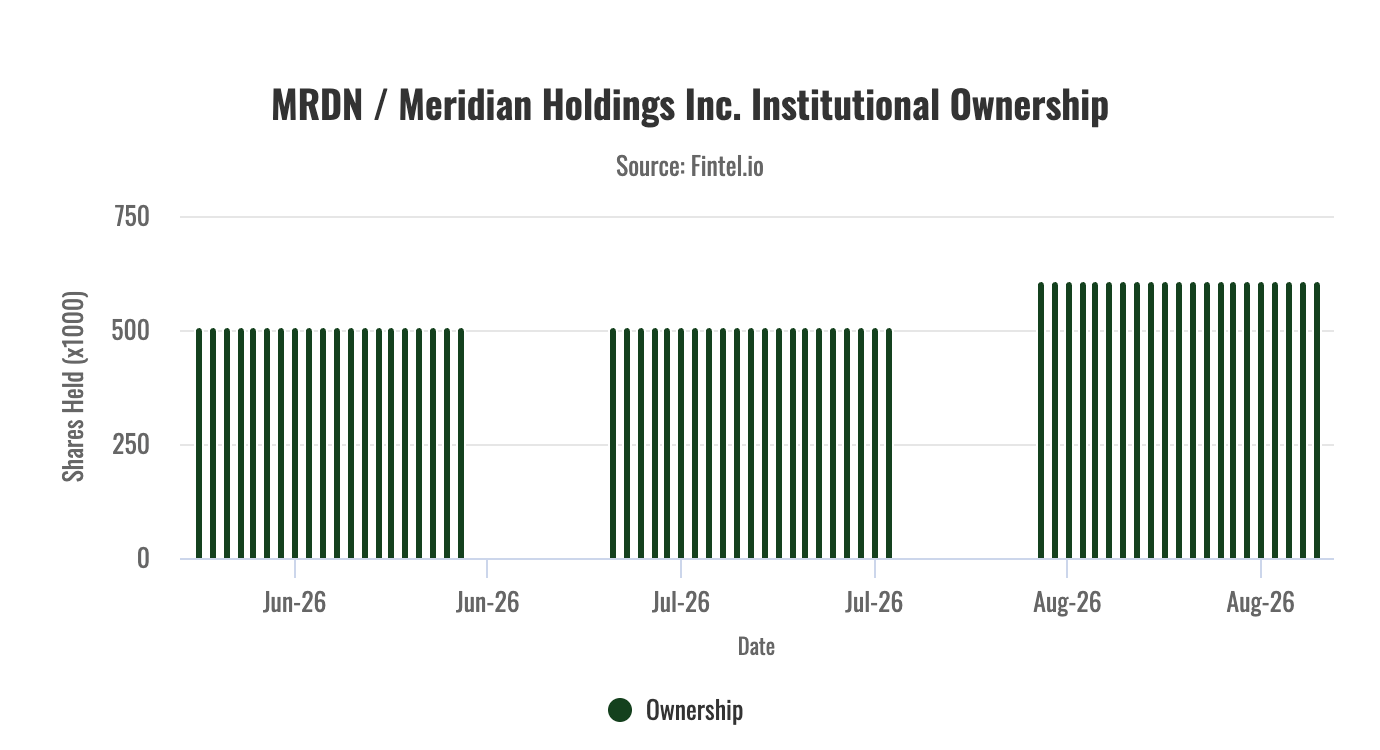
As you can see in the chart above, per Fintel.io, overall institutional ownership has been growing steadily in the last month.
Smart money is seeing value here!
9. Valuation Model
Let’s build a quick valuation model.
It is hard to adequately estimate the growth of the RKings, Classics, and GMAG segments. So, I am going to model a modest 5% CAGR.
For Meridian, they reported $5.33M in revenues from Latin America in 2024, so I am assuming that all of it relates to MexPlay and the recent entry into Brazil.
Meridian, excluding Brazil and Mexico, I model them growing with a 9% CAGR till 2030. This mostly consists of the core business in Europe and the expansion in Africa.
Regarding Mexico and Brazil, I model a rapid expansion, reaching revenues of $68M in 2030.
As per the 2030 forecasts, the Mexican industry would generate $2.52B in revenues, the Brazilian $3.9B. So to get revenues of $68M, Meridian would only need a market share of 1.1%. This seems a very reasonable and achievable market share target.

In such a scenario, total revenue could reach $312.6M, a CAGR of 11%!

Modeling the operating margin reaching 14%, and tax, interest, and other expenses of 30% of operating income.
Net income could reach $30.6M in 2030, a margin of 9.8%!
Next dilution. I am going to model 15.168M shares outstanding in 2030, an increase of 20% in 5 years. This assumes that a significant portion of the remaining acquisition debt gets converted into equity.
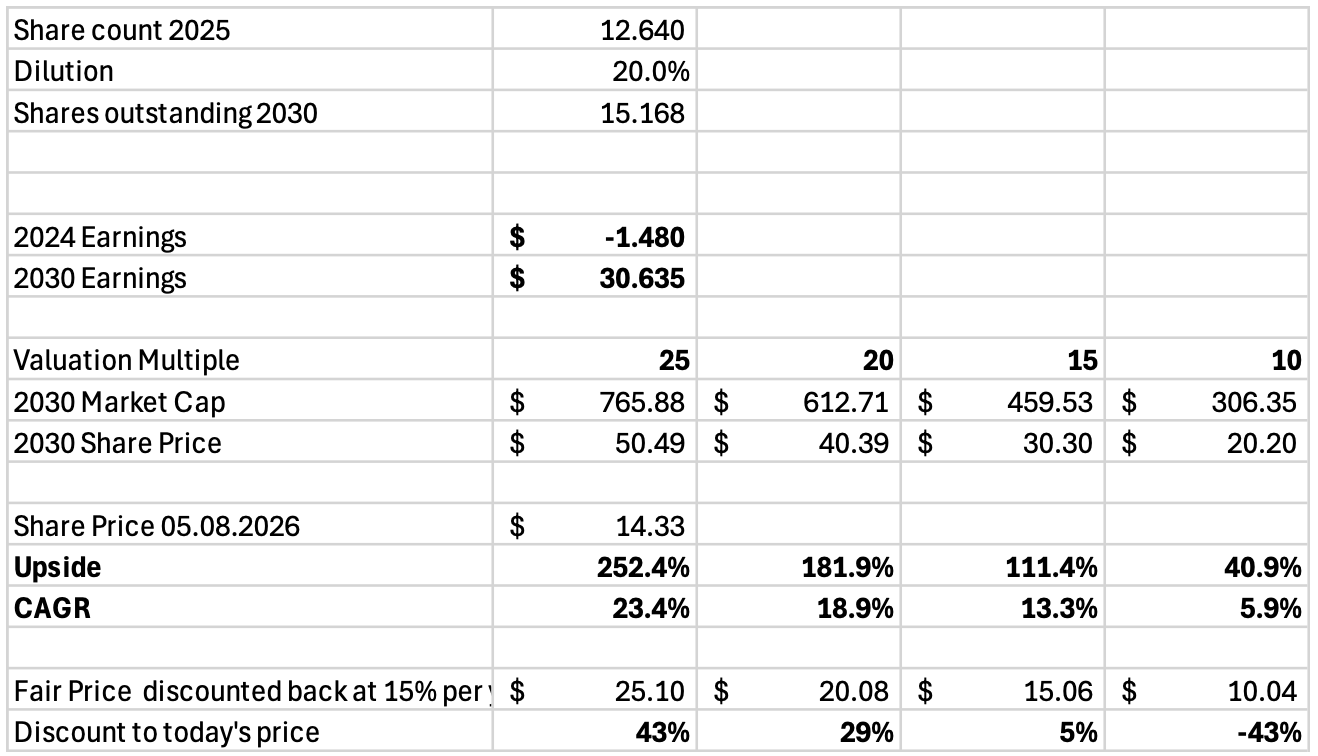
If the Meridian trades for a P/E of 15-20, we could be looking at a $460-613M market cap company and a $30-40 stock in 2030.
That would be an upside of 111-182% from today’s share price of $14.33!
Discounting it back at 15% per year to calculate a fair value per share, we get $15-20, implying that currently the company might be trading for a 5-29% discount to its fair value.
10. Conclusion
Let’s look again at the key factors behind the 22% sell-off.
First, the slight revenue miss of $50M vs $51-53M guide can easily be explained by the $1.2M large win and the unfavorable betting results. There are no long-term structural issues that would indicate a deteriorating business. As the CFO, William Scott said, when volumes are growing, the business is healthy, as the margin trend will stabilize.
This goes straight into the second point, the gross margin decline from 56.4% to 53.5%. This is also a temporary headwind linked with those 2 large wins. Overall, the operating leverage is improving, as demonstrated by the 8.5% decrease in SG&A costs and over 40% growth in ADJ EBITDA.
Third, the CFO transition doesn’t indicate any long-term issues with financials. Zoran will be a competent CEO, as he has led the Meridianbet segment for 20 years. Furthermore, William Scott is an experienced manager who will handle the CFO job well, as he did as the Interim CEO.
Lastly, the H2 2026 guide of 8-10% revenue growth being barely in line with the analyst consensus estimate of 9.6% is also just the company being more conservative. They just missed the guidance and want to have an easier path to beat in the second half of the year. Considering the gain of hundreds of thousands of new players and the upcoming sports calendar, I see it as quite probable that guidance will be beat.
Overall, the first half of 2026 has delivered progress for Meridian.
The company has successfully moved from a period of heavy investment and occasional losses into a state of steady, GAAP profitability.
By growing its revenue 16% and returning over $2.2M in profit, the company has proven that its strategy of integrating successful brands like Meridianbet, Mexplay, Expanase, RKings, and Classics is working.
Furthermore, the company’s decision to focus on its strongest brand, pay down its debt, and invest in AI technology has made its financial position the strongest in its history.
With a net debt leverage of only 0.39x and $17.3M in cash, the company is well-prepared to handle the required investments to achieve its growth strategy.
So, in conclusion, Meridian appears to be undervalued compared to what its peers are trading at. As the valuation model showed, there is further potential for decent upside.
But execution is the key!
Integration needs to go smoothly, and operational synergies must be achieved.
Legacy markets in Europe must continue to grow.
The company shouldn’t experience any issues in Africa, Brazil, or Mexico.
If that happens, Meridian Holdings could make its shareholders very happy.
However, as always, investing in small caps comes with additional risks, and this is not a guaranteed slam dunk.
Nevertheless, the business does look promising.
Disclosure:
This report is Issuer-Sponsored Research. Global Equity Briefing has entered into a research and distribution agreement with Meridian Holdings Inc ($MRDN). The compensation may create a conflict of interest; however, the Analyst maintains editorial independence and all opinions expressed in this report are strictly his own. The Analyst agrees not to trade Meridian securities during the period of the agreement. The compensation received is a fixed fee and is not contingent upon the content of the report or the performance of the issuer’s securities. This is not a recommendation to buy or sell any security. Global Equity Briefing is not a registered broker-dealer or investment adviser.
Thank you for reading Global Equity Briefing!

You can follow me on Social Media below:
X(Twitter): TheRayMyers
YouTube: TheRayMyers
Threads: @global_equity_briefing
LinkedIn: TheRayMyers
Disclaimer: Global Equity Briefing by Ray Myers
The information provided in the “Global Equity Briefing” newsletter is for informational purposes only and does not constitute financial advice, investment recommendations, or an offer or solicitation to buy or sell any securities. Ray Myers, as the author, is not a registered financial advisor, and readers should consult with their own financial advisors before making any investment decisions.
The content presented in this newsletter is based on publicly available information and sources believed to be reliable. However, Ray Myers does not guarantee the accuracy, completeness, or timeliness of the information provided. The author assumes no responsibility or liability for any errors or omissions in the content or for any actions taken in reliance on the information presented.
Readers should be aware that investing involves risks, and past performance is not indicative of future results. The author may or may not hold positions in the companies mentioned in the “Global Equity Briefing” report. Any investment decisions made based on the information in this newsletter are at the sole discretion of the reader, and they assume full responsibility for their own investment activities.