
Meta: Most Undervalued Mag7!
Investors are worried that Meta might be over investing in AI, while ignoring the Opportunity.

The stock market has been segregated into a 2-tier market.
AI winner stocks are ripping, reaching new highs almost daily.
Everything else is either flat or falling.
Mr. Market has placed Meta in the second camp, as Zuck’s social media giant has seen its stock fall 20% from the August 2025 highs.
Investors are concerned that Meta might be overinvesting in AI infrastructure without having an easy and direct way to monetize that infrastructure.
Microsoft, Google, and Amazon have highly successful enterprise cloud businesses that are showing accelerated revenue growth, driven by AI startups and large enterprises implementing AI across their organizations.
Meta doesn’t have such a business, and it doesn’t have highly visible, easily monetizable consumer AI products comparable to ChatGPT, Claude, or Gemini.
Furthermore, Meta just reported its first quarter-over-quarter daily active user decline in years.
These factors have built a strong bear narrative that has dragged down the stock.
But if one looks under the hood, the reality of a high-quality undervalued business smacks you in the face.
Revenue growth is accelerating, margins remain top-class, AI is a clear tailwind, and the valuation is by far the most appealing among the Magnificent 7 companies.
Most importantly, this week, Meta revealed a slew of consumer subscriptions, aiming to further monetize its most active users and create directly monetizable AI products.
In today’s article, I will explain why the market is wrong about Meta!
It can monetize AI
It will continue gaining users
It is undervalued
Let’s begin.
1. Subscriptions
2. AI
3. Growing User Base
4. ARPU Growth
5. WhatsApp Monetization
6. RealityLabs
7. Valuation
8. Valuation Model
1. Subscriptions
On May 27, 2026, Meta announced a set of paid subscription plans for its 3 flagship apps.
$3.99 a month for Facebook Plus.
$3.99 a month for Instagram Plus.
$2.99 a month for WhatsApp Plus.
These tiers operate in parallel to the existing Meta Verified program, which continues to provide verification and impersonation protection for creators and businesses at price points ranging from $15 to $500 per month.
Ultimately, Meta plans to consolidate these social offerings, along with professional and AI packages, under 1 unified brand known as Meta One.
This integrated ecosystem aims to create high-margin recurring revenue products as the company invests aggressively in its Reality Labs VR venture and AI buildout.
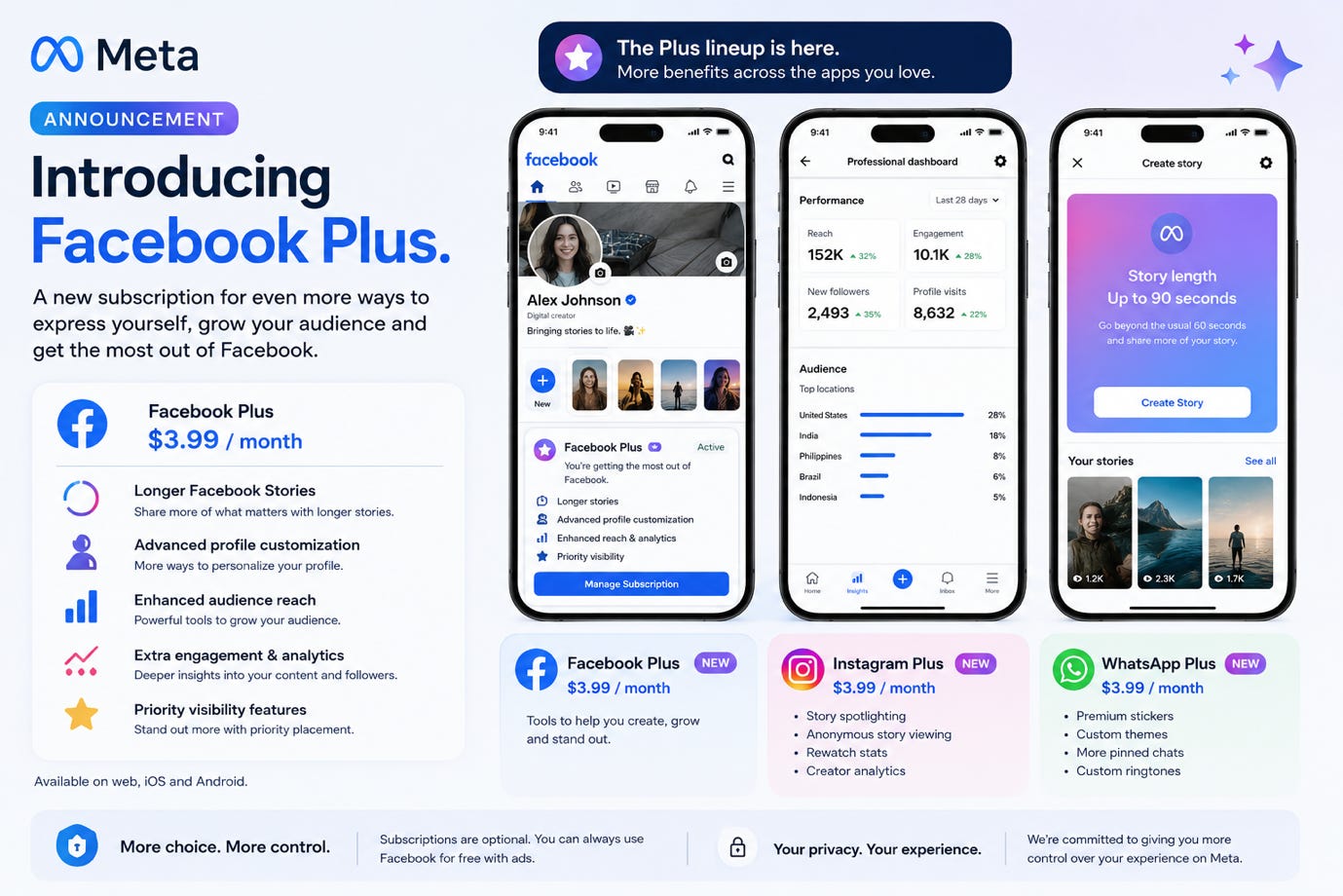
The Plus subscriptions provide optional tools for users looking for deeper customization, detailed analytics, and enhanced privacy controls.
Interestingly, these tools do not remove advertising from the feeds.
Instead, they establish a 2-tier user experience where paying subscribers receive functional perks while non-paying users operate with standard features and a less engaging interface.
This makes sense as the average US DAU is estimated to generate over $80 in yearly revenue. This subscription would generate less than that, about $48, and that assumes no churn.
So revenues generated by these new offerings will be incremental, and not reduce advertising revenues.
For Instagram Plus, subscribers paying $3.99 per month receive tools that provide advanced insights and profile design choices.
Key capabilities include:
More detailed statistics
How many people rewatched a story
The option to build unlimited story audience lists
Secret preview mode to view stories without appearing on the viewer list
Extend stories beyond the standard 24-hour window
Spotlight 1 story per week for extra visibility
Search story viewer lists
Additionally, to enhance privacy, subscribers can post content directly to their profiles and highlights without displaying those posts in the feeds of their followers.
Cosmetic enhancements include animated Super Heart reactions, custom app icons, special fonts for bios, and additional profile pins.
Facebook Plus offers a matching suite of features, including story rewatch statistics, profile customization, and detailed user analytics.
WhatsApp Plus, priced at $2.99 per month, prioritizes messaging utility and visual personalization.
Subscribed users can change the visual theme of the application, apply custom app icons, send premium stickers, set unique ringtones, pin extra chats beyond the standard limit, and access advanced list customization tools.
Overall, these seem like cosmetic features that will appeal to creators, teens, or power users.
I am a user of all 3 of Meta’s main apps, and none of these features raises any interest in me. However, I imagine that millions of people will sign up, especially considering the affordable price tags.
These features remind me a bit of video game skins. For those unfamiliar, many video games offer players the opportunity to purchase in-game customizations that have no impact on the gameplay, they simply change how some weapons or characters look. Despite having no benefit on the game field, gamers spend billions of dollars on these in-game skins.
I expect these subscriptions to have the same effect.
Meta is also introducing high-capacity plans for AI power users, creators, and businesses, consolidating them under the Meta One offering.
While basic access to Meta AI remains free, high-volume consumers will eventually hit usage caps.
Meta is testing 2 consumer AI subscription levels to resolve this issue:
$7.99 per month Meta One Plus
$19.99 per month Meta One Premium
The Meta One Plus for $7.99 a month tier is built for individuals who frequently generate images and videos or require extended reasoning capacity from Meta’s chatbot.
The Meta One Premium for $19.99 a month provides the same features as Meta One Plus but with significantly higher usage ceilings and access to the chatbot’s advanced thinking mode.
According to Helen Ma, the head of subscriptions at Meta, users who purchase these AI packages will also have access to premium features from the individual app subscriptions.
If that was not confusing enough, for business users and professional creators, Meta is launching 2 separate tiers designed to improve visibility, simplify management, and solve common operational pain points.
$14.99 per month for Meta One Essential
$49.99 per month for Meta One Advanced
Meta One Essential for 14.99 per month provides a Verified badge, impersonation protection, and enhanced linksheets to promote cross-platform presence.
Meta One Advanced for $49.99 per month gives businesses priority feed visibility on Facebook, higher ranking in Instagram search results, and enhanced Follow buttons on Reels.
It also features optimized scheduling tools, account moderator management without password sharing, and alert notifications when other users copy original content.
A major benefit is direct access to human customer support for Facebook and Instagram pages, resolving a historical pain point for small businesses.
Meta is currently testing all these subscriptions in various geographies before a global rollout.
Yes, it is a bit confusing with Meta now releasing 7 different subscription offerings, each with different features and use cases. This is the first serious foray of Meta into consumer subscriptions, so it is expected that there will be some learning moments on the way. I expect it will figure out which price points and feature sets appeal the most and consolidate and simplify its offering in the future.
Overall, I don’t believe that any of these subscriptions will create game-changing revenues for Meta.
In the last 12 months, Meta generated over $200B from advertising revenues. Let’s assume Meta gets to 100M subscriptions in a few years, which is a generous assumption. If the blended average subscription price is about $5, Meta would make $6B in subscription revenues.
That’s only 3% of its current advertising revenues. By the time Meta reaches that many subscriptions, advertising revenues would have already reached $300B. So, the subscriptions are just a small cake slice that will slightly increase revenue growth.
Nevertheless, these revenues are incremental and likely will have a huge incremental EBIT margin of 90%, as they would only require limited expenses. That could result in a $4-5B bump to EBIT.
Most importantly, it could end up helping Meta beat the narrative that it doesn’t have ways to monetize AI.
2. AI
A lot of investors are worried that Meta is overinvesting in AI development.