
Sivers Semiconductors: Asymmetric Photonics Opportunity or Hype?
$360M Market Cap Swedish Semiconductor Small Cap, in a Multi-Billion Dollar AI Photonics Niche.

The more time passes since the AI revolution began, the more winners are emerging.
Nvidia was the big first winner, making hundreds of billions from selling AI GPUs. Lately, the company has been throwing its weight around, investing in its suppliers and technology partners to ensure that the AI industry continues improving.
And as we are starting to reach the limits of physics of what electrical signals can achieve, Nvidia has invested billions in the next generation of tech, photonics.
Thanks to the company, the global AI industry is currently undergoing a structural transformation that favors speed, energy efficiency, and high-capacity data transmission.
At the core of this transformation is the shift from electrical signals to light-based signals, a field known as photonics. And today, we are going to be talking about an interesting Swedish semiconductor firm:
Sivers Semiconductors!
While the company has a history spanning more than seven decades, in the last few years it has positioned itself as a primary provider of the essential building blocks for this new AI era.
This report examines the company’s strategic role in the burgeoning AI and Lidar markets, its business units, financials, and its long-term valuation potential.
As always, the report will conclude with a 2030 Valuation Model.
1. Photonics Industry and Nvidia
2. Business Model
3. Finances
4. Key Growth Opportunities
6. Valuation
7. Valuation Model
8. Conclusion
1. The Photonics Industry and Nvidia
Before getting to Sivers and what products the company provides, let’s talk a bit about the Photonics Industry.
Because training and running AI models require an extreme quantity of data, the demand for data processing has reached a level where traditional copper-based electrical systems are no longer sufficient.
In modern data centers, especially those built to support large-scale AI models developed by Anthropic and OpenAI, the sheer volume of data moving between processors creates massive amounts of heat and consumes excessive power.
This physical limitation, often referred to as the interconnect bottleneck, has forced the industry to look toward light as the primary carrier of data.
Photonics, which involves the generation, manipulation, and detection of light particles, or photons, offers a solution that is faster, cooler, and more energy-efficient than copper.
The strategic importance of this technology is best illustrated by the actions of Nvidia!
Recognizing that its future growth depends on the ability to move data between its high-performance chips at incredible speeds, Nvidia has made significant financial commitments to secure its supply chain.
In early 2026, Nvidia announced a $4B investment initiative within the photonics sector. This initiative included $2B each invested into Coherent Corp and Lumentum, two of the largest established players in the optical technology market.
These investments are part of a multi-year strategic partnership intended to enhance the energy efficiency and resilience of AI factories. Nvidia’s commitment includes multi-billion-dollar purchase agreements to ensure it has priority access to advanced laser components and optical interconnect technologies.
For a smaller, specialized player like Sivers, this massive capital inflow into the sector validates the entire market.
It signals that the biggest names in technology view optical components as the critical infrastructure of the next decade.
Do you like this report?
Become a Paid Premium member to see dozens of exclusive pay-walled equity research reports such as this.
Curious about which stock I own?
Full portfolio with all holdings, cost basis, and unrealised gains is visible to Premium members. I do weekly updates and detailed monthly reviews. Premium members are also notified of all sales and purchases using the pay-walled Substack Chat.
The annual plan is available 50% cheaper than the monthly plan.
2. Business Model
Sivers does not produce end-user consumer electronics. Instead, its business model focuses on being a critical enabler of the technology used by other companies.
It develops highly specialized chips and lasers that solve performance challenges in high-growth markets such as satellite communications, defense, autonomous driving, and AI data centers.
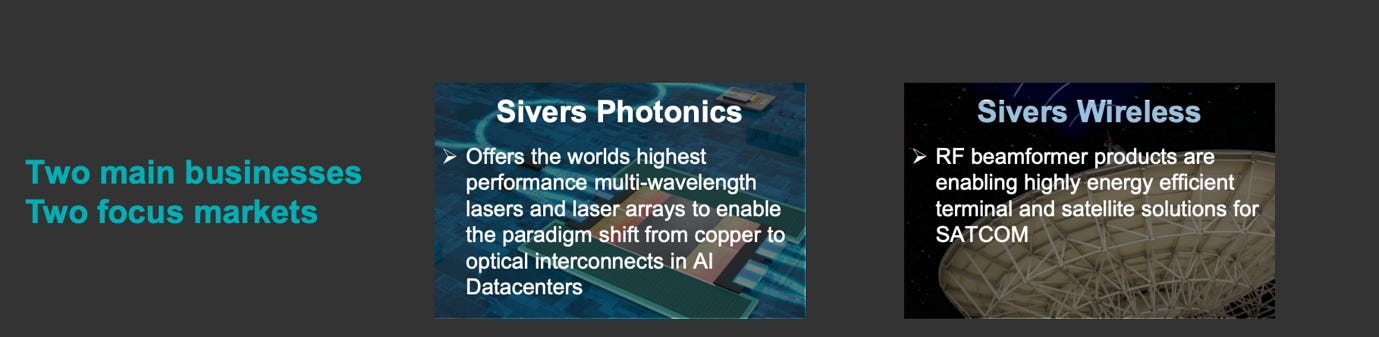
The company operates through two main subsidiaries: Sivers Wireless and Sivers Photonics.
Let’s expand on them.
2.1. Sivers Wireless
Sivers Wireless develops advanced semiconductor technology for microwave and millimeter-wave applications for communication systems.
These are high-frequency radio waves that can carry large amounts of data over short to medium distances.
The primary applications for this technology include:
Satellite Communications (SATCOM)
Fixed Wireless Access and 5G
Defense
For SATCOM, Sivers provides chips that allow ground terminals to communicate with satellites in space, particularly for next-generation constellations that provide global internet. Key clients include the satellite communications company Intelsat and the European Space Agency.
Meanwhile, Fixed Wireless Access refers to providing high-speed internet to a stationary location (like a home or office) using wireless signals rather than physical cables. Instead of a technician digging up your yard to lay a cable, they install a small receiver on your roof or window that sends signals to a nearby cell tower. This is significantly cheaper than laying cables, and with the rise of 5G is becoming fast enough.
Sivers communication chips are enabling telecommunications companies to provide such high-speed internet!
Furthermore, the company also supplies secure, high-bandwidth communication tools for military contractors.
A major technical achievement for this division is its beamforming integrated circuits.
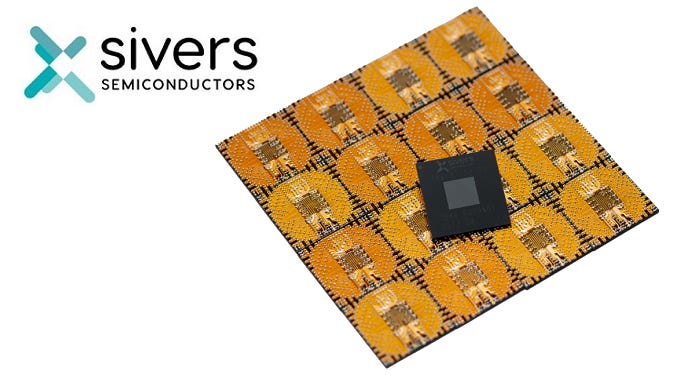
Unlike traditional antennas that broadcast a signal in all directions, beamforming chips can focus a signal into a narrow beam, which makes the communication much more efficient and harder to jam. Essentially, the signal is sent directly to the receiver instead of in all directions. Sivers is currently the only commercial provider based in the EU for certain types of these chips.
2.2. Sivers Photonics
The Photonics segment manufactures specialised photonic devices.
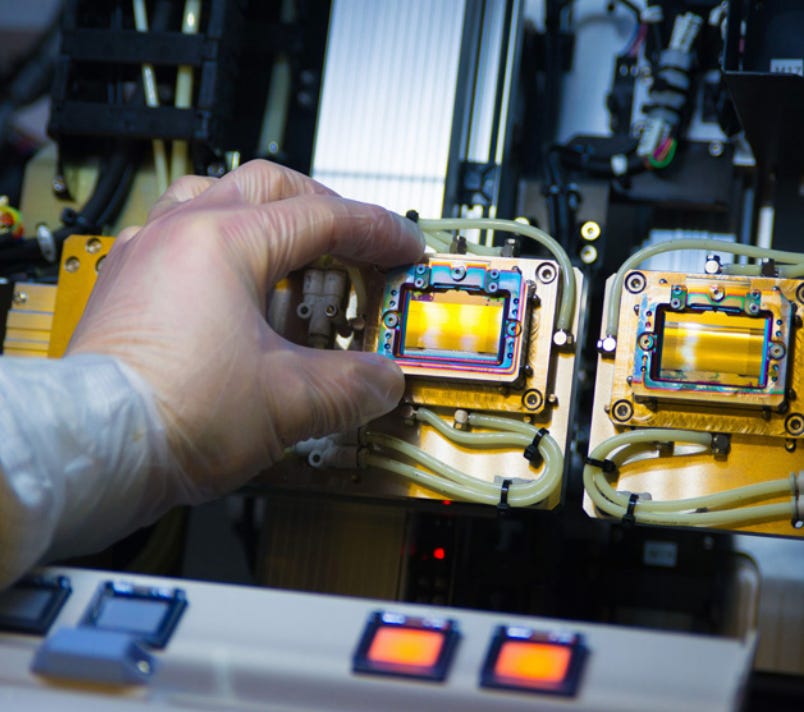
Unlike traditional computer chips made of silicon, these devices use materials that are better at generating and manipulating light.
This division is the primary driver of the company’s growth in the AI market, and its products include:
Lasers
Optical Amplifiers
Lidar Components
The company makes high-precision lasers that are used to send data through fiber optic cables. These are special lasers that produce a very pure and stable light at one exact wavelength. In addition to fiber optic cables, they are used in things like 5G networks, various sensors, and increasingly AI data centers to send data quickly and accurately.
Additionally, this division makes Optical Amplifiers, devices that boost the strength of a light signal as it moves through a system. They are used in fiber-optic networks to boost signals so data can travel longer distances without losing quality.
Lastly, another potential high-growth application from this segment is Lidar Components.
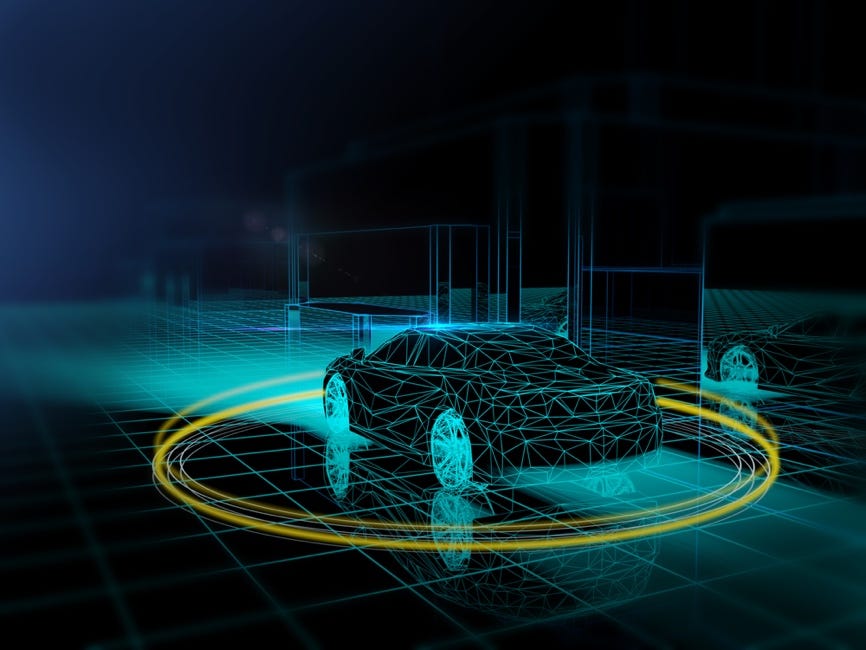
Lidaruses laser light to measure distances and create detailed 3D maps of objects and surroundings.
Sivers sells lasers and sensing chips used in self-driving cars and industrial robots.
The company provides custom foundry services, meaning it can design and manufacture specific parts for other companies, as well as sell its own standardized laser products.
2.3. Revenue Lifecycle
The company’s revenue is driven by a cycle that begins with technical engagement and ends with high-volume production.
This design-to-revenue cycle is critical for understanding the company’s future value because it acts as a leading indicator of sales.
Pipeline: This phase represents all potential opportunities Sivers is currently discussing with customers. In 2025, Sivers reported that its opportunity pipeline grew by 64% to reach $453M. This growth suggests a strong long-term demand for the company’s technology.
Design Win: A design win occurs when a customer officially chooses Sivers’ technology to be a part of their future product. For example, the company reported that a “strategic Lidar customer” has already incorporated Sivers’ lasers into its sensing platforms. This is an important step, as a single design win could bring in stable revenues for years, as companies rarely change input suppliers once the design is final.
Ramp-up: This is the phase where the customer moves from testing prototypes to mass-producing their product. Sivers expects its lidar customer to begin this ramp-up in Q4 2026.
3. Financials
Sivers is currently in a transitional financial phase.
It is moving from being an engineering-focused research company to a product-focused manufacturing company that earns recurring revenue from high-volume sales.
3.1. Revenue Growth and Profitability
For several years, Sivers has maintained a pattern of significant investment in research and development, which has led to strong revenue growth, but consistent negative FCF.
This is common for semiconductor firms that are building IP for markets that are only just beginning to mature.
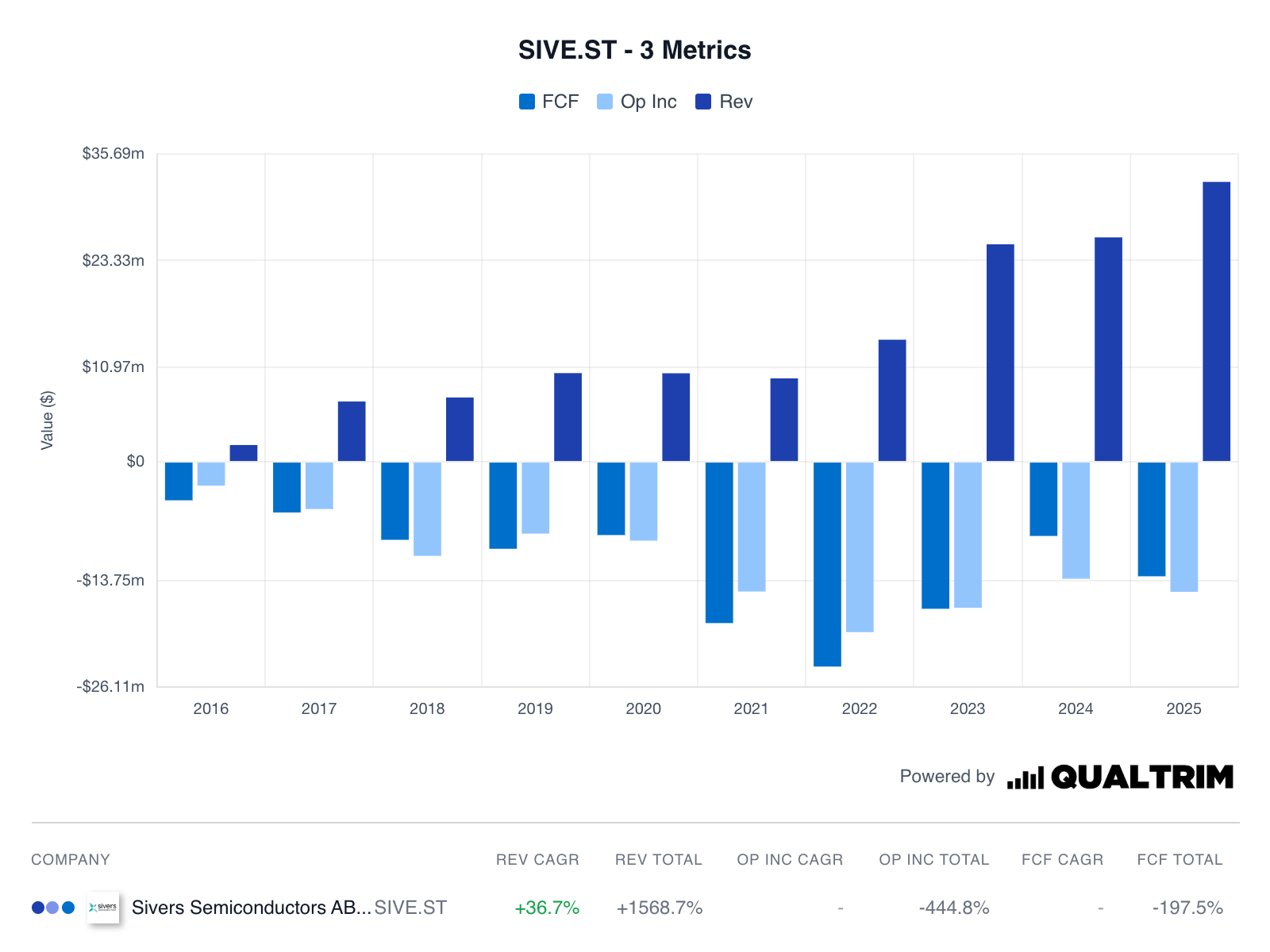
From 2016 to 2025, revenues grew with a CAGR of 36.7%, an increase of 16X to 304M SEK ($32M)!
As you can see in the above chart, the revenue fluctuated a lot, with some slow years and a few strong years. During that period, the company was heavily focused on qualifying its products for major customers. This is the result of the discussed revenue cycle affecting their business, as growth is driven by design wins.
2025 revenues were 304M SEK ($32M), which was a strong 25% Y/Y increase.
While operating losses remain high at 141M SEK ($15M), a margin of -39%, it is a significant improvement from the -83% operating margin of 2022.
Meawhile FCF losses fell from 151M SEK in 2022 to 66M SEK ($13M) in 2025, a decrease of 56%.
The revenue acceleration indicates that the company’s design wins are starting to move into the production phase for several customers.
3.2. Q4 2025 Results
Let’s look at the last reported quarter to see the most up-to-date performance.
In Q4 2025, it reported net sales of 80.7M SEK, which represents a 5% Y/Y growth.
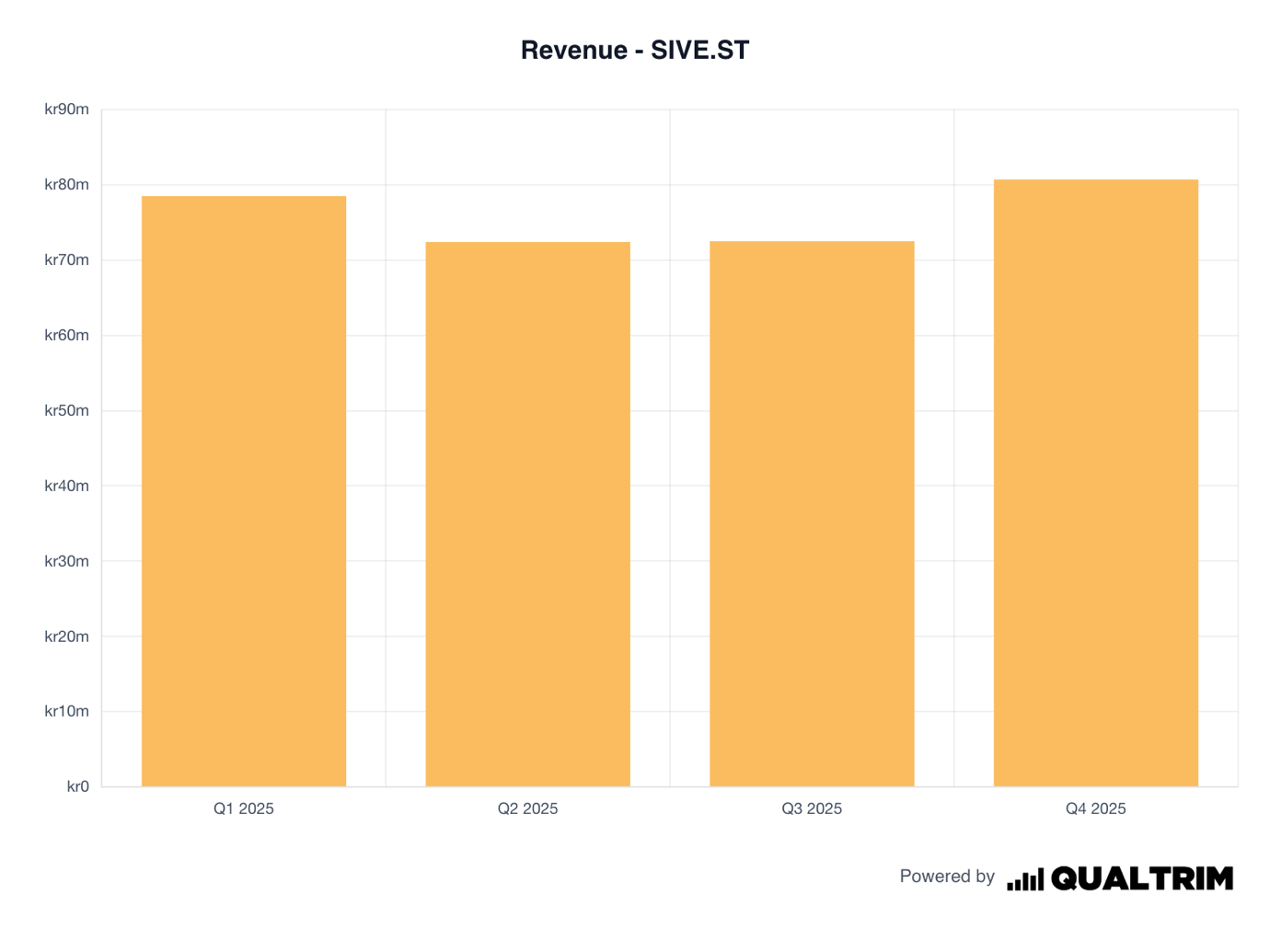
Key Metrics:
Revenue of SEK 80.7M +5% (+17% FXN)
ADJ EBITDA SEK 10.8M -30%.
Product Revenue SEK 21.3M +13% Q/Q
OCF SEK -17.5M
Total CASH SEK 43.5M
For Q4 2025, the company reported an adjusted EBITDA of 10.8M SEK, which was a 30% decrease Y/Y. This was driven by high R&D and expansion costs.
A critical detail in this report is the growth of product revenue. In the past, Sivers relied heavily on non-recurring fees, where customers paid them for development work. The company is beginning to earn more revenue from selling actual products to clients.
In 2025, annual product revenues reached 85.7M SEK, an increase of 13% at FXN. This trend is important because product sales generally have higher profit margins and are more predictable than one-time development contracts.
3.3. Balance Sheet
At the end of 2025, Sivers held a total available cash position of 43.5M SEK.
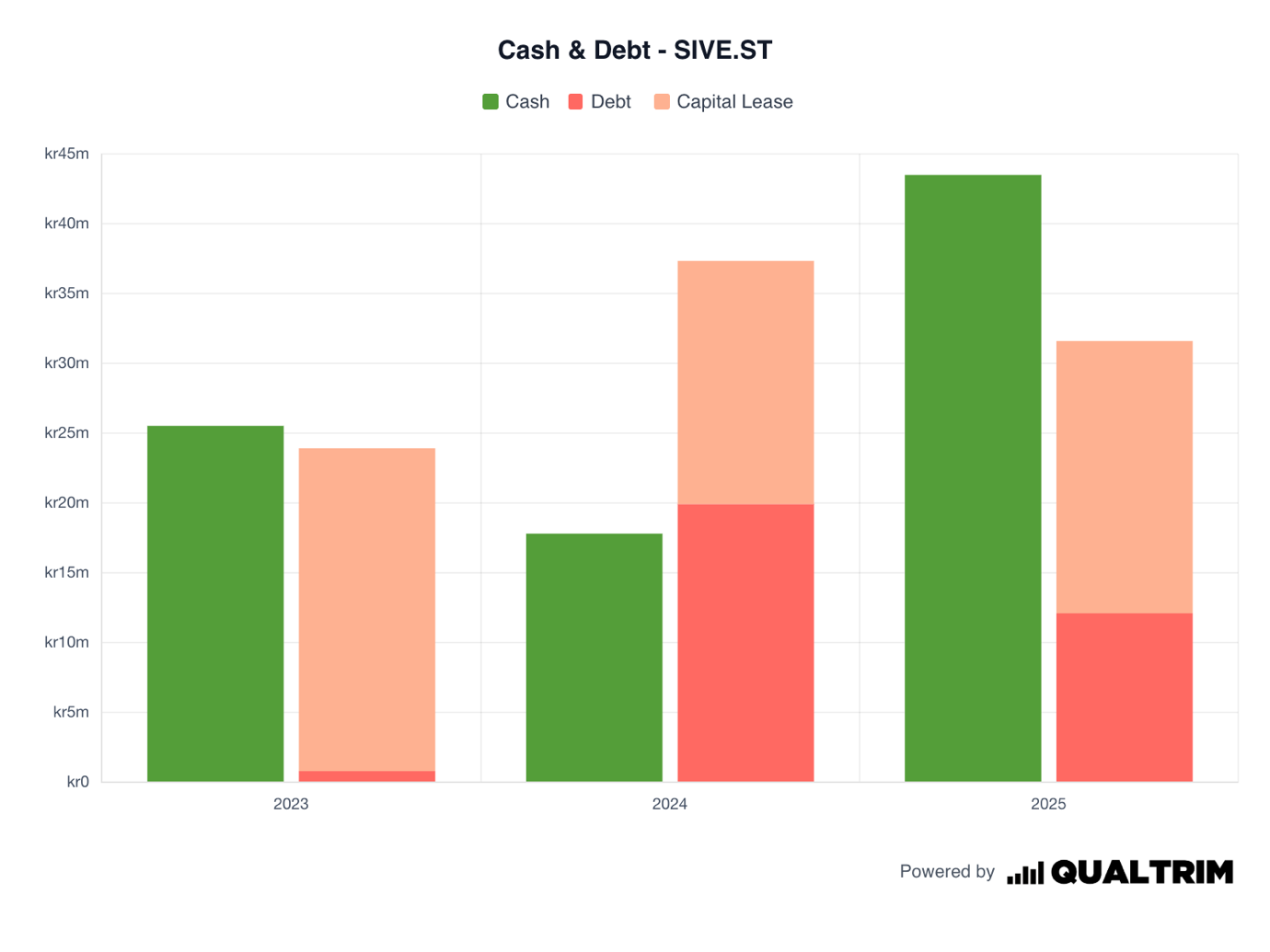
This is a significant increase from 18M SEK last year, as the company successfully completed a directed share issue to raise 95M SEK in 2025, diluting shareholders by about 8%.
The cash burn remains a concern as the company is unprofitable. Last month, in February of 2026, the company raised an additional $17M via $5M term loan and a $12M convertible debt.
However, with the decrease in debt, capital leases, and an increase in cash position, the company is not in danger of insolvency.
4. Growth Opportunities
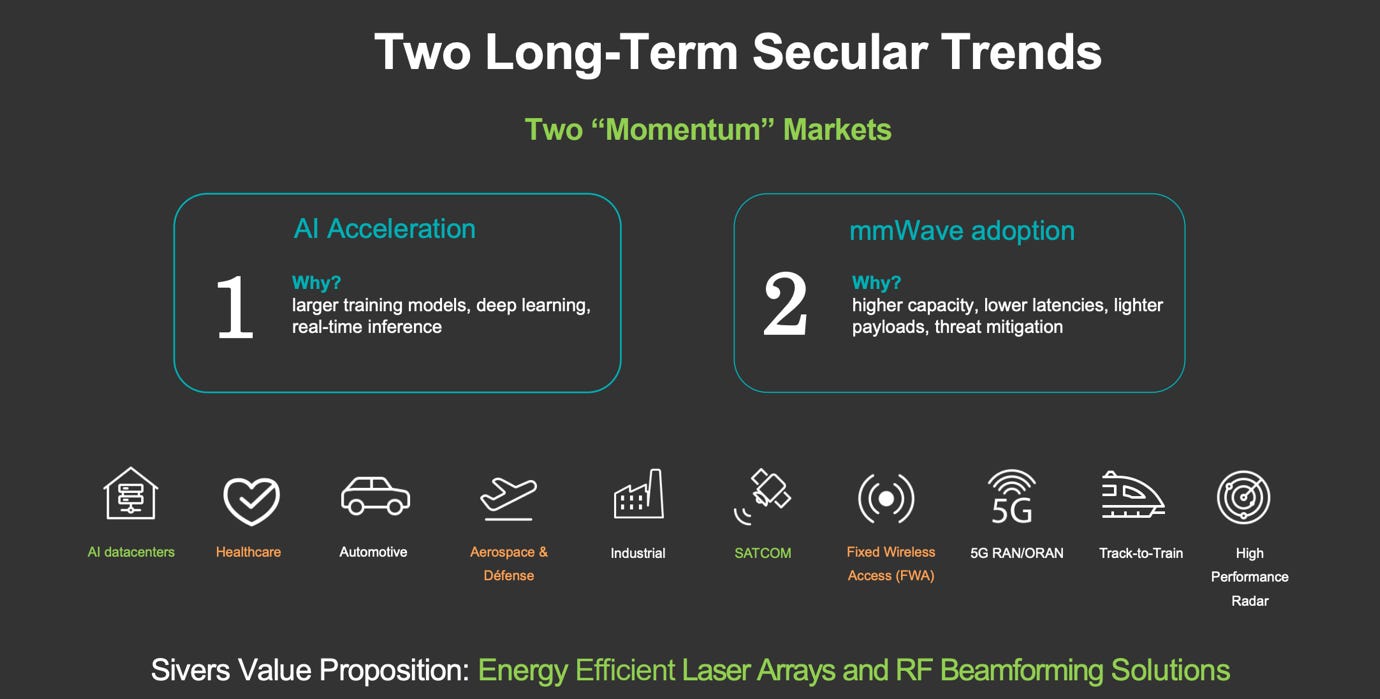
Sivers is currently leveraging several high-profile partnerships to gain access to the most lucrative segments of the AI and wireless markets.
These partnerships allow Sivers to integrate its specialized lasers into larger systems designed for mass production.
Let’s look at the AI and Lidar opportunities.
4.1. The AI Data Center Opportunity.
The industry is currently moving toward a design concept called Co-Packaged Optics (CPO).
In older systems, optical transceivers were separate parts that plugged into a machine. CPO seeks to integrate the optical components directly into the same package as the processor.
This proximity reduces the distance signals must travel, which can lower energy consumption by as much as 80% compared to traditional copper setups. However, because processors generate intense heat, the lasers used for communication must be moved slightly away to remain stable. This has created a demand for Sivers lasers.
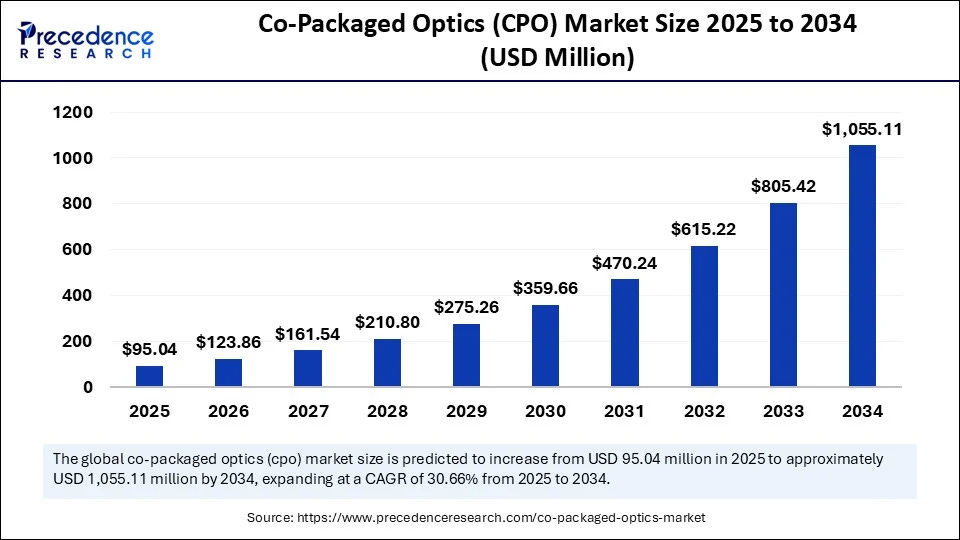
For instance, analysts at Precedence Research forecast the CPO market to grow with a 30.66% CAGR to reach $1.055B in 2034!
The transition to Co-Packaged Optics in data centers requires highly reliable external light sources. Sivers has formed two major collaborative efforts to meet this need.
First, Sivers is working with Poet Technologies.
This collaboration combines Sivers’ high-power lasers with Poet’s Optical Interposer platform. In fiber optics, components like lasers, detectors, and modulators are discrete parts connected by wires and fibers. This is bulky and expensive. Poet’s optical knterposer acts like a motherboard, allowing all these components to be integrated onto a single, tiny chip.
The goal is to create plug-and-play light engines that are energy-efficient, scalable, and can be easily slotted into AI infrastructure.
Simply put, traditional optical modules are reaching their performance limits as connectivity speeds move toward incredible speeds into terabits (125 GB) per second. By using Poet’s platform, Sivers can help customers reach higher speeds.
Prototypes are expected to be shown to customers in the first half of 2026, with the goal of being ready for production by the end of 2026.
Second, Sivers has announced a strategic partnership with O-Net Technologies and Enablence Technologies to develop new light source modules for CPO technology.
In this arrangement:
Sivers provides the laser arrays.
Enablence Technologies provides tech that helps distribute the light wavelengths efficiently.
O-Net Technologies serves as the manufacturing partner, which will manufacture the final module.
This collaboration is specifically meant to targeted at the AI data center markets. Because CPO brings optics so close to the processors, the heat becomes a major problem for the lasers.
The ELS module developed by this group solves that problem by keeping the lasers cool and stable in a separate compartment.
Furthermore, beyond just Co-Packaged Optics, Sivers is targeting the broader AI factory infrastructure through two key technology paths:
Optical Input/Output
Memory Pooling
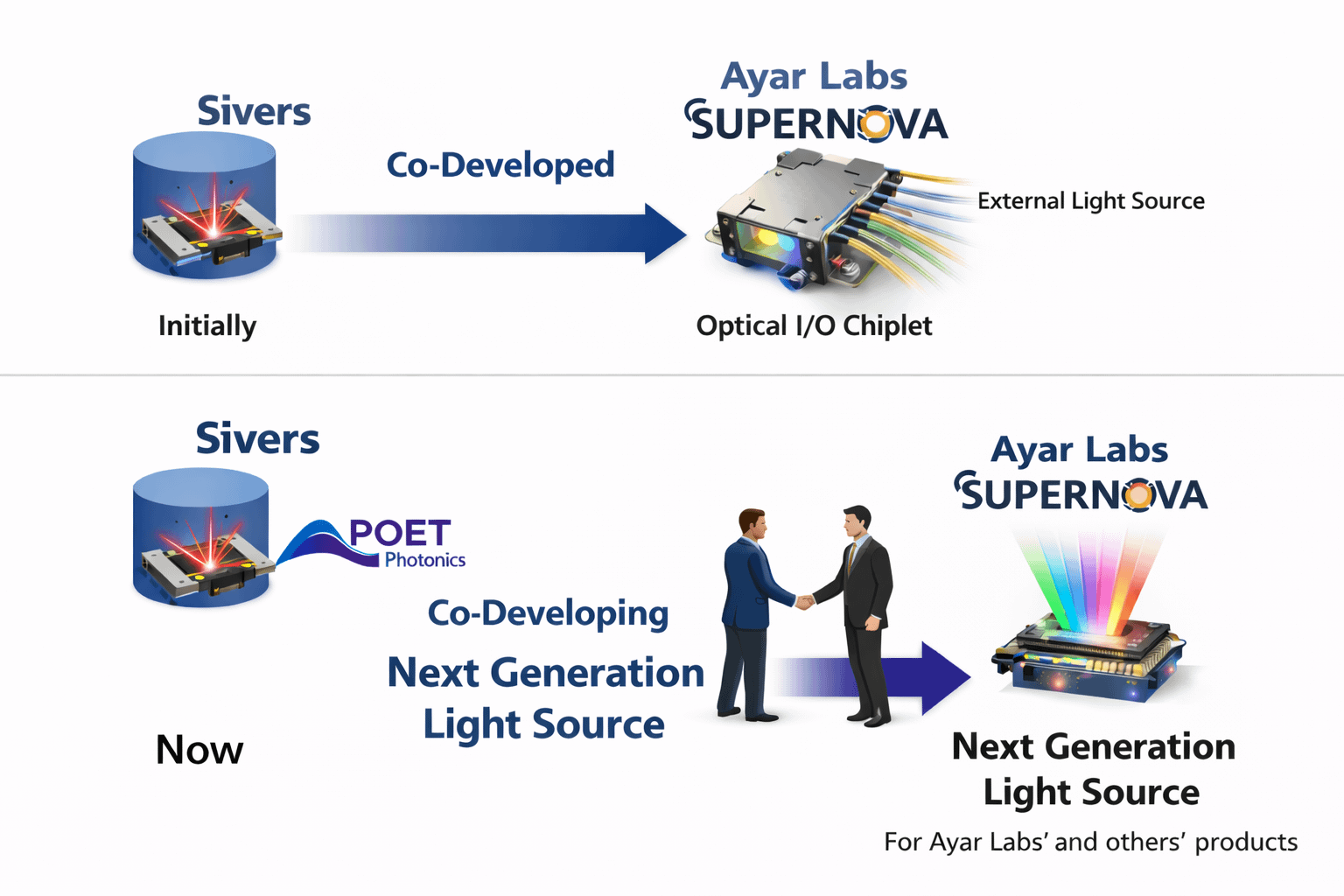
Large AI clusters require incredible connectivity, linking GPUs and accelerators as if they were a single system. Sivers is a key partner for Ayar Labs, providing compliant laser arrays for their “SuperNova” light source. This optical input/output system bypasses copper limits, delivering potentially 5-10x faster communication speeds within a GPU cluster.
Next is memory pooling.
AI workloads are limited by stranded memory, which is RAM memory that’s physically available in a server but cannot be used by the processors that need it. It is essentially wasted capacity. Every server is built with a set amount of memory, for example 512GB. If a specific AI task only needs 100GB of that RAM but requires 100% of the CPU’s power, the remaining 412GB sits idle.
Usually, Server A cannot lend its extra RAM to Server B. Even if Server B is running a massive LLM and is crashing because it ran out of memory, it cannot reach across the rack to use Server A’s idle capacity.
Thus, the industry is moving toward tech called Compute Express Link over optical interconnects to share memory across racks. Sivers’ high-power lasers provide the necessary light sources for these next-generation memory fabrics, enabling AI models to access 100+ terabytes of shared memory with low latency.
Simply put, Sivers helps to “un-strand” memory!
4.2. Lidar and Automotive Opportunity
Outside of the data center, Sivers is seeing a significant ramp-up in the Lidar market.
Let’s remember that Lidar is a sensor technology that uses lasers to create a 3D map of a car’s surroundings. This is essential for advanced safety features and self-driving capabilities.
Sivers recently announced that a strategic Lidar customer has incorporated its technology across all their platforms. This customer plans to start high-volume production in the fourth quarter of 2026. According to the company, the revenue potential for this single partnership is estimated to be between $53-138M over the customer’s product lifecycle, which could be about 8-10 years, around $5-14M per year.
For context, that would be 16-44% of 2025 revenues, from a single deal.
This deal is particularly significant because it moves Sivers into the consumer automotive market, with its technology being adopted by Tier 1 Automotive OEMs.
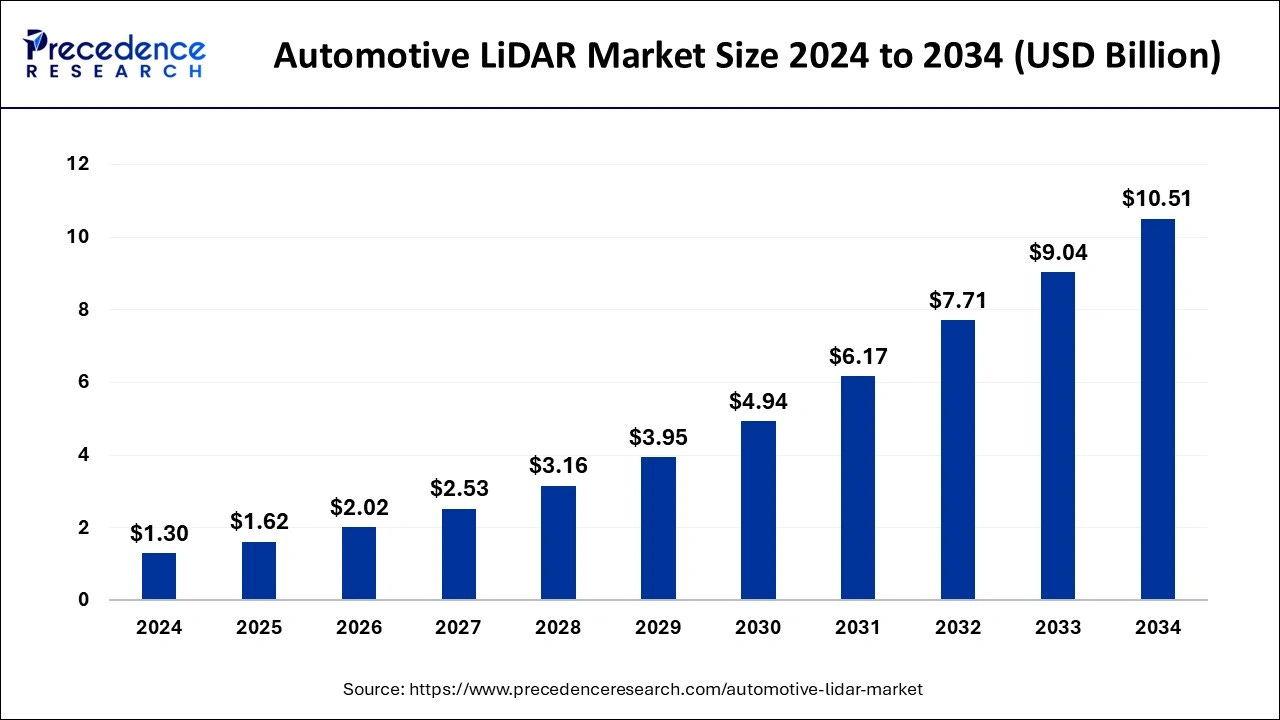
Per Precedence Research, the global market for automotive Lidar is expected to grow from $1.3B in 2024 to $10.5B by 2034, a CAGR of 23%!
By being designed into a major customer’s platform now, Sivers is well-positioned to benefit from this industry-wide growth.
5. Key Risks
Despite the strong technological position of Sivers, there are three major risks that investors must consider.
Liquidity and Dilution
Execution
Competition
5.1. Liquidity and Dilution
Sivers is currently a loss-making business, and at the end of 2025, the company had 43.5M SEK in cash.
Given its current rate of spending on research, development, and global office expansion, this cash may not last very long. To continue operating and growing, the company will likely need to raise more capital.
In the past, Sivers has raised money by issuing new shares.
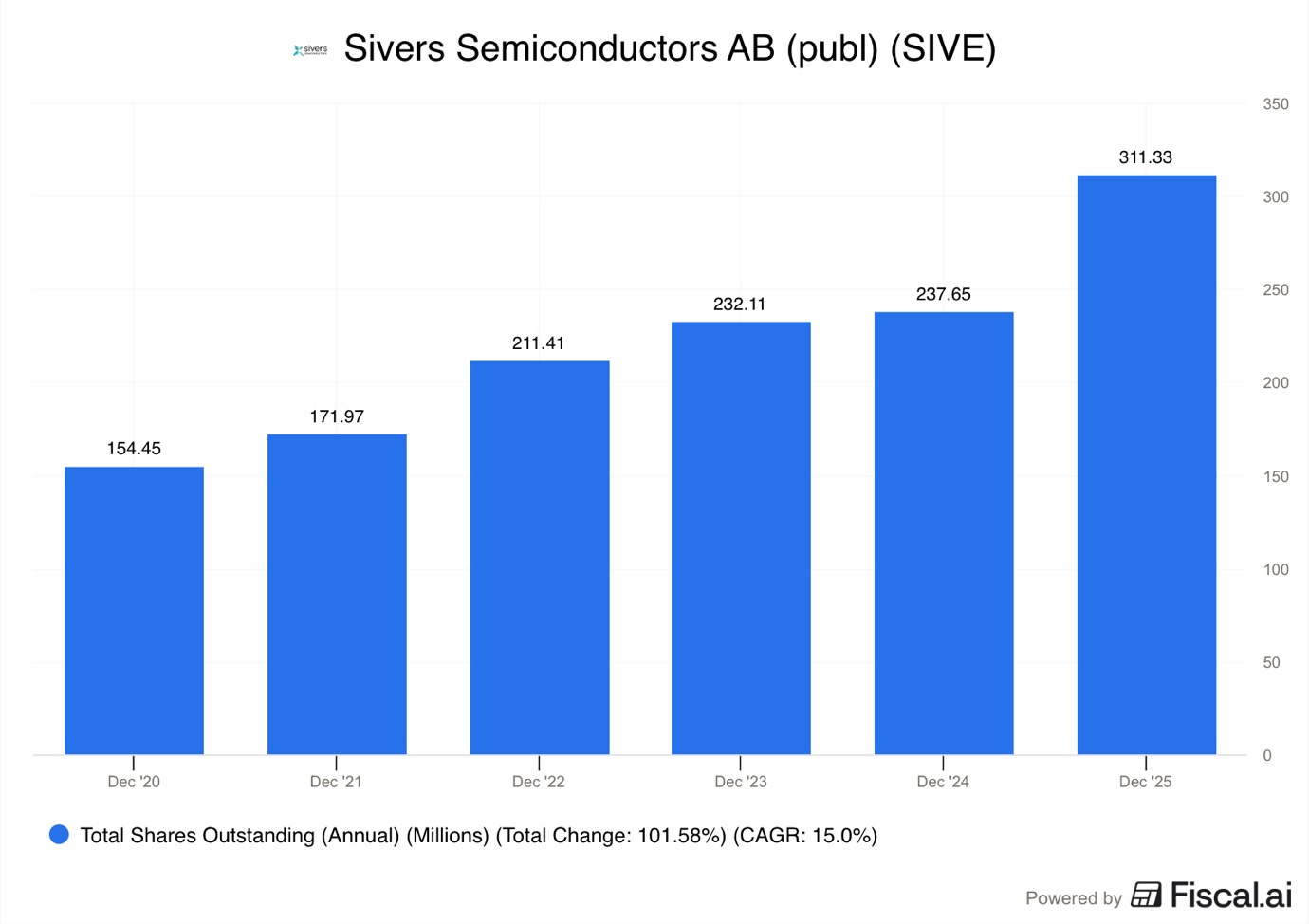
Total number og shares outstanding has increased by 101.58% since 2020 to 311.33M shares!
While this provides the cash needed to survive, it also reduces existing shareholder ownership. If the company cannot reach profitability before it runs out of its current cash, shareholders may face further dilution.
5.2. Execution
The most valuable parts of Sivers’ future are currently tied to production ramps that have not yet happened. For example, the Lidar revenue of up to $138M depends on the customer successfully starting mass production in late 2026.
Similarly, the AI partnerships with POET and O-Net are targeting late 2026 or 2027 for full production.
In the semiconductor manufacturing industry, delays are common. There could be technical problems with the designs, issues in the factories, or a slowdown in the overall economy that causes customers to delay their orders.
Because much of Sivers’ current stock price is based on the expectation of this future revenue, any delay in these timelines could cause the stock price to drop significantly.
5.3. Competition
Sivers is a relatively small player in a market that includes some of the largest companies in the world.
On the wireless side, it competes against established semiconductor giants. On the photonics side, Nvidia’s massive investments in Coherent and Lumentum show that the biggest customers in the world are already forming deep partnerships with Sivers’ larger competitors.
Furthermore, Sivers’ revenue is currently concentrated among a few very large customers. For instance, a single development contract from a major customer or a single Lidar platform can represent a huge portion of the company’s potential sales. If one of these major customers decides to switch to a competitor or cancel a project, Sivers would lose a large part of its projected income.
6. Valuation
In 2026, Sivers Semiconductors’ stock experienced a dramatic surge, rising 166%, reaching a market cap of 3.4B SEK, about $360M.
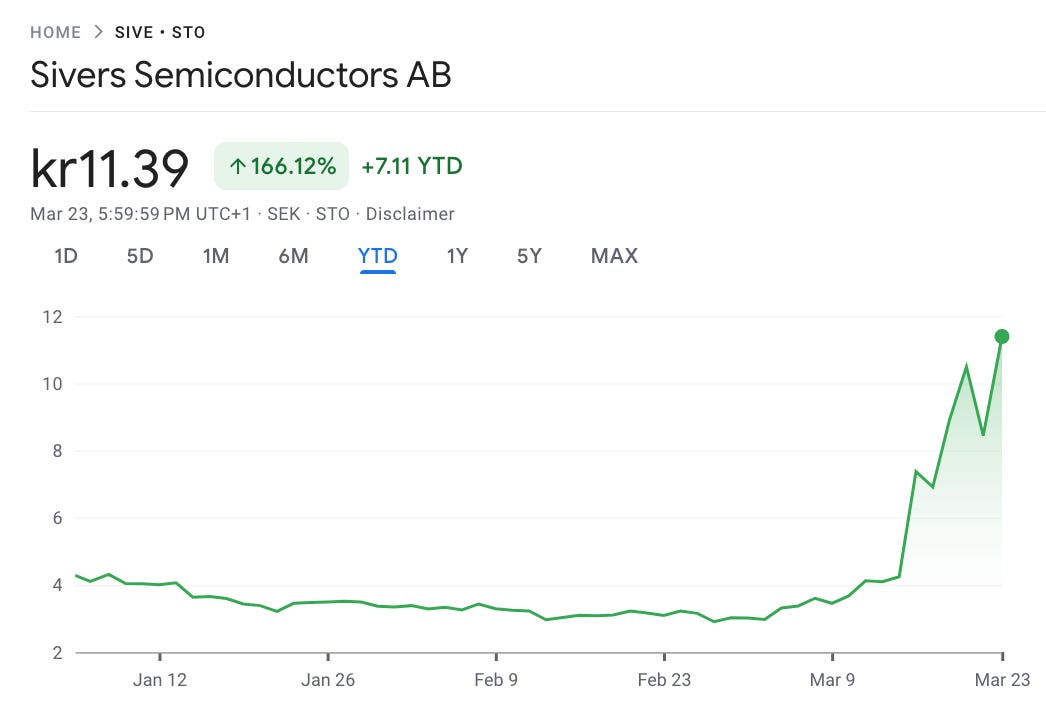
This rally was triggered by several factors, including the announcement of the Lidar production ramp and the AI partnerships with O-Net and Enablence.
Speculative interest also grew after a prominent analyst, Serenity, highlighted the company’s potential value compared to American competitors.
The valuation of Sivers is complicated by the fact that the company is not yet profitable. So metrics like the P/E ratio are not useful when a company has no earnings. Instead, we must look at how the company is valued compared to its sales and its future growth potential.
6.1. Analyst Expectations
Analysts generally remain optimistic about Sivers’ growth prospects.
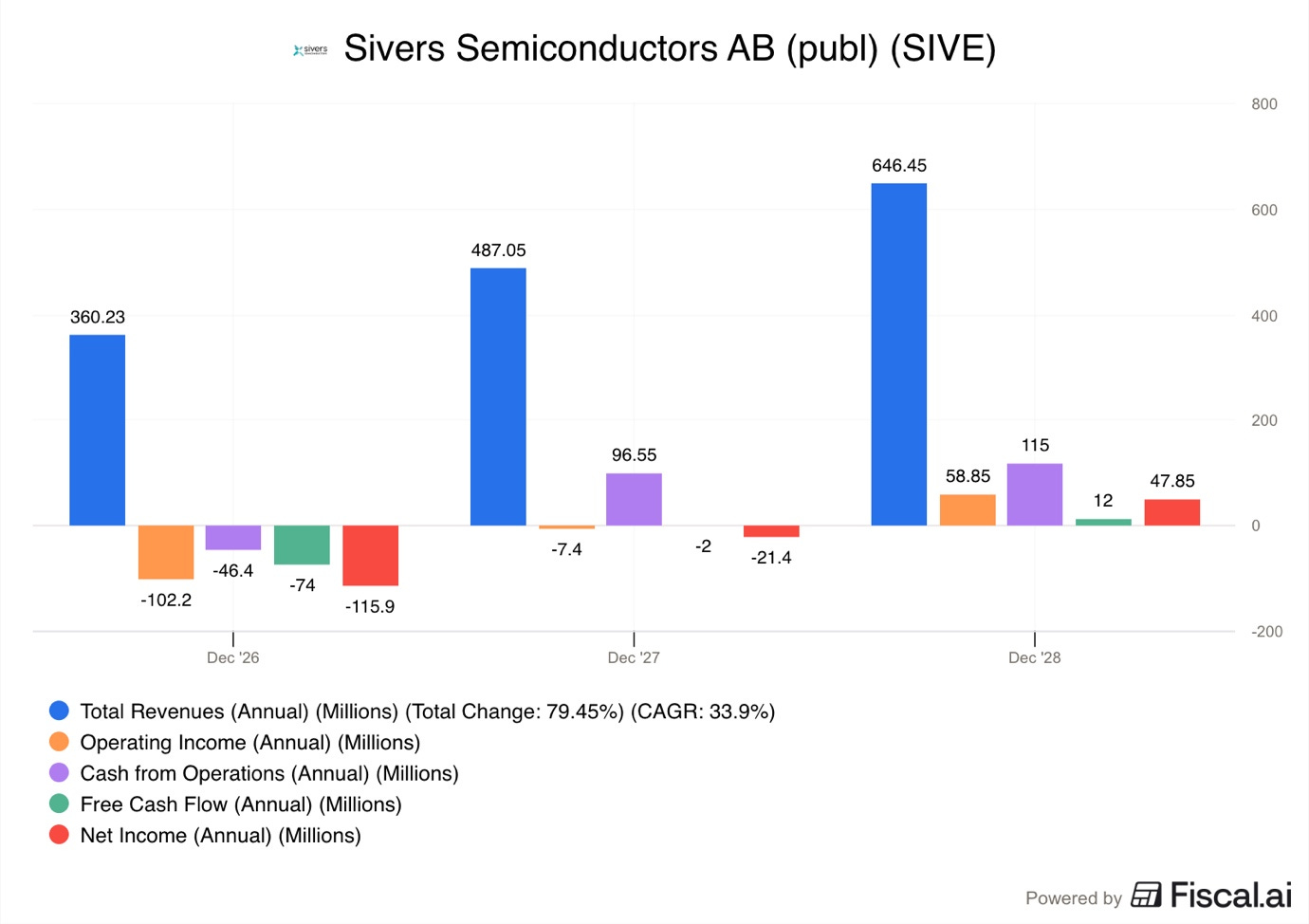
For 2028, revenue is estimated to reach 646M SEK, more than doubling from 2025!
Operating losses are projected to turn into earnings by 2028, with 58.9M SEK in EBIT.
Similarly, the 2025 net loss of 186.5M SEK is projected to turn into a 47.85M SEK profit.
At the same time, the company is expected to begin generating a positive OCF of 97M SEK in 2027 and 12M SEK FCF in 2028.
These estimates demonstrate that the company is expected to successfully convert its $453M pipeline and new partnerships into real sales.
Today, the Sivers trades for a P/S of 7.2, but taking these estimates into account, it trades for a 2028 P/S of 4 and P/OCF of 23.
This is a premium multiple that requires strong sales growth to justify it.
7. 2030 Valuation Model
To understand what Sivers Semiconductors could be worth by the year 2030, we can create a model based on a few sets of assumptions.
This model assumes that the company successfully navigates its production ramps and becomes a major supplier in the AI and Lidar markets.
Assumptions for the 2030 Model:
Revenue CAGR of 45%. This is aggressive but consistent with the expected explosive growth of Sivers’ core markets.
Operating margin of 25%.
Tax and other costs of 30% of operating income.

We get 2030 revenues of 2.3B SEK, an increase of 659% from 2025!
Net income of 404M SEK vs 187M SEK net loss in 2025.
Dilution of 5% per year, about 28% by 2030. This is less than Siver have diluted historically, but they just did a large raise and are projected to be profitable and cash flow positive in 2028. I model them needing to do fewer equity sales in the future.
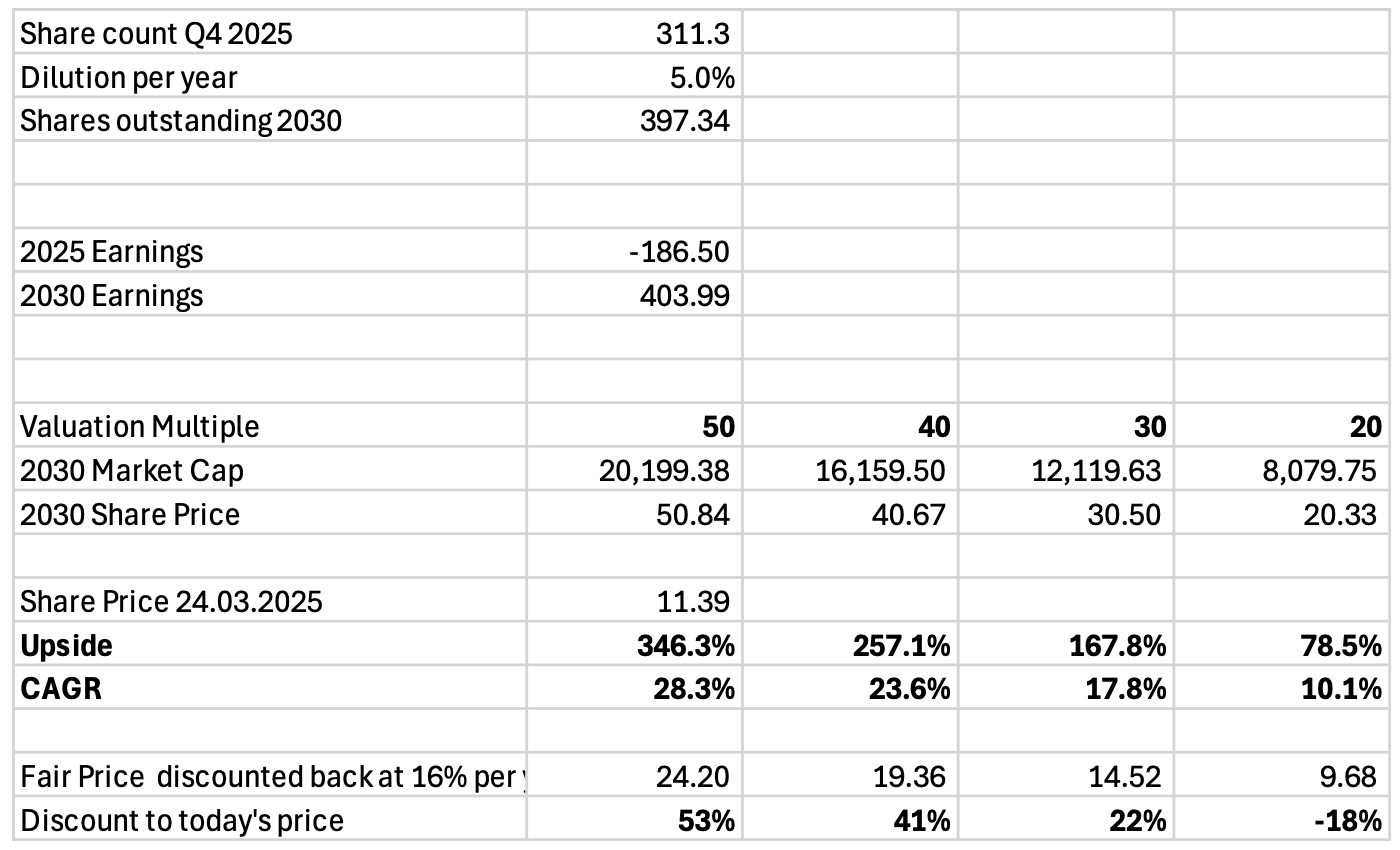
With an exit multiple of 30, we could be looking at a 30.5 SEK stock in 2030, 168% above today’s share price of 11.39 SEK.
Discounting that back at 16% per year, we get an estimated fair value per share of 14.52 SEK, implying Sivers could be trading today for a 22% discount to its fair value.
There is an additional upside if the market assigns a higher multiple. Considering that the AI data center industry is entering a stage where it needs to become more efficient, that seems plausible.
Hyperscalers are spending hundreds of billions of dollars on AI data centers, and Nvidia’s investments in this sector clearly show that the photonics demand could be much higher than the current model.
8. Conclusion
Sivers Semiconductors is currently standing at the intersection of two important technology trends of the decade:
AI
Lidar
By providing the specialized lasers and wireless chips that these systems require, Sivers is rapidly transforming itself from a local Swedish engineering firm into a critical global supplier.
The company’s results for 2025 confirm that its strategy is working. Achieving strong 25% revenue growth and significantly increasing its pipeline to $453M demonstrates that the market is ready for its products.
Furthermore, strategic partnerships with companies like POET, O-Net, and major automotive customers provide a clear path toward high-volume production in late 2026 and 2027.
However, the investment is not without risk. The company must manage its limited cash carefully to avoid excessive dilution of its shareholders. It must also ensure that its technology remains ahead of much larger competitors who are also investing billions of dollars into the photonics space.
For patient long term investors, Sivers represents a high-risk, high-reward opportunity.
It is a way to bet on the new “plumbing” of the AI revolution, light.
If the company can successfully transition from design wins to mass production over the next few years, it has the potential to become a cornerstone player in the more efficient, light-speed data economy of the future. The transition from copper to light is a physical necessity for the next stage of AI development, and Sivers is well-positioned to be a major player.
Thank you for reading Global Equity Briefing!

You can follow me on Social Media below:
X(Twitter): TheRayMyers
Threads: @global_equity_briefing
LinkedIn: TheRayMyers
Disclaimer: Global Equity Briefing by Ray Myers
The information provided in the “Global Equity Briefing” newsletter is for informational purposes only and does not constitute financial advice, investment recommendations, or an offer or solicitation to buy or sell any securities. Ray Myers, as the author, is not a registered financial advisor, and readers should consult with their own financial advisors before making any investment decisions.
The content presented in this newsletter is based on publicly available information and sources believed to be reliable. However, Ray Myers does not guarantee the accuracy, completeness, or timeliness of the information provided. The author assumes no responsibility or liability for any errors or omissions in the content or for any actions taken in reliance on the information presented.
Readers should be aware that investing involves risks, and past performance is not indicative of future results. The author may or may not hold positions in the companies mentioned in the “Global Equity Briefing” report. Any investment decisions made based on the information in this newsletter are at the sole discretion of the reader, and they assume full responsibility for their own investment activities.