Welcome to Global Equity Briefing, my weekly investing newsletter.
I am Ray, a passionate investor and equity analyst. And today I am covering SpaceX.
Elon Musk is, without a doubt, the most successful and famous internet entrepreneur of the 2000s.
He made hundreds of millions during the internet boom when he sold PayPal. He didn’t retire to living a lavish life, as many dot-com founders who sold did.
Instead, he chose to invest that money into revolutionary and experimental businesses.
Tesla became a highly successful electric vehicle, renewable energy, autonomous driving, and robotics company with revenues nearing $100B and a market cap of $1.3T.
For a long time, Tesla was Elon’s most successful business, but that could change with the upcoming IPO of SpaceX.
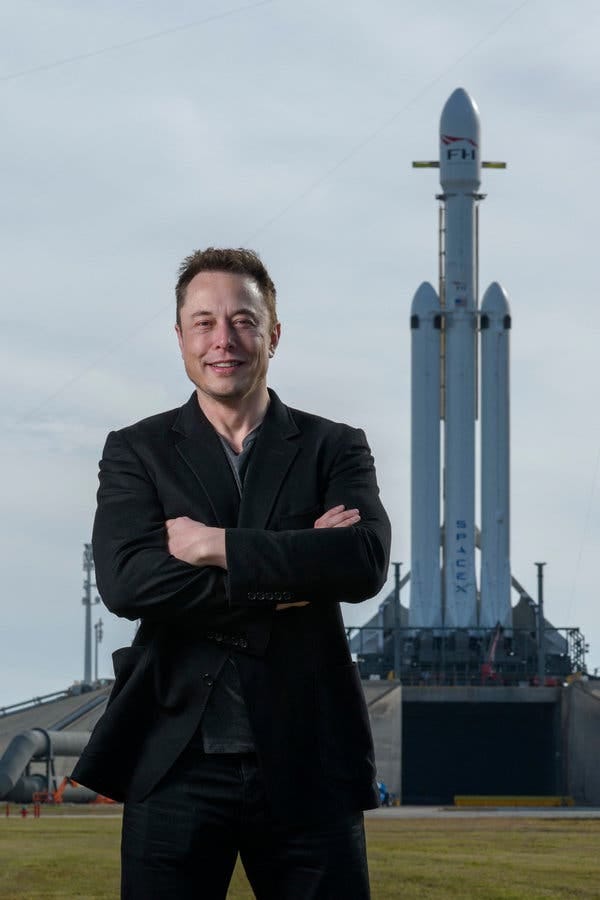
SpaceX is the developer of rockets and satellites, responsible for handling the vast majority of payloads going into orbit.
The space economy is booming, as the world looks to use the vast resources of the galaxy to deliver services that previously were only seen in science fiction movies.
For many years, Elon fans were eagerly waiting and hoping for a SpaceX IPO so they could invest in Elon’s dreams of the stars.
That is finally happening, as the company plans to list its shares on the Nasdaq under the ticker symbol SPCX on June 12, 2026.
The offering aims to raise roughly $75B at a $2T valuation.
However, this is not the SpaceX of old that is going public, as during the last few years, Elon has transformed the company from largely a space technology business into a conglomerate consisting of:
Space
Satellite Internet
AI
Social Media
The company is justifying this valuation by citing a mind-boggling $28.5T global total addressable market! This is looking like the IPO of the century.
However, does it make sense for investors to enter at this valuation?
What is SpaceX’s actual business?
How are individual segments performing?
How much money does SpaceX actually make?
Is the balance sheet strong?
What are the opportunities for growth?
In this SpaceX Deep Dive, I will answer all of these questions.
Let’s begin.
1. Brief History
2. SpaceX
3. Starlink
4. X/Twitter
5. xAI
6. Competitors
7. Risks
8. Finances
9. Valuation
10. Opportunities
11. Conclusion
1. Brief History
Elon Musk has been a famous billionaire for seemingly forever, but that wasn’t always the case.
He made his early fortune through PayPal.
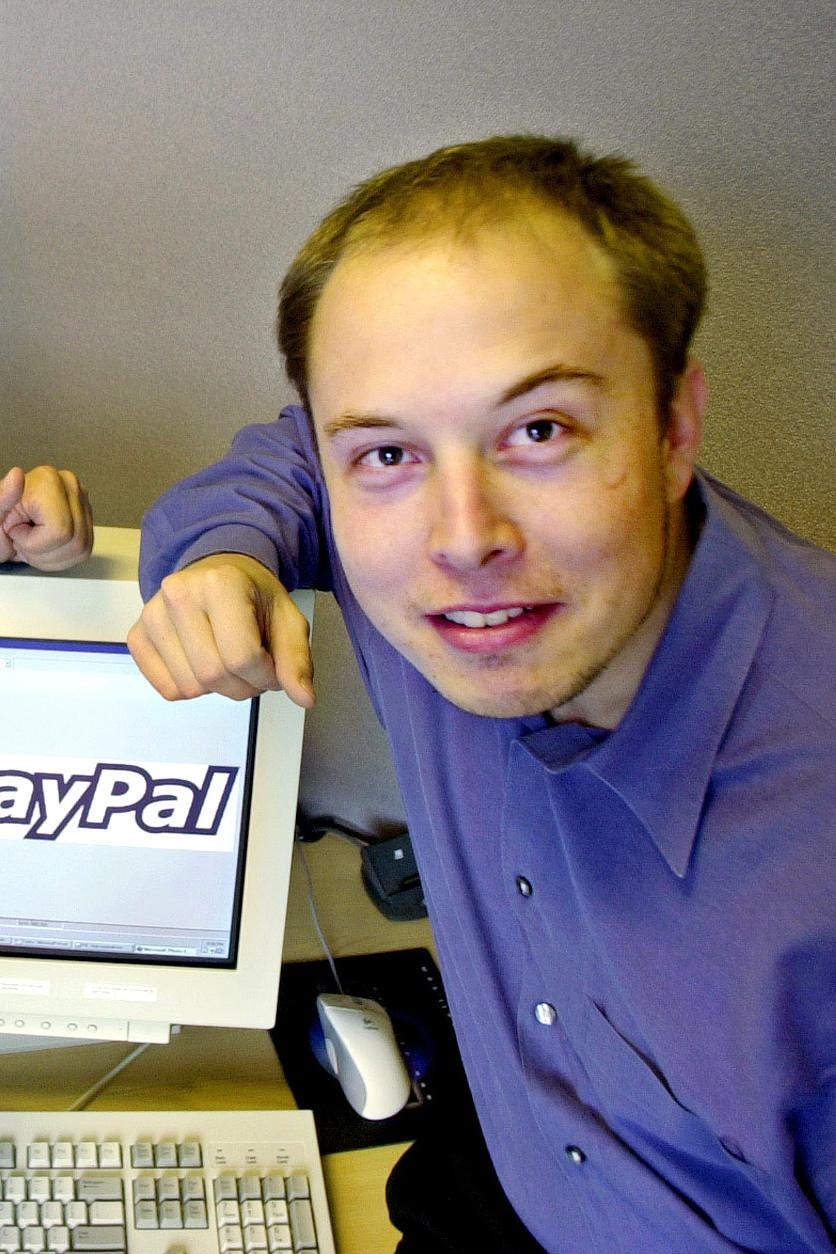
The 2002 $1.5B sale of PayPal generated hundreds of millions of dollars for Elon, providing the seed capital for his subsequent ventures.
He founded SpaceX in 2002 with the goal of building reusable rocket systems to make life multiplanetary.
Simultaneously, he financed Tesla, an electric vehicle pioneer, serving as its chief executive officer and driving its valuation to massive levels.
In October 2022, Musk purchased Twitter for $44B.
Next, seeking to compete with OpenAI and build a “truth-seeking” alternative to existing AI models, he founded xAI in March 2023.
For years, these businesses operated separately until they were merged into a single mega company.
In March, 2025, Elon decided to consolidate its AI and social media businesses with XAI, acquiring X in an all-stock deal valuing X at $33B.
Next, just a few months ago, in February 2026, SpaceX acquired xAI in an all-stock deal valuing SpaceX at $1T and xAI at $250B, for a combined total of $1.25T.
This created a vertically integrated company combining rocketry, satellite internet, social media, and AI.
2. SpaceX
The space and rocket division of SpaceX is reported as the Space segment in the S-1 filing.
It handles the design, manufacturing, and launch of rockets for commercial and government clients.
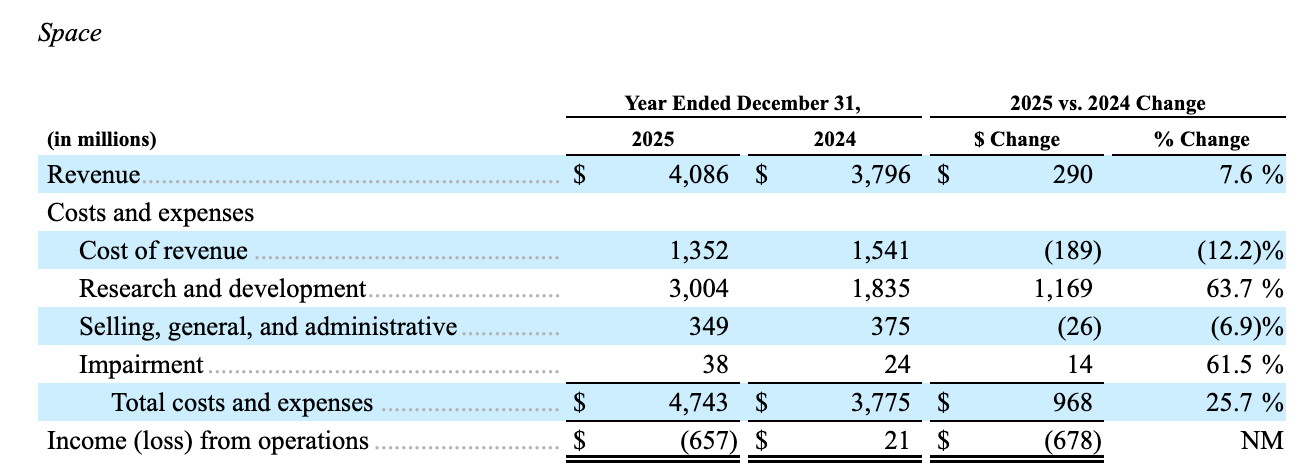
In 2025, the Space segment generated $4.1B in revenue, a modest 7.6% Y/Y increase.
However, the segment posted an operating loss of $657M for the full year of 2025, compared to the $21M profit generated in 2024.
The business is very R&D intensive, with $3B, an increase of 63.7% Y/Y, about 74% of revenues spent on this category.
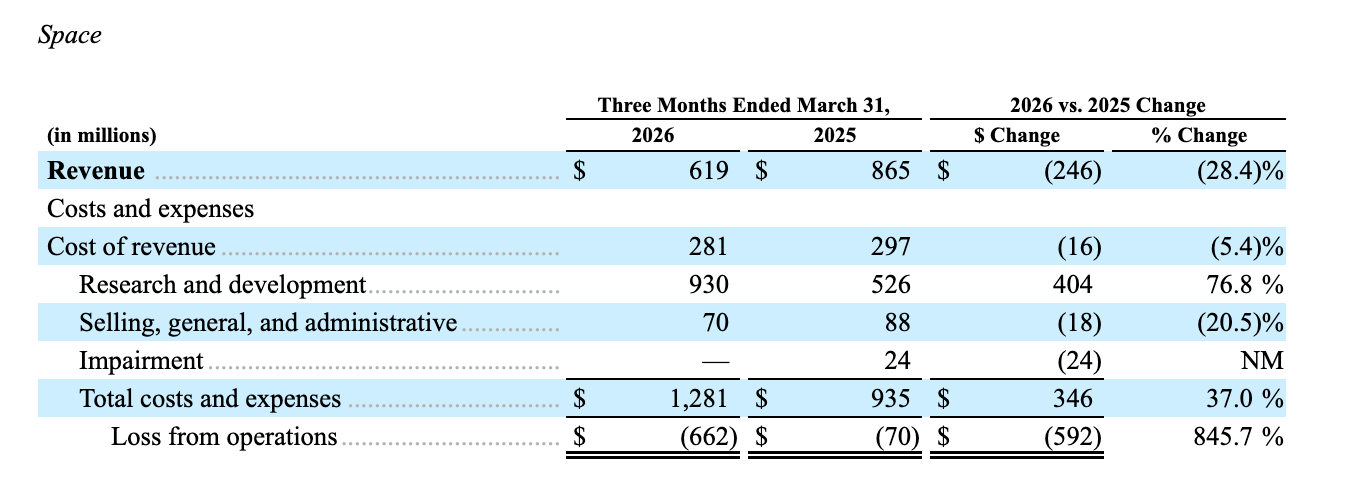
This unprofitability continued in Q1 2026, with the Space segment generating $619M in revenue but reporting an operating loss of $662M.
This operating loss is driven by high investment in Starship and launch pads, showing that the launch business is highly capital-intensive and relies on Starlink to provide cash.
Furthermore, this business is not very stable and predictable, as revenues declined 28.4% Y/Y.
Growth is highly dependent on launch cadence and new government and private contracts.
2.1. Reusability
SpaceX has reshaped the economics of space by demonstrating that orbital boosters can be used multiple times.
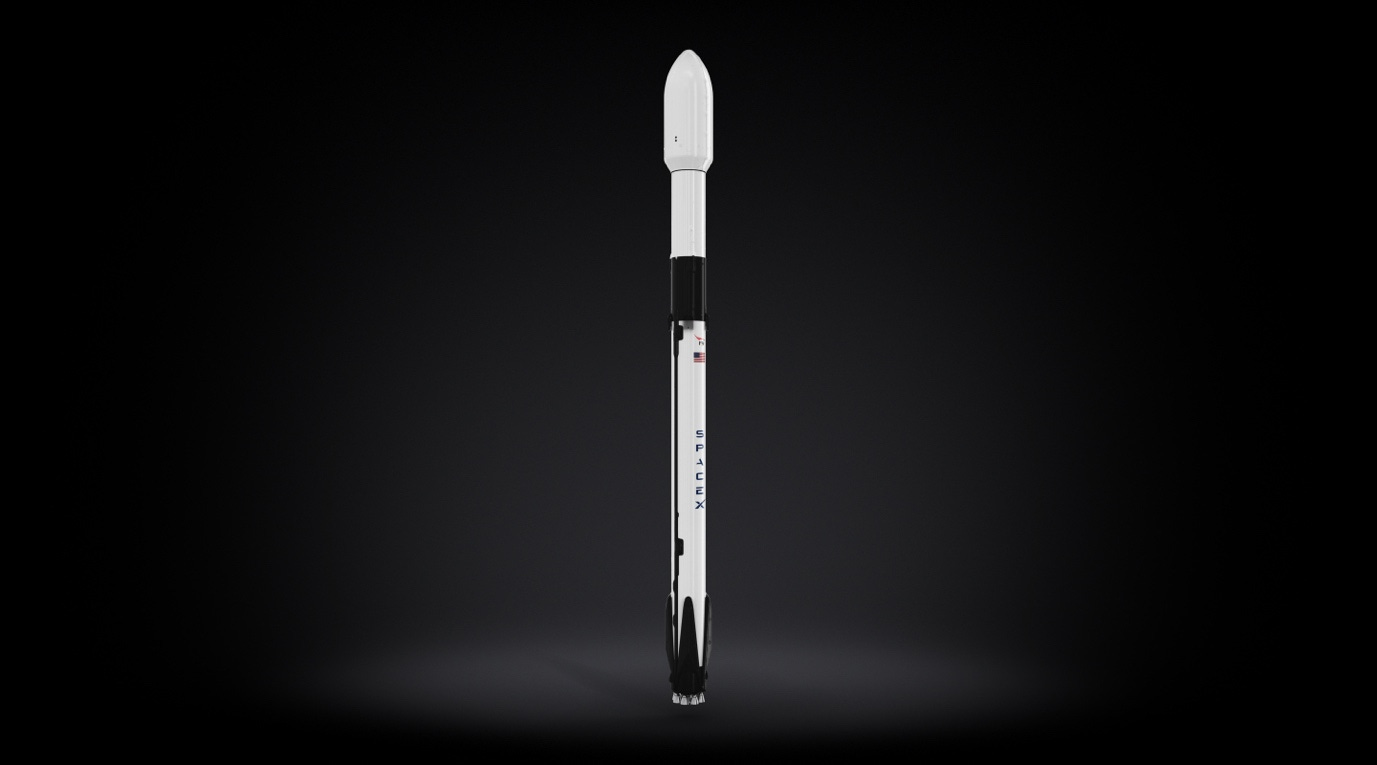
The Falcon 9 is a 2-stage rocket where the 1st stage booster can return and land on ground pads or drone ships in the ocean.
This allows SpaceX to fly the booster multiple times, reducing the cost of space launches.
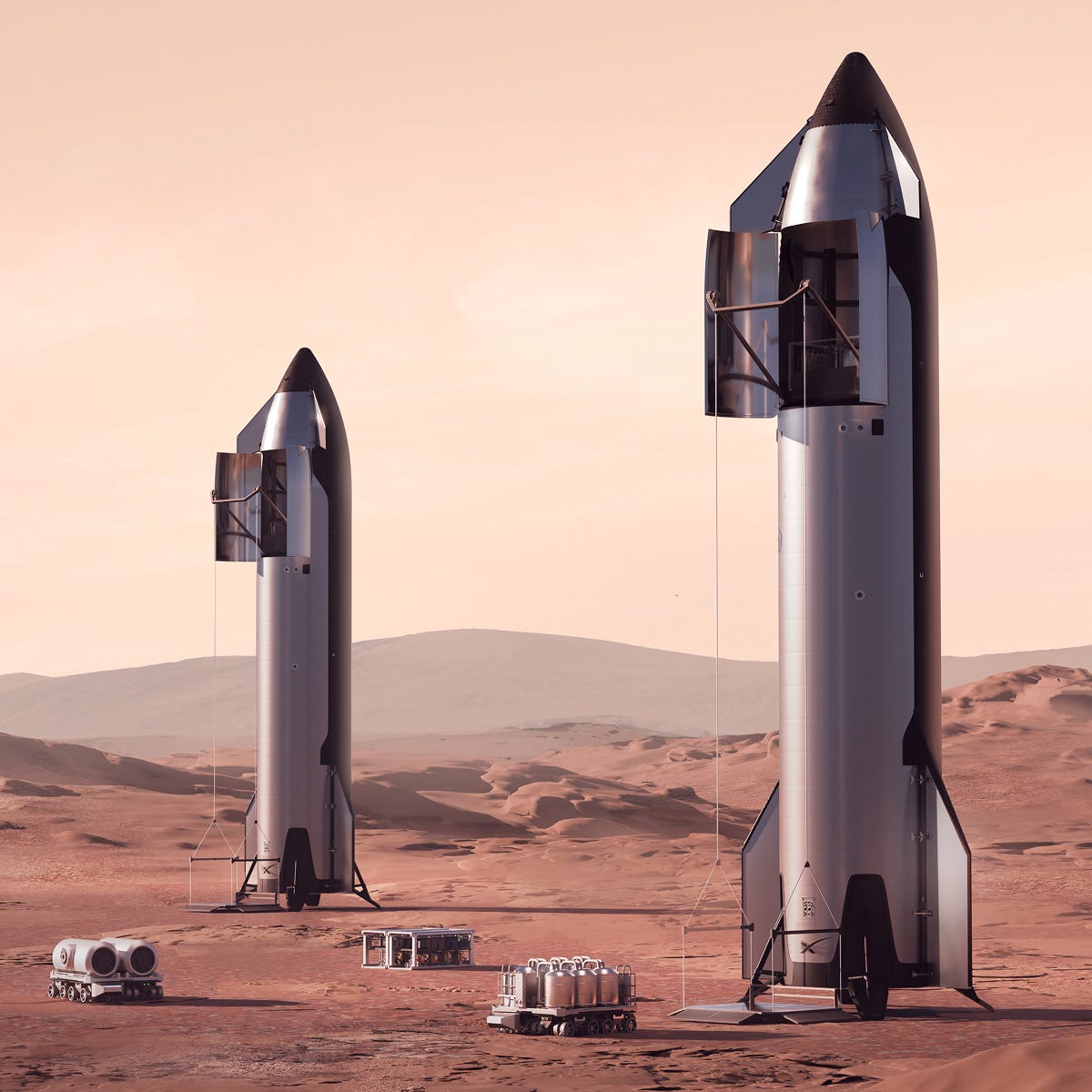
Meanwhile, Starship represents the next-generation, fully reusable heavy-lift platform designed to transport over 100 tons of cargo into orbit
It consists of the Super Heavy booster (powered by 33 engines) and the Starship upper stage (powered by 6 Raptor engines, including 3 standard and 3 vacuum engines). Starship’s 10th flight test took place on August 26, 2025.
The Starship program is highly capital-intensive, costing approximately $4M per day to develop, with total R&D costs expected to reach $10B.
SpaceX spent approximately $3B on Starship development in 2025 alone, being a massive drag on cash flow.
This program is extremely important for the company because full reusability is required to make the economics of lunar and Mars cargo flights commercially viable at scale.
We have yet to see a successful launch.
2.2. Launch Services
SpaceX holds a near-monopoly on Western commercial launches, accounting for over 80% to 90% of global payloads launched annually.
In 2025, the company completed 170 launches, an increase of 23.2% Y/Y and 73.4% over 2 years.
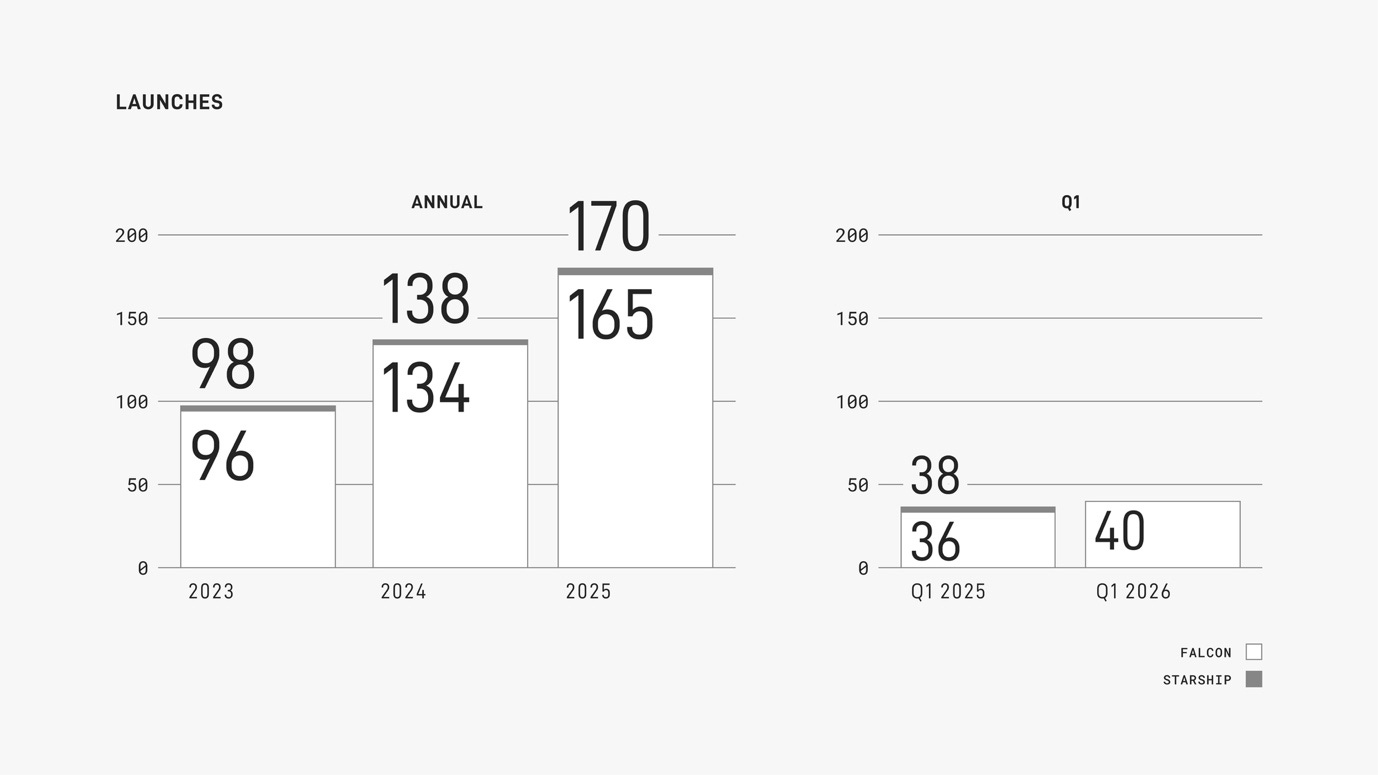
The 2026 launch cadence has been steady, having 40 launches in Q1 2026 compared to 38 last year.
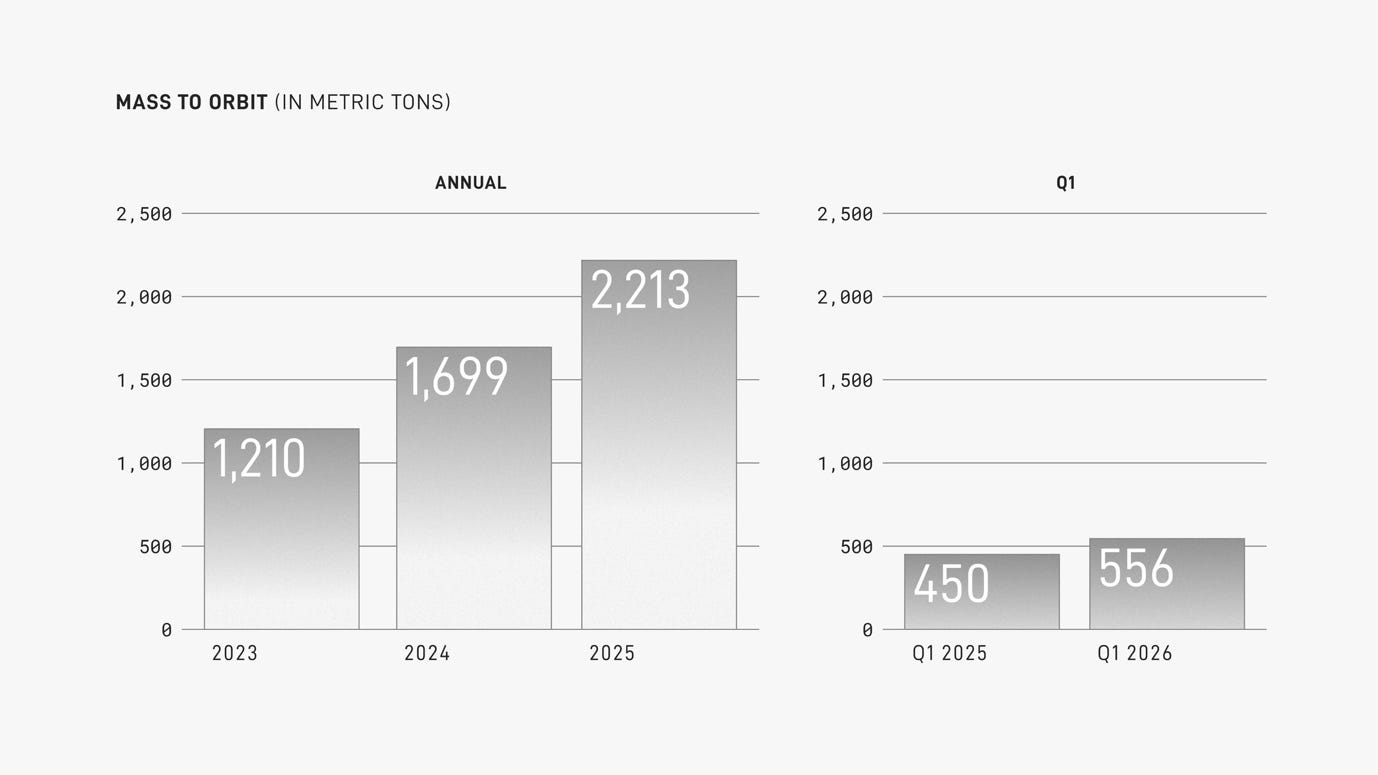
While the number of launches grew by 23.2% in 2025, the mass of those launches grew by 30.3%, to 2,213 tons.
The same trend continued in Q1 2026, with mass growing by 23.6%, despite just 5.3% launch growth,
This indicates that SpaceX is able to launch more satellites into orbit with each launch, thanks to its larger Falcon Heavy rocket.
This is reducing the cost per launch and further solidifying SpaceX’s position as the leading space launch company.
A major customer for these services is the US federal government. SpaceX has secured over $6B in contracts from NASA, the US Department of War, and other agencies over the last 5 years.
In 2025, US government contracts accounted for 20% of SpaceX’s total revenue.
2.3. Moon and Mars
SpaceX has become the most important hardware provider for NASA’s Artemis program.
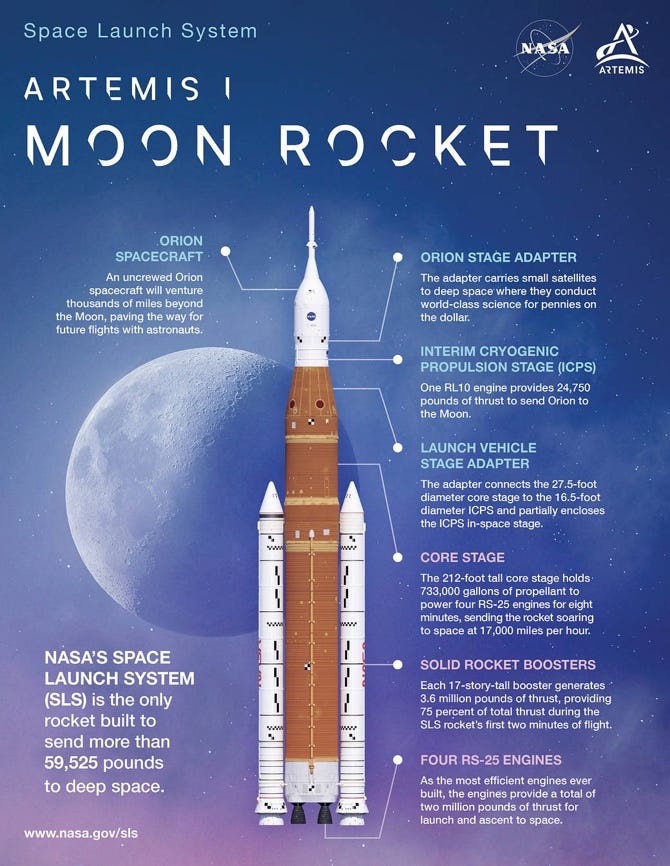
In April 2021, NASA awarded SpaceX a $2.89B contract to build Starship HLS, a lunar lander variant of Starship designed to land astronauts on the Moon.
To reach the Moon, Starship HLS must refuel in space.
This is an insanely complicated engineering problem that requires a propellant depot in Earth orbit and roughly 10 Starship tanker flights to carry propellant. The Artemis III mission has been delayed to late 2027, and the actual crewed landing has been pushed to Artemis IV in 2028.
For Mars, Musk intends to build a permanent human colony with at least 1M residents.
The S-1 details an incentive package where Musk receives 15 tranches of 66,666,665 shares, amounting to 1B shares, worth roughly $600B at today’s valuation.
These shares only vest if SpaceX reaches a market valuation of $7.5T and establishes a self-sustaining Mars colony of 1M residents while Musk remains employed by the company.
Very ambitious to say the least.
3. Starlink
Starlink is the satellite telecommunications division of SpaceX!
Historically, space-based internet was slow and very expensive, because there were few satellites that were very far from the Earth.
To fix this, the company is utilizing a massive low Earth orbit satellite constellation of thousands of satellites that deliver high-speed, low-latency broadband internet globally.