
Teradyne: Photonics, Memory, AI, and Physical AI Tailwinds!

The AI revolution has created massive demand for semiconductor chips such as GPUs, CPUs, memory, and networking. However, to manufacture millions and millions of these chips, semiconductor manufacturing companies like TSMC, Samsung, Micron, and SK Hynix must spend billions on specialized equipment.
A key part of the manufacturing process is quality testing, and this is where the business I am covering today operates.
Teradyne sells equipment and software that tests chips, making sure they live up to the standards of the largest technology companies in the world.
Additionally, the company has a segment that manufactures robots used in various manufacturing settings, bringing AI to the physical world.
But most interestingly, recently Teradyne expanded to testing photonics systems, which are seeing explosive demand growth thanks to AI.
In this Teradyne Deep Dive, I will explain everything an investor must know to determine whether they see the stock as an attractive long-term investment. Business model, services, the AI opportunities, and the physical AI opportunity.
Most importantly, as always, I will conclude with a 2030 valuation model that calculates the target share price.
Let’s dig in.
1. Business Model
2. Opportunities
3. Q2 2026 Results
4. Valuation
5. Valuation Model
6. Conclusion

1. Business Model
Teradyne sells equipment and software that help semiconductor and other electronics manufacturers answer 1 basic question:
Do their products work exactly as designed?
1. Its largest business tests semiconductor chips.
2. Under the Product Test division, the company tests larger electronic products, including circuit boards, wireless devices, electronics, and silicon photonics.
3. The Robotics division sells collaborative robot arms and autonomous mobile robots used in factories and warehouses.
Let’s discuss each of these segments in detail.
1.1. Semiconductor Testing
Semiconductor Testing is Teradyne’s main business and the main reason the stock has moved so sharply higher in 2026.
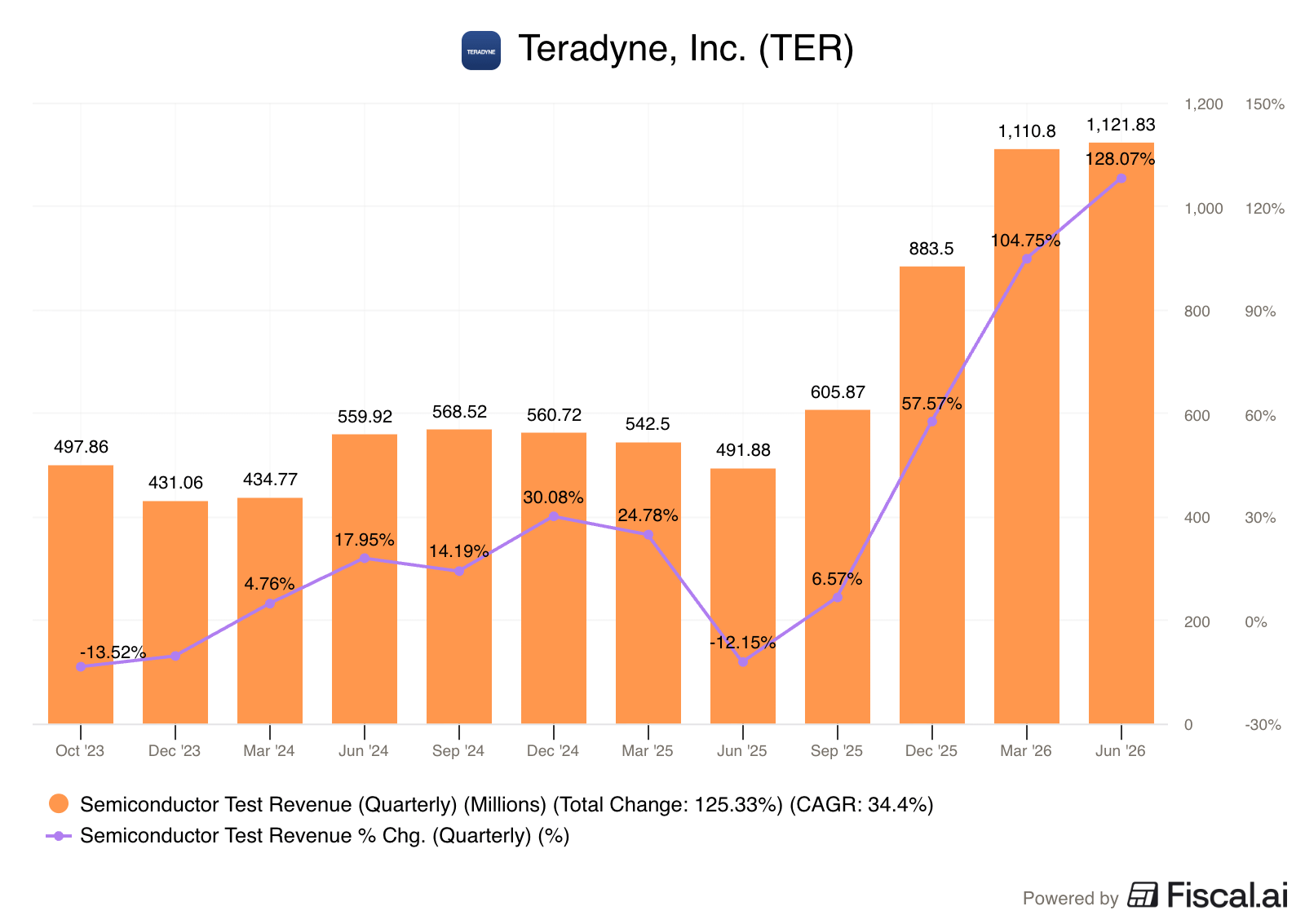
As you can see in the graph above, in Q2 2026 semiconductor testing revenues grew by an incredible 128% Y/Y to $1.12B.
This was incredible acceleration from the 12.2% Y/Y decline in Q2 2025. In fact, the Y/Y growth rate has been accelerating for 4 quarters in a row now, thanks to strong demand across the semiconductor ecosystem.
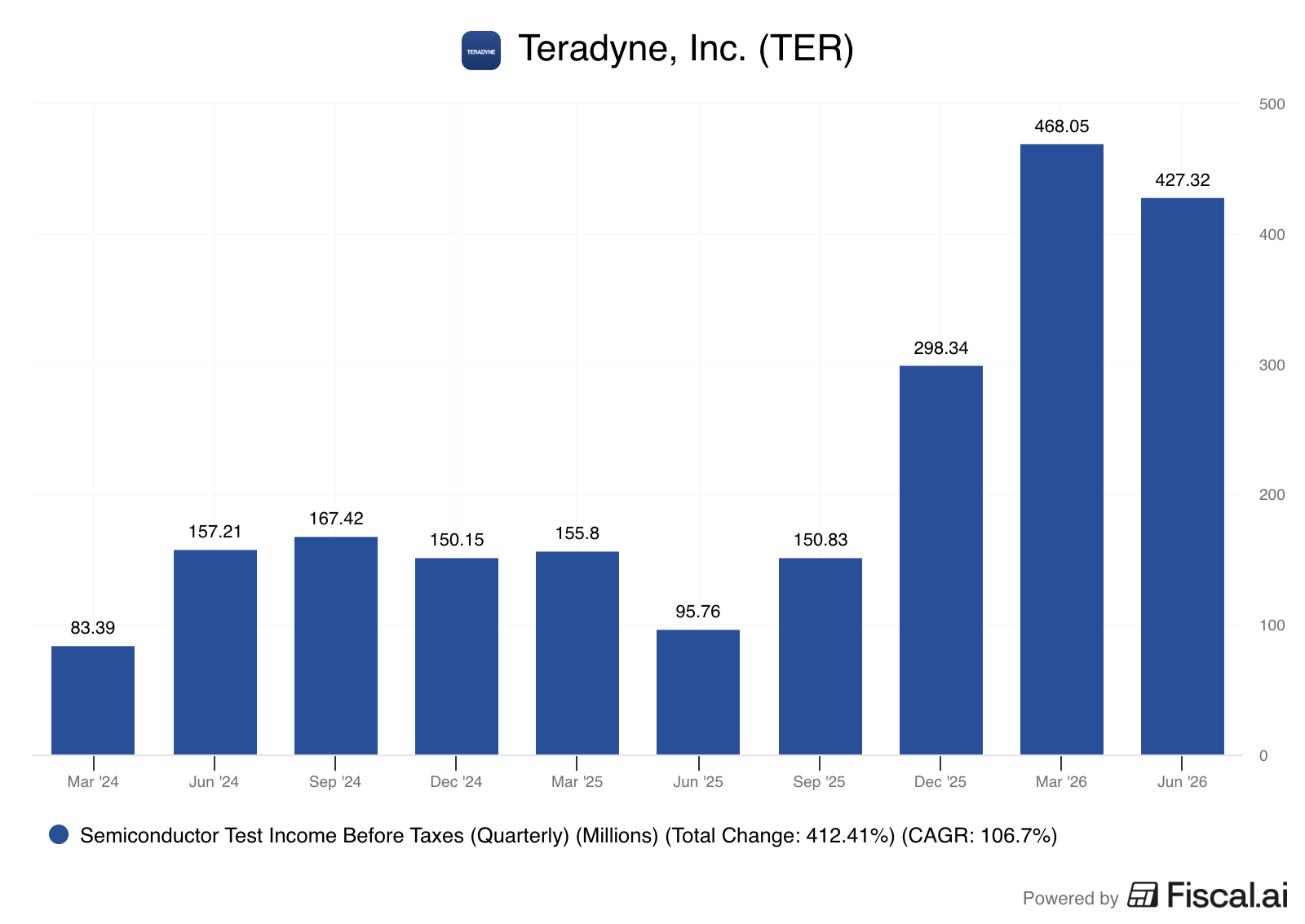
This segment is also the main profit driver, generating $437M in operating income for the company in Q2 2026, a margin of 38%.
Teradayne sells semiconductor testers, a large electronic system used in chip manufacturing.
This testing system sends electrical signals into chips, measures the response, and determines whether the device works within its required specifications. This can happen while the chip is still on a wafer, after it has been cut and packaged, or later when the device is tested under conditions closer to real use.
The goal is to find faulty chips before they are put into expensive end products like AI chips or smartphones.
Teradyne sells the equipment, software, and related tools needed to run these tests at a fast speed of a large supply line.
Crucially, the testing step has been becoming more valuable as the chip itself becomes more valuable.
An AI server costs millions of dollars and combines a lot of very expensive equipment. A faulty chip found later when already in use could incur losses multiples higher than the chip is worth, if it ruins or delays the AI task, or even damages other equipment.
Complex designs also need more test patterns and more electrical connections to be checked. Thus, Teradyne has been increasing tester memory and other capabilities to handle this rising test complexity.
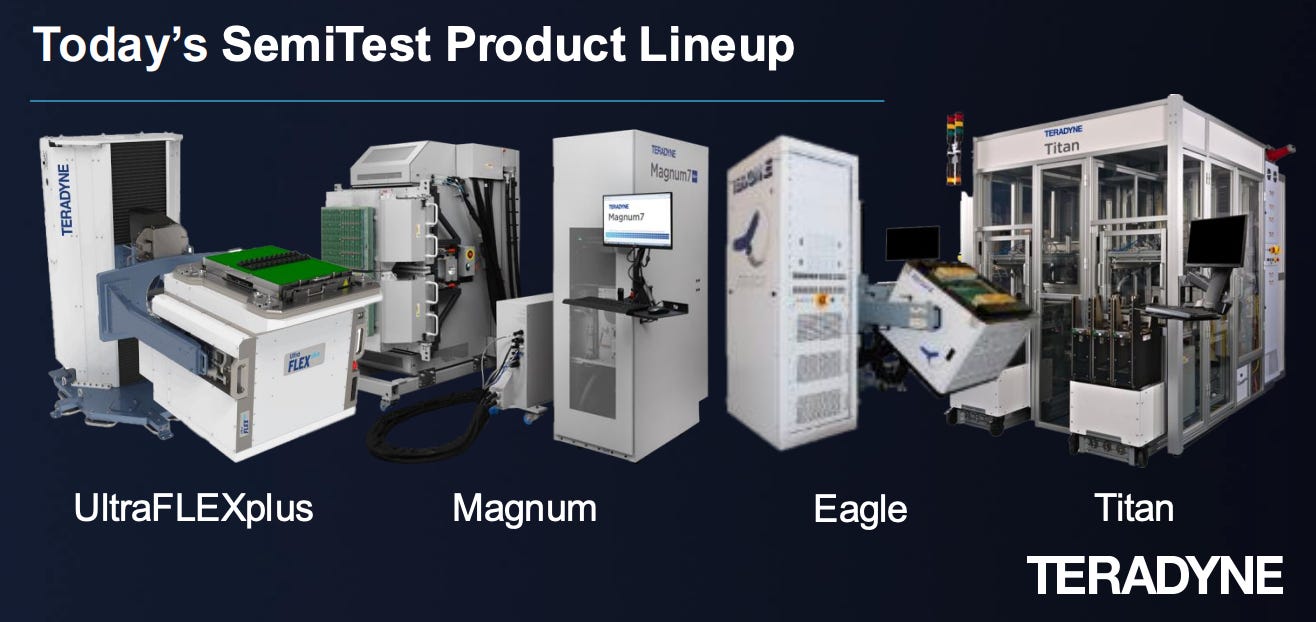
Let’s look at its product lineup.
The Systems-on-Chips (SoCs) subsegment of the semiconductor testing segment grew by 112% to $843M in Q1 2026!
Teradyne’s UltraFLEX and UltraFLEXplus systems are aimed at higher-performance chips. These machines can test products such as complex processors, SoCs, and high-end AI and networking devices.
The UltraFLEXplus delivers high-density electrical power and signal connections directly into the chip under test. This allows testers to examine up to 64 chips at the same time on 1 test machine, which reduces total equipment cell needs by 15% to 50%.
Next, Teradyne also has the Magnum product line, designed to test memory chips.
For example, the Magnum V GV system supports up to 20,480 digital pins on 1 system, allowing memory makers such as Micron, SK Hynix, or Sandisk to run parallel tests on thousands of memory chips at the same time.
Q2 2026 memory test revenue was $212M, which was a 249% Y/Y increase.
The growth of HBM used alongside GPUs in AI servers is a major demand driver for Magnum equipment. As we are currently in a massive memory shortage, it is likely that there will be huge demand for Teradayne’s memory testing equipment as all players are investing heavily to increase supply. Micron, SK Hynix, Sandisk and others are investing tens of billions to build new fabs.
Moving on, after normal chip testing, some high-value devices receive another check in an environment closer to how they will actually be used. Teradyne calls this Integrated System Test.
Instead of checking only individual electrical functions, the device can run software and interfaces under realistic workloads.
This is a smaller subsegment that generated $66.5M in Q2 2026, an increase of 94% Y/Y.
Within this subsegment, Teradyne makes the Titan machine. This is Teradyne’s newer system-level platform aimed at AI and cloud computing chips. High-end AI chips can consume large amounts of power and produce large amounts of heat, so the test system needs to deliver power while controlling temperature. Teradyne says Titan HP is deployed in production at multiple customers and includes active thermal control, high power delivery and software that can move test programmes between Teradyne systems.
The key objective is to verify that these very expensive processors will not crash under real data center conditions, such as heat and voltage.
Meanwhile, Eagle Test Systems is designed for high-voltage power management chips and analog circuits used in electric vehicles and power networks.
1.2. Product Testing
Product Test is much smaller than Semiconductor Test, but it is becoming more relevant to Teradyne’s AI strategy.
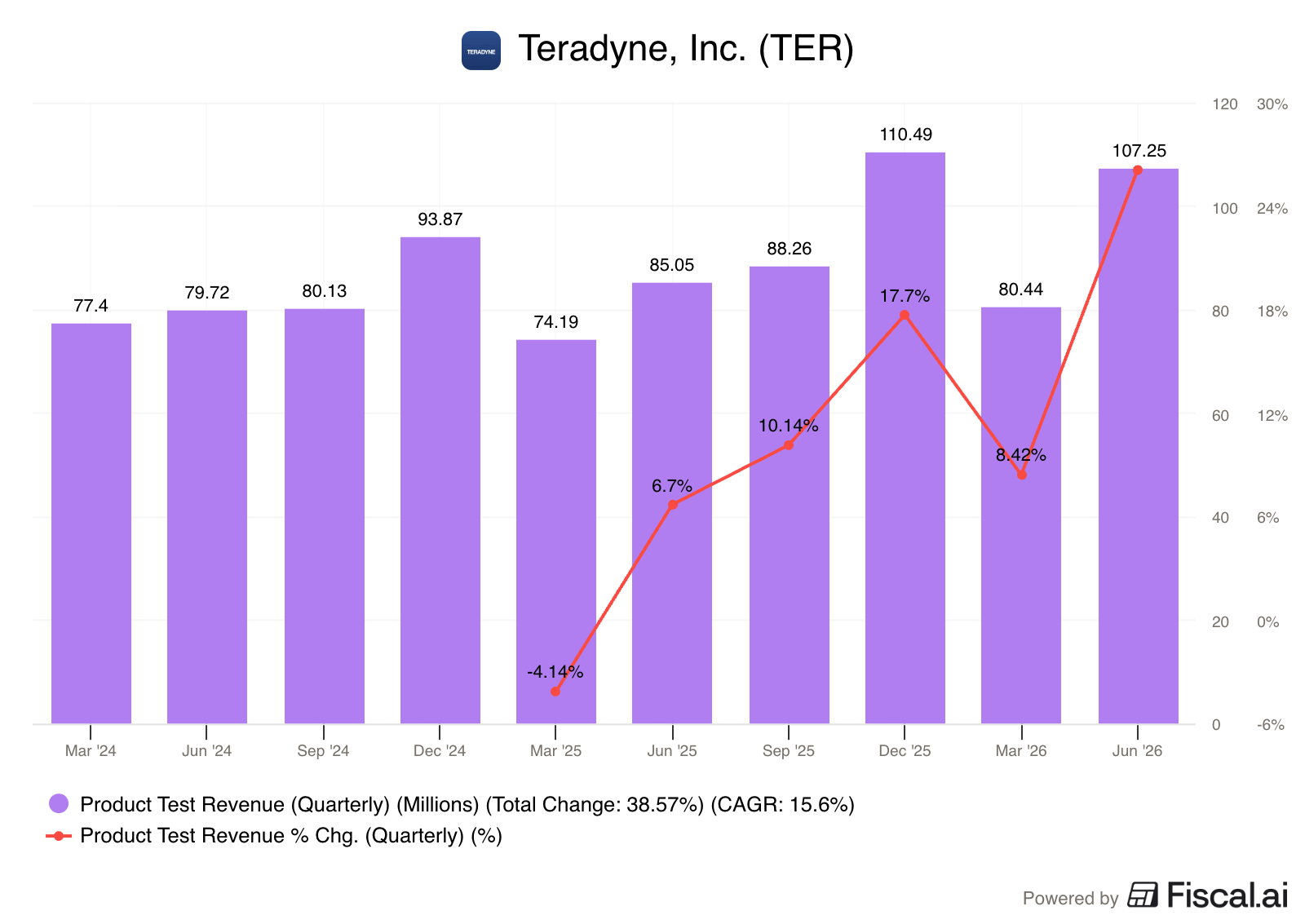
The segment generated $80M in Q1 2026 and $107M in Q2 2026, with Q2 revenue growing +26% Y/Y.
In the above graph, we clearly see that while this segment is not growing as quickly as the semiconductor segment, the growth is decent and accelerating from Q1 2025 lows of -4.1%.
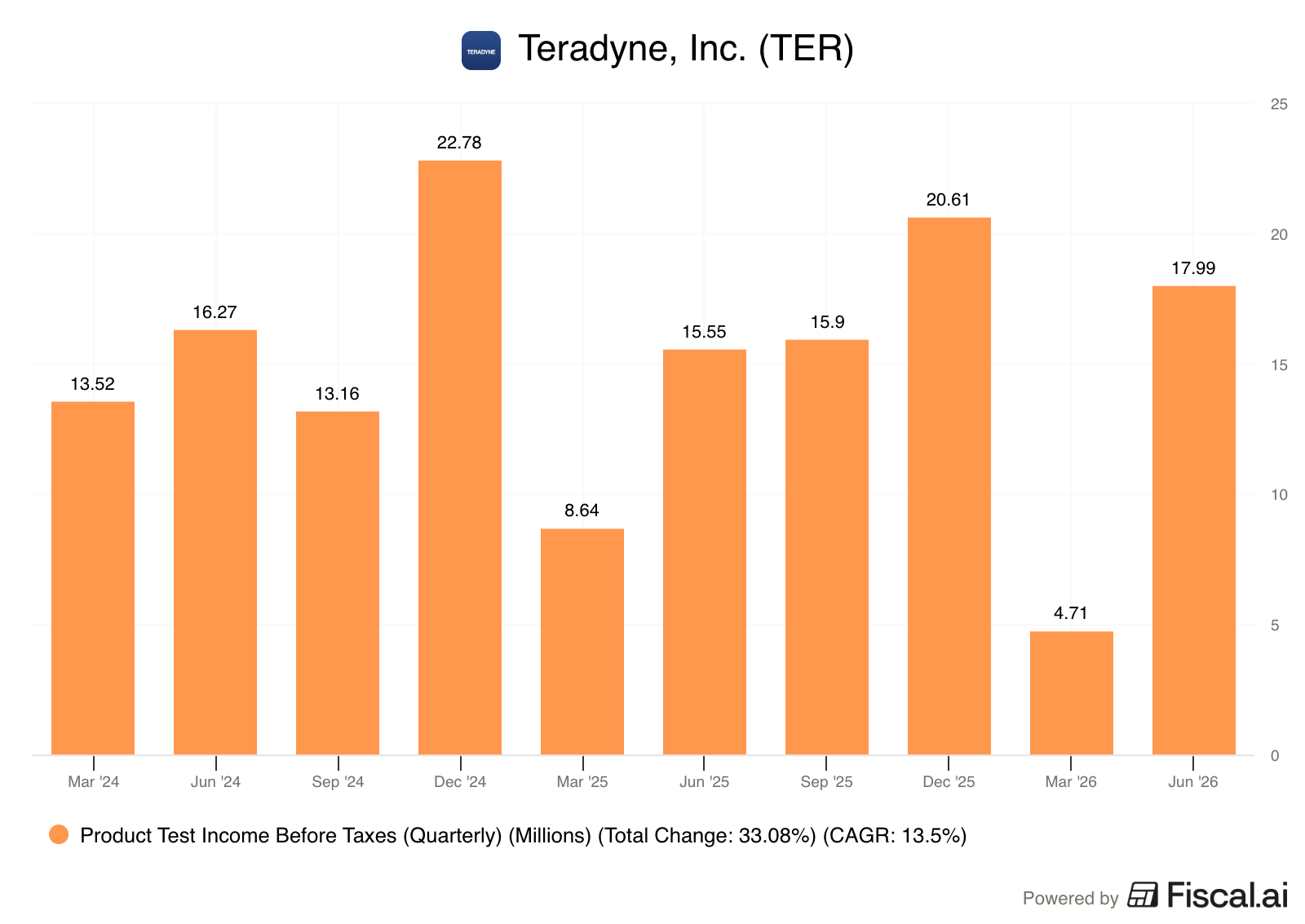
In Q2 2026, this segment delivered a decent operating profit of $18M, a margin of 16.6%. However, this is less than half of the semiconductor segment EBIT margin.
This segment of Teradyne tests electronics outside the main semiconductor die.
Simply put, the semiconductor segment checks the chips, while the product testing checks the products that contain said chips.
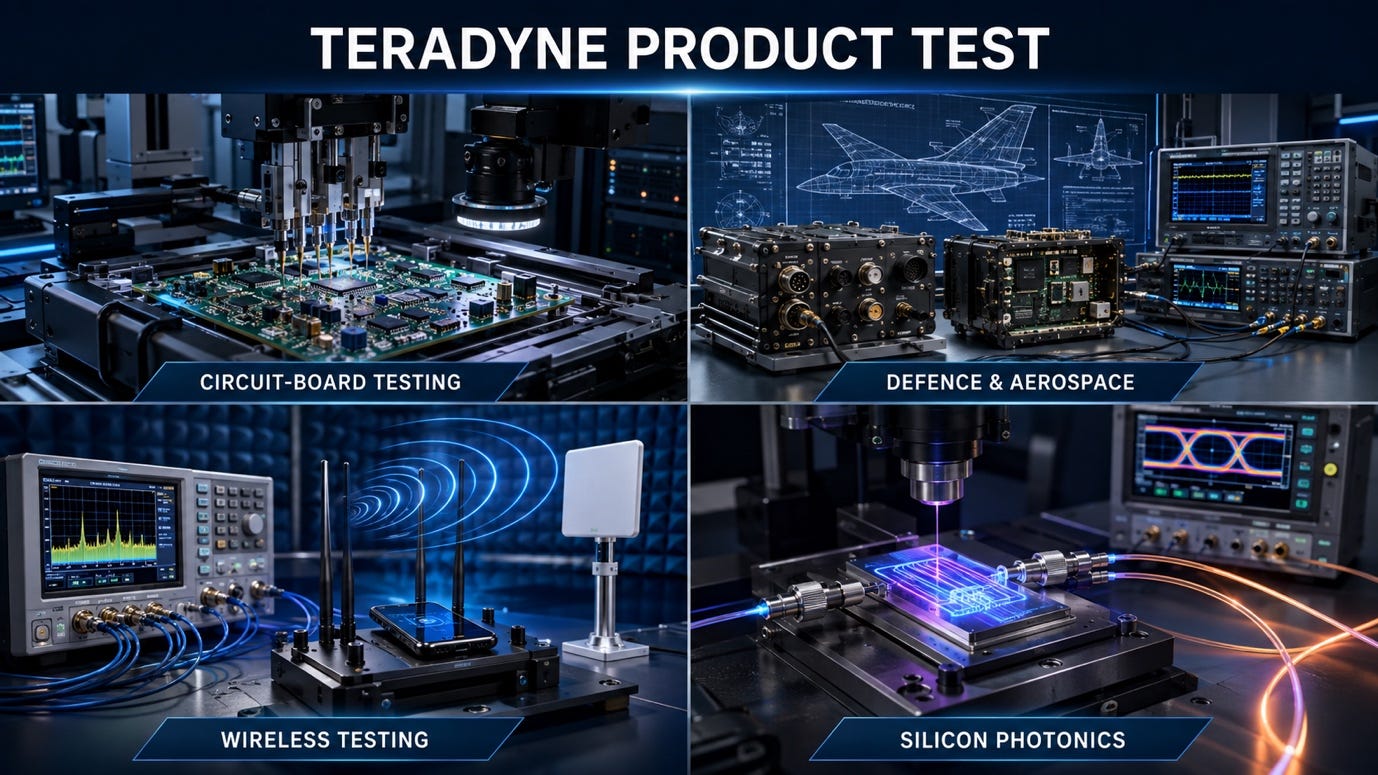
Within this segment, they test circuit boards, defence and aerospace systems, wireless equipment, and silicon photonics systems.