
Zeta is an AI winner, not a SaaS loser!
Review of 2025, Outlook for 2026-28!

Some of you already know that 2026 has been brutal for Software-as-a-Service companies, as investors fear AI-driven disruption will lead to a slowdown in growth.
Zeta’s stock was pulled down in this panic, being down 38% before earnings, from its January high.
However, that didn’t make much sense, as the company doesn’t offer simple commoditized software on a per-seat subscription basis.
Zeta is a clear AI winner, and the market is starting to accept this reality, as the stock has jumped over 20% since the Q4 2025 earnings release.
Revenue $395M +25.4% vs $379M estimate.
ADJ EBITDA $95M +35.7% vs $91M.
ADJ EBIT $75M +40.7% vs $72M.
ADJ EPS $0.28 +43% vs $0.23.
GAAP Net income of $6.5M.
FCF $61M +90% vs $49M.
These were stellar earnings, with Zeta beating on all metrics and delivering strong top-line growth and improving margins.
In this report, I will explain why Zeta is a clear AI winner using a simple 6-point checklist.
Next, I will analyze their updated 2028 Guidance.
And I will conclude with an analysis of the valuation and a 2030 Valuation Model.
Let’s begin.
1. AI Bull Case
The core software bear thesis is that AI will automate many layers of workflows, reducing the number of per-seat-based subscriptions used by corporations. While I agree with the premise, I disagree with how this premise is impacting all SaaS share prices. Some companies will be affected more than others.
So here is a simple 6-point checklist to analyze a SaaS disruption risk:
1. System of Record
2. Switching Costs
3. Regulatory or Audit Requirements
4. Data Advantage
5. Ecosystem Moats
6. AI Costs and Monetization
1)A system of record is the place where data is created, stored, audited, and used. The idea is that if a SaaS stores important client data, it will be able to use that data to deliver value-added AI services, protecting itself from disruption.
For AI, Data = King
The more data, the more accurate AI results will be.
Zeta clearly wins points in this category, as it acts as the marketing operating system for enterprises.
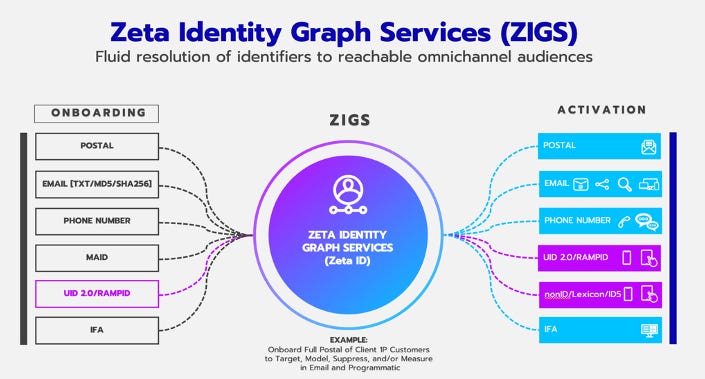
Zeta is not a point solution that solves a single issue. The company is a foundational infrastructure that unifies customer identity, 3rd party data, and proprietary internal data. But most importantly, it saves the results of millions of marketing and advertising campaigns it runs on behalf of its clients.
Next is 2) switching costs.
If it’s quite difficult, expensive, and time-consuming to switch providers, then the SaaS is at a smaller risk of AI disruption.
Moving all data from Zeta to another company is complex and risks disrupting ongoing campaigns. Zeta works with some of the largest companies in the world, so if things go wrong during the switch, lost revenue could be in the tens of millions of dollars.
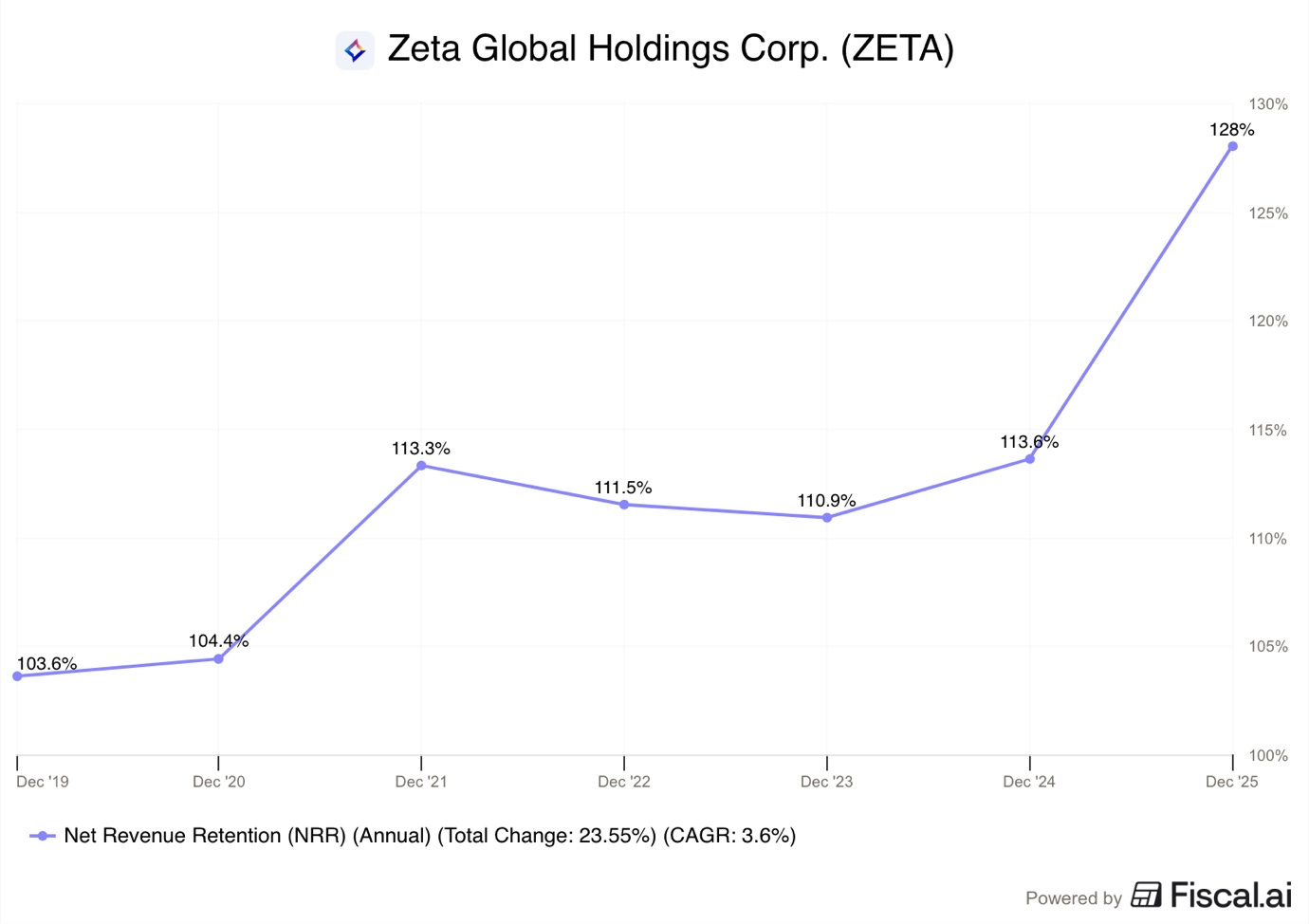
We clearly see that in Net Revenue Retention, which reached a record 128% in 2025, showing that once a client joins the ecosystem, they not only stay but expand.
The next point is everyone’s favorite, 3) regulatory and audit requirements.
In regulated environments, it’s not enough for the AI Agent to do the task. It must do the task correctly, with controls and traceability, every time.
As regulations like GDPR tighten data sharing and consumer privacy, Zeta’s reliance on first-party, deterministic data becomes a compliance advantage. Their platform is built to help brands navigate these regulations by using their own permissioned data rather than risky third-party tracking.
While regulations are not as strict as in healthcare or cybersecurity, Zeta still must comply with these data privacy regulations, making it harder for AI agents to disrupt them.
Now comes Zeta’s strongest competitive advantage and biggest moat protecting them from AI disruptions, 4) data advantage.
Some of you might remember how, in 2022, Meta said that they lost $10B in revenues because of Apple’s privacy rule changes that limited data sharing between apps. Since then, businesses have been wary of being dependent on third-party data. This is why Zeta has been so active in collecting as much proprietary first-party data as possible.
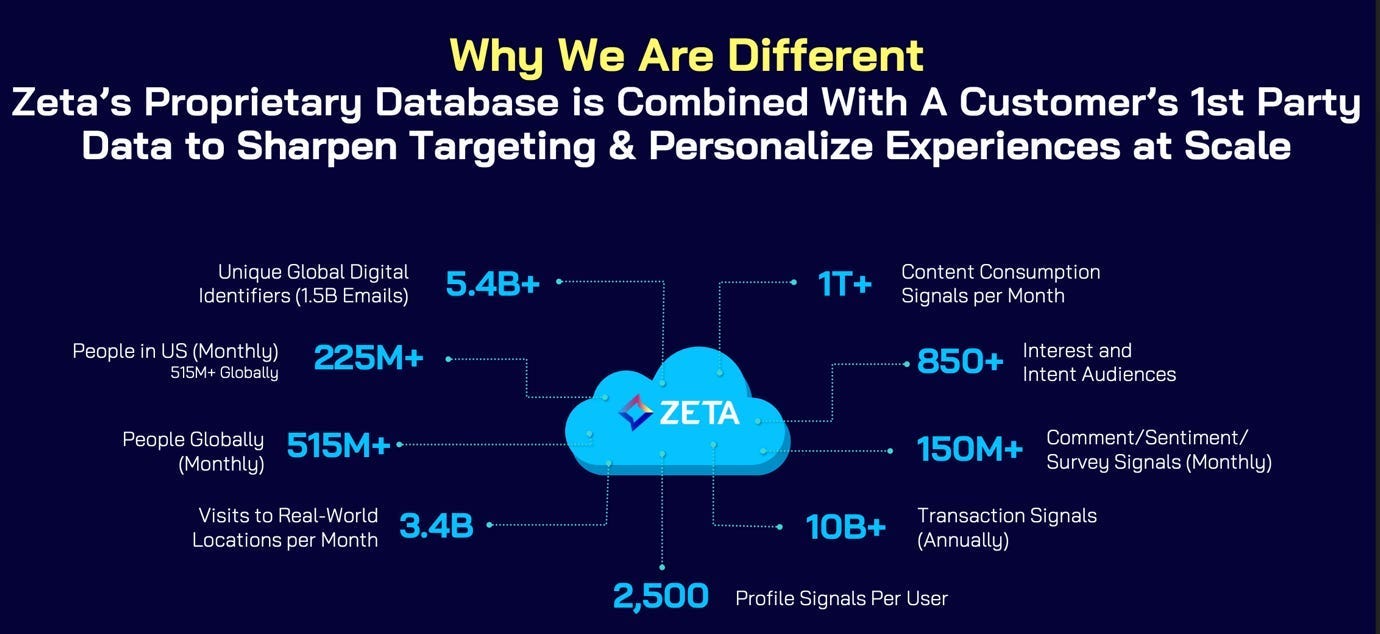
As you can see above, Zeta collects a lot of data from all its services that directly feed the AI to become more effective at finding customers and converting them.
Over 500M people globally.
Over 200M people in the US.
1.5B emails.
Data on 3.4B real-world locations per month.
1 trillion signals per month.
850 audience interest and intent categories.
150M+ surveys per month.
10B+ transactions a year.
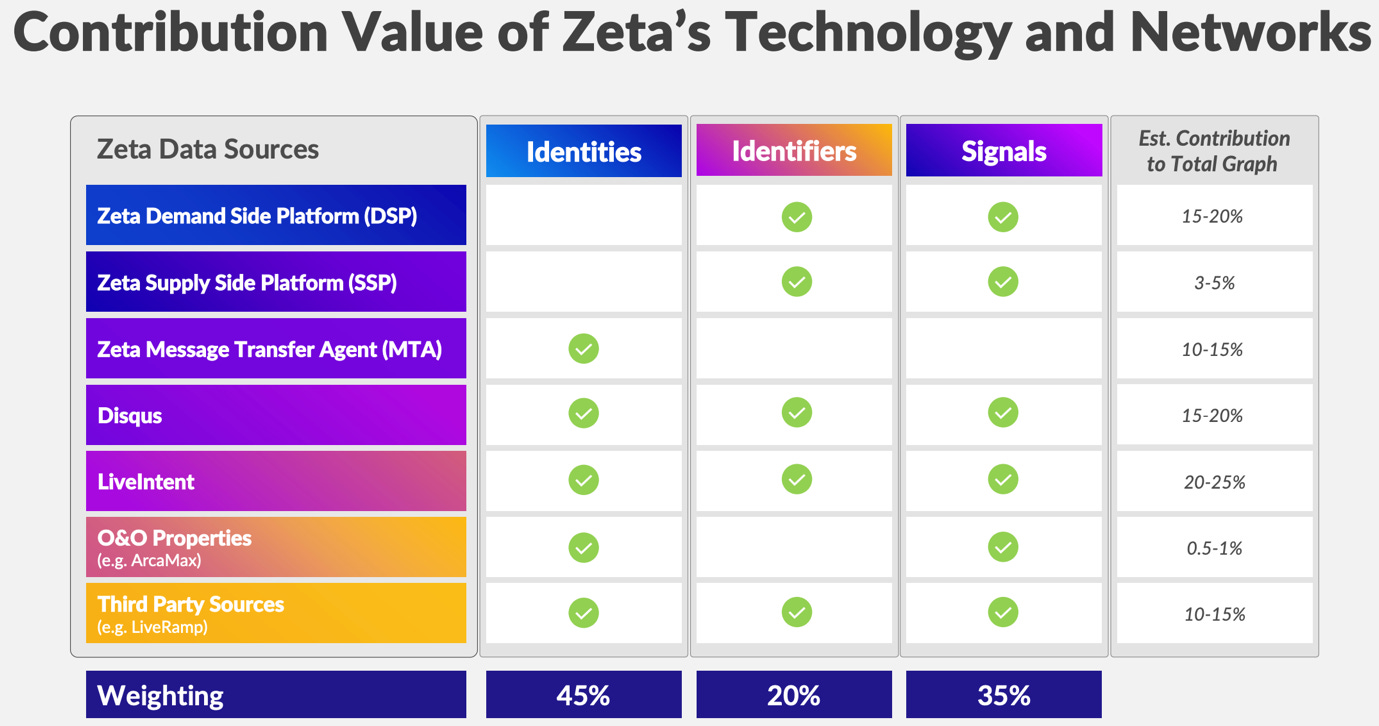
As you can see, 3rd party sources generate just 10-15% of all data and are complementary to the 85-90% is direct proprietary internal data coming from Zeta’s platform’s offerings.
Demand Side Platform lets advertisers place ads across the web, generating 15-20% of Zeta’s data. It records data on all campaigns, whether they converted or not.
Supply Side Platform lets publishers post their advertising inventory, so Zeta can find ads. Generates 3-5% of data.
Message Transfer Agent lets clients run marketing campaigns across the Web, devices, email, and apps. Generates 10-15% of data.
isqus and LiveIntent are both publisher tools, and they generate 35-45% of data.
Next, let’s move on to point 5) ecosystem moats.
While their ecosystem of partners and integrations is not as vast as giants such as Salesforce, Microsoft, or AWS, it is developing.
Zeta has a large platform that is being expanded through acquisitions and the development of new offerings, with the strategy of consolidating all 3 key marketing software categories.
Data Management
Marketing Automations
Programmatic Engagement
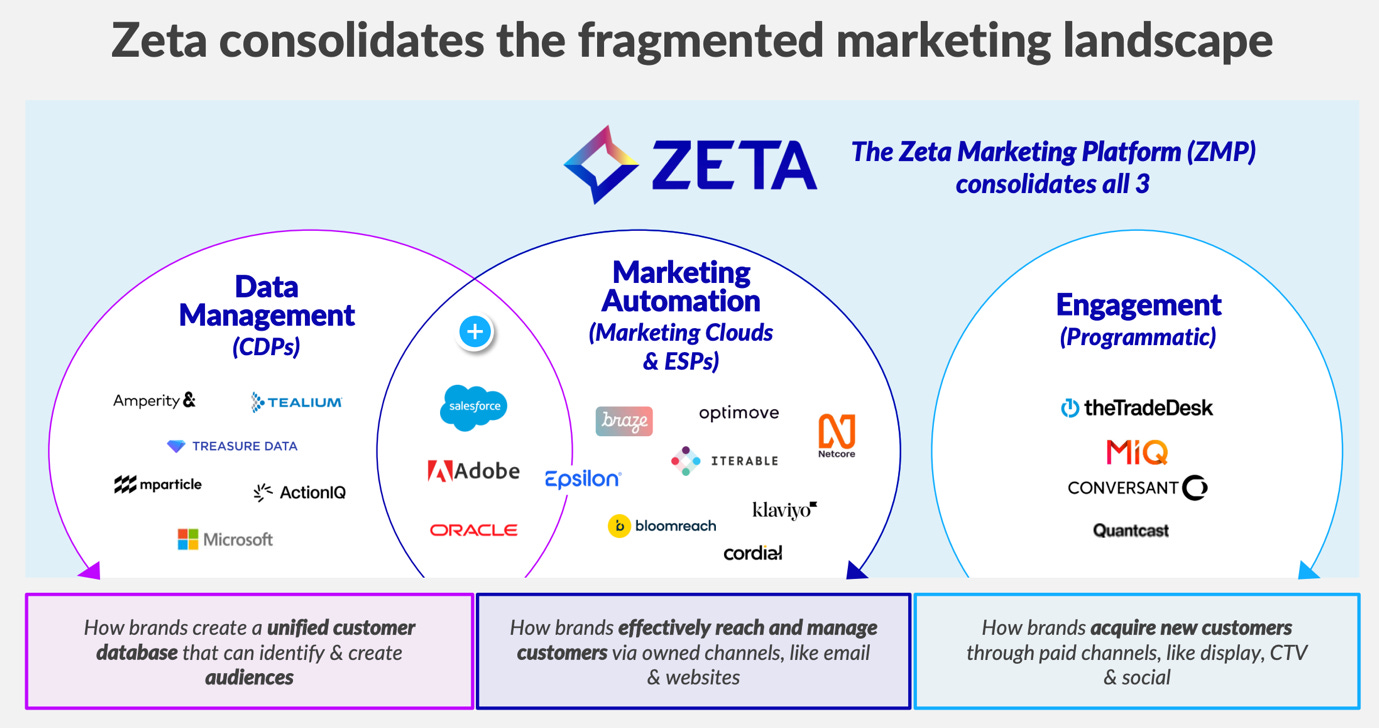
There are data management companies, marketing automation SaaS, and programmatic engagement companies.
There are a few that do 2 of the 3, but Zeta is the only large player active in all 3 categories.
This strengthens the value proposition of Zeta, improving the moat and driving strong customer retention.
Not only is Zeta not vulnerable to AI agents here, but it is actively building AI agents that will help its customers achieve better results. The company is actively working to disrupt other smaller players in the industry that are active only in some parts of the 3 marketing categories.
Furthermore, Zet has a strategic partnership with OpenAI to embed its LLM models directly into its architecture. By combining world-class LLMs with their proprietary data, they create a unique value proposition that neither a pure AI company (which lacks the data) nor a traditional data company (which lacks the AI) can easily match.
The 6) last, and most important point of the checklist is whether a company manages AI costs and successfully monetizes AI offerings.
And here again, the answer is a resounding YES.
AI is central to Zeta’s narrative and growth. Rather than bolt-on features, its AI services are deeply integrated and drive measurable client outcomes, which translates into monetization ability and pricing power. The company can easily monetise AI through new offerings and shift AI costs to customers through higher prices.
Simply put, Zeta monetizes results.
If its AI products can deliver increased conversions on its marketing activities and higher returns on advertising spend, customers will pay more.
In its demand-side advertising platform, Zeta keeps a percentage of each advertising dollar that its customers spend. The better the results, the more they spend, the higher the revenues. As results improve, Zeta can justify a higher take-rate.
The same in its supply-side advertising platform, the higher the price Zeta can get for the inventory, the more money it keeps.
2. 2028 Guidance
Zeta updated its previously released 2028 guidance to incorporate the Marigold acquisition.
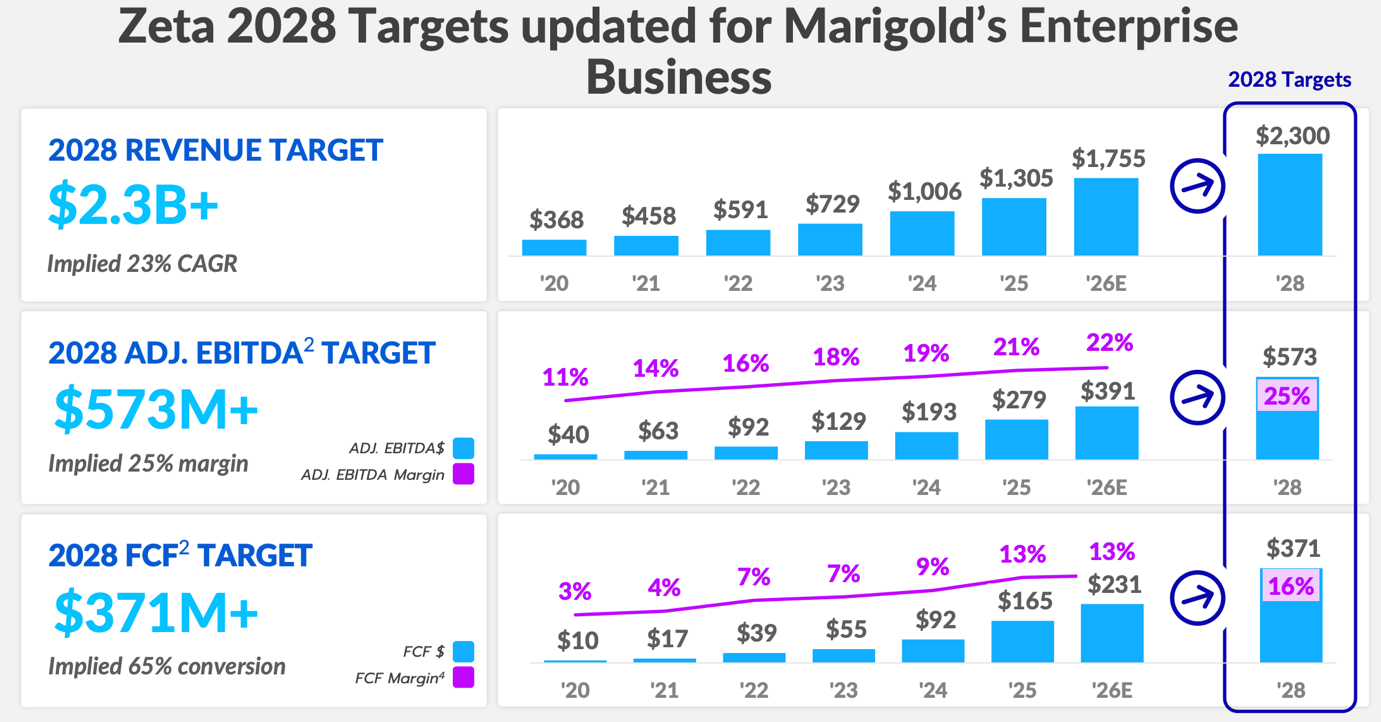
Revenue $2.3B, a CAGR of 23%.
ADJ EBITDA $573M, 25% margin.
FCF $371M, 16% margin.
The company increased its revenue guidance by $200M, ADJ EBITDA by $51M, and FCF by $31M.
Previously, Zeta disclosed that it expects Marigold to contribute $190M to revenue in 2026. The guidance implies that Zeta expects additional organic growth from 2026-28 to be just $10M, or about 5.3%. Some might view it as a bad sign, but I see it as conservative guidance.
Under promise and overdeliver has been Zeta’s strategy, and they are sticking to it.
Not a Premium member?
Become one to access the rest of this report, and see what my calculated fair value per share is and what upside Zeta could deliver for its shareholders by 2030!
The annual plan is available for a 50% discount!