
SanDisk Investment Thesis!
Transition from cyclical commodity to high-value AI infrastructure!
When the AI boom began in late 2022, investors began speculating about which companies would come out as the big winners of the AI revolution.
It quickly became apparent that GPUs are indispensable, so the demand for them exploded, making Nvidia the largest company in the world by market cap!
Now investors are on the lookout for the “next Nvidia”. However, it is increasingly looking likely that instead of a single gigantic winner, such as Nvidia, the AI boom is elevating whole sectors, whilst destroying others.
2026 has begun with a rapid and severe correction in Software-as-a-Service companies, as investors fear AI disruption. While at the same time, the stock prices of AI infrastructure equipment sellers have risen, driven by an unprecedented rise in capex spending.
All AI infrastructure players plan to spend big in 2026:
Amazon $200B
Google $180B
Microsoft $105-140B
Meta $115-135B
There is a famous saying that always gets repeated in detective movies:
“FOLLOW THE MONEY”.
Understandably, as all great investors are basically shrewd detectives, they are following the money. These capex guidelines clearly imply that 2026 will be an incredible year for companies manufacturing the equipment that’s driving the AI revolution.
And here I would like to introduce you to SanDisk, the business I am covering today.
They specialise in manufacturing memory chips, which are crucial for storing the vast amounts of data that AI training and deployment require.
The global memory industry is entering a transformative era, characterized by a structural pivot from cyclical commodity to high-value AI infrastructure.
Let’s take a look at the business.
1. Business Model
2. The Opportunity
3. Valuation
4. Valuation Model
5. Conclusion
1. Business Model
The semiconductor industry is vast and very complicated, so when people talk of computer chips, they could mean dozens of different things. Sandisk operates in a specific niche of the industry, manufacturing memory chips. But even that is a broad description, as within the term memory, there are sub-niches that might sound the same, but are very different.
About a year ago, in February of 2025, Sandisk was split from its parent company, Western Digital, to fully focus on the NAND flash memory market.
The memory market is mainly split into two technology families:
DRAM
NAND Flash
DRAM is very fast and holds the data that CPUs and GPUs are actively using to process computer computations. The data is not permanent and disappears if the power is lost.
Meanwhile, NAND Flash is slow and is used to store memory for the long term to be used by DRAM and GPUs later. The data is permanent, so in case of a power outage, it is safe.
Both types are very useful for different use cases.
While key players in the memory industry, such as Samsung, SK Hynix, and Micron, produce products using both technologies, Sandisk exclusively focuses on the NAND market.
Sandisk does not sell raw memory as that would be a commodity business with low margins. Their value comes from turning NAND flash into complete, performance-optimized storage solutions that bundle hardware, firmware, controllers, and reliability features.
The company is organised into the 3 key segments:
Edge
Consumer
Data Centers
Let’s expand on them.
1.1. Edge Segment
Under the Edge segment, Sandisk sells memory systems to original equipment manufacturers. These chips are put inside the final products of Sandisk customers to store data on the device, outside of the cloud. Most of the time, the final user doesn’t even know or care that Sandisk chips are used, as Sandisk is not the end user-facing brand.
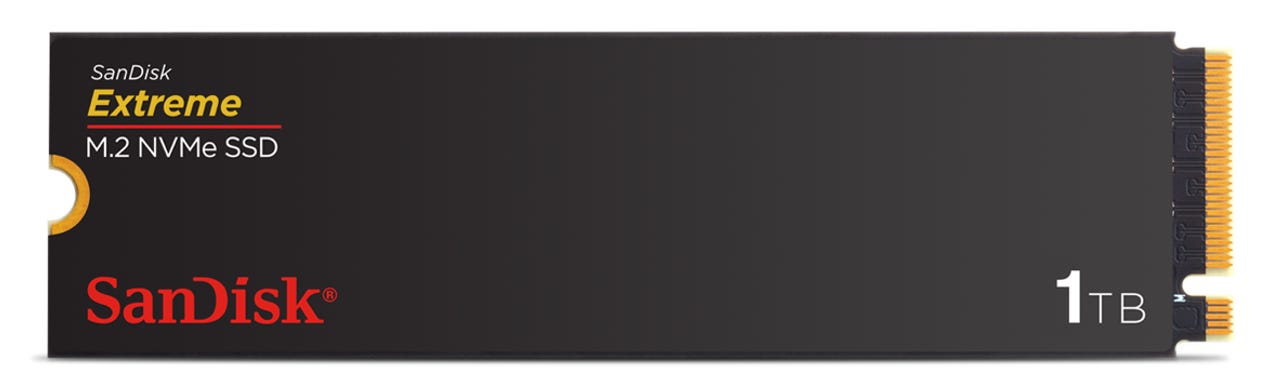
A key product that Sandisk sells is Solid State Drive (SSD) memory chips that are used in PCs and gaming consoles. These chips are tightly integrated with other equipment on the device to optimise performance. These are mature technologies that are unlikely to grow meaningfully in this segment.
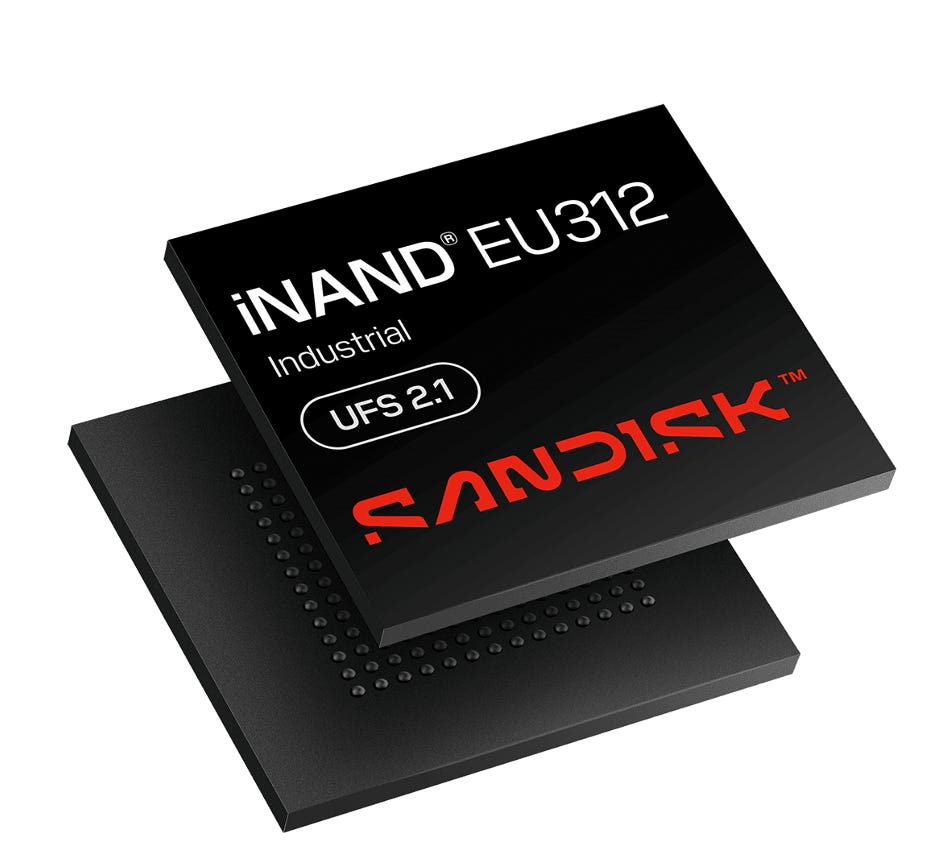
An area that is expected to be a growth segment is embedded flash memory. While they store less memory, these chips are significantly smaller, making them perfect for various emerging technologies.
Key use cases include:
Smartphones
Automotive
Industrial equipment
IoT devices
AR/VR systems
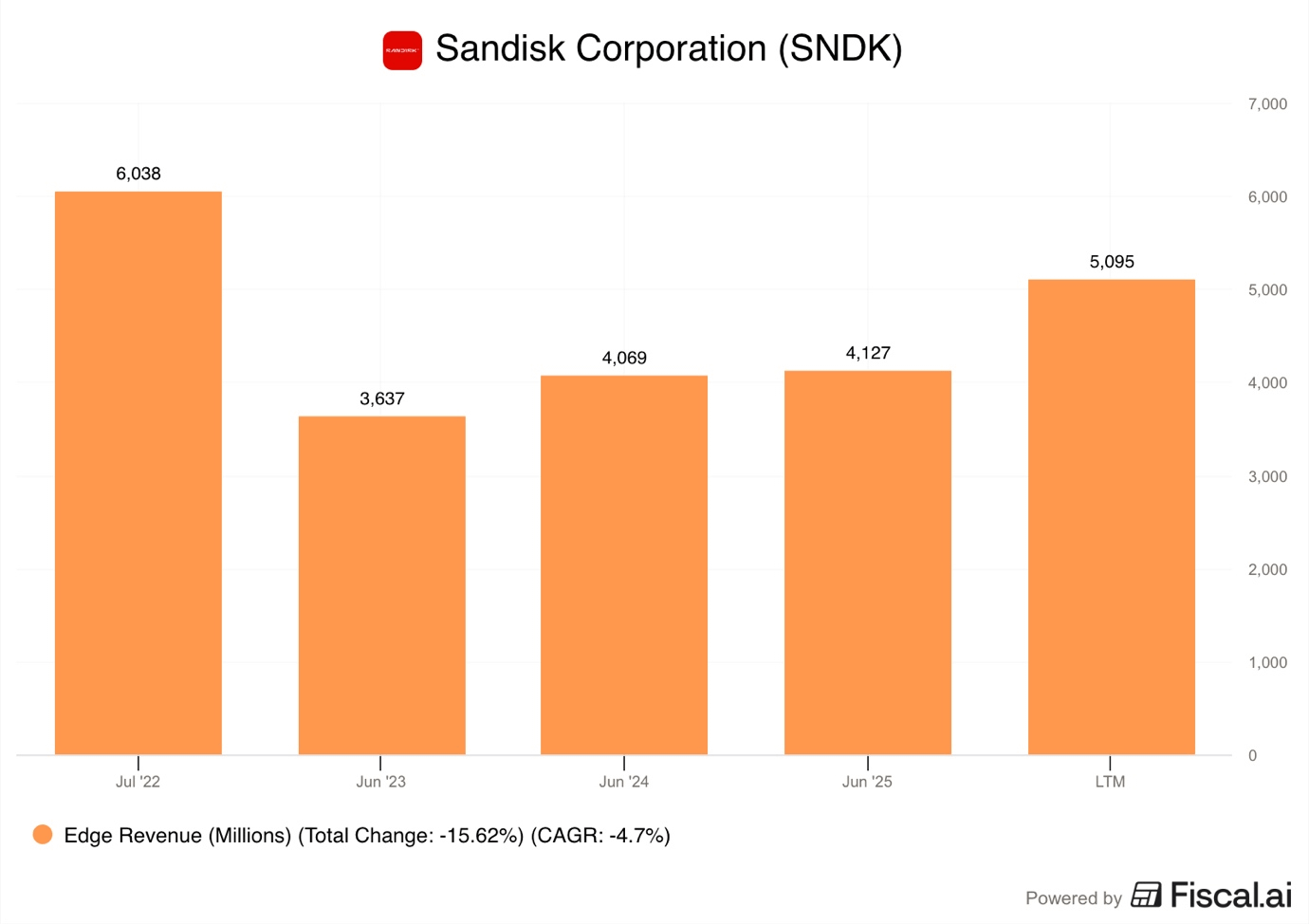
This is the largest segment, generating $5.1B, about 57% of total revenues. As you can see in the graph above, sales are down 15.6% from 2022, because the industry is in a down cycle. I will expand on the cyclicality a bit later.
The company has said that this segment is beginning to grow more meaningfully as the PC and smartphone industry is recovering from the down cycle, driven by the AI upgrade cycle.
1.2. Consumer Revenue
Sandisk’s second largest operating segment is Consumer, under which the company sells memory products directly to end users.
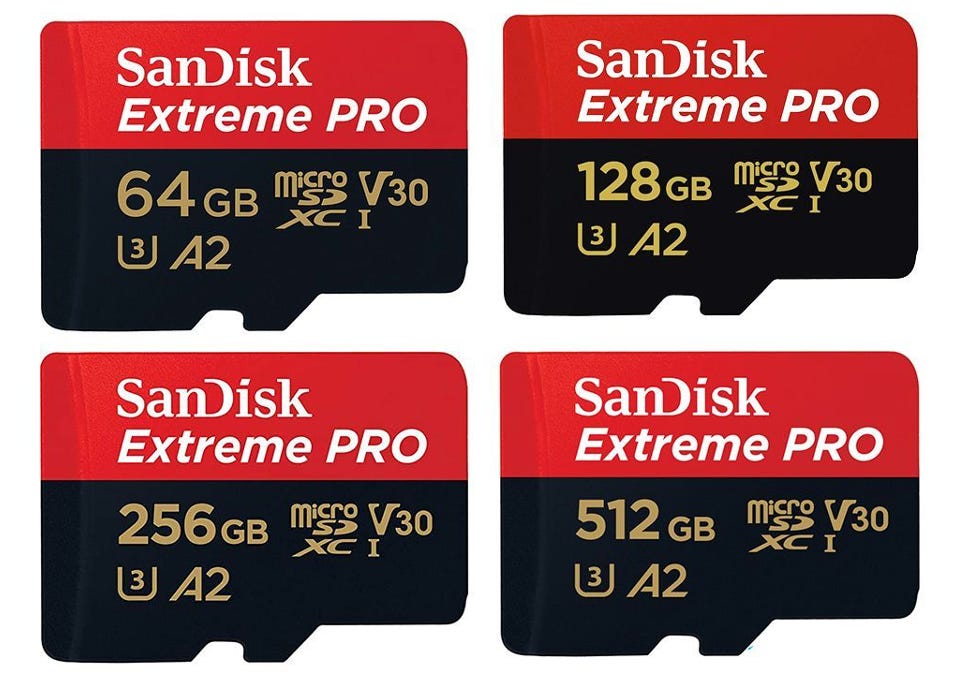
Portable SSDs
USB flash drives
Memory cards
The company’s products are especially popular with professional photographers who require on-device storage for thousands of photos.
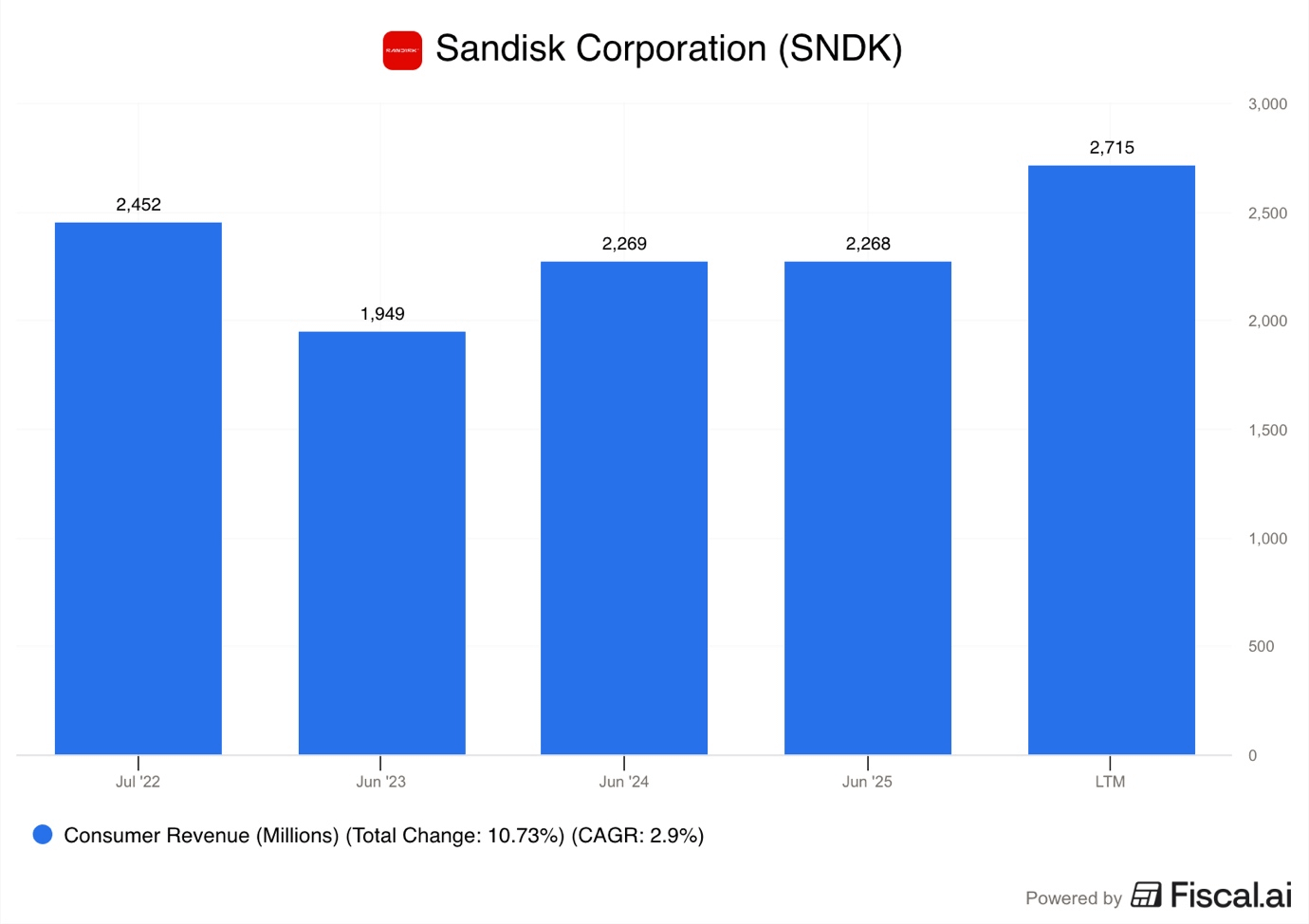
This segment is responsible for generating $2.7B in sales during the last 12 months, about 30% of total revenues. As you can see in the graph above, the sales are less cyclical than other segments, as they are brand and usage driven, not affected as strongly by the overall memory cycle.
This segment is seen as a steady performer, but not a growth driver.
1.3. Data Centers
While the data center segment is the smallest one, generating just $1.1B, 13% of total revenues, it is seen as an important growth driver.
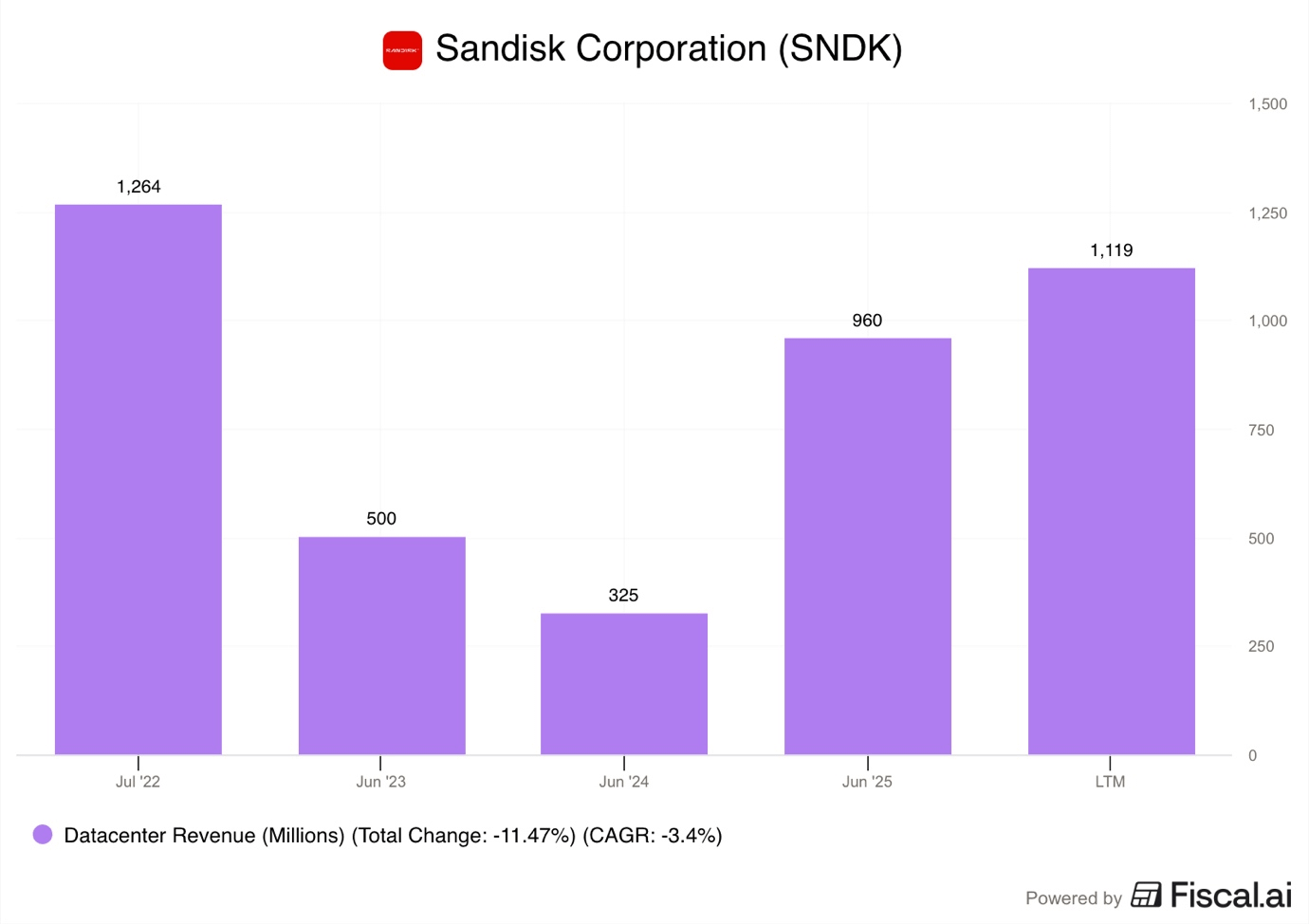
Sales collapsed from $1.3B in 2022 to just $325M in 2024, again demonstrating the cyclicality of the business. However, the segment has begun a strong recovery, growing by 76% Y/Y in Q4 2025.
All hyperscalers are significant customers, as they are investing aggresivly to build AI data centers.
These large data center operators buy Sandisk enterprise memory products, which differ significantly from the ones in the Edge or Consumer segments.
Even for use in normal workloads, data center memory chips require much larger memory, higher performance, and greater reliability. But for AI workloads, these requirements are even stricter.
Ability to sustain high workloads
Lower latency
Improved power efficiency
Smarter workload scheduling firmware
Chip health monitoring
Overall, much higher standards for reliability
These additional requirements of AI workloads mean that significant product R&D needs to take place to improve the reliability, endurance, and power efficiency of NAND chips.
This additional demand, coupled with stricter requirements, could lead to much higher volumes and significantly better margins than in previous memory cycles.
1.4. Cyclicality
Sandisk operates in the semiconductor memory industry, which has long been characterized by high capital intensity, rapid technological obsolescence, and a notorious boom-and-bust cycle.
This cycle is driven by the incredibly strong demand elasticity of the memory industry.
When demand is high, prices rise rapidly as users of memory chips race to secure supply. Memory is an input in the final product, which can’t be shipped without memory.
It takes years and costs $10-20B to build new fabs, so memory makers can’t quickly increase supply, further driving higher prices.
When prices are high, manufacturers look for ways to reduce memory requirements, reducing specs or changing designs.
Let’s not forget that high prices also incentivize suppliers to increase production. So, memory manufacturers all at the same time race to invest in capacity to increase supply. While it takes years for the additional supply to reach the market, it does at the same time.
Supply explodes, and pricing collapses.
The same factors that make increasing supply quickly difficult also make decreasing supply a non-starter. Once built, foundries must operate constantly, as the equipment that they spent billions on degrades while interest costs pile up. Raw material input costs are a lower share of the cost of sales than the depreciation of equipment, compared to other industries.
Simply put, by shutting down foundries, memory makers will lose more money than by selling each chip at a loss.
Furthermore, SanDisk’s business is also complicated by the bullwhip effect!
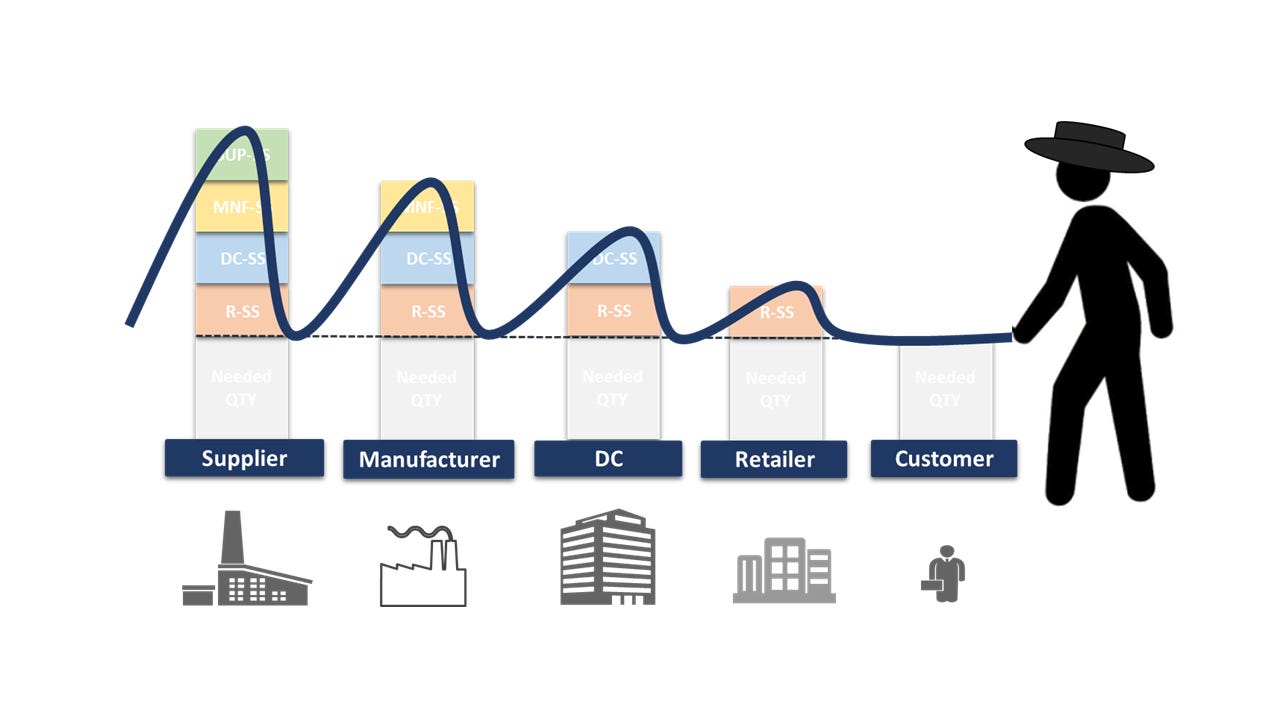
Its a supply chain phenomenon where small changes in consumer demand for end-products (like smartphones or PCs) result in increasingly larger swings in orders as one moves down the supply chain to the semiconductor manufacturers.
When Walmart runs out of 100 PCs, they make a large order to rebuild their inventory, thinking that strong sales will continue, they order 200 PCs.
When the distributor gets an order for 200 PCs from Walmart, they make an order for 400 PCs with the manufacturer.
The manufacturer receives an order for 400 PCs, so they call their suppliers to order enough chips for 800 PCs.
This growth in orders is seen not only as proof of current demand but as a signal towards future demand.
They do this because each party wants to have enough inventory to meet customer demand, as nobody wants to lose sales due to something “simple” like a lack of inventory.
But then, it takes Walmart much longer than they expected to sell 200 PCs, so they don’t make new orders next time. This creates a cascading series of events, the distributor doesn’t make new orders with the manufacturer, and the manufacturer doesn’t make purchases from the supplier.
The supplier already increased capacity to meet the demand, so they keep manufacturing, as not doing so is worse, supply explodes, and prices collapse. Lower prices increase demand, and the cycle begins again.
We can see the effects of the cyclicality in the graph below.
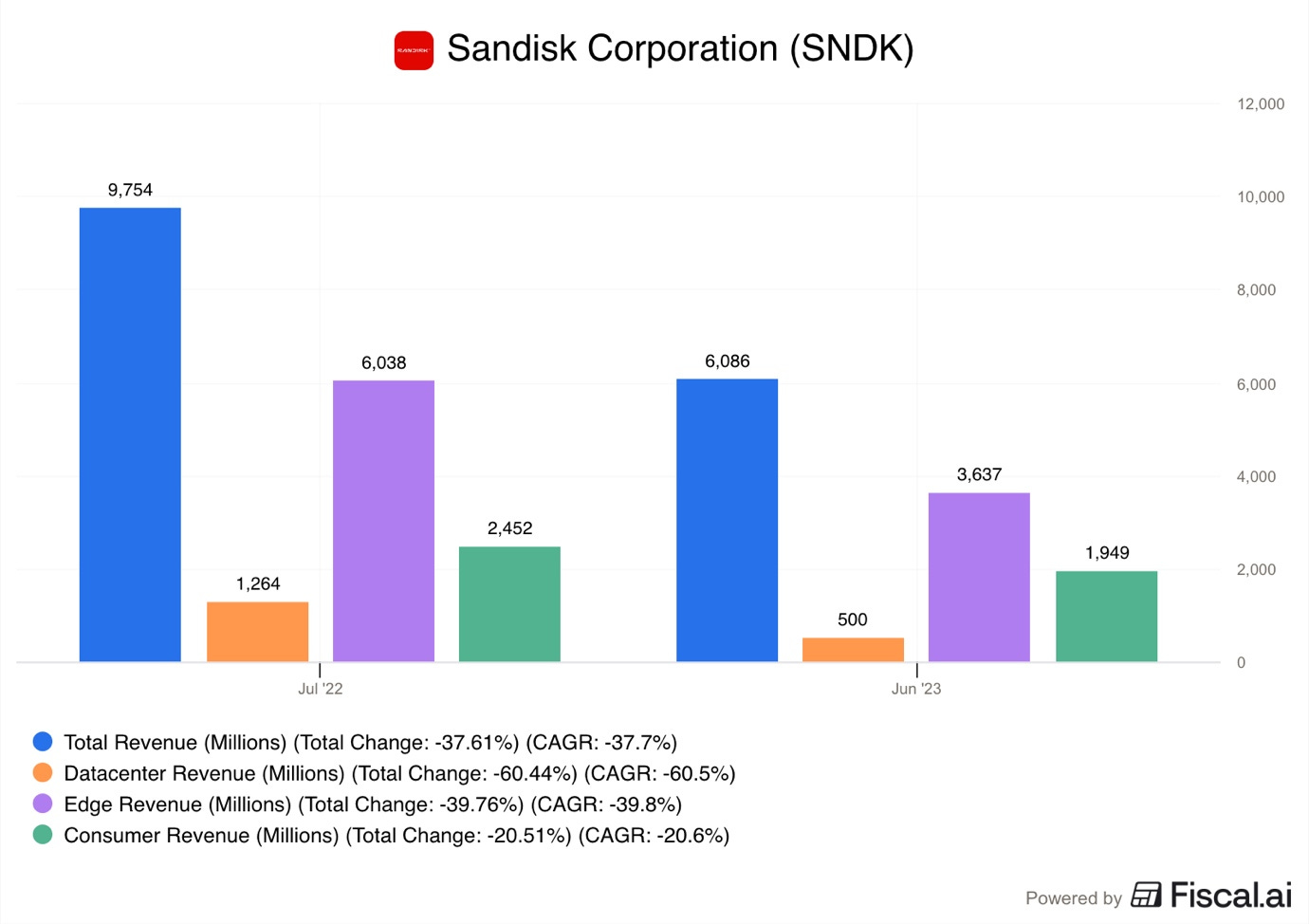
From 2022 to 2023:
Total revenue fell by 37.6%
Data center revenue by 60.4%
Edge revenue by 39.8%
Consumer revenue by 20.5%
However, it seems that not only the industry might be exiting the low demand period, but entering a future of much higher structural demand.
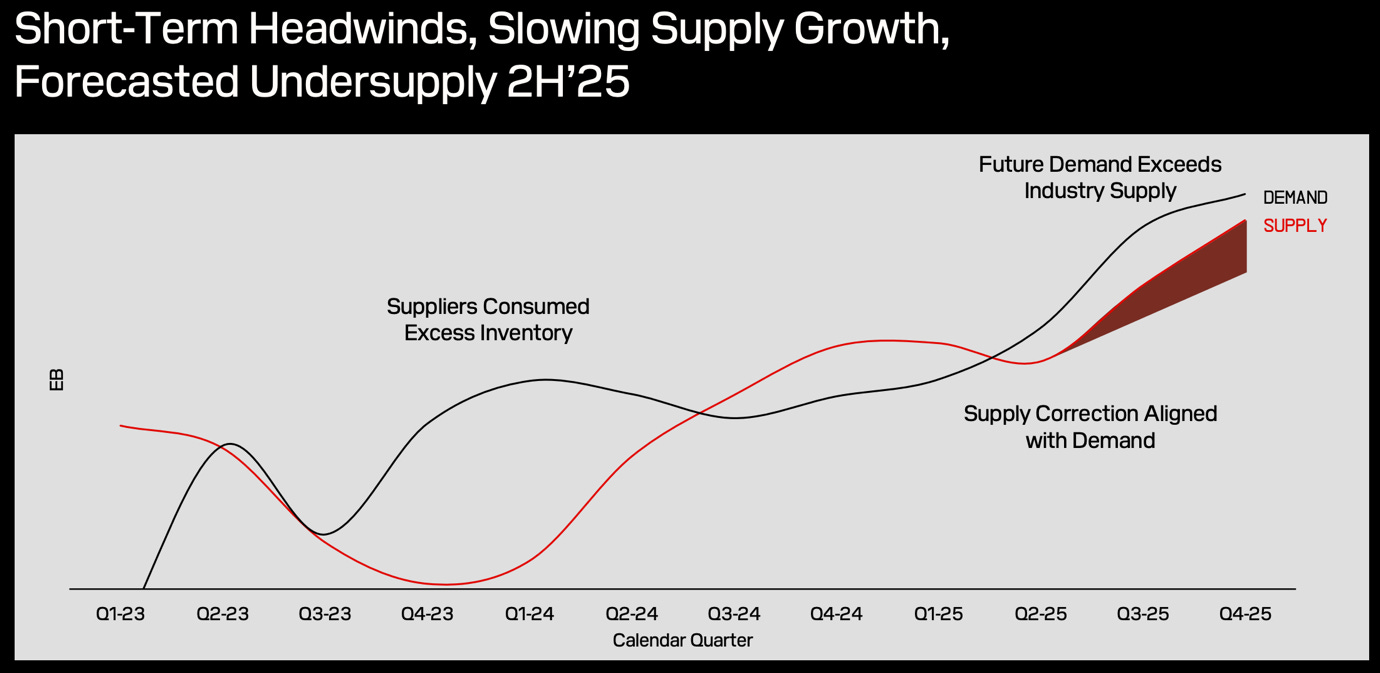
In the above picture, we see the slide from the Sandisk Q4 2025 earnings presentation. The company says that they are increasing supply to meet the higher demand from the market.
So the current supply and demand ratio is favorable for Sandisk, because leading NAND suppliers such as Samsung and Micron have shifted capacity towards DRAM HBM memory chips, to meet demand from Nvidia for its AI servers.
SanDisk, as a pure-play NAND company, is a primary beneficiary of this shortage as it doesn’t have to balance HBM production.
Early 2026 has seen record-breaking price increases, with NAND contract prices rising between 20% and 60% across various product categories as demand from AI data centers absorbs almost all available capacity.
1.5. Manufacturing Strategy
Sandisk is not a foundryless semiconductor designer. Instead, the company operates a capital-intensive, vertically coordinated, but not vertically integrated model. While Sandisk doesn’t technically own the foundries, so it is not vertically integrated, it coordinates heavily with the foundry through partnership and IP sharing.
Each semiconductor foundry takes 4-6 years to build and costs $15-25B!
As we just established, the semiconductor memory industry is highly cyclical. Combining cyclicality with high capital intensity, we get a business with a high bankruptcy risk.
If Sandisk were to go at it alone, the company would be exposed to all of the risk, and if the development of new sites didn’t match the cyclicality, it would be on the hook for paying billions of dollars to operate unprofitable sites.
Thus, for over 25 years, at the core of Sandisk’s manufacturing strategy is its joint venture partnership with the Japanese company, Kioxia.
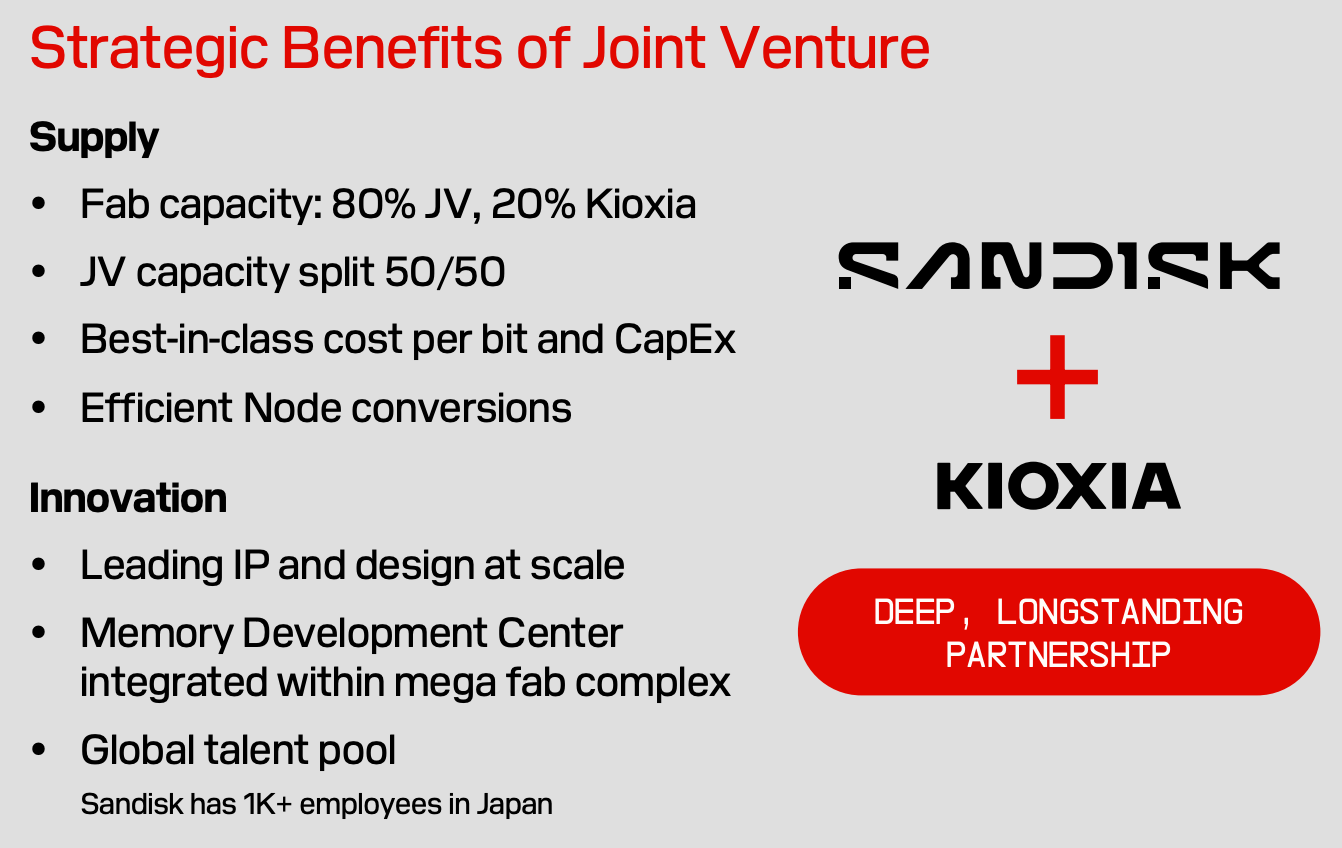
Key benefits of this partnership include:
Capex sharing
Higher economies of scale
Shared leading IP
Avoiding duplicate spending
Balance sheet protection
The joint venture is called Flash Ventures, and it owns all the factories in Japan that manufacture NAND memory wafers. Additionally, Sandisk and Kioxia share all their core NAND memory patents and intellectual property. The companies have a shared R&D team that co-develops new NAND technology.
While Flash Ventures owns the foundries, the day-to-day operations are managed by Kioxia, for which the company earns service fees and gets a higher share of the capacity, which is split 60/40 towards Kioxia. The manufactured wafers are then sold by the joint venture to both companies for the same price using the cost+ model.
The joint venture is not a profit center, so it doesn’t charge a fair market price for wafers!
Both companies benefit from shared economies of scale, resulting in some of the most cost-efficient NAND memory chips in the industry. While at the same time, they avoid duplicate spending on R&D.
Flash Ventures is 49.9% ownded by Sandisk and 50.1% by Kioxia.
The structure was intentionally designed this way, so Sandisk doesn’t have to consolidate the financials of the joint venture.
Moreover, this partnership helps both companies smooth out the cyclicality, sharing manufacturing losses during the down cycle and protecting the balance sheet from having to take out emergency debt at distressed interest rates.
After the joint venture delivers the NAAD wafers, Sandisk assembles them at other sites into final end products.
Essentially, both companies don’t compete in core NAND technology and wafer manufacturing. However, they do compete on everything above it, how the wafers are used and packaged, in which devices they are used, and for end-client contracts.
2. The Opportunity
As I said in the introduction, the semiconductor memory market is in the early stages of transforming from a cyclical commodity to a high-value AI infrastructure.
Analysts at the research firm Intel Research forecast the global flash storage market to grow with a 9.8% CAGR to reach $132.7B in 2032!
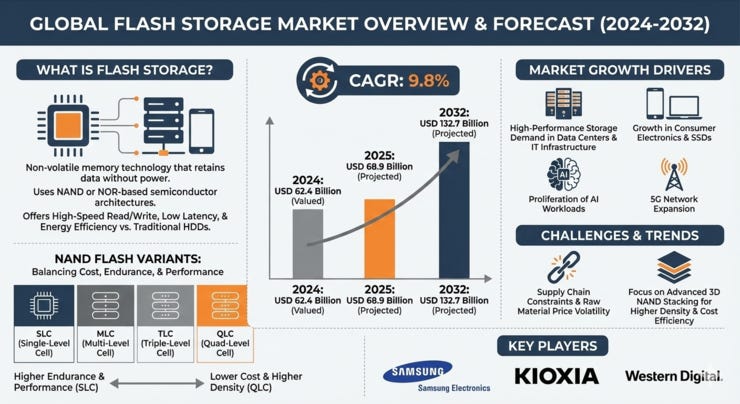
There are 3 clear opportunities that Sandisk has to benefit from the rapidly expanding NAND memory market.
Industrial and Automotive
AI Devices
AI Cloud
An important growth not only for Sandisk, but for the entire semiconductor industry is the transformation of automotive vehicles and industrial equipment from mechanical, manual, and dumb machines into software-driven, automated, and intelligent platforms.
Sandisk 2025 Investor Day Presentation!
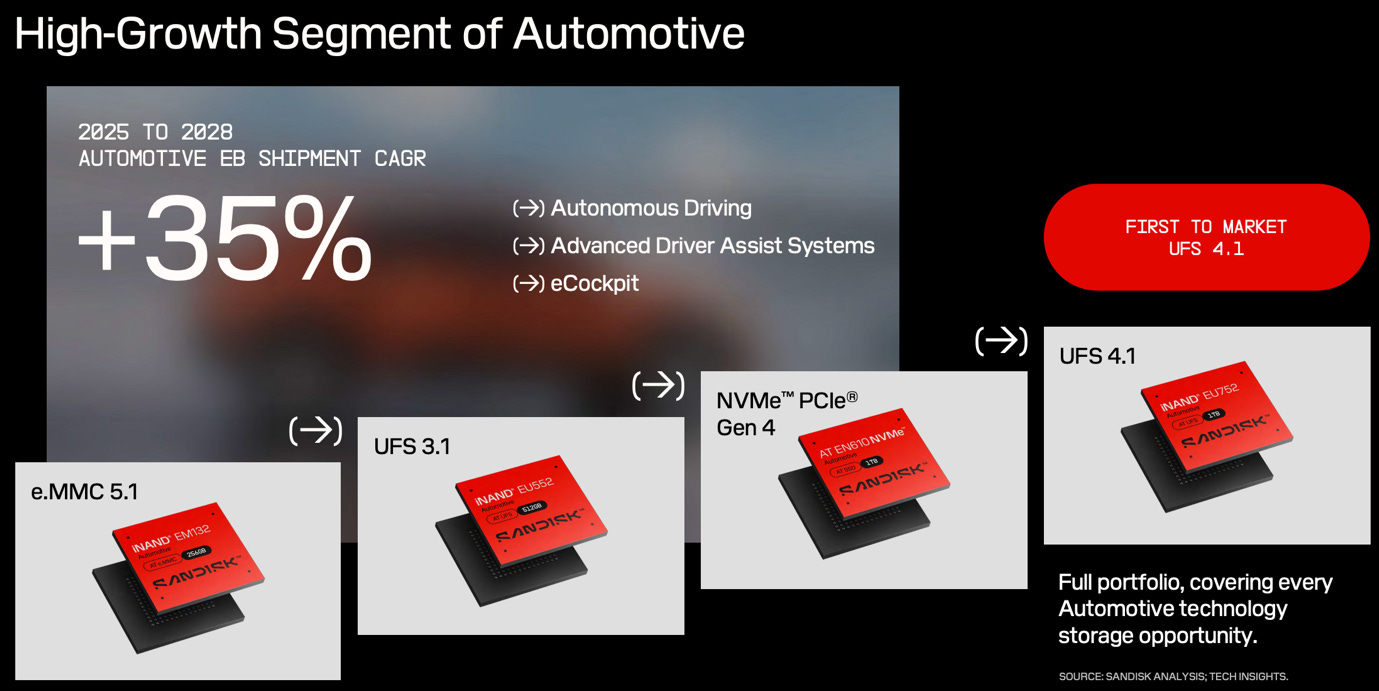
This transformation is leading to an increased demand for on-device memory systems. Just for example, autonomous driving and driving assist capabilities require hundreds of GB to a few TB of storage. Some analysts estimate that a LEVEL 5 fully autonomous vehicle could require even 19TB of on-vehicle storage.
Multiply that by tens of millions of new vehicles sold a year, and you understand why Sandisk is projecting a 35% CAGR in total automotive NAND memory shipment volumes from 2025 to 2028.
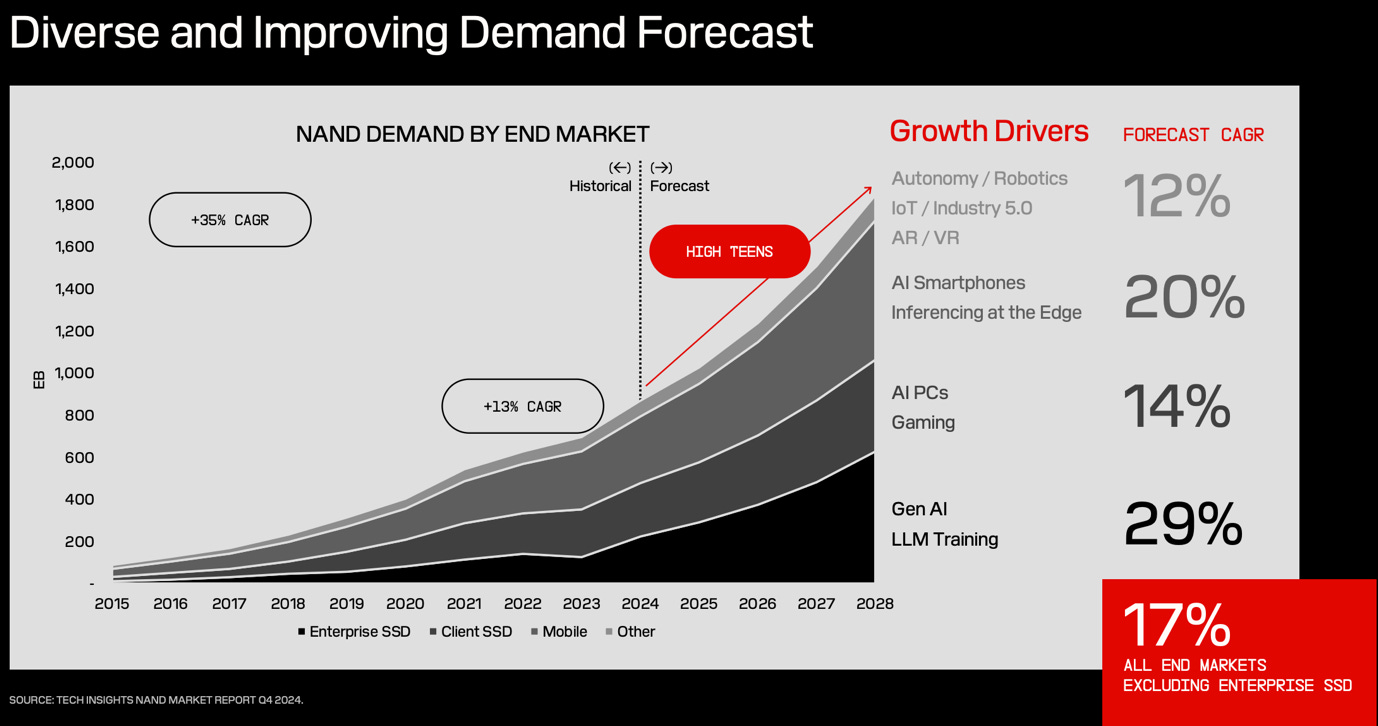
While the industrial segment will clearly be a meaningful growth driver, the largest demand boost is coming from AI!
AI LLMs are basically extremely sophisticated math equations. A chatbot doesn’t understand the essence of a question, it calculates the answer using the math equation that it is based on (an AI model, like GPT5).
To do that, an LLM needs a place to store the math equation it is using and the vast data set that the AI model uses to calculate the answer to the question. This is where NAND memory technology is used.
Essentially, NAND memory chips store AI training data sets, AI model versions, training logs, back-ups, and more.
This means that AI requires a lot of NAND memory.
As manufacturers of smartphones, PCs, and other smart devices begin releasing on-device AI models, the requirements for storage increase. The problem with today’s AI models is that they are slow and require an internet connection. By embedding smaller AI models directly on the device, these consumer brands can deliver many ”basic” AI model functions faster and without an internet connection.
However, even “basic” AI models may require additional GBs of memory to store the AI model and the data set. So Sandisk projects that industry NAND shipment volumes from 2025 to 2028 for smartphones will grow with a 20% CAGR, whilst PC volumes will grow with a 14% CAGR.
Lastly, the most significant driver of SanDisk’s financial and technological resurgence is the massive buildout of AI cloud infrastructure.
Just the big 4 hyperscalers plan to spend $650B on capex in 2026, a large majority of which relates to AI data centers. As global investment in data centers is projected to reach trillions by 2030, the role of NAND storage has shifted from supporting general-purpose servers to anchoring sophisticated AI architectures.
Stargate is Sandisk’s next-generation enterprise data-center SSD platform architecture, built specifically to meet strict AI server rack requirements.
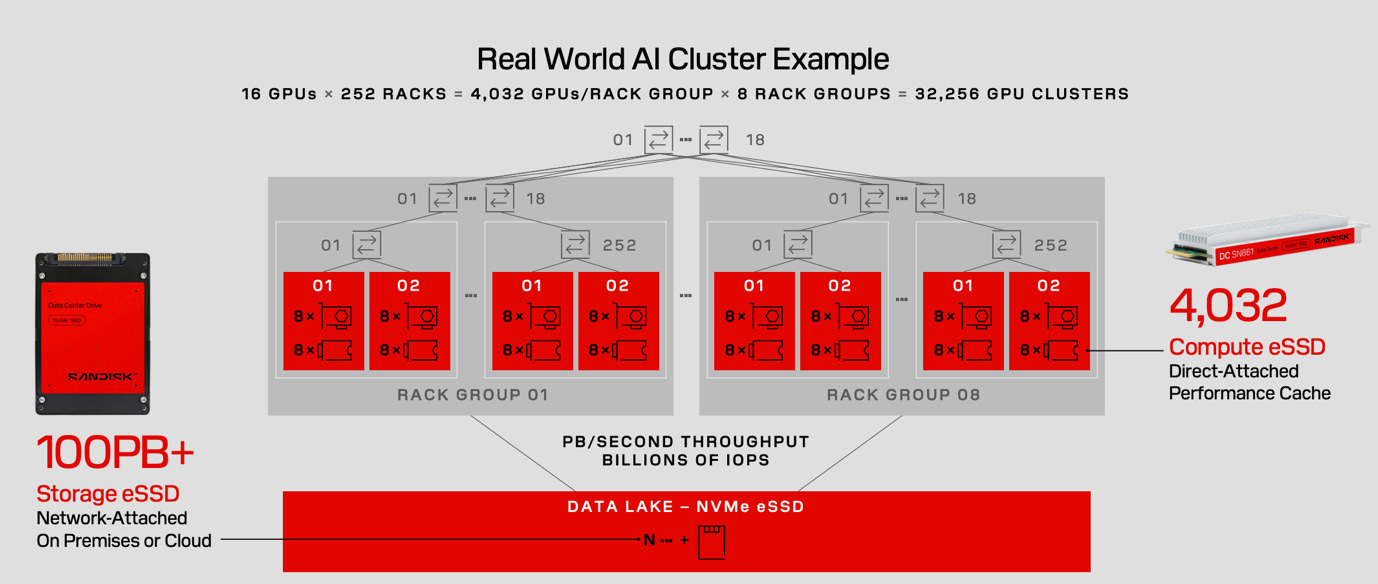
Let’s look at the example above from the Sandisk 2025 Investor Day Presentation.
A large AI data center cluster would use 32,256 Nvidia GPUs, split into 8 rack groups, with each group containing 252 racks of 16 GPUs.
Each GPU requires an SSD memory, so 4,032 SSDs per rack group.
So this AI data center requires 32,256 SSDs.
But that is not all, as the data center also requires a vast data lake with over 100PB of data. For context, that is about 100 million GB, requiring about 800 additional 128TB memory chips.
The company is well-positioned to capture a large share of this growing AI market!
3. Valuation
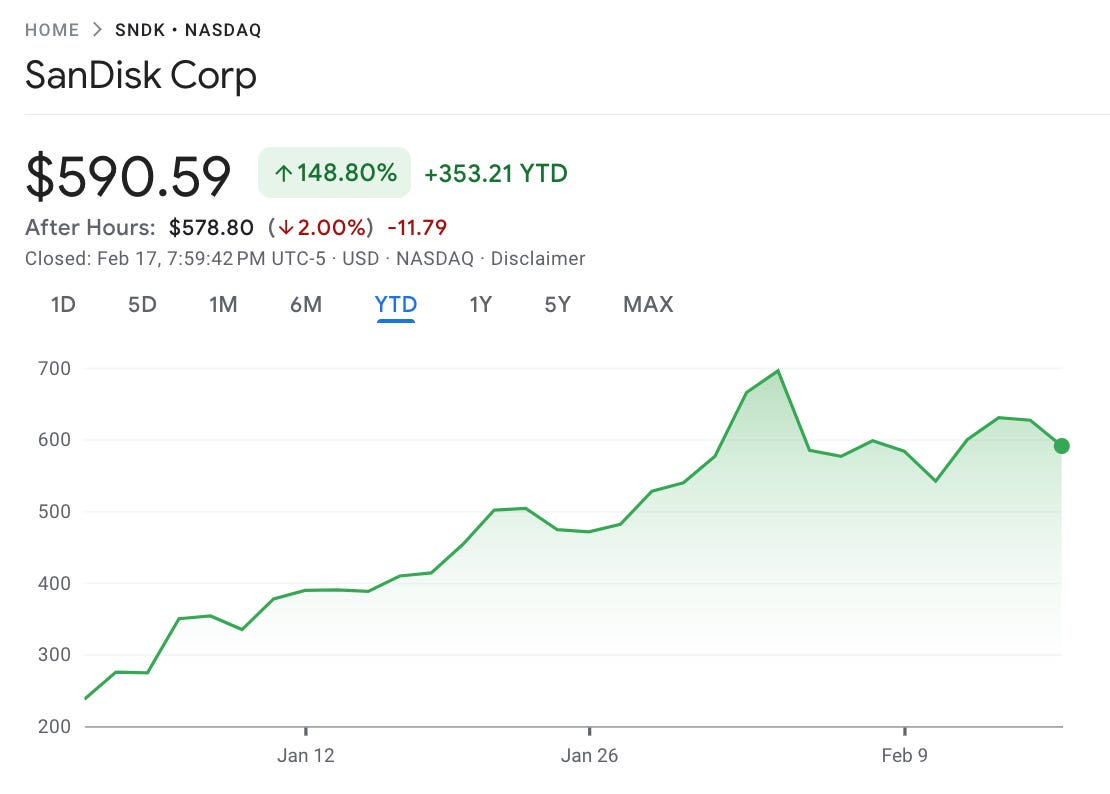
Sandisk has quite an incredible start to the year, rising 149% to reach a market cap of $87B. This rise was driven by strong Q4 2025 earnings and provided incredible growth guidance.
The industry is experiencing a rapid supply shortfall at the same time that demand is going through the roof because of AI, and Sandisk is reaping all the benefits.
I have placed some valuation metrics below.
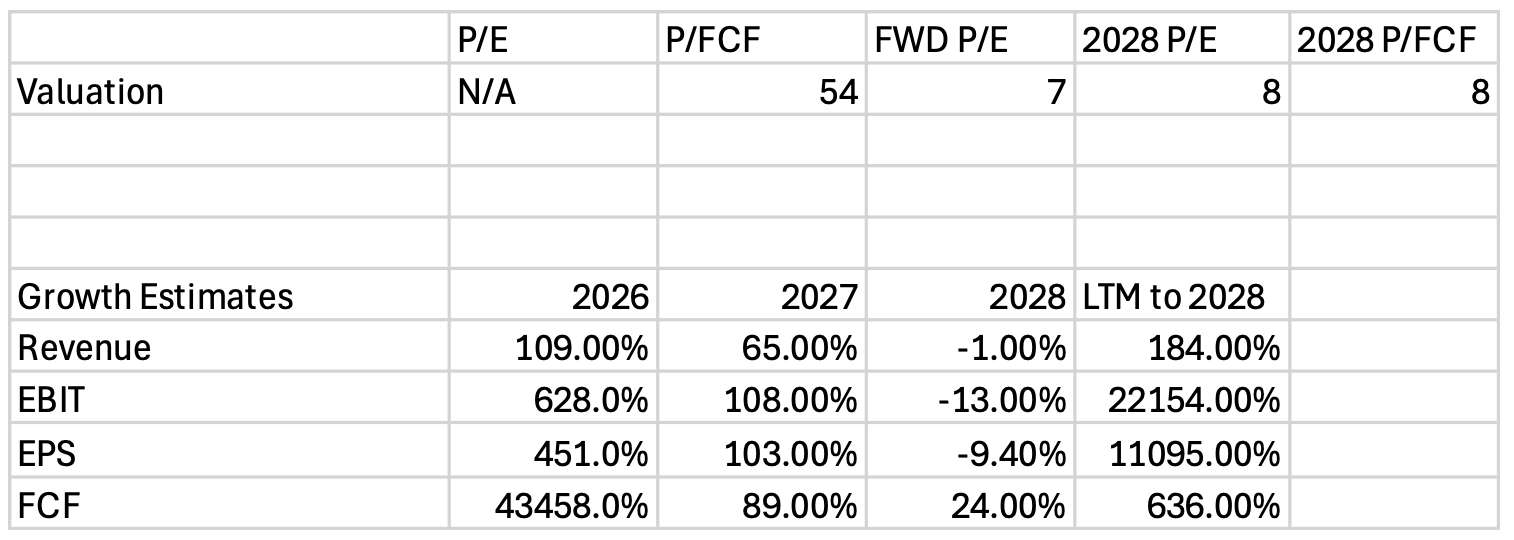
On a trailing 12 month basis, Sandisk is still unprofitable, so there is no P/E to look at, as it has only now begun to exit the downcycle. Q4, however, was extremely impressive, with Sandisk posting an EBIT of $1B, a margin of 35%, a clear indication of future growth potential.
Analysts expect revenues to grow by an incredible 109% in 2026!
In a high fixed costs business that Sandisk operates, rapid revenue growth leads to explosive profit growth. EBIT is estimated to grow by 628%, EPS by 451%, whilst FCF is set to explode by 43x.
Strong growth is forecast to continue in 2027, with revenue growing by 65%, and earnings by over 100%.
However, analysts expect the old cyclicality trends to kick in in 2028, with revenue and earnings expected to decline by a few percent.
Considering the explosive Capex guidance of big tech, that seems premature.
You have to remember that it takes years to ramp up production and meet chip demand. The current demand explosion is driven by investments that were committed by AI companies 1-3 years ago. The 2026 $650B capex of the Big 4 will take a few years to end up in orders for Sandisk. Thus, I find the 2028 cycle reversal a bit premature and conservative.
“we continue to successfully navigate these early stages of a far-reaching evolution in our business………… NAND is a critical technology enabling the development and proliferation of artificial intelligence. For the first time, data center is expected to become the largest market for NAND in 2026, driven by some of the world’s largest and well-capitalized technology companies. Fueled by the performance our technology delivers, customers across all our end markets are increasingly seeking business practices built around shared commitments and agreed financially attractive terms aligned with our pre-existing supply plans. Our supply plans will remain aligned to such attractive, real, and sustainable long-term demand. With this backdrop, margins are expected to reset at a structurally higher level.” Sandisk CEO David Goeckeler, Q4 2025 Earnings Call
Let’s build a valuation model that takes into account the current market shift.
4. Valuation Model
So my first assumption is that analyst estimates are too conservative and don’t take into account the structural shift in the market. As the CEO confirmed during the Q4 2025 earnings call, Sandisk is entering into a long term agreements that secure capacity at good prices, delivering a greater return on invested capital than we have seen historically.
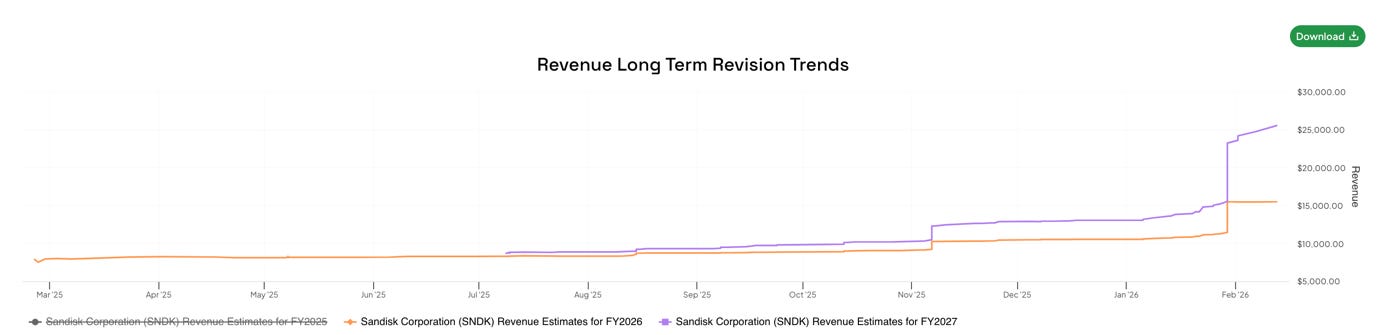
In the picture above, you see long-term revenue estimate revision trends. The orange line for 2026 and the purple line for 2027 are straight lines up.
Thus, I model 2026 revenue growth at 125%, above 109% estimate.
2027 at 75% above, the 65% estimate.
2028 at 20% above a -1% estimate.
10% in 2029 and 2030.
The result is $37.1B in revenues in 2030!

While pricing power is strong, and 2026 could deliver 50% operating margin and 52% in 2027, over the long term, it is likely to come down as higher supply erodes pricing power.
So I model 42% operating margin.
Taxes, net interest of 20% of operating income.
We get a net income of $12.5B in 2030!
Next, Sandisk I model dilution at 2%, a low figure, but Sandisk SBC is reasonable at about 2.5% of revenue.
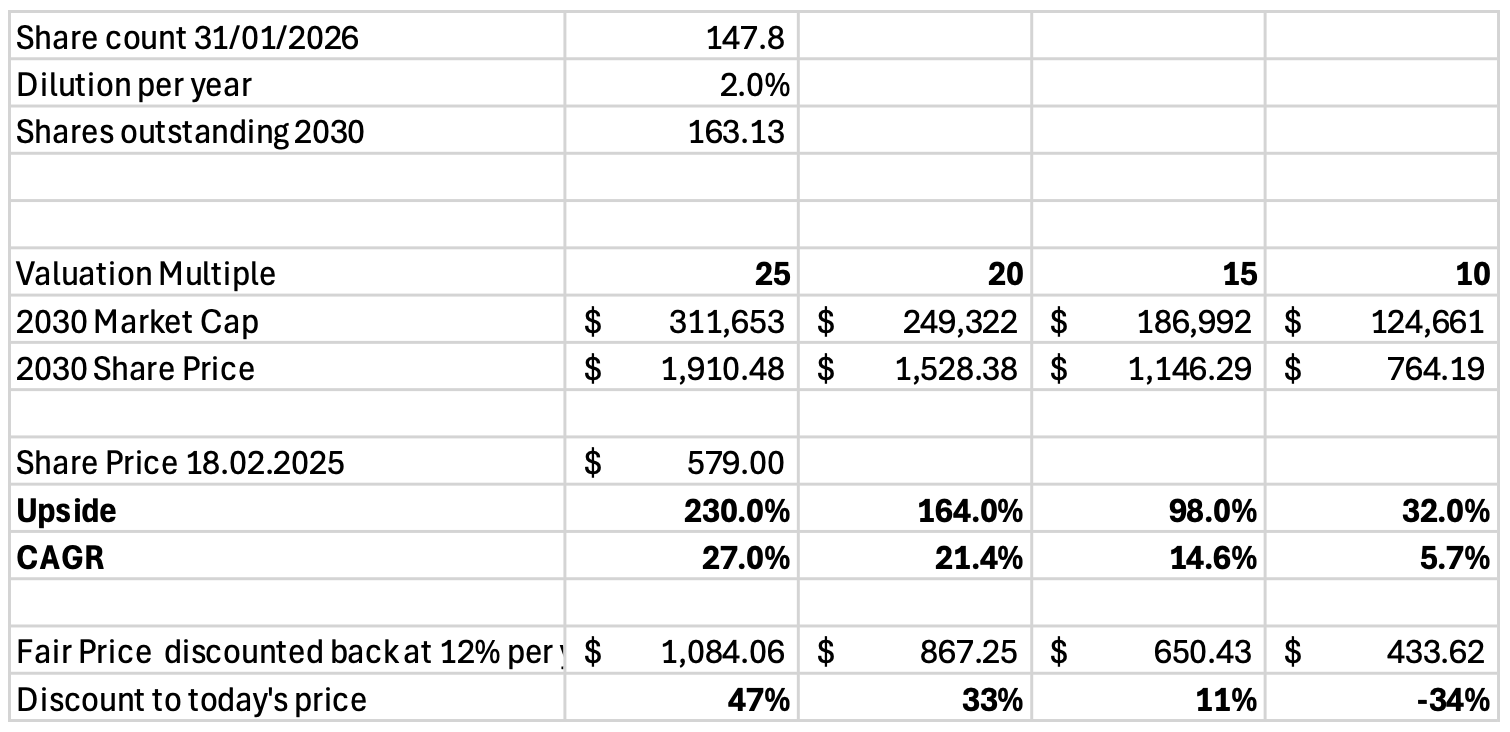
Estimating the P/E ratio is quite tricky and depends on growth expectations past 2030.
Micron trades for a TTM P/E of 30, but its FWD P/E is 8, while SK Hynix trades for a P/E of 17.
If Sandisk trades for a P/E of 20, we are looking at a $1,528 stock, 164% upside from today!
Discounted back at 12% per year, we get a fair price of $867, implying that Sandisk could be trading for a 33% discount to its fair value.
However, it is difficult to say that with certainty, as this is a highly volatile industry. For multiples to meaningfully increase, investors need to fundamentally reevaluate the memory industry and apply multiples of a high growth, higher margin, higher return on invested capital industry.
If that happens, then returns for Sandisk could truly be explosive, significantly above what the valuation model shows.
5. Conclusion
In conclusion, Sandisk is a highly capable manufacturer in the rapidly evolving NAND memory industry.
Through their manufacturing, R&D, and capex joint venture with the Japanese semiconductor company, Kioxia Sandisk gets access to the most advanced NAND IP, whilst limiting duplicate R&D spend and increasing economies of scale, meaningfully de-risking the overall business.
The global memory industry is in the early stages of transforming from a cyclical commodity to a high-value AI infrastructure.
Analysts at the research firm Intel Research forecast the global flash storage market to grow with a 9.8% CAGR to reach $132.7B in 2032!
Sandisk is well-positioned to benefit from the steady and strong long term growth of the NAND memory industry by producing innovative memory products perfect to serve the growth of the:
Industrial and Automotive
AI Devices
AI Cloud
The NAND volumes of the automotive segment are forecast to grow with a 35% CAGR, smartphones with 20% CAGR, and PCs with 14% CAGR.
But most importantly, each AI GPU requires an SSD memory, and Hyperscallers are ordering millions of GPUs for hundreds of billions of dollars.
AI demand is projected to make data centers the largest NAND memory segment, overtaking consumer and edge for the first time in 2026.
As the valuation analysis showed, despite the share price rising 140% in 2026, there is still significant upside left in the stock. However, that is only if the NAND market is indeed transitioning into a more stable and steady long-term industry.
Thank you for reading Global Equity Briefing!

You can follow me on Social Media below:
X(Twitter): TheRayMyers
Threads: @global_equity_briefing
LinkedIn: TheRayMyers
Disclaimer: Global Equity Briefing by Ray Myers
The information provided in the “Global Equity Briefing” newsletter is for informational purposes only and does not constitute financial advice, investment recommendations, or an offer or solicitation to buy or sell any securities. Ray Myers, as the author, is not a registered financial advisor, and readers should consult with their own financial advisors before making any investment decisions.
The content presented in this newsletter is based on publicly available information and sources believed to be reliable. However, Ray Myers does not guarantee the accuracy, completeness, or timeliness of the information provided. The author assumes no responsibility or liability for any errors or omissions in the content or for any actions taken in reliance on the information presented.
Readers should be aware that investing involves risks, and past performance is not indicative of future results. The author may or may not hold positions in the companies mentioned in the “Global Equity Briefing” report. Any investment decisions made based on the information in this newsletter are at the sole discretion of the reader, and they assume full responsibility for their own investment activities.
Ray, you are missing too many things here. You need deeper analysis of the competition, the Koreans are going to smash them in 2-3 years. This is one company that I absolutely know will be lower in 3-4 years as the current demand is unsustainable and the competition is catching up. Is it a co incidence that Western Digital are unloading? No way they know it’s the top they used to own them!
Lastly again not enough analysis in the supply chain. They manufacture in Japan, ship to Shenzen China for Packaging and then onto Taiwan for final assembly. What could possibly go wrong with that supply chain in the next 2-3 years?