
State of the Robotaxi Wars!
Briefing on the race towards vehicle autonomy!

The automobile was a revolutionary invention that drastically changed the world. People and goods could be transported over short and long distances relatively cheaply and quickly. As a result, there are 75M new vehicles sold every year, resulting in 1.5B operational vehicles worldwide, and tens of millions of commercial vehicle drivers.
While undeniably a great invention, there are many issues:
Vehicles are still expensive to buy and maintain.
Taxis are expensive and inefficient.
Public transportation is very labor-intensive.
Most vehicles are idle over 95% of the time.
Over 1M traffic deaths globally.
Between 20-50M non-fatal traffic accidents.
The average American spends over 1 hour per day behind the wheel.
These are just some of the issues that autonomous driving aims to solve!
An autonomously driven car will be significantly safer than even the best human driver ever could, leading to millions of saved lives and billions of dollars in savings from lower healthcare costs and insurance losses.
By removing the most expensive cost element of any drive, human time, the cost per mile driven will fall significantly, making rides much more affordable for the masses. It is estimated that for taxis, the driver’s time is 80% of the fare, whilst for trucking, it is 30-40% of the shipping costs.
Autonomy enables a near-zero marginal cost of usage!
Vehicles can operate nearly 24/7 continuously without breaks.
Predictable maintenance schedules.
Considerably reduced idle time, down from 95%.
Lower costs through shared ownership.
But most importantly, autonomous driving will improve human productivity by eliminating the time people waste behind the wheel. The average American will gain an additional 1 hour a day to spend on more productive tasks, such as work or entertainment.
One way in which companies that solve autonomy will become exceptionally wealthy is by operating robotaxi networks!
By some estimates, the operating costs of a single robotaxi could be even 70-90% less per mile than a human-driven taxi. This is due to increased vehicle utilization and lower insurance, maintenance, and other operating costs.
The potential for such attractive unit economics has ignited an arms race between some of the world’s largest technology companies and well-funded start-ups!
Thus, in this report, I will look at the key fighters in this robotaxi war and where they stand.
1. Uber
2. Google’s Waymo
3. Tesla
4. Nebius’ Avride
5. Amazon’s Zoox
6. Others
7. Final Thoughts
1. Uber
Uber transformed the global taxi industry by combining smartphones, mobile internet, digital maps, and online payments to radically improve user experience.
Ordering a ride went from an inconvenient process of phone calling a taxi or hand waving one down and paying in cash to a convenient process of clicking a few buttons on one’s phone. They quickly scaled to thousands of cities and millions of drivers and riders, but there is one glaring problem.
Uber pays 80% of the booking to the driver!
Thus, quite early in its life, the company began working on autonomous driving, with the goal of replacing human drivers and keeping 100% for itself.
In 2015, it established the Advanced Technologies Group business unit in Pittsburgh to build self-driving cars. In the next few years, they expanded autonomous driving testing to Arizona and California using Volvo XC90 SUVs.
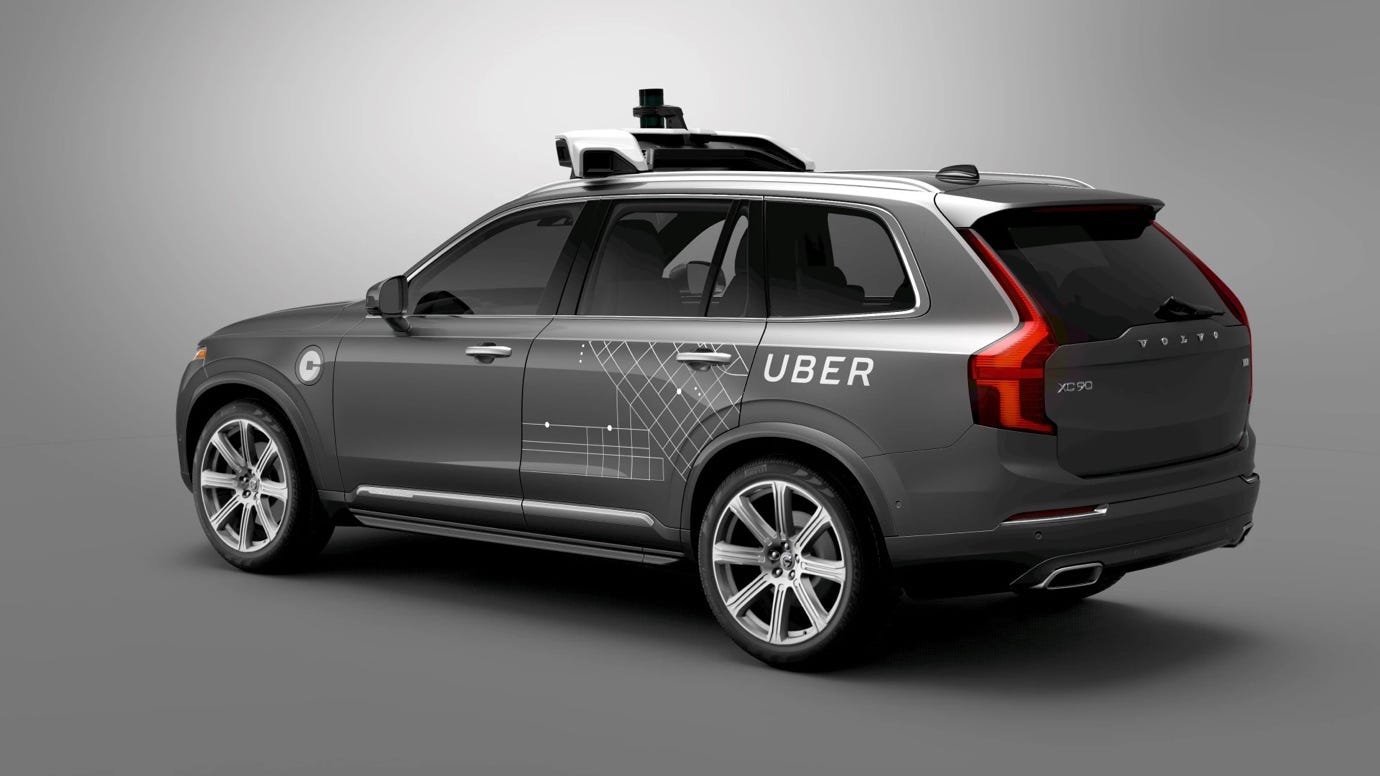
However, developing robotaxis is way more difficult and expensive than Uber expected!
In 2018 and 2019, Uber bled $2.1B and $4.9B in negative FCF, scaling its core human-driven ride-hailing business, and it would take many more billions in losses before Uber would begin generating real cash flow.
Realizing it would take 10+ years and billions of dollars to develop the autonomous driving technology, Uber sold this division in 2020!
However, this doesn’t mean that Uber is done with robotaxis, it just pivoted to a new model. Instead of spending billions of dollars to develop its own tech and then being locked into using only it, Uber is on its way to becoming a ride-hailing marketplace where suppliers of robotaxi technology compete for passengers.
Basically, Uber’s goal is for people in the future to open their Uber App, order a ride, and then the algorithm will assign an autonomously driven vehicle from a collection of robotaxi companies. Instead of a person registering with Uber to become a driver and opening the app to find customers, robotaxi companies will agree with Uber on terms such as financial split, pricing, and how many cars they can add to the network. Governments will also have various regulations in this space.
So instead of paying a human driver 80%, Uber will pay technology partners less than that, possibly 40-70%!
The exact split will depend on many factors, and it is impossible to predict now, but it will almost certainly be less than the 80% that goes to the drivers today.
Today, Uber benefits from strong network effects as millions of drivers and customers use the platform. The idea is that Uber’s tens of millions of customers, the brand, the app, and route-scheduling AI are perfect for a robotaxi technology supplier to partner with.
Robotaxi suppliers don’t need to build an app, acquire customers, and manage customer service. They just connect to Uber’s app and see the money roll in!
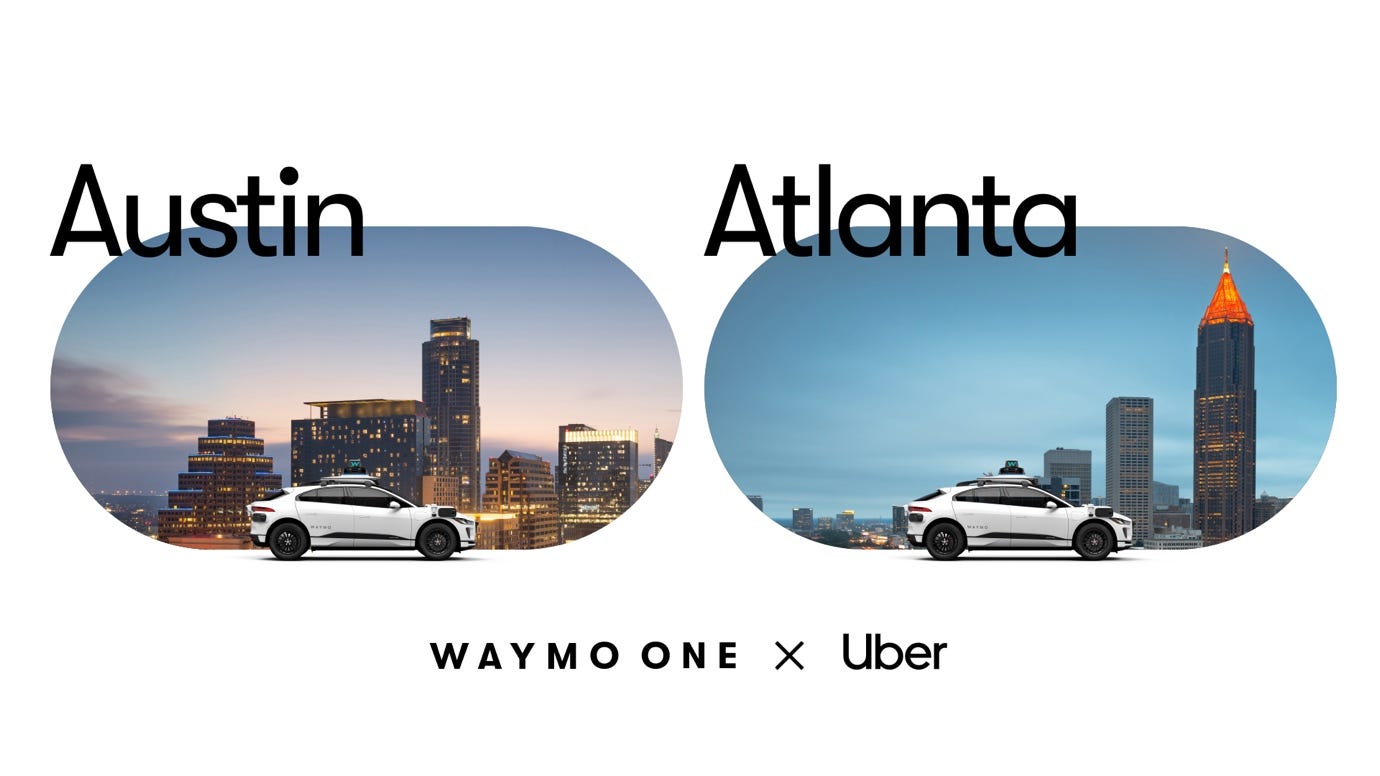
This is what Waymo has done, as it offers robotaxi services in Austin and Atlanta, with plans to expand the partnership to more cities.
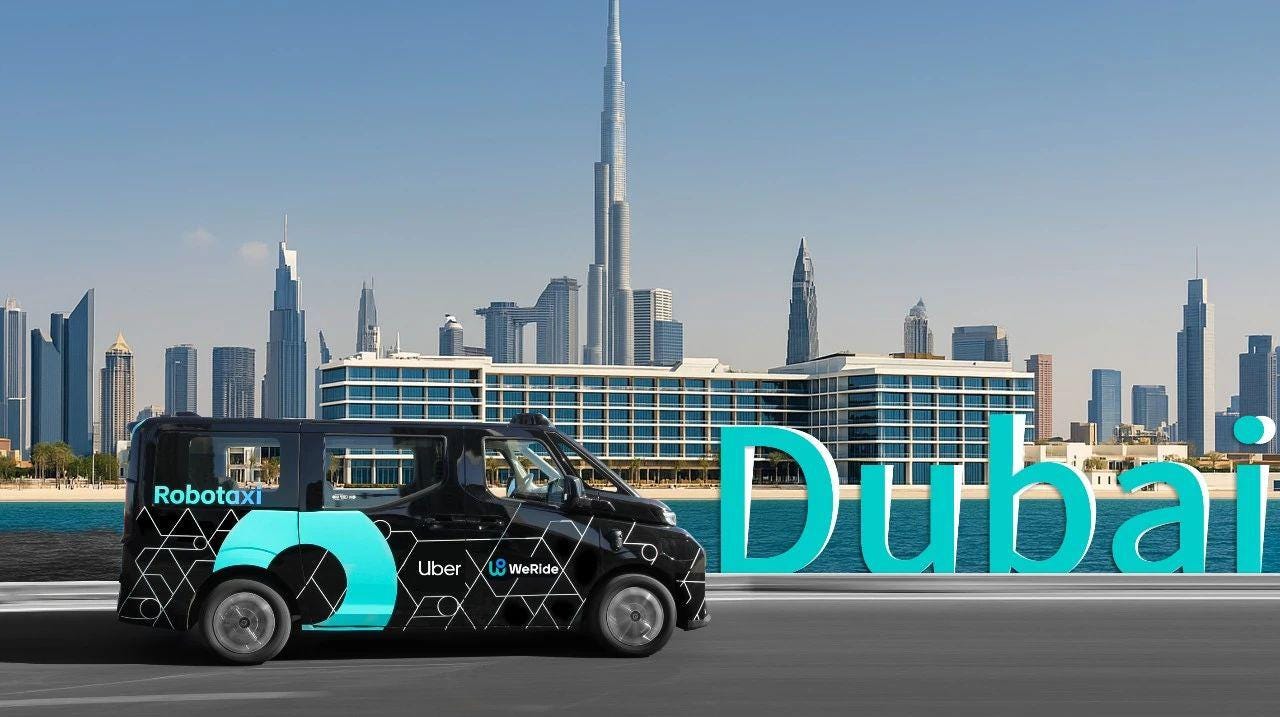
Additionally, Uber has partnered with the Chinese autonomous driving company WeRide to begin robotaxi services in the United Arab Emirates and Saudi Arabia.
Furthermore, Uber plans to launch robotaxi services in Dallas by the end of the year through Nebius’ autonomous driving subsidiary Avride.
Another area in which Uber is positioning itself to be an attractive partner for robotaxi companies is fleet management!
An operational robotaxi network might start with the car and the AI that drives it, but it would end without efficient fleet management processes. Robotaxis still need to be cleaned, oil needs to be changed, tires maintained, gas cars fueled, EVs charged, and other basic tasks. Additionally, the same as taxis, robotaxis need to be kept somewhere while they are not in use.
These are not complicated tasks, but they are expensive and time-consuming. All the robotaxi companies are bleeding money, and will do so for many years, so if Uber can help them expand to new regions quicker and cheaper, they will use this opportunity.
2. Google’s Waymo
Google founded its self-driving car division in January 2009, known internally as “Project Chauffeur.” The progress was painfully slow at first and excruciatingly expensive. However, in the last 2 years, the company has shown an accelerated pace of progress, becoming the clear market leader.
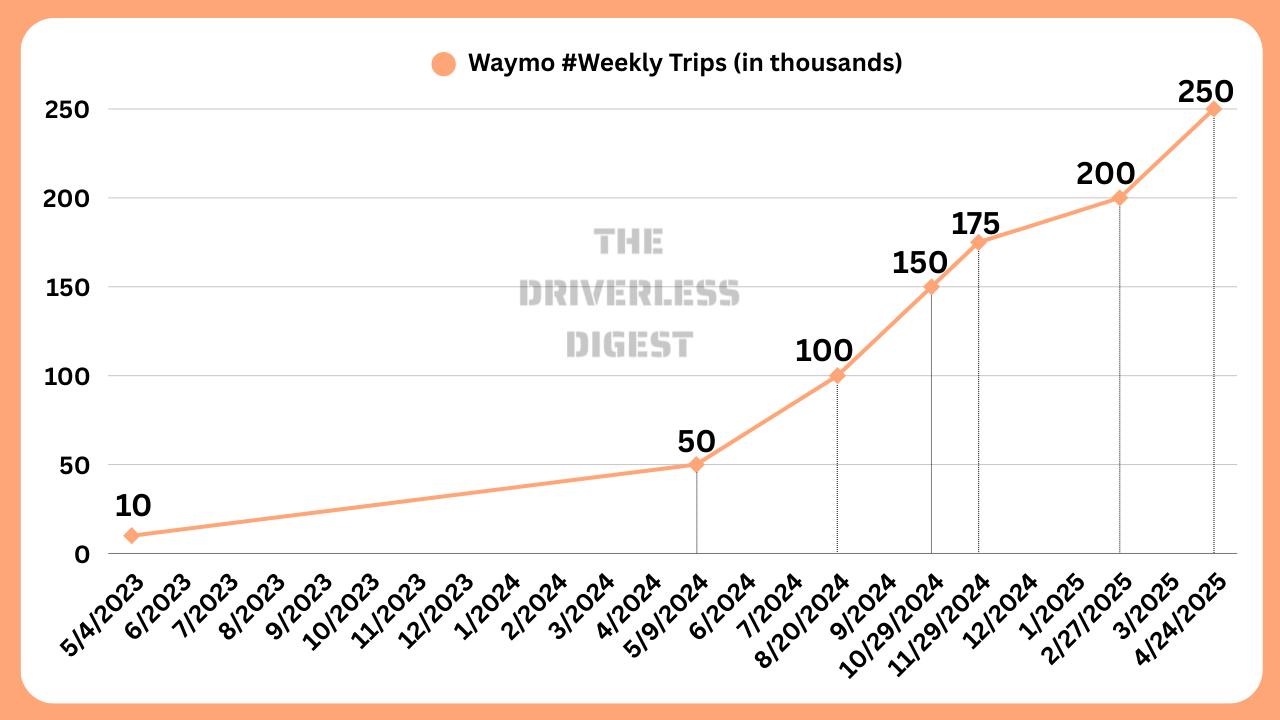
Per Google’s reporting, Waymo now does over 250 thousand weekly paid autonomous trips!
There is nobody even remotely close to challenging them in this metric.
Since its founding, Waymo has done 10M paid rides and 100M autonomous miles!
Waymo’s 2,000 vehicles are currently available in San Francisco, Los Angeles, Phoenix, Atlanta, Austin, and a few smaller towns in Silicon Valley.
As I already mentioned in the Uber section, Waymo has entered into a strategic partnership with Uber, who list Waymo robotaxis on its app and manages their fleet in Atlanta and Austin.
In other towns, their services can be used through the Waymo app.
However, last month Waymo announced that it will begin offering robotaxi services in Nashville in 2026 through a partnership with Lyft. This is clearly an intentional action to spread its bets and not be too dependent on Uber.
Additionally, Waymo has announced plans to begin operations in Miami, Washington DC, Dallas, Seattle, and Denver in 2026. Also, the company intends to begin operations internationally by expanding to London and Tokyo.
Notice that so far, Waymo has been operating in areas with stable weather. This is because rain, wind, clouds, and snow are significant obstacles that interfere with sensors on which robotaxis depend. In Denver, Waymo will have to deal with strong snow, whilst in Miami and Seattle, with rain. Data from such environments is crucial to increasing the reliability of AI driving models.
In my eyes, the company enjoys a few competitive advantages:
First mover advantage
Unlimited resources
Cloud and AI integrations with Google
Lower advertising costs
It is clear that by being the first mover, Waymo has established a strong position in the robotaxi space and has developed a well-known brand. The company has collected a lot of data from completing 10M paid trips, which is directly fed back into the AI to improve the service. This is enabling them to enter new cities faster and cheaper. In 2026, they plan to begin operations in as many new cities as they had in the previous 5 years.
Moreover, Google is a $3T corporation with $133B in operating cash flow. From robotaxi companies, only Amazon operates on a similar scale. Having unlimited resources is certainly an advantage in such a capital-intensive fight.
Furthermore, Google is one of the AI and Cloud industry leaders. This gives them a major operating and cost advantage in training Waymo’s autonomous driving AI.
Last, Waymo has an advantage that is often overlooked, the ability to advertise on Google’s properties at significantly lower cost. As Uber’s example shows us, any robotaxi that wants to scale would have to spend tens of billions on advertising, and by diverting some of that to its own properties, Google can achieve more exposure than competitors, saving billions of dollars that it can divert towards other operating expenses.
3. Tesla
Elon Musk’s Tesla is possibly the most well-known company aspiring to build a robotaxi network. The company has made robotaxis a core objective of theirs since 2016 and has regularly talked of the huge profit potential for a scaled robotaxi network.
Elon famously said in 2019 that there would be a million robotaxis by 2020, but it soon became apparent that developing this technology would be significantly more difficult and expensive than he thought.
However, after years of delays, Tesla finally launched their robotaxi service on June 22, 2025, in Austin, Texas!
While Tesla bulls celebrated, the reality is that the company is still far away from challenging Waymo in actual autonomous rides driven.
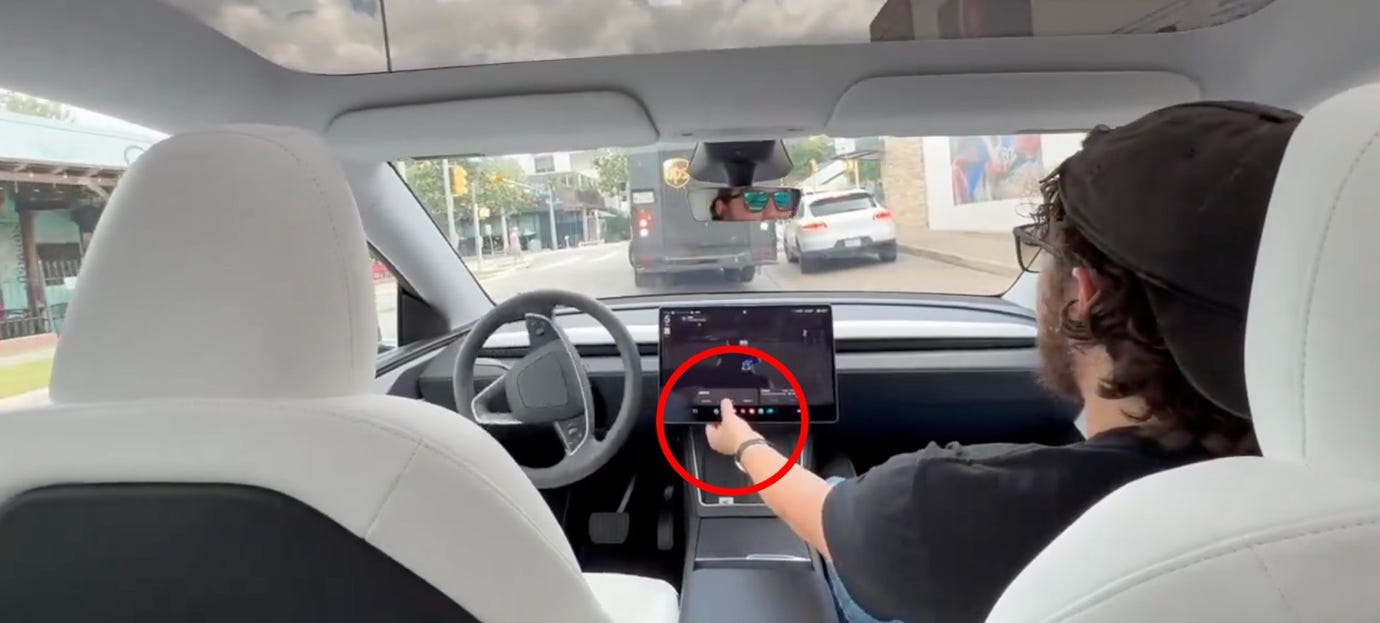
Firstly, the rides are not truly autonomous, as there is a person from Tesla sitting in the vehicle who is observing the ride and ready to intervene if there are issues. Elon has said that he plans to get rid of the “babysitters” by the end of the year.
Secondly, this was just a limited launch in one city with 30 cars, while Waymo has over 100 vehicles in Austin and almost 2,000 countywide.
Third, Tesla hasn’t disclosed any statistics, such as rides completed or miles driven, indicating that it is likely very small, other wise they would have disclosed.
However, the key aspect of Tesla’s thesis and their approach to robotaxis is that they are building a system that is more scalable and cheaper!
Tesla has taken a unique approach to developing autonomous driving technology that doesn’t rely on “expensive sensors” but only uses cameras.
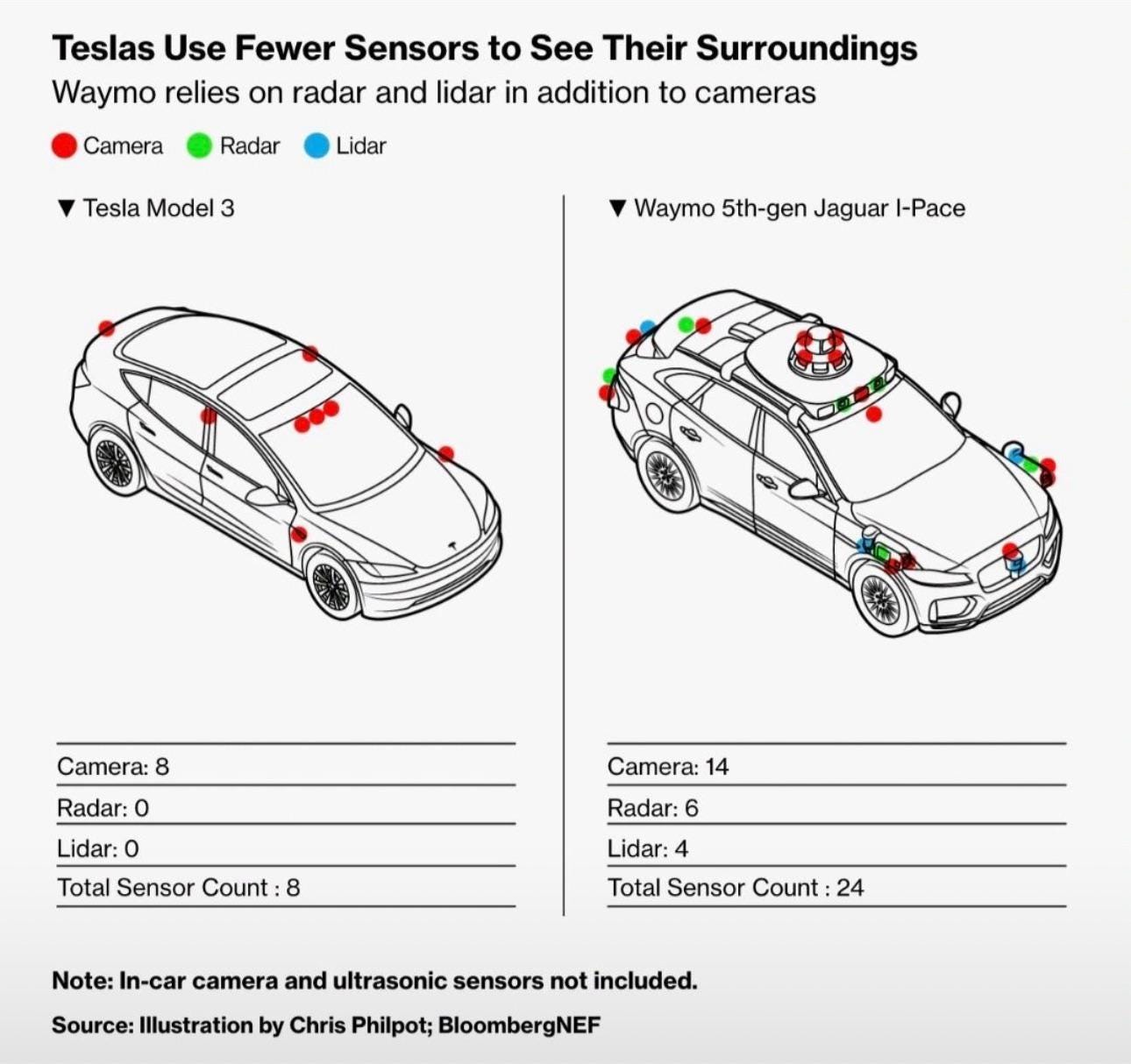
In the above image from BloombergNEF, we see a comparison of a Tesla vehicle versus a Waymo 5th-generation Jaguar robotaxi.
Tesla only uses 8 cameras, whilst Waymo uses 14 cameras, 6 radars, and 4 lidars, resulting in 24 total sensors!
Elon and Tesla bulls claim that their vision-only approach is cheaper and better at developing a generalized AI that can drive autonomously on all roads everywhere, whilst Waymo is just building a dumb robot that follows mapped routes and simple rules.
While there is some truth in that, I find this view simplistic and incorrect!
Firstly, the widely circulated claim that Waymo costs over $200K whilst Tesla costs $30K is complete nonsense. Waymo has significantly reduced the costs of its vehicles as lidar and radar costs have plummeted. While it is still much higher than Tesla, likely around $100K, the difference is not 7x as Tesla bulls suggest, and Waymo is rapidly innovating to reduce the cost.
Secondly, there is an assumption that there are no improvements in Waymo tech and processes, while in reality, the company is learning from each robotaxi city roll-out. As I mentioned in the Waymo section, after 10 years, they are in 5 cities, and next year, they plan to enter 5 more. The narrative that Tesla can just turn on robotaxis everywhere once the tech is ready is false. Regulators won’t allow it, and the AI needs additional custom training as well. It will take years of careful development before they enter new cities, just like Waymo.
Third, and likely most importantly, there are serious doubts in the industry that a truly autonomous self-driving vehicle can be developed with vision-only technology!
Elon and Tesla bulls say that “humans drive with only vision, so AI can too”, but I don’t support this argument. Humans are terrible drivers, as the millions of yearly deaths demonstrate. I thought the whole point of autonomy was to drastically improve the safety. A vision-only system makes significant errors during bad weather and night conditions, just as humans do.
Lidar provides accurate 3D data in poor lighting, and radar is great at depth estimation. Many experts believe that if we want a fully autonomous system that is perfect in all instances, including fog, rain, snow, wind, day, night, and unique edge cases, lidar and radar are a must. However, a key issue with having many sensors is that they often produce contradictory data, leading to sensor fusion conflict. Vision-only approach avoids it, but I think solving the sensor fusion conflict with AI could be easier and better in the long term than building a vision-only AI of comparable quality.
My opinion is that Elon is just too stubborn to admit his mistake and reverse course!
A key issue is that Elon has claimed that all vehicles Tesla has sold are able to be fully autonomous, and he has sold millions of vehicles with this promise. These vehicles lack lidar and radar, and thus would require costly upgrades. Tesla would have to pay for this, as otherwise owners would sue them.
When Elon made the decision to go with vision-only in 2019-2020, lidar was much more expensive than it is today!
It would not make any sense to manufacture cars that had thousands of dollars of equipment that won’t be used for many years. It would have cost Tesla billions of dollars and made their EVs more expensive, at a time when people were already complaining that EVs were too expensive. Let’s not forget that Tesla was barely profitable back then and needed all the funds they had to build the factories in Germany, China, and Texas. Thus, they decided not to equip their EVs with lidar and radar.
So Tesla is stuck now. Even if lidar prices are down 90% and it would be beneficial for the development of autonomous driving to use this technology, Elon can’t do it, because that would either mean reneging on the previous promise that all Tesla cars will be autonomous or paying billions of dollars to add this additional equipment to millions of Tesla cars on the road. Most crucially, it would mean admitting that he made a mistake.
Also, I find it likely that Tesla will struggle to convince regulators and the public that their vision-only systems are as safe as those with lidar and radar. Especially with his erratic behavior and involvement in politics, Elon has increased the required level of safety. Rightfully or not, regulators take into account the Elon factor in their Tesla autonomy technology reviews and deliberations. Personally, I find it extremely unlikely that Elon will get approvals for Tesla’s robotaxis in the EU, UK, Australia, and China.
However, there is one huge advantage that Elon indeed has.
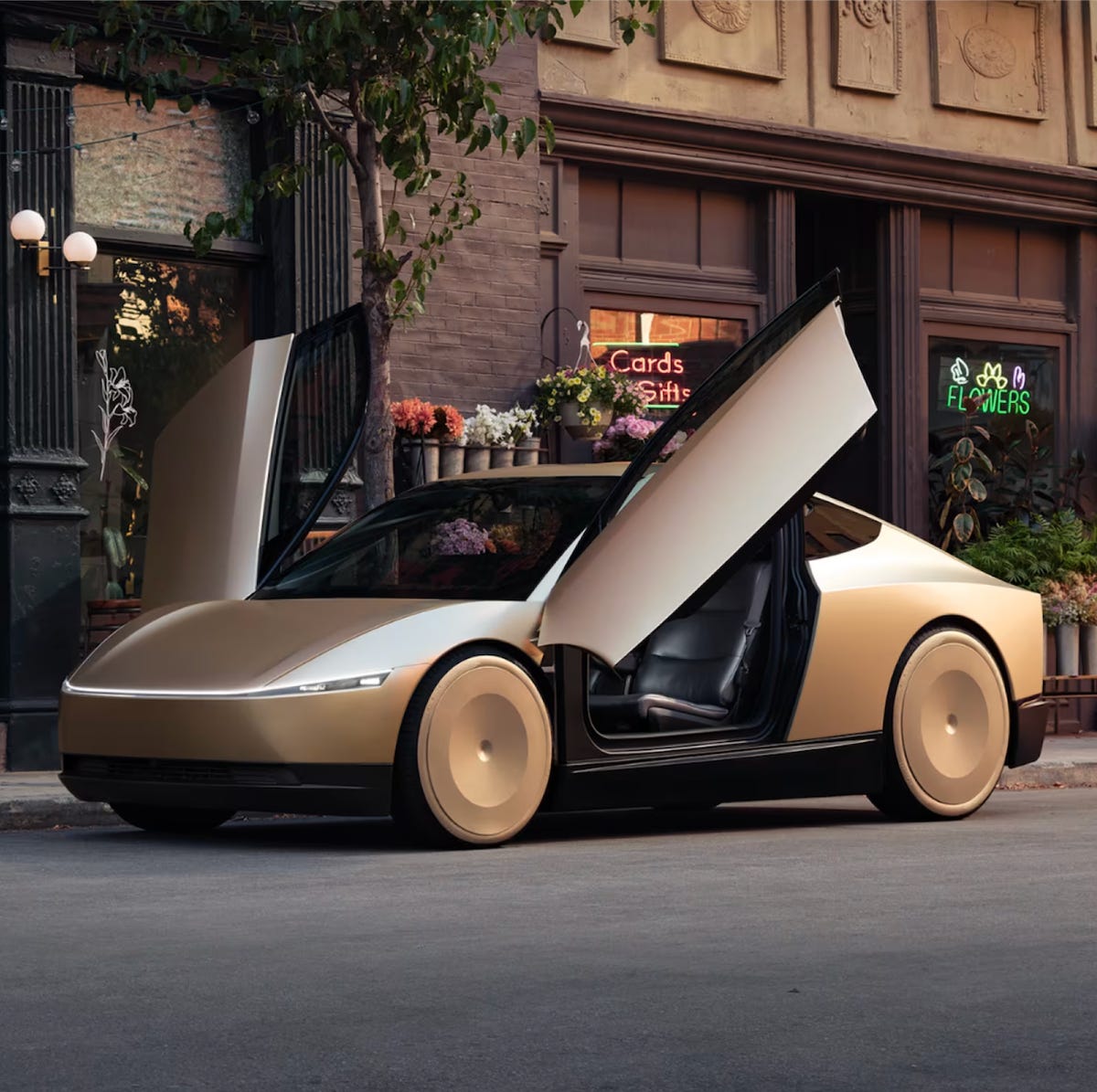
If he is right and vision only works, this purpose-built robotaxi vehicle will enable Tesla to make billions upon billions in profits.
If he is right, Tesla will become a $10T company as he promised!
Essentially, an investment in Tesla is an investment in Elon being right. Tesla is a rather asymmetric bet, either he solves autonomy in the way he intends and Tesla becomes a $10T company, or he doesn’t and the company is massively overvalued.
I am not willing to make that bet, but I have no issue with those who are.
4. Nebius’ Avride
Nebius has mostly been in the spotlight thanks to its fast-growing AI data center business. However, the company has a few interesting subsidiaries that could become major companies, but Avride, their autonomous driving technology venture, is what interests me today.
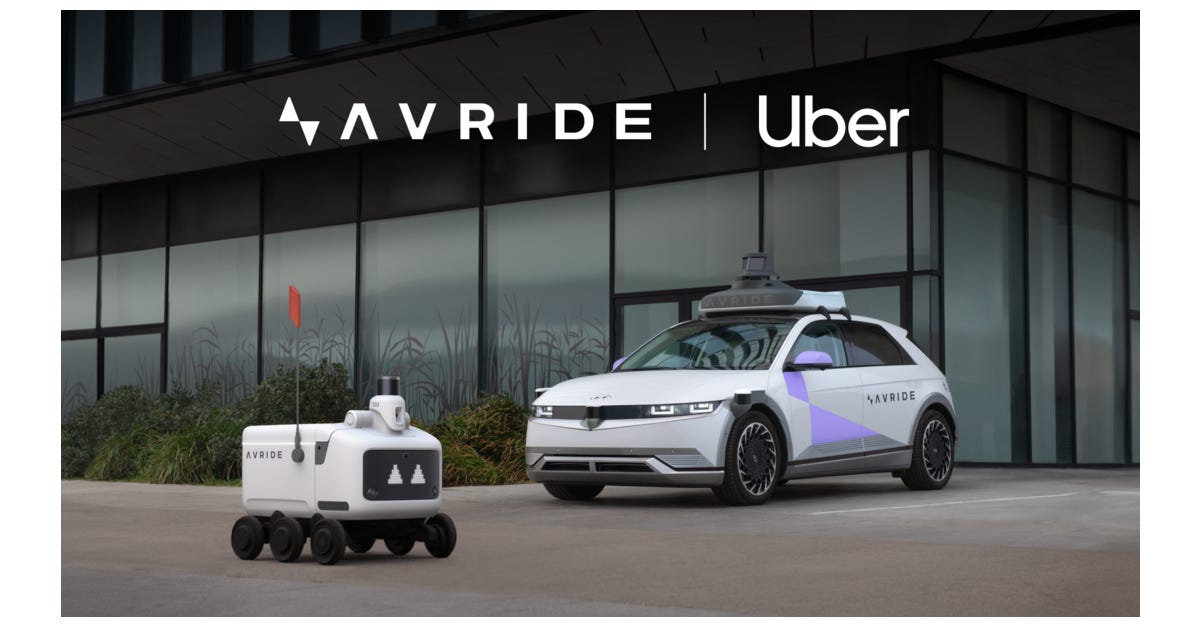
The company is working to develop what one could call a conventional, autonomously driven car for taxi services. But in addition to that, Avride is working on a unique solution that addresses smaller, shorter-distance delivery use cases.
A small autonomously driven sidewalk delivery robot that is designed to handle short distances in urban areas, and is perfect for food, mail, and package delivery!
Through their partnership with Grubhub, these food delivery robots are making around 1,200-1,400 deliveries a day at the Ohio State University campus, and recently, the company revealed that they have completed over 100,000 deliveries on said campus. The deliveries are made in around 15 minutes, drastically improving convenience and user experience.
Last month, it was announced that after the smashing success of this pilot, Grubhub is bringing this partnership to the University of Arizona!
If they can deliver 100,000 meals on a single campus, there is a potential for millions of deliveries if this technology is brought to thousands of large universities in the US and Canada.
Furthermore, Uber Eats is deploying Avride’s small autonomous delivery robots for food delivery in Dallas and Jersey City, in addition to Austin. This is going well, and companies are planning to enable grocery delivery as well.
Grocery delivery in urban areas using small robots is another multi-billion-dollar vertical!
Additionally, Avride and Uber are doing final testing to begin robotaxi services in Dallas by the end of the year. This would make Avride only the 3rd company doing paid robotaxi miles in the US, next to Tesla and Waymo.
Notice that here again, Avride is partnering with Uber and Grubhub, demonstrating that these apps could be highly attractive partners.
5. Amazon’s Zoox
Amazon entered the robotaxi wars in 2020 through their $1.2B acquisition of Zoox.
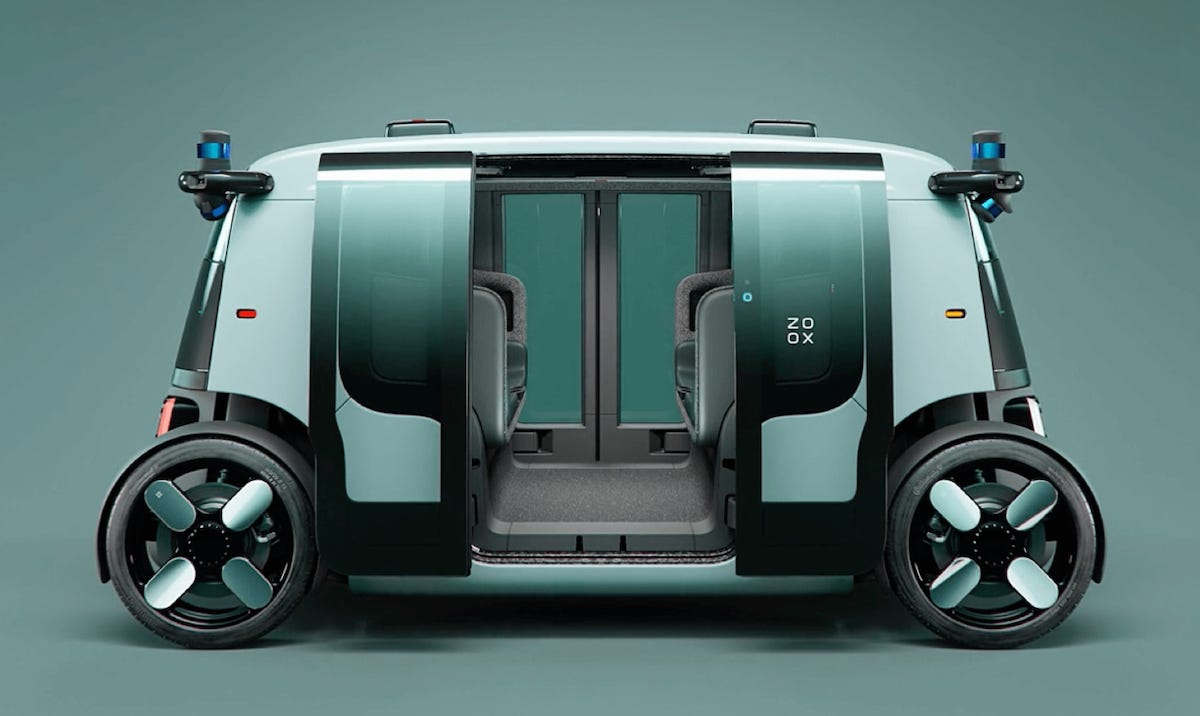
As you can see in the picture above, Zoox is taking a unique approach to other robotaxi companies. The company has designed a purpose-built robotaxi without a steering wheel, which from the beginning was meant for commercial use.
Airports
University campuses
Military bases
Logistics
Public transportation
Robotaxi
Recently, Zoox launched a public robotaxi service offering free rides in Las Vegas, with plans to commence paid services pending regulatory approval. While it is way behind Waymo and Tesla, I still thought that they deserve a separate mention because of their integration with Amazon.
Amazon has the capital and the ambition to rapidly accelerate robotaxi development!
Through their integration with AWS, Zoox has the potential to train AI models significantly cheaper than competitors, who need to rent compute at market rates. This is the same advantage that Waymo has.
However, in addition to AWS, Amazon has the potential to deploy its Zoox autonomous driving technology across its huge logistics network. Waymo and Tesla need to find trucking partners and agree on financial terms with them. Amazon can just use its own network to train Zoox.
6. Others
I choose to focus on these five companies, but there are a lot of other players.
As I mentioned in the Waymo section, Lyft has entered into an agreement with them as well. Lyft has large operations in the US and Canada and will surely follow Uber’s example of preparing itself for the eventual arrival of full autonomy.
Grab is sort of the “Uber of Southeast Asia”. Due to logistical, cultural, and financial reasons, Southeast Asia is ill-suited for robotaxis at the moment. Most cities are just too chaotic and difficult to navigate, with many local vehicles that I would describe as unconventional, bad roads, and heavy rains. However, robotaxis will arrive there too, just much later as AI gets better. Recently, Grab partnered with WeRide to begin deploying limited testing in Singapore, with potential for a full service in 2026.
The just-mentioned WeRide is a Chinese autonomous driving technology company that is partnering with Uber to launch a robotaxi service in the Middle East.
Another Chinese robotaxi company is Baidu, who have over 1,000 robotaxis in service across China.
Apple reportedly had an Apple Car division that focused on developing an EV and autonomous driving technology. Tim Cook lacked the ambition, so he shelved this project after spending a decade and a reported $10B. For the largest company in the world to do this was pathetic, and undoubtedly, Steve Jobs is rolling around in his grave.
GM’s Cruise went offline in 2023 after a series of crashes and huge losses.
There are hundreds of start-ups in this space, but so far, it is clear that China and the US are in the lead.
7. Final Thoughts
Uber offers a compelling value proposition to potential robotaxi partners.
“You bring autonomous driving technology, and we bring an already functioning app, a well-known brand, and relationships with millions of restaurants and customers.” Some Uber exec somewhere to potential partners.
While it does sound logical, I see a few issues with it.
Uber became a $100B+ global company by taking a middleman fee from the marketplace that connects supply and demand. They built this marketplace by burning tens of billions of dollars on subsidies for both sides.
Billions of dollars on bonuses to drivers to convince them to drive for Uber, and billions of dollars to customers in discounts so they pick Uber over a taxi.
This created a situation where, for a period of a few years, Uber drivers made more money than taxi drivers, whilst customers paid less for rides than a comparable taxi ride would cost.
This was done deliberately to create a network effect!
Drivers want to work for the service that has the most customers, whilst customers want to use the service that has the most drivers, leading to lower prices and shorter wait times.
The process of building the marketplace is complete, and now Uber is making large profits because it can lower pay for drivers and increase prices for customers. The network effects keep this functioning, as neither drivers nor customers have a better alternative.
But robotaxis completely destroy the supply side of the network effect!
Uber no longer has an advantage, as robotaxis will displace human drivers. Currently, Waymo, Avride, and others are partnering with Uber because their technology is not ready for mass deployment, as the AI requires lots of training.
But once that is done, what stops Waymo or Tesla from spending billions of dollars on marketing to acquire customers in the same way that Uber did?
Google’s Waymo and Tesla have the means to do to Uber what Uber did to the taxi industry, undercut it with lower prices to acquire customers. Tesla has the cost advantage by manufacturing its own vehicles, but Google’s Waymo has access to cheap cloud and advertisements on YouTube and Search.
I don’t believe that anyone is particularly loyal to Uber. If Waymo or Tesla offers a ride for $1 less, why would a customer pick Uber?
A common argument against this is that Uber will simply partner with other robotaxi companies, and Uber’s loyal customers will just use that service. So if Waymo or Tesla are not on Uber, their competitors will take that business.
But that assumes that autonomous driving technology will get commoditized and extremely easy to develop, making it easy for Uber to do so. But that certainly won’t be the case at the beginning, giving Tesla and Waymo a significant first-mover advantage. Also, this argument forgets the cost advantage that a scaled company, such as Google and Tesla, has over smaller rivals.
Another argument is that people don’t want to use multiple apps, and if Uber can aggregate services from lots of robotaxi companies, they will certainly have more supply, leading to lower wait times and a more convenient service for the customer.
As Uber’s rise in the first place demonstrates, people love convenience, and if Uber can offer a larger selection of vehicles from different suppliers, lower wait times, competitive prices, and a superior user experience, customers will choose them over an alternative.
If that is the result, then Uber wins big!
But Tesla and Waymo certainly want to cut Uber out and keep all 100%, instead of sharing a large slice with Uber. However, a robotaxi operator’s take rate is not the only factor that determines the income, volume does too.
100% from $1B is less than 60% from $5B!
We could also return to a situation where licenses to operate become a moat. Before Uber, NYC taxi licenses were valuable because the city regulated supply. Cities will likely return to this system, as if let operate without limits, robotaxi companies will just put as many cars as they can on the streets, completely clogging them.
In such a scenario, a company with a license for 100 robotaxis will want to deploy them in a way that maximizes earnings.
If they can make more money by deploying these robotaxis on the Uber app than operating independently, they will do so!
Another crucial area that I didn’t mention is the licensing of autonomous driving software. Sundar Pichai, the CEO of Google, said that Waymo could license their technology to automakers for deployment to their customers. This would create a new revenue source.
It could be that Waymo is not interested in the capital-intensive task of actually operating a robotaxi network. It could partner with legacy autos that lack the capital and technology known how to build a robotaxi network. Unlike Tesla, all legacy autos are mechanical engineering companies, not technology companies. Autonomous driving could completely disrupt their business model and make them obsolete. Elon has also said that he is not against licensing his FSD software to others.
Sales of legacy autos are collapsing in China, and now that their EV line-up can’t compete with Tesla and Chinese EVs, their bankruptcy seems just a question of when, not if.
Some of them might see a partnership with Waymo or Tesla as a last-ditch attempt at survival!
Could Waymo just license its software to VW for deployment on Uber? VW would manufacture the cars and manage the fleet, and place them on Uber using Waymo’s autonomous driving technology? In such a scenario, VW could keep 40% of the fare, and Waymo and Uber 30% each? The margins for Uber and Waymo would be incredibly strong, while VW would keep its 10% operating margin, as they do the lowest value-added service.
But the risk for Waymo is that if they don’t go direct to consumer, what stops Uber and VW from finding a different autonomous driving supplier that would do it cheaper?
If autonomous driving tech really becomes commoditized, then the customer relationship and the brand become the moat!
In such a scenario, should Waymo acquire Lyft, or do they just build up the Waymo brand?
In any case, I see going direct to consumer as a must for Waymo, otherwise, they invite competition from pure autonomy software providers.
Furthermore, as legacy automobile companies near bankruptcy, many will seek buyers, and Google could acquire one for the cheap and simply repurpose it for its robotaxi network. However, I find it extremely unlikely that Google will do so. These companies have been poorly managed for decades, are way behind Tesla and the Chinese, have terrible margins, and would only cause headaches for Google. It would be much cheaper and easier to simply contract one to make custom vehicles for Waymo.
In conclusion, the robotaxi war is only in its first mile in this marathon!
So far, Waymo is clearly winning, but it’s not always the fastest horse that wins the race. With its unique vision-only approach, Tesla could overtake Waymo if they are correct. Moreover, smaller pure-play autonomous driving start-ups such as Avride, WeRide, and the Chinese could challenge the industry.
Here is what my Premium Members can expect:
Top Monthly Picks - Each month, I will select a few stocks that I find likely to outperform.
These picks will focus more on short-term pricing movements and swift through market narratives.
Recent developments.
Unwarranted pullbacks.
Insider activity.
Potential catalysts.
Deep Dives – 8,000+ word detailed analysis of a company, delivered in 3 Parts.
Part 1 – Brief History of the company and its Business Model.
Part 2 – Management, Moats, Competitors, and Risks.
Part 3 – Opportunities, Financial Analysis, and a Valuation Model.
You can expect a comprehensive research report that is educational, interesting, and provides actionable insights!
To see what you can expect, read my Palantir Deep Dive!
Members of the Premium service get access to my library of 11 Deep Dives and to all future Deep Dives, which will be released on semi-monthly basis.
Investment Cases – A short, concise report with actionable insights.
This report is about the size of a single part of a Deep Dive.
Focused Investment Thesis
Main drivers of the Bull Case
Valuation Model
To see what you can expect, read my Oscar Health Investment Case!
Earnings Reviews and Updates – For companies that are of great interest to me and my readers, I will provide regular quarterly or semi-annual updates after earnings reports.
Financial performance
Business Update
New developments
Updated Valuation Model
To see what you can expect, read my Google Q2 2025 Earnings Review!
Pricing Structure
I strive to build a long-term relationship with my Premium subscribers, so I have chosen a pricing structure that emphasizes annual subscriptions.
The standard practice is to give 2 months free for annual plans, but I have decided to give 6!
Small note, please go to the website to purchase the subscription, as if you do it on the iOS app, you have to pay the 30% Apple Tax. (The plan cost more there)
Thank you for being a reader. I look forward to seeing you on Global Equity Briefing!
Equity Research Report List

You can follow me on Social Media below:
X(Twitter): TheRayMyers
Threads: @global_equity_briefing
LinkedIn: TheRayMyers
Disclaimer: Global Equity Briefing by Ray Myers
The information provided in the “Global Equity Briefing” newsletter is for informational purposes only and does not constitute financial advice, investment recommendations, or an offer or solicitation to buy or sell any securities. Ray Myers, as the author, is not a registered financial advisor, and readers should consult with their own financial advisors before making any investment decisions.
The content presented in this newsletter is based on publicly available information and sources believed to be reliable. However, Ray Myers does not guarantee the accuracy, completeness, or timeliness of the information provided. The author assumes no responsibility or liability for any errors or omissions in the content or for any actions taken in reliance on the information presented.
Readers should be aware that investing involves risks, and past performance is not indicative of future results. The author may or may not hold positions in the companies mentioned in the “Global Equity Briefing” report. Any investment decisions made based on the information in this newsletter are at the sole discretion of the reader, and they assume full responsibility for their own investment activities.
It's an interesting area and thanks for the work. I'm wondering if Elon is looking at the Optimus program. Have them drive the cars. Things are moving LITERALLY.
Excellent in depth review