
Grab Taiwan Entry: One-Off or A Blueprint For the Future?
Analysing Grab's $600M acquisition of Foodpanda Taiwan.

After rising $1.5B using convertible notes, Grab ended 2025 with $6.8B in cash!
Retail investors are not very patient, so for many months, Grab has been criticized for not putting its large cash balance to good use, and some even questioned why a profitable company would raise this much in the first place.
However, the funds were clearly intended to purchase its biggest competitor in Indonesia, Gojek.
While that deal has been rumored to be in the works for years, it seems Gojek will have to remain an independent company for longer, as any potential deal is stalled while Gojek goes through various scandals and government investigations.
Grab was forced to pivot and find another M&A target, and they finally did.
Grab is buying the Taiwanese food delivery business, Foodpanda, for $600M in cash!
With this deal, Grab takes a first step beyond its core region of Southeast Asia, expanding to a large, developed, and advanced economy of 23M people.
By stepping into Taiwan, Grab is testing its ability to compete in high-income, high-density markets outside its home turf.
In today’s report, I will analyze:
The strategic reasons for the deal
The current state of the industry in Taiwan
How this could serve as a blueprint for Grab to enter other countries
1. The Deal
The acquisition is a cash deal worth $600M, where Grab will take over Foodpanda’s entire delivery business in Taiwan from its parent company, Delivery Hero.
This transaction is expected to close in the second half of 2026, and Grab expects to migrate all customers, merchants, and driver partners to its app by the end of 2027.
The strategy behind this deal is built on three main pillars:
Geographic expansion
Financially accretive
Tech synergies
First, Taiwan represents Grab’s ninth market and its first venture outside of Southeast Asia!
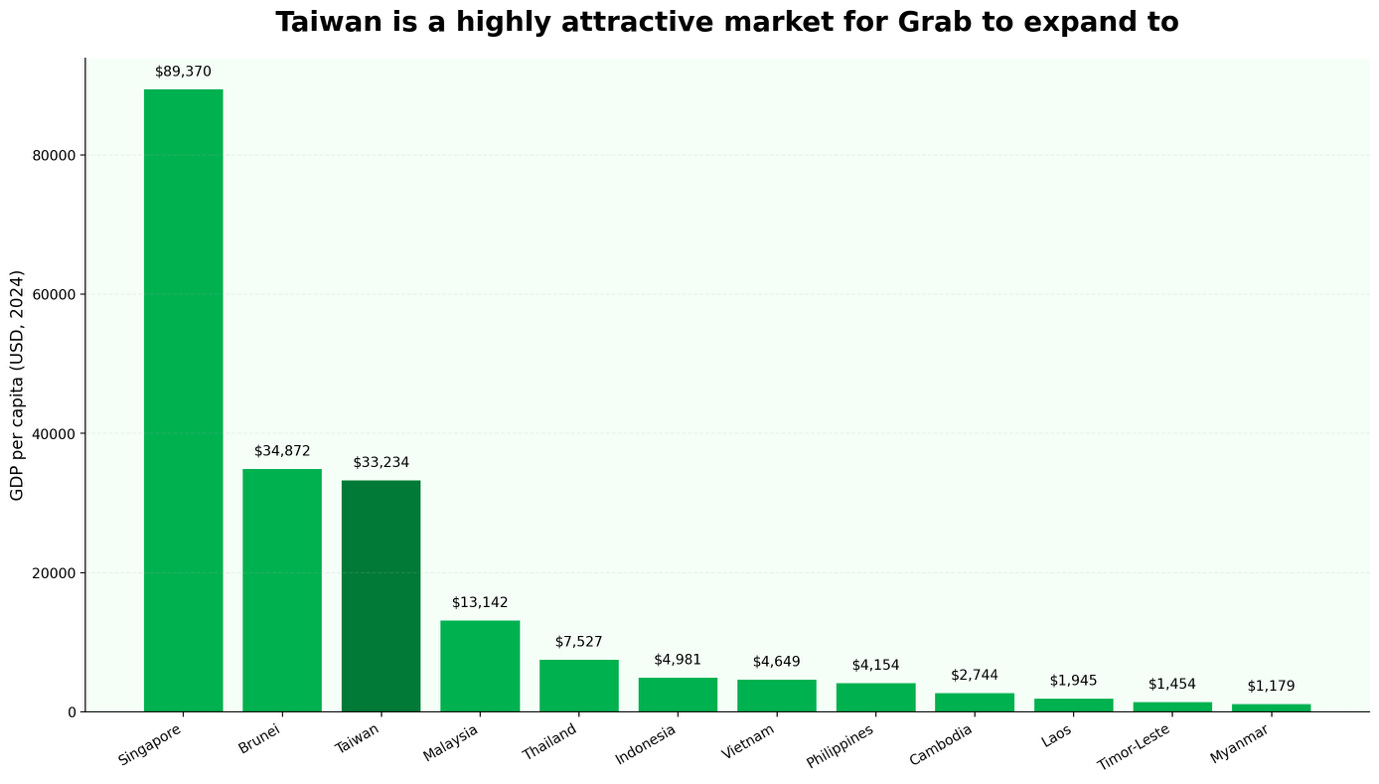
Taiwan is an attractive market because of its incredibly strong economy and very dense cities. In 2025, Taiwan’s economy grew by 9%, and it had a GDP per capita of over $30K, much higher than all of Grab’s current markets, except Singapore.
Second, Grab is looking for assets that are already accretive to the bottom line!
Foodpanda Taiwan generated about $1.8B in GMV in 2025 and was profitable on an ADJ EBITDA basis, excluding Delivery Hero HQ costs. This acquisition will increase Grab’s 2025 $22.1B GMV by about 7%. Grab expects that after synergies and consolidation costs, this unit will generate $60M in ADJ EBITDA in 2028.
While adding this to its book will help Grab reach its goal of tripling ADJ EBITDA to $1.5B by 2028 more easily, it won’t be a huge contributor.
The price is a bargain compared to Uber’s previous attempt to buy the business.
Uber offered $1.25B for in 2024 but failed because Taiwan’s antitrust regulator blocked it over competition concerns. They argued the combined company would control 90% of the market, potentially leading to higher prices and reduced competition.
Third, Grab believes its technology can make Foodpanda even better.
Grab has spent years perfecting AI for routing and mapping in complex and highly dense cities like Jakarta, Manila, and Bangkok. By bringing these tools to Taiwan, Grab can reduce the time it takes for a rider to deliver food, which makes both customers and restaurant partners happier.
Of course, if they are successful, then Grab will significantly increase GMV and earnings.
2. Foodpanda Presence in Taiwan
Foodpanda is currently a dominant force in the Taiwanese delivery market. It operates in 21 cities across the island, providing a network that reaches almost the entire population.
This wide reach is why Grab was willing to pay $600M for it.
Essentially, Grab believes that it can significantly increase the GMV by more effectively competing in this market.
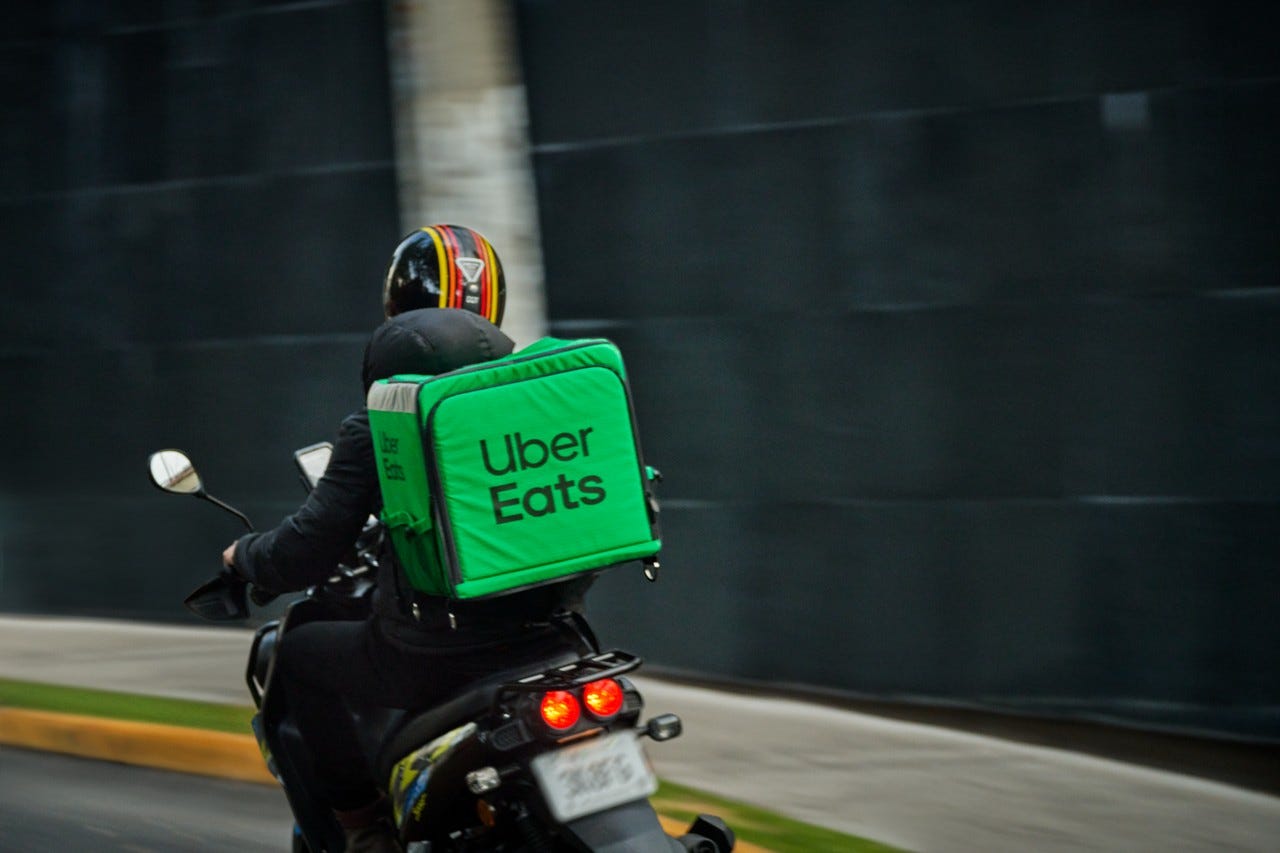
In the battle for Taiwan’s delivery market, Foodpanda holds a slight lead over its biggest rival, Uber Eats.
Analysts at Momentum Works estimate that Foodpanda has a 52-55% market share in Taiwan.
This position is supported by a very loyal group of users who use the pandapro subscription service.
About one-third of Foodpanda’s customers in Taiwan are subscribers, and these people are responsible for more than half of the total money spent on the platform. This creates a steady stream of income that Grab can rely on and mirrors Grab Unlimited strategy.
Taiwan’s food delivery market is essentially a two-horse race, with Uber Eats holding an estimated 48-45% market share.
3. Taiwan’s Ride-Hailing Industry
Meanwhile, the ride-hailing market in Taiwan is very crowded.
There are three main players that control most of the business: Taiwan Taxi, LINE GO, and Uber.
Taiwan Taxi: This is the traditional leader. They have a massive fleet of yellow taxis and have built a very successful mobile app to keep up with modern technology.
LINE GO: This is a very strong competitor because it is built into the LINE messaging app, which almost everyone in Taiwan uses. It is a joint venture between the tech company and local taxi groups.
Uber: After struggling with financial lossesf or many years, Uber now operates a stable business and is a cash flow-generating machine.
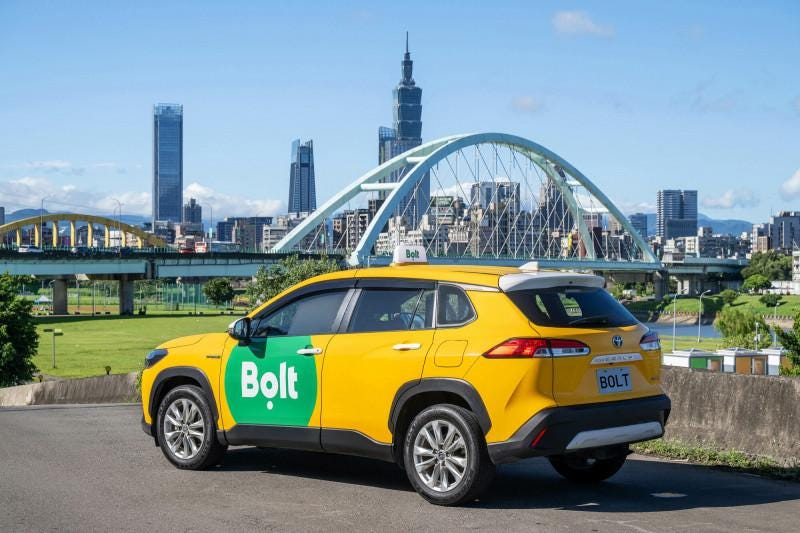
In 2025, a new player named Bolt entered the market, which has made competition even more intense.
The ride-hailing market continues to grow as more people in cities choose not to own cars because of high costs and a lack of parking.
4. Taiwan Opportunity
Grab’s real goal in Taiwan is not just delivering lunch. It wants to build a full superapp that captures more of customers wallet share.
Once Grab has millions of people using its app for food, it can easily offer them rides and more.
Grab is already known as the king of ride-hailing in Southeast Asia and has a lot of experience and tech know-how to build a great network.
However, Grab is unlikely to build a new ride-hailing network from scratch!
That would be difficult and very expensive.
Instead, it would probably partner with existing local taxi companies, just like Uber and LINE GO have done. This allows Grab to follow local rules while still providing a fast and reliable service using its own dispatching technology.
This partnership-led approach would allow Grab to offer a full suite of mobility services to its users without the significant capital expenditure and regulatory risk associated with managing a massive independent driver network in a mature market.
While the market is incredibly competitive, I believe it must and ultimately will expand beyond just food delivery, because of the risk of losing customer mind share!
If Grab doesn’t have ride-hailing in its app, customers will be forced to use Uber or others. So Grab would essentially force its people to use a competing product. Now, once they have the Uber app, what stops them from using Uber Eats?
People are creatures of habit, and while many of us always price compare, the reality is that a lot of people don’t, and these are the most profitable users.
In a sense, ride-hailing is a low-margin customer acquisition service to get food delivery, mart, quick commerce, and fintech customers.
These activities have higher margins and stronger customer loyalthy that taxi rides. But taxi rides are crucial to attract customers to the app, to use these more profitable services.
Taiwan has a very high number of convenience stores like 7-Eleven and FamilyMart. Grab can expand into grocery delivery by partnering with these stores to deliver items like milk, snacks, and toiletries in 30 minutes or less. This is a high-growth area that Foodpanda has already started, but Grab has the tech to take it to the next level.
Another opportunity is to expand its fintech division!
Taiwanese consumers are very comfortable using mobile phones for payments. Grab has a financial services division that’s growing rapidly. However, unlike most of Southeast Asia, Taiwan is an advanced economy where financial services are easily available.
This makes the financial services industry more competitive, so simply offering a digital wallet won’t be sufficient. Grab needs to offer innovative and high-quality services to attract customers.
Also, let’s not forget about the tourists!
The integration of tourism-related synergies also presents a significant upside. Approximately 30% of visitors to Taiwan in 2025 originated from ASEAN countries, a demographic that already uses the Grab app in their home markets. By owning the dominant delivery infrastructure in Taiwan, Grab can offer these travelers a familiar interface for discovering local cuisine, thereby increasing its transaction frequency among existing users as they move across borders.
However, during the deal presentation press conference, the company said that for now, they are focused on closing the deal and integrating Foodpanda, and they won’t comment on ride-hailing or financial services expansion.
Do you like this report?
Become a Paid Premium member to see dozens of exclusive pay-walled equity research reports such as this.
Curious about which stock I own?
Full portfolio with all holdings, cost basis, and unrealised gains is visible to Premium members. I do weekly updates and detailed monthly reviews. Premium members are also notified of all sales and purchases using the pay-walled Substack Chat.
The annual plan is available 50% cheaper than the monthly plan.
5. Blueprint for the Future
Could the Foodpanda Taiwan deal serve as a blueprint for future M&A?
This strategy is much faster and less risky than trying to build a new business from the ground up.
The blueprint could follow a simple set of steps:
Find a strong local player: Look for the company in first, second, or third place in a country’s delivery or ride-hailing market.
Buy the business at a fair price: Use cash to take over an asset that is already running and has many customers.
Upgrade the technology: Introduce Grab’s AI, mapping, and logistics tools to make the local business more efficient.
Add new services: Once the customers are on the new Grab app, start offering rides, groceries, and financial products.
This model could work best in countries that have a large population and a growing middle class who want to save time.
When looking at where Grab might go next, we must evaluate different regions based on their current competition and how well Grab’s technology would fit.
Let’s look at two potential countries:
5.1. Bangladesh
Bangladesh is an emerging market country with a huge population of 176M people, and could be quite an exciting opportunity for Grab.
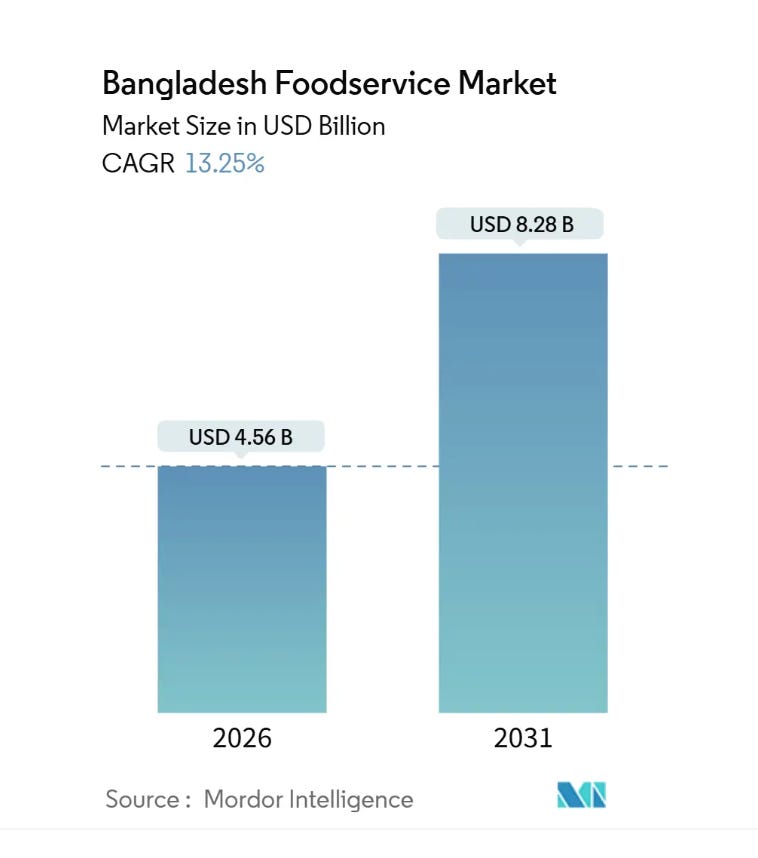
Per Mordor Intelligence, the food delivery market is expected to grow with a 13% CAGR, reaching $8.3B in 2031.
The market is currently a battle between Foodpanda and a local company called Pathao. Foodpanda has about 65% of the market and operates in 64 districts. Pathao is a local success story that offers rides, food, and logistics.
Grab could acquire Pathao, which recently raised $12M to build its own financial services. Pathao is already profitable, which makes it a perfect stepping stone for Grab to enter South Asia.
Or it could continue its history with Delivery Hero and buy Foodpanda Bangladesh.
In Bangladesh, the digital economy is booming. More than 70M people now use mobile money services.
This means people are ready for a superapp that combines payments with delivery.
Pathao is the perfect partner for Grab because it has already done the hard work of building a brand that people trust. Unlike Foodpanda, which spent millions on discounts to get users, Pathao focused on providing good service and building a local network of restaurants.
If Grab bought Pathao, they would not only get a ride-hailing and food business but also a gateway into the lives of millions of young Bangladeshis who are looking for their first bank account or credit card.
5.2. Sri Lanka
Sri Lanka is another logical choice because its market is dominated by a company that already operates just like Grab.
The leader is PickMe, which holds 70% of the ride-hailing market and about 45% of the food delivery market. Its main rival is Uber.
PickMe is a very healthy business. In 2025, its revenue grew by 51%, and it paid out dividends to its shareholders. Grab could buy PickMe to immediately become the number one player on the island.
Sri Lanka is a smaller market than Bangladesh, but it is more advanced in how it uses technology for transport. PickMe has succeeded because it understands the “tuk-tuk” economy better than anyone else. They have over 100,000 drivers on their platform.
For Grab, Sri Lanka would be a safe bet. PickMe’s net profit grew by 84% in a single quarter in 2025, reaching 514M rupees. By bringing Grab’s AI dispatching and mapping to PickMe, Grab could help the company grow even faster in rural areas where demand is still untapped. This would be a high-margin business that provides steady cash for Grab’s other projects.
6. Conclusion
The acquisition of Foodpanda Taiwan for $600M is much more than a simple business purchase.
It is a bold statement that Grab is ready to compete on the global stage in more economically developed markets.
By acquiring a profitable market leader and upgrading it with world-class technology, Grab has created a clear blueprint for expansion.
As this report has shown, the opportunity in Taiwan is vast, it is a large, economically developed, and fast-growing country.
But the real excitement lies in what comes next. By following this same blueprint in countries like Bangladesh and Sri Lanka, Grab could transform itself from a Southeast Asian success story into a global superapp powerhouse.
The journey from Singapore to Taipei could be just the beginning.

Here is what my Premium Members can expect:
Portfolio Review - Each month, I will present the portfolio performance and discuss my stock watchlist and my best ideas.
Recent developments.
Unwarranted pullbacks.
Insider activity.
Potential catalysts.
Deep Dives – 8,000+ word detailed analysis of a company, delivered in 3 Parts.
Part 1 – Brief History of the company and its Business Model.
Part 2 – Management, Moats, Competitors, and Risks.
Part 3 – Opportunities, Financial Analysis, and a Valuation Model.
You can expect a comprehensive research report that is educational, interesting, and provides actionable insights!
To see what you can expect, read my Palantir Deep Dive!
Members of the Premium service get access to my library of 11 Deep Dives and to all future Deep Dives, which will be released on semi-monthly basis.
Investment Cases – A short, concise report with actionable insights.
This report is about the size of a single part of a Deep Dive.
Focused Investment Thesis
Main drivers of the Bull Case
Valuation Model
To see what you can expect, read my Oscar Health Investment Case!
Earnings Reviews and Updates – For companies that are of great interest to me and my readers, I will provide regular quarterly or semi-annual updates after earnings reports.
Financial performance
Business Update
New developments
Updated Valuation Model
To see what you can expect, read my Google Q2 2025 Earnings Review!
Equity Research Report List
You can follow me on Social Media below:
X(Twitter): TheRayMyers
Threads: @global_equity_briefing
LinkedIn: TheRayMyers
Disclaimer: Global Equity Briefing by Ray Myers
The information provided in the “Global Equity Briefing” newsletter is for informational purposes only and does not constitute financial advice, investment recommendations, or an offer or solicitation to buy or sell any securities. Ray Myers, as the author, is not a registered financial advisor, and readers should consult with their own financial advisors before making any investment decisions.
The content presented in this newsletter is based on publicly available information and sources believed to be reliable. However, Ray Myers does not guarantee the accuracy, completeness, or timeliness of the information provided. The author assumes no responsibility or liability for any errors or omissions in the content or for any actions taken in reliance on the information presented.
Readers should be aware that investing involves risks, and past performance is not indicative of future results. The author may or may not hold positions in the companies mentioned in the “Global Equity Briefing” report. Any investment decisions made based on the information in this newsletter are at the sole discretion of the reader, and they assume full responsibility for their own investment activities.