
Nebius Q2 2026: Arkady Delivers Again!
Nebius continues to execute flawlessly across the board.

This was yet another stellar quarter from Arkady and the Nebius team:
Capacity guidance increased from 4GW to 5GW.
New sites in the UK, Estonia, and Finland.
AI Cloud revenues up 454% Y/Y.
50% AI Cloud ADJ EBITDA margin.
New additional business model.
The company announced plans to offer its AI cloud platform to infrastructure investors who want to own the hard data center assets, but don’t want to build the software stack. This could help the company generate additional asset-light, high-margin revenues from its AI cloud stack.
The market loved this quarter, sending the stock up over 30%!
Last quarter, I published my Nebius 2030 valuation model, which by now seems already outdated.
As such, I have decided to create a new one, with improved assumptions.
But before that, let me look at a few of the most important things announced in this earnings release.
1. New Business Model Addition
This quarter, Nebius announced an additional new business model of asset-light partnerships.
Now the company operates 3 different AI cloud business models:
1. Owned Data Centers
2. Colocation
3. Asset-light partnership model
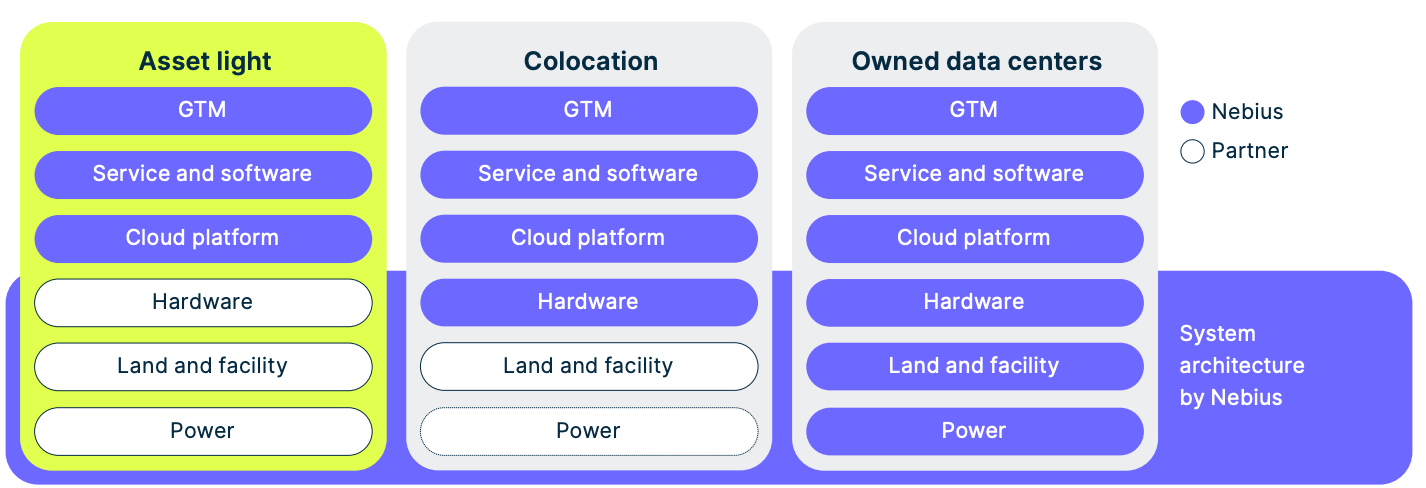
The 1st model relies on fully owned and operated data centers.
This approach requires the highest level of Capex, as the company must purchase land, construct the physical buildings, secure power connections, and install all necessary hardware, including servers, networking equipment, and cooling systems.
However, the advantage of the owned model is total control over the infrastructure architecture. AI workloads, running on advanced Nvidia GPUs such as Blackwell and Vera Rubin, require highly specialized environments.
By building from the ground up, Nebius can implement specific AI solutions that maximize the performance and lifespan of the hardware.
The 2nd model is colocation!
In this model, Nebius does not build the actual data center. Instead, the company leases space, power, and cooling capacity from existing 3rd-party data center operators. Nebius then brings in its own server racks, networking gear, and software stack.
Colocation allows the company to move much faster than the owned model.
Constructing a new facility can take years due to permitting, land, and construction timelines.
Colocation allows Nebius to bypass these steps and bring capacity online in a matter of months. This speed to market is essential in the current AI environment, where customer demand heavily outweighs available supply.
The 3rd and newest business model introduced in Q2 2026 is the asset-light partnership model.
This model marks a significant shift in how an AI Cloud business can be scaled globally.
Because the demand for AI compute is so vast, building enough data center infrastructure requires a lot of capital that is difficult for Nebius to raise. The asset-light model is meant to address this problem.
In this model, others take on full responsibility for financing, building, and owning the data centers.
These partners provide everything physical, land, buildings, power, GPUs, memory, and all equipment. Simply put, the partner takes on all the heavy capex burden, not Nebius.
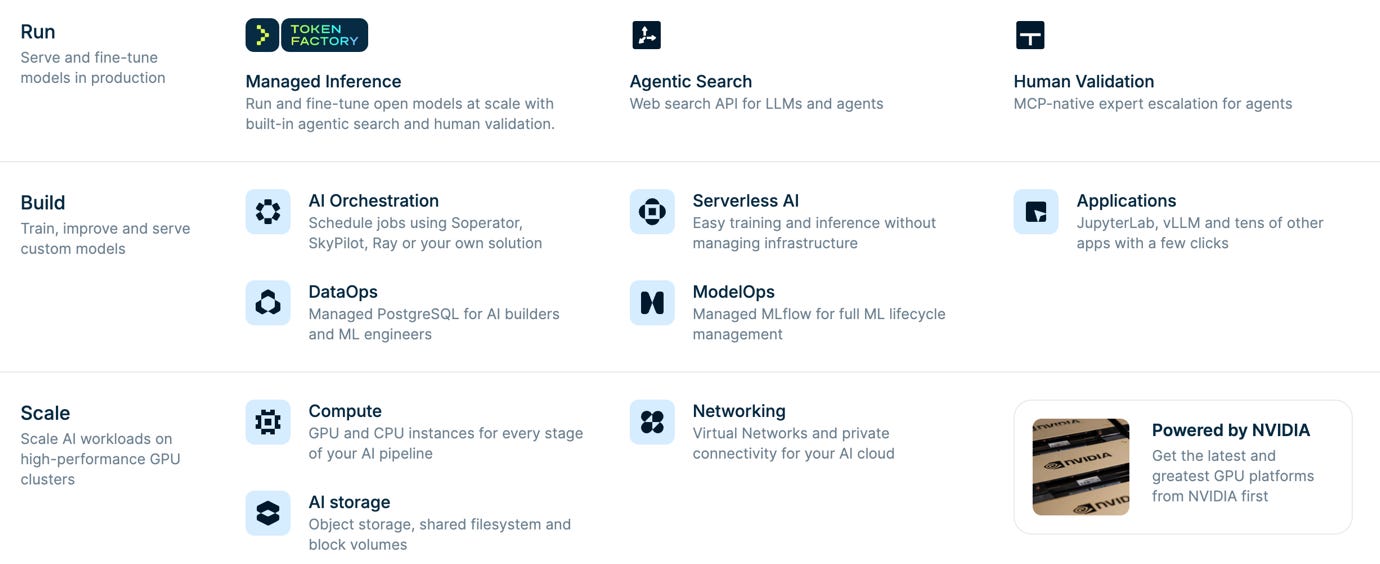
In return, Nebius provides its complete AI software ecosystem!
“We provide value-added services that sit on top of our partners’ infrastructure, which delivers us with high-margin revenue and requires minimum balance sheet capital. This model has the potential to unlock new capacity for us in 2027 and beyond.” Arkady Volozh, CEO, Q2 2026 Earnings Call.
Nebius deploys its proprietary software stack, known as Aether 3.6, onto the partner hardware and integrates it into the global Nebius capacity pool.
Most importantly, Nebius brings the customer demand, acting as the sales team.
Because Nebius operates a global sales organization with a massive backlog, it can immediately route high-paying customer workloads to the partner infrastructure as soon as it goes live.
Nebius aims to create a highly beneficial relationship for both parties, a win-win partnership.
Real estate developers and infrastructure investors have capital and access to power, but they lack the specialized know-how and relationships with top-tier AI developers.
By partnering with Nebius, these investors gain a route into the highly lucrative AI cloud market and can begin generating a return on their capital.
This transforms a part of the business from a capital-heavy infrastructure business into a high-margin software company.
As Nebius doesn’t need to pay for all the hard and expensive assets, the revenue generated by this AI cloud model will have significantly higher margins. I would compare it to a franchise model.
When McDonald’s received a $1 franchise fee from its franchisees, most of it is pure profit as they don’t have to build the restaurant and pay for the potatoes. Similarly, when Nebius receives $1 from the new asset model, a larger share of it will be profit as they don’t have to pay for the data center, they only need to pay for the tech and sales teams.
By utilizing partner hardware, Nebius generates high-margin revenue streams with minimal incremental capital requirements on its own balance sheet.
This allows the company to scale its capacity and revenue much faster than if it were relying solely on its own capex.
Essentially, Nebius is copying the Microsoft playbook, where Microsoft pays for bare-metal rental of equipment and then earns AI cloud software revenues.
Similarly, as when Microsoft pays Nebius and Iren to rent Nvidia GPUs on a per-hour basis, Nebius will do that to other partners.
Management noted that they are exploring various economic arrangements under this model, including revenue-sharing agreements, licensing fees, and commissions.
“After we announced our asset-light model, we have had dozens of inquiries from potential partners who have significant capacity and enough capital, but do not know how to build and how to sell it. With GPUs increasingly becoming an investable asset... we expect more and more companies who will want to come to the market but will need our help to deliver this capacity to customers.”
“By having the right tech platform and access to the market, we can help them... The model is still in a very early stage, but we are very much encouraged by early signs and think that it has great potential.” Arkady Volozh, CEO, Q2 2026 Earnings Call.
There is huge interest by large institutional investors who want to participate in the AI infrastructure boom. Because this segment will have much higher margins, it is clear that my margin estimates for 2030 are way too low.
2. Customer Pricing
The company is in an AI market where demand for compute significantly outpaces supply.
Rather than simply contracting away all future capacity as quickly as possible, the company is delaying deals to maximize the revenue per MW.
“Most importantly, we could sell today our entire 2027 capacity on these terms if we wanted to. We are not doing this. We see that we can achieve higher value by retaining some capacity to serve shorter-term and immediate client needs.” Arkady Volozh, CEO, Q2 2026 Earnings Call.
The company could sell all its capacity today if it wanted to, but they are choosing not to do it, as short-term agreements to smaller clients generate a better return from each MW of capacity.
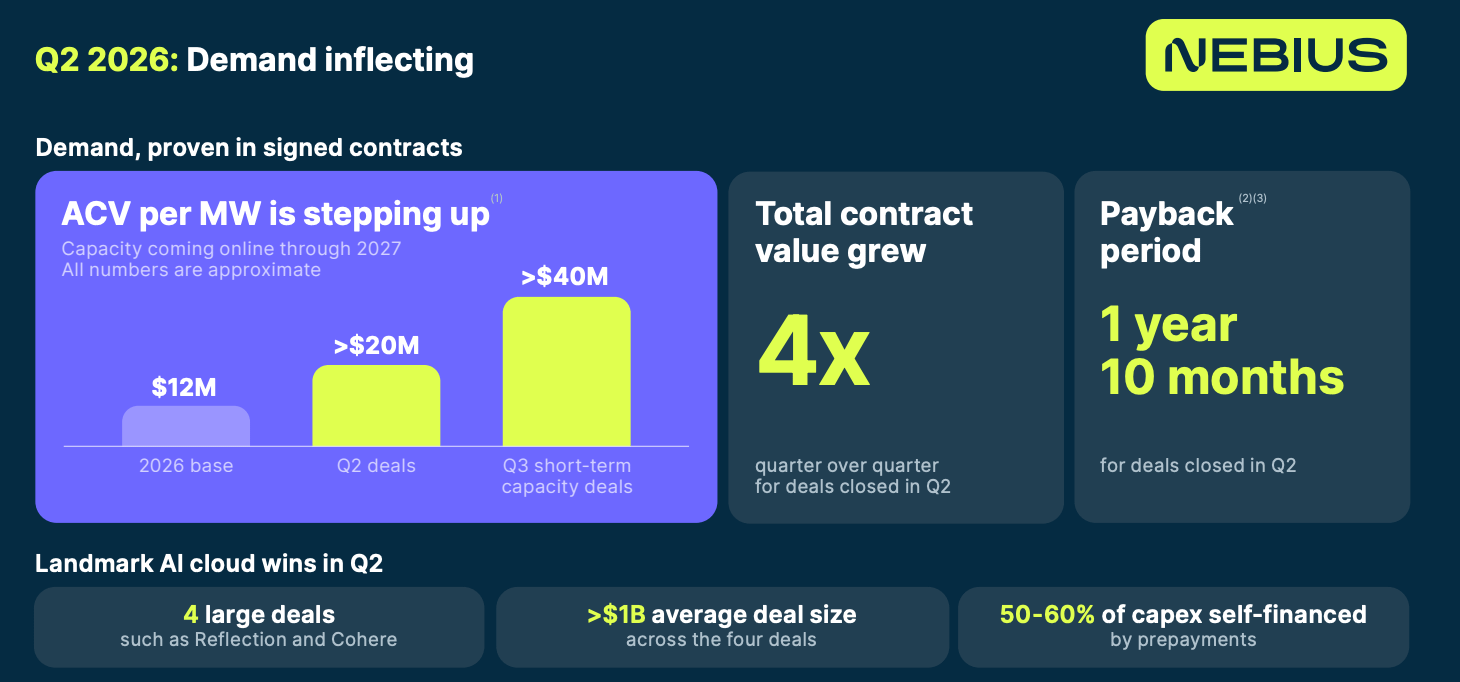
Long-term contracts generated about $12M per MW in annual contract value in the company’s earlier agreements in 2026.
However, deals signed in Q2 2026 are for more than $20M per MW, significantly higher than just a few months ago.
The company is currently selling out of new capacity as fast as it comes online. As I said, they could easily sell all; however, doing so would lock the company into current market rates and prevent them from capturing the premium pricing available from customers who require immediate access to compute.
By strategically retaining a portion of their capacity for later, the company can increase the revenue per MW to above $40M per MW.
If this is not impressive enough for you, Nebius already indicates that it is getting better in Q3.
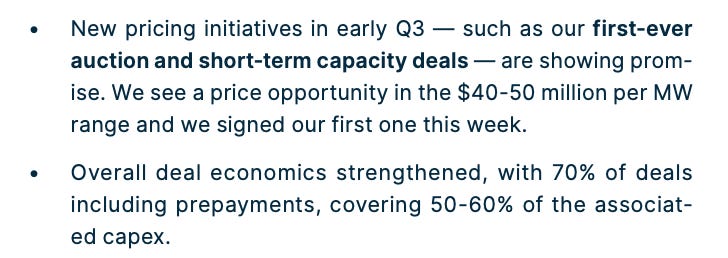
They had an auction for short-term capacity deals, where they see an opportunity for even $50M per MW. For comparison, I estimated that their $17.4B 5-year deal with Microsoft generated about $11M ARR per MW. So, these short-term deals are 5x better per MW. Additionally, 70% of these deals had pre-payments, generating about 50-60% of the capex required to serve these deals.
The demand is simply extraordinary!
Nebius has now structured its business in 3 parts:
1. Long-term deals
2. Mid-term deals
3. Short-term deals
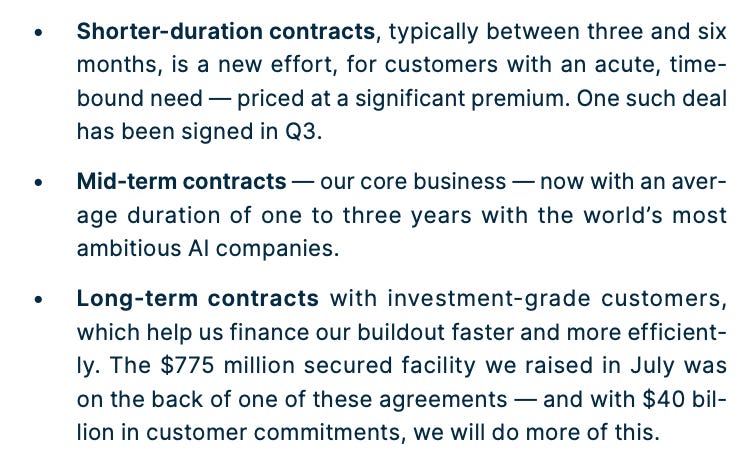
Long-term deals last at least 5 years, such as the $17.4B deal with Microsoft and the $27B deal with Meta.
These deals serve as a foundation of the AI cloud business. The dollar per MW yield on these long-term mega-deals is much lower than spot-market rates due to volume discounts. However, these deals are essential for funding the initial capex to build the company’s owned and colocation data centers.
Mid-term contracts are more profitable. These agreements typically have a duration of 1 to 3 years and are signed with some of the most well-funded AI start-ups in the world.
Nebius signed 4 large deals this quarter, worth over $1B each on average.
As a result of improving terms, the capex payback period for deals signed in Q2 has now reduced from 2-3 years before to 1 year and 10 months. Absolutely incredible.
The 3rd type of pricing strategy is the shorter-term contracts.
These are highly lucrative agreements that last up to 6 months.
Nebius will now reserve a portion of its active capacity to serve these specific deals. The target audience for this capacity includes customers who have immediate, time-sensitive need for a lot of compute power.
This could be a company needing to finish training a specific AI model on a tight deadline, or an AI video company such as Higsfield dealing with a surge in traffic. Or it could also be a large mature enterprise testing Nebius service quality before signing a long-term agreement.
Nebius is also achieving these higher prices thanks to significantly better utilization of older GPUs than previously believed.
“We launched our first capacity auction. It was very successful and cleared at the highest price we have seen for the Blackwell generation of chips, 15% above the highest price we ever charged before.” Arkady Volozh, CEO, Q2 2026 Earnings Call.
For context, Blackwell is the 2024 generation and Nebius secured prices that were 15% higher than the previous all-time high for the company. This is alleviating some concerns that investors were having about the utilization of older infrastructure as Nvidia releases newer chips.
This week, Coreweave reported that they have contracted some A100 chips till 2029. These were originally released in 2020, so there is demand even for older chips.
However, this doesn’t mean that we can adjust depreciation schedules from 5 years to 9. Most likely a small share of chips would survive that long, as many of them would break. Nevertheless, this is a clear signal that bears who claimed that GPUs’ useful lives are now 1-2 years in the AI era were clearly wrong.
3. Q2 2026 Financial Results
ARR: $3B +598% Y/Y
Revenue: $582M +454%, vs $574M estimate. BEAT
ADJ EBITDA: $236M +1,225%, vs $173M. BEAT
ADJ EPS: -$0.68 vs -$0.70. BEAT
GAP Net Income: -$190.4M
In short, Nebius grew faster than expected and demonstrated significantly better profitability.
3.1. ARR
ARR grew by 598% Y/Y, 56% Q/Q to $3B!
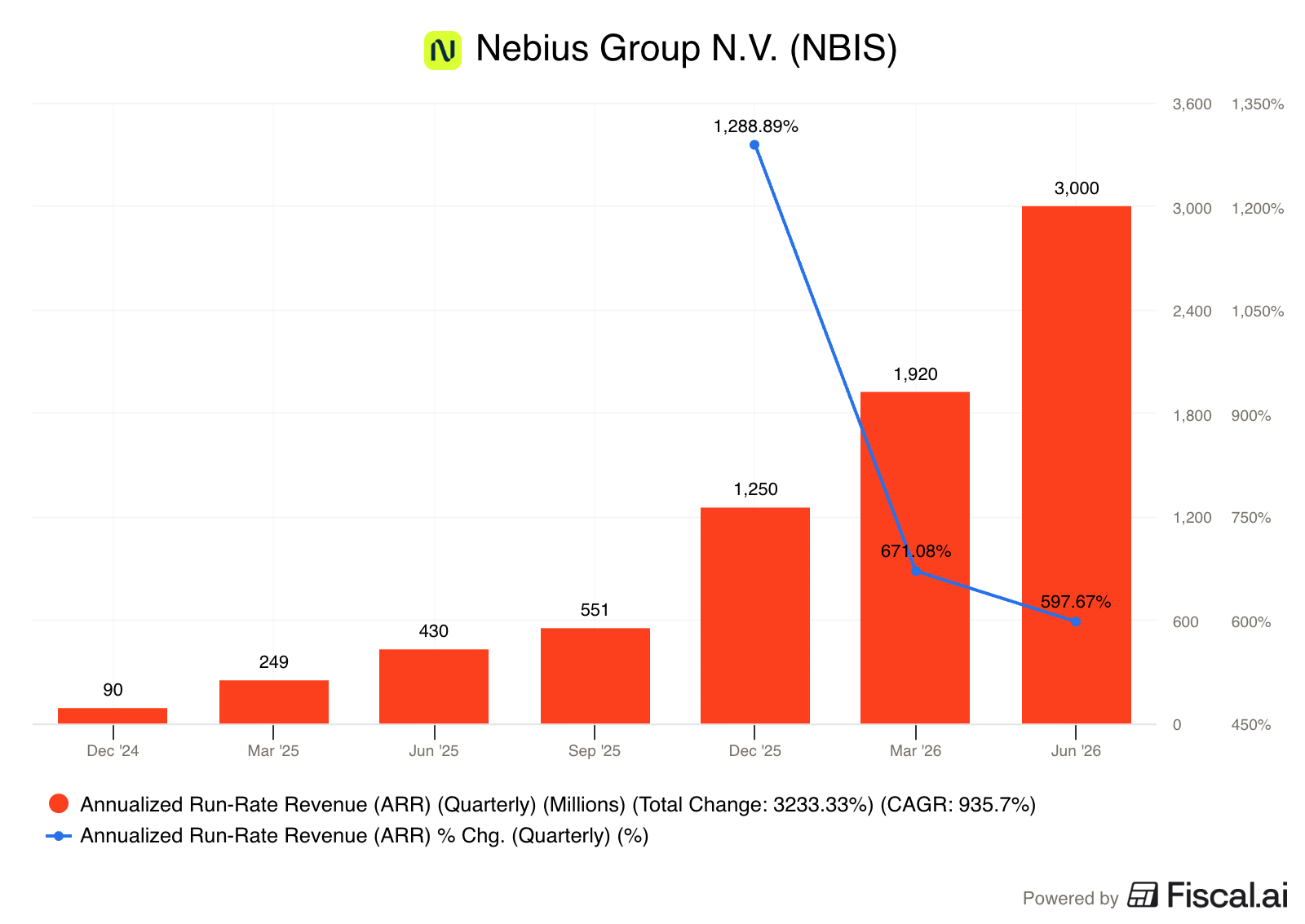
ARR is calculated by multiplying last month’s revenues by 12.
This means that Nebius June revenues were $250M, compared to $104 in December 2025. 140% growth in monthly revenues in just 6 months.
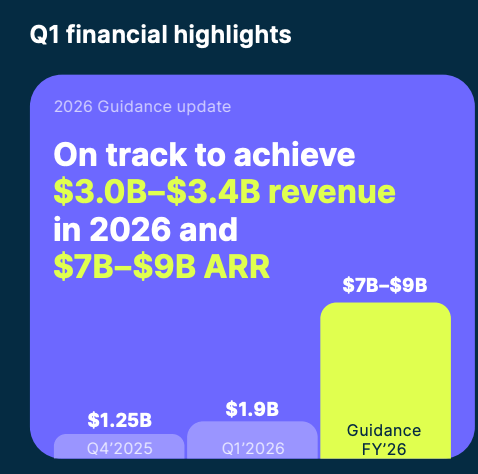
The company reiterated its end-of-year 2026 ARR guidance of $7-9B!
This implies December 2026 revenues of $583-750M. So, Nebius expects to grow its monthly revenue by 133-200% in the next 6 months. Absolutely insane growth by the company.
3.2. Capacity Guidance
Most importantly, Nebius increased its end-of-year 2026 contracted capacity guidance from 4GW to 5GW!
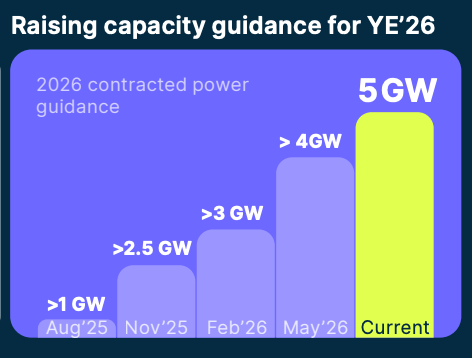
This is a 5x increase in guidance since August 2025!
The increase comes from Nebius announcing new data centers in the UK, Estonia, and Finland.
“We are raising, actually, the contracted power to 5 GW now, by the end of 2026... Our future capacity pipeline effectively makes Nebius one of just a few companies in the world able to build more than 1 GW of new capacity a year, and we plan to do so in 2027.” Arkady Volozh, CEO, Q2 2026 Earnings Call
Essentially, he confirmed that they plan to add over 1GW in new capacity in 2027 and will continue doing so in the future. They are scaling significantly faster than I and other expected.
It is important to remember that last quarter, Arkady revealed an important piece of information concerning a criticism often directed at Nebius.
Owned data centers account for 75% of their contracted capacity.
Previously, some analysts criticised the company for relying too heavily on rented colocation facilities. It is much faster and cheaper upfront to develop a colocation data center, but it’s more expensive in the long term, as Nebius needs to pay rent and the landlord has to make a margin.
But colocation is just 25% of contracted capacity!
Much lower than many analysts estimated.
However, let’s remember that contracted power is the energy that the utility has agreed to deliver to Nebius, but a lot of the equipment still needs to be built and installed.
Meanwhile, connected power is what is already connected and ready to draw from the grid.
Active power is the power currently being consumed by Nebius clients for AI workloads, and this is what ultimately generates the company’s revenues. So contracted power guidance is great, but only as long as the GPUs actually start running.
Notice that Nebius didn’t give an active power guidance, because there is a lot of uncertainty about when exactly the company could have the facility built, GPUs delivered, and energy connected for active data center activities.
It will be a few years before the 5GW mentioned will be fully active!
Nevertheless, the pace at which this guidance increases clearly suggests that my earlier 3.8GW active power target for 2030 was too low.
If your head is spinning from this 5x increase in contracted power target, then you are not the only one. This is an absolutely insane target, and very ambitious. Understandably, this means that Nebius will have to invest significantly more to meet this target.
3.3. Capex
Last quarter, they increased their 2026 capex guidance from $16-20B to $20-25B!
Considering rising memory prices and the fact that all Hyperscalers have increased their capex, I was expecting Nebius to increase it again, yet they didn’t.
First, I thought that the guidance was not increased because the new 5GW capacity guidance figure includes capacity from the new asset-light business model. However, then I read the earnings call transcript again.
“We continue to build our future capacity pipeline through our own and co-located sites, and today raise our year-end contracted power target to 5 GW.”
“This model (capital light) has the potential to unlock new capacity for us in 2027 and beyond.” Arkady Volozh, CEO, Q2 2026 Earnings Call
I interpret these statements to mean that the 5GW contracted capacity number doesn’t include this new business model. So how come Nebius didn’t increase their capex guidance?
My friend Alex mentioned his theory to me on X.
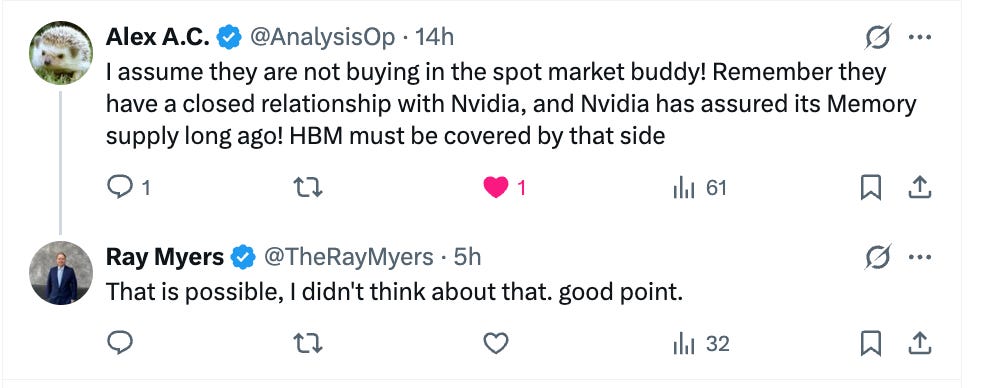
Alex’s theory is that Nebius memory prices were locked in a long time ago when it signed AI server purchase agreements with Nvidia, who were very early to act to guarantee its memory supply.
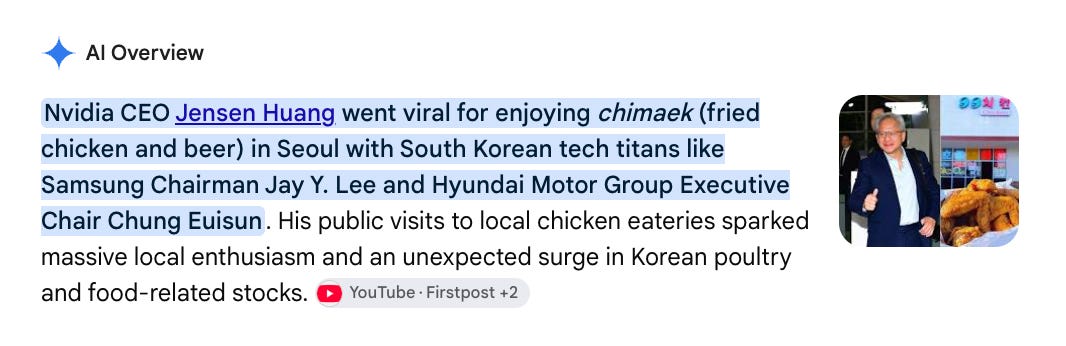
This is why he was having that fried chicken and beer in Korea with the Samsung Chairman.
However, you can’t increase owned connected IT capacity without increasing capex, so capex will increase in the future, especially with the company aiming to connect more than 1GW each year.
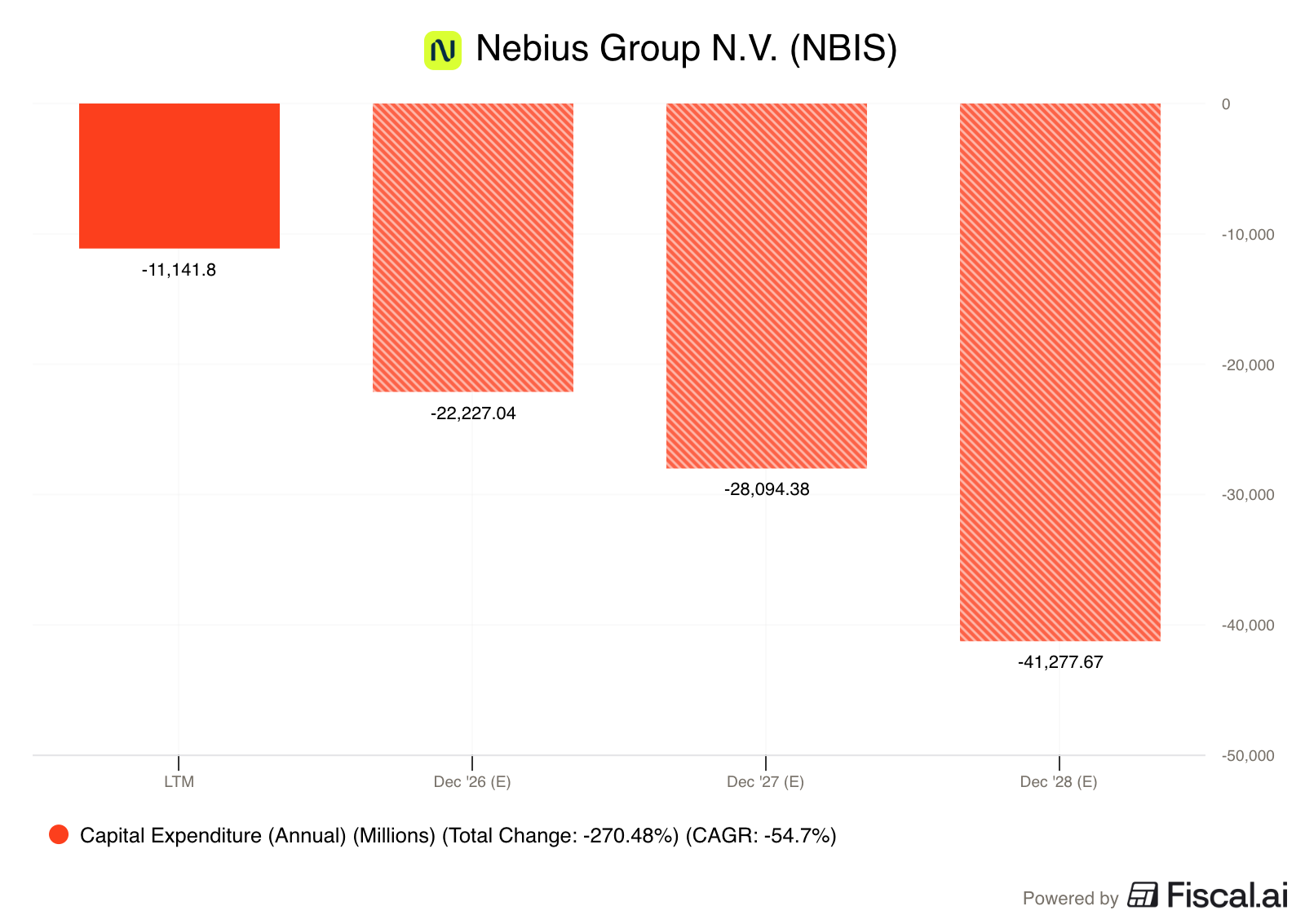
As $11B was spent in H1, about $10-15B will be spent in H2 to meet that $20-25B guidance.
Furthermore, analysts expect Nebius to spend about $92B on capex between 2026-2028.
Where will this cash come from?
3.4. Cash Situation
Nebius closed Q2 2026 with a strong cash balance of $8B!
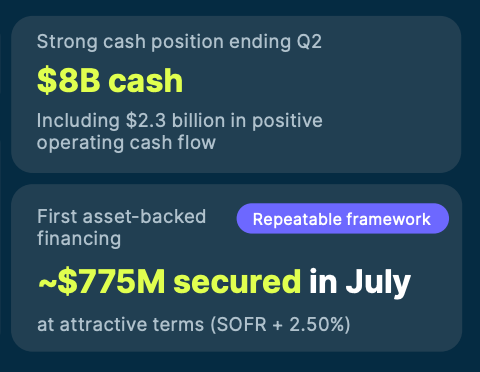
This already covers almost half of the capex needs, and a massive increase from $3.7B in Q4 2025. Nebius was able to raise funding from:
$775M from asset-backed financing
$2.9B from selling its stock
$1.2B from customer pre-payments
Let’s talk about the $775M raised through its first senior secured debt facility.
The financing was secured by pledging GPUs alongside contracted cash flows from a customer, likely Microsoft. The raise was organized by the Japanese bank MUFG, but there was a lot of interest from major global banks, including Bank of America, Deutsche Bank, HSBC, Morgan Stanley, and Goldman Sachs.
This was great as Nebius established a non-dilutive method to turn GPUs into growth capital. It signals that Wall Street and institutional lenders now treat AI servers like real hard assets, comparable to aircraft or real estate, which can now be pledged as collateral.
“The $775 million facility we completed in July, ……. was backed by deployed GPUs infrastructure and contracted cash flows from an investment-grade customer. It demonstrated that even in a more volatile market, there is a strong demand to finance these contracted cash flows on attractive terms. Look, with more than $40 billion of committed backlog, we believe this is a highly scalable and repeatable financing model.“ Dado Alonso, CFO, Q2 2026 Earnings Call
Most importantly, as the CFO confirmed in the above quote, it creates a repeatable financing template!
Nebius can securitize and unlock liquidity from its pipeline of over $40B in contracted commitments from Microsoft and Meta.
The transaction was done at highly favorable terms for an AI infrastructure business. Priced at SOFR + 2.50% with an October 2030 maturity, the interest rate is significantly cheaper than high-yield debt.
Next, the company raised $2.9B from selling its stock on the market!
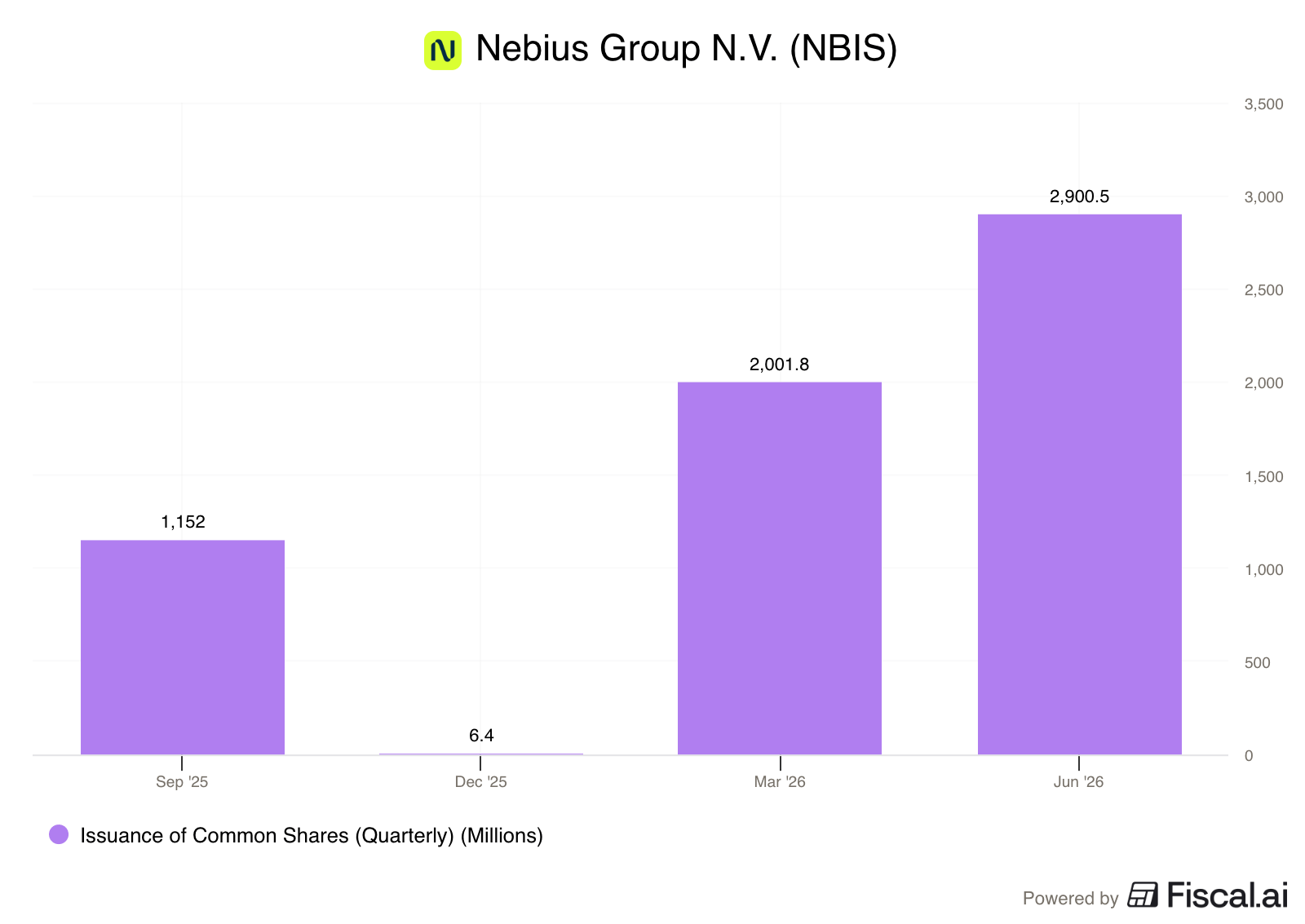
This means that in the last 4 quarters, the company has now raised over $6B from selling stocks directly on the market. This creates a lot of dilution, but is absolutely necessary if the company is to grow rapidly.
Earlier in the year, it filed an ATM filing with the SEC, indicating it plans to sell $6B of stock. So far in H1 2026, they have already sold $4.9B, so about $1.1B remains.
Lastly, the company collected $1.2B in customer pre-payments in Q2 2026.
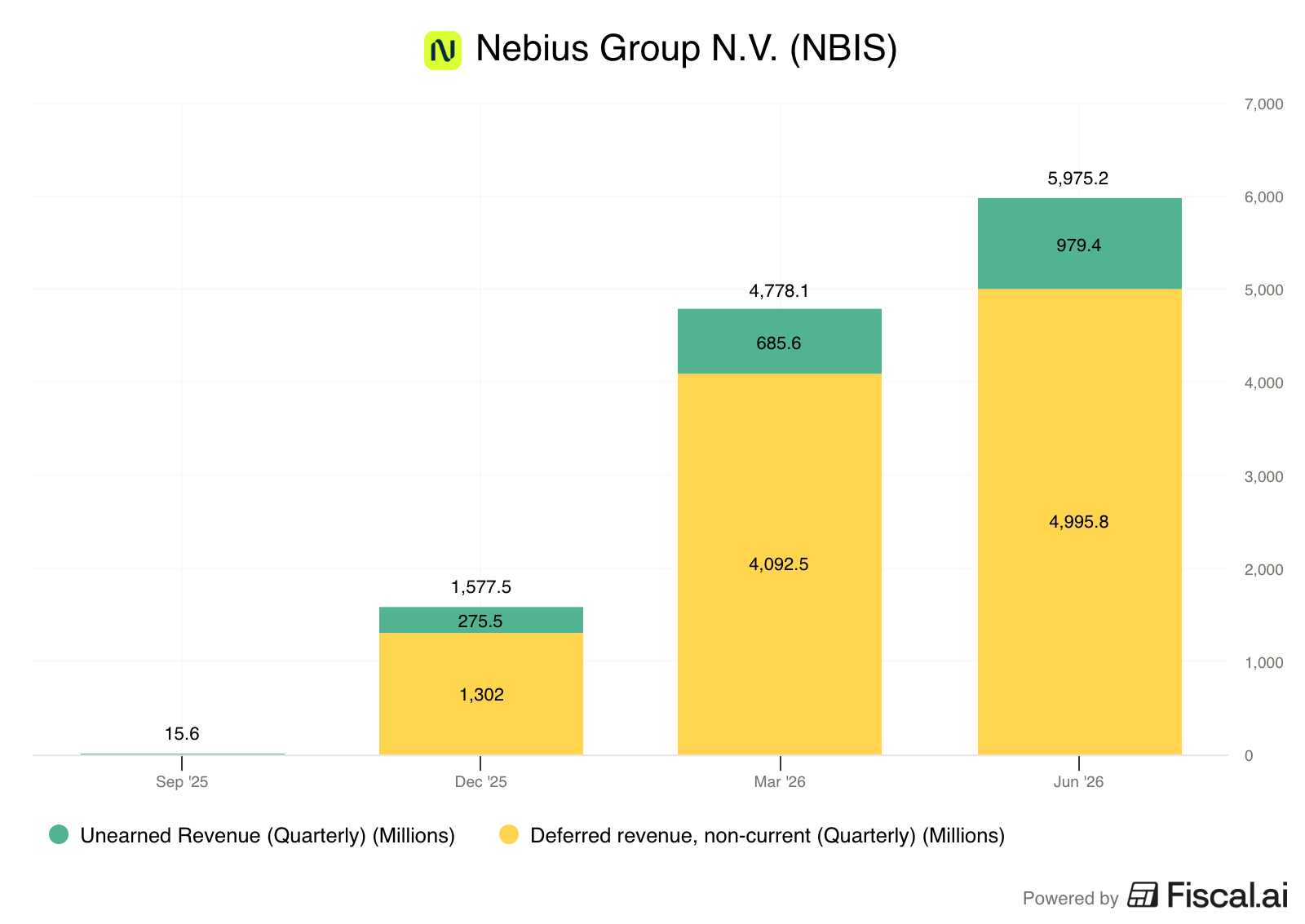
In fact, as of Q2 2026, Nebius has collected $6B in customer pre-payments!
This is extremely impressive and again destroys a bear argument. As there were no detailed announcements earlier in the year regarding pre-payments from specific customers, some bears claimed that Nebius won’t be getting any. This clearly disproves that.
Most importantly, only $979M of the deferred revenue liability is current and to be recognized in the next 12 months as revenue.
So Nebius has already received $5B in pre-payments from customers for services that will be delivered in 2027 and 2028. Again, this is extremely impressive and demonstrates how strong the demand is for their services.
Which company collects payments from customers more than a year before delivering the services?
Most of the time, in the corporate world, it is the opposite, with clients paying suppliers 60, 90, and even 180 days after receiving the service.
3.5. Acquisitions.
2026 has been busy for Nebius on the M&A front, as they did 3 important acquisitions:
Tavily
Eigen AI
Clarifai
Tavily is an Agentic AI search business. Essentially, Tavily helps companies find the right data and format it in a way that AI Agents can easily understand and process it. Basically, Google Search for AI Agents.
Eigen AI is an inference and model optimization platform that specializes in making AI deployment faster and cheaper.
Clarifai is a deep learning and computer vision company that strengthens Nebius’ managed inference and orchestration offering.
All 3 of these acquired companies will be integrated into Nebius AI Cloud, offering to build a full suite of services that could rival Hyperscalers!
This is how Nebius plans to reach its ADJ EBITDA target!
3.6. ADJ EBITDA
Nebius just reached a 50% AI Cloud ADJ EBITDA margin in Q2 2026.
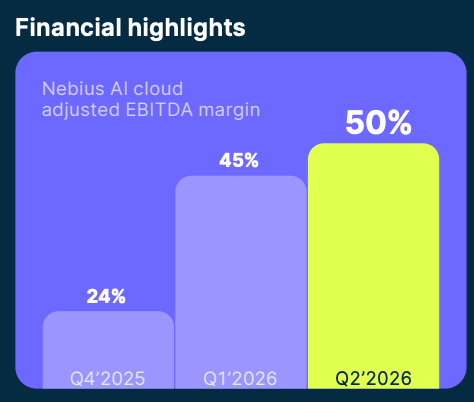
This is a massive improvement from the 10% ADJ EBITDA margin Nebius had in Q4 2025.
The company is achieving scale and operating leverage, thanks to its AI cloud and bare metal offerings.
Despite 454% revenue growth in Q2 2026:
Cost of sales grew 344%
SG&A expenses grew 155%
R&D grew 346%
SBC grew 597%
Depreciation grew 245%
As it integrates the acquired capabilities and develops new ones, its AI cloud value proposition will only get better and better, supporting margin improvements.
4. Valuation
After rising 210% in 2026, Nebius now trades for a market cap of $66B!
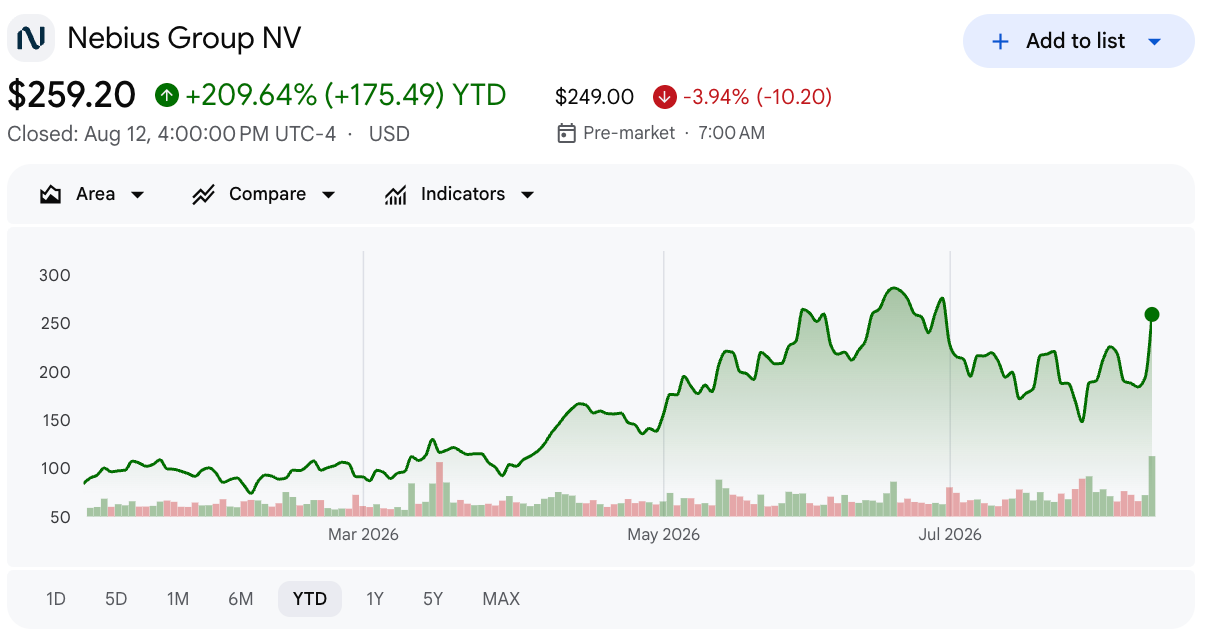
Using the trailing valuation metric is a bit pointless because Nebius gets its value from future potential, not current performance.
At any other company, a P/S of 50 would be insane, but not for Nebius, as they are essentially a start-up.
The only reason Nebius is public in the first place is the unconventional situation with Yandex and its split from Russian assets due to forced selling.
Nebius is essentially a start-up that venture capital investors would normally invest in!
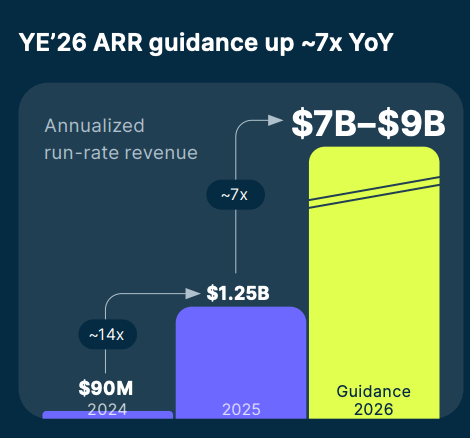
The company expects to close 2026 with an ARR of $7-9B, a 7x Y/Y increase!
This is why Nebius trades 60x TTM sales.
Incredible growth deserves VC-like revenue multiples.
Taking this guidance into account, Nebius trades for 7-9x 2026 ARR!
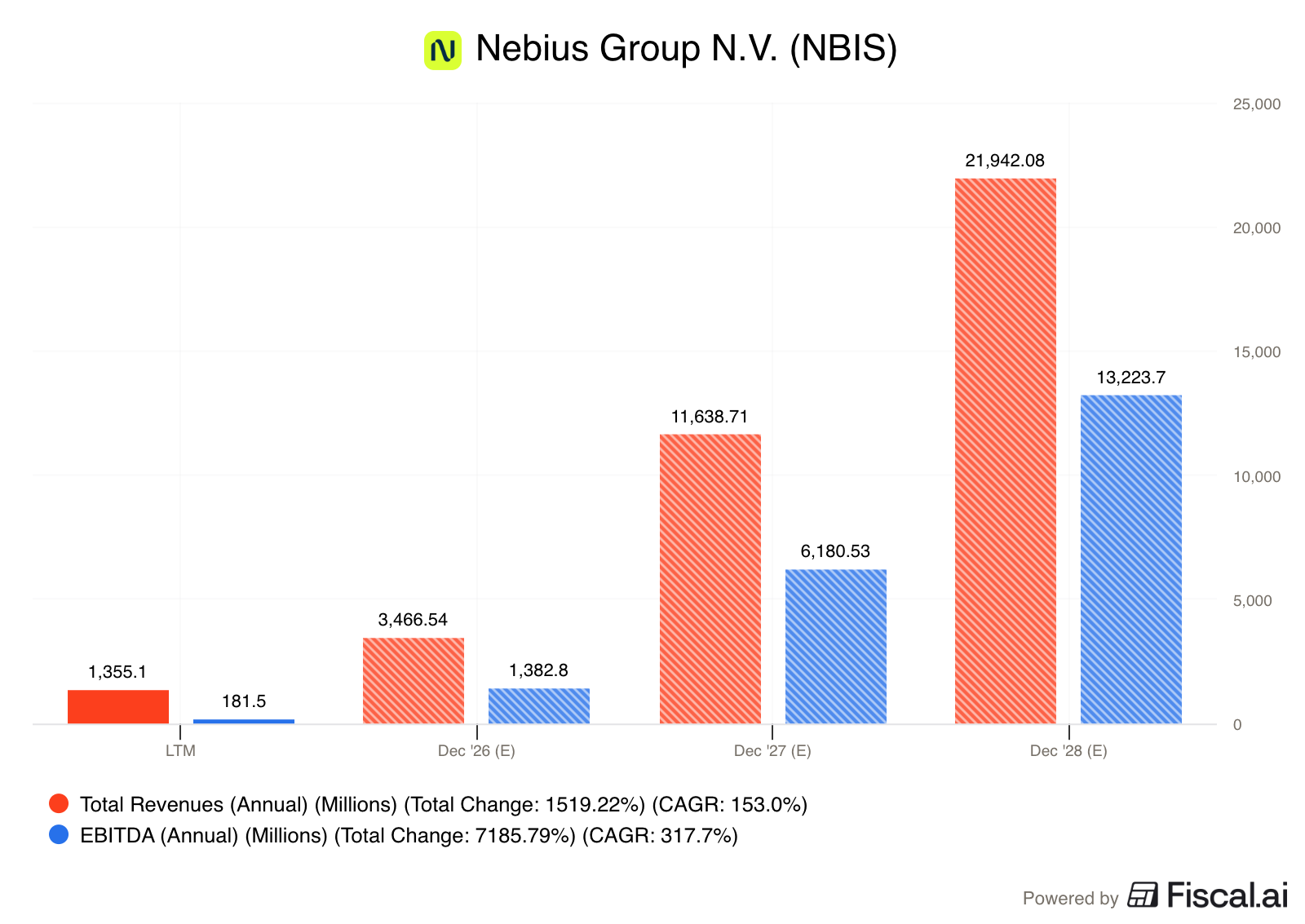
Analysts expect the business to grow revenues by 15x in the next 2.5 years, reaching $22B!
This is absolutely mind-boggling growth, which will come from the company turning on the data centers under construction to begin serving the massive Microsoft and Meta contracts.
At the same time, EBITDA is forecast to reach $13.2B in 2028, compared to the $141.6M loss in 2025.
Taking these analyst consensus 2028 estimates into account, Nebius trades at 3x Sales and 5x EBITDA.
However, these estimates were made before we knew of:
1. Higher short-term pricing contracts
2. Higher pre-payments
3. New asset-light segment
I think the company can do much better.
While EBITDA is not the best and final measurement of Nebius’ profitability, as it excludes depreciation and interest, two of the most important expense categories. However, I still view it as an important metric, as it essentially shows the earnings this business is creating from its operations, before looking at what it costs to create that business.
Taking into account depreciation, interest, and taxes, analysts expect 2028 net income to be negative $1.34B.
So let’s build a valuation model to try to see what kind of results Nebius could deliver by 2030.
5. Valuation Model
First, Nebius 2026 contracted power target is 5GW, which means that Nebius expects to have agreements with utilities to supply them with 5GW of electricity on 31 December 2026.
Yet, to bring all this capacity online as active IT power, Nebius will need years, as they have to construct the building and install all the electrical, GPUs, cooling, networking, and other equipment.
Thus, I am modelling 4.2GW of active IT power in 2030, a 400MW increase from the previous model
What I am also adding is an additional 1.5GW of capacity from its new asset-light model.
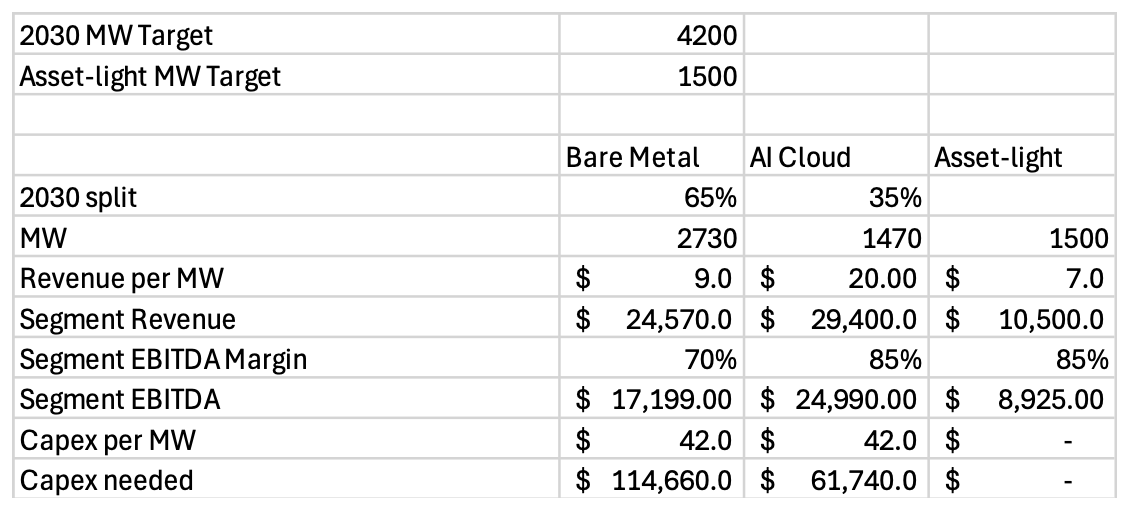
Next, I am modelling that 65% of that capacity will go towards bare metal contracts, largely with Hyperscalers and major start-ups, and 35% as AI cloud to others.
The demand that Hyperscalers have for bare metal compute is absolutely insane. I believe Nebius will not miss out on the opportunity to serve them.
This is a slight increase from the 68/32 split in my prior valuation model. Recent acquisitions clearly indicated that Nebius is very focused on its Cloud offering, so I increased its share slightly.
This model is also a bit simplified, as I am kind of blending owned and colocation sites together, some of the depreciation expense will probably shift to opex in reality. However, with the recent reveal that 75% of the capacity is to be owned, that has a small impact.
For bare metal, I am modeling $9M revenue per MW, whilst for AI cloud, I model $20M.
However, in the asset-light segment, I am modeling $7M in revenue per MW. This is net of payments to the infrastructure partner. I am assuming that in this model Nebius earns $16-20M per MW gross, but then pays about $9-13 per MW to the partner.
You are probably thinking, why would Nebius then sell their capacity to Microsoft and Meta for $9 if they have so much demand that they need this asset-light model in the first place? Well, this is necessary because Meta and Microsoft pay large pre-payments, and lenders are willing to lend against customer contracts with them. These contracts are needed to fund the data center buildout. In the future, Nebius would ideally move to a 100% AI cloud business and not serve the Hyperscalers anymore.
Some are probably saying that the 65% bare metal estimate is too high, and could very well be the case, but I will use it for now.
This would give us bare metal revenues of $24.6B, AI cloud of $29.4B, and asset light of $10.5B.
Bare metal segment EBITDA of 70%, AI cloud segment EBITDA of 85%.
Furthermore, I am modeling that the asset-light segment will also have EBITDA of 85%.
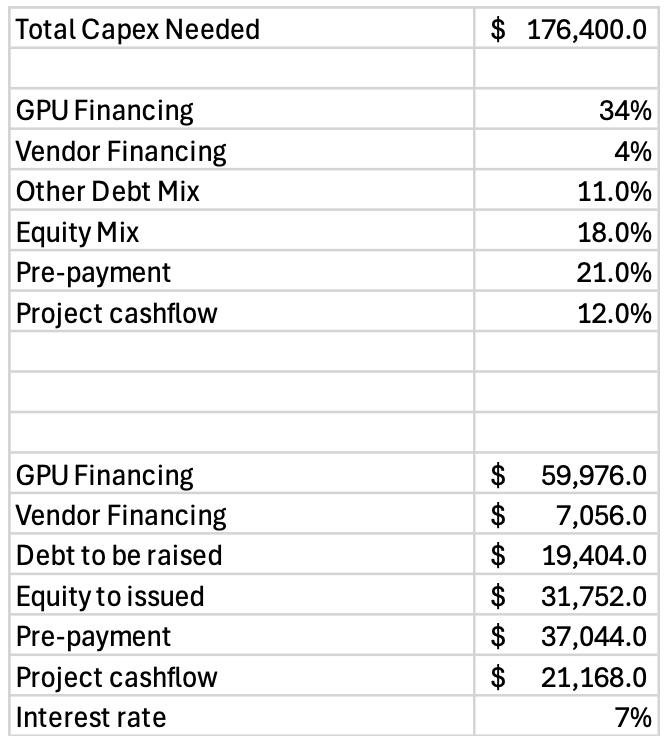
At $42M per MW, it would cost Nebius $176.4B to bring 4.2GW of capacity online!
While this is an incredibly large amount, I estimate Nebius raising this funding in the following ways:
$60B in GPU financing, about 34% of the total amount.
$7.1B in vendor financing, 4% of total
$19.4B in conventional debt, 11% of total.
$31.8B by selling equity.
$37B in pre-payments from customers.
$21.2B from internal project cash flow.
So, I model $86.5B of the $176.4B funding coming from debt at 7% average interest rate!
Banks are open to lending even 90% of the GPU value, so $60B sounds completely doable. Also, as I mentioned in the cash section, Nebius just reported $6B in cash from deferred revenues, and said that they plan to fund the $25B capex for 2026 largely internally.
It is clear that the company is well capitalized, and they have plenty of venues to raise funding from.
Next, to calculate the depreciation, I create a detailed depreciation table.
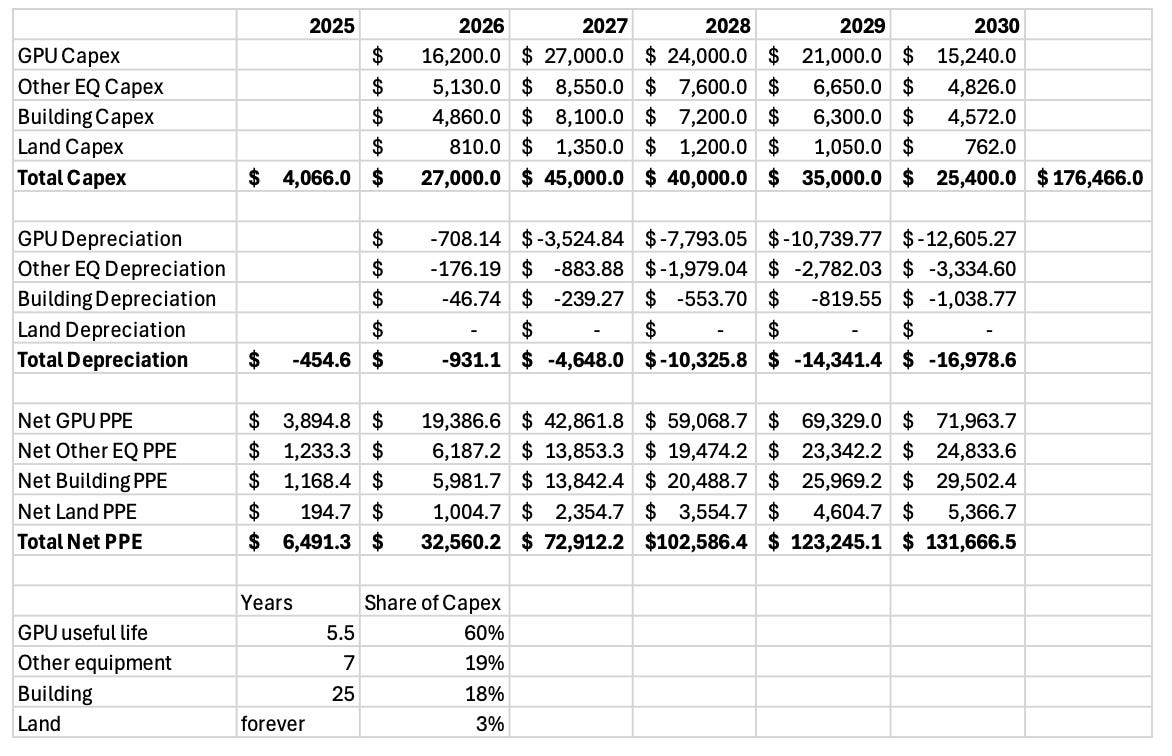
From total capex, I am modeling 60% going towards GPUs, 19% other equipment, 18% building, and 3% land.
GPUs depreciate in 5.5 years, other equipment in 7, building in 25, and land never.
The result is 2030 depreciation of $17B, and net PPE of $131.6B.
In terms of operating expenses, I model Nebius needing about 13% of revenues to cover R&D and other opex.
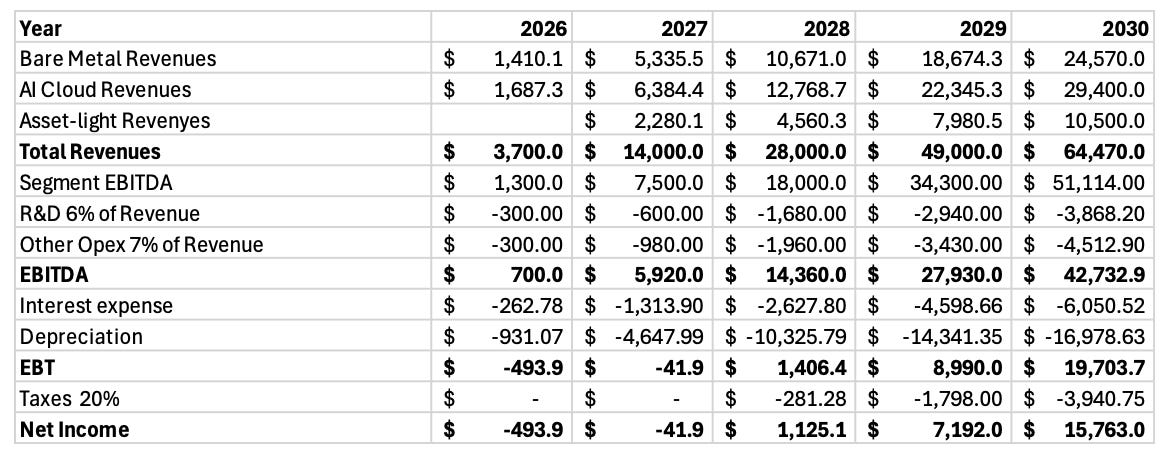
We get 2030 revenues of $64.5B, and group EBITDA of $42.7B.
A 66% EBITDA margin might seem high, but we need to remember that for a high-capex data center business such as Nebius, depreciation is the biggest expense.
After taking into account $17B in depreciation and $6.05B in interest, we get to earnings before taxes of $19.7B.
Tax of 20%.
The result is net income of $15.8B, a margin of 24%.
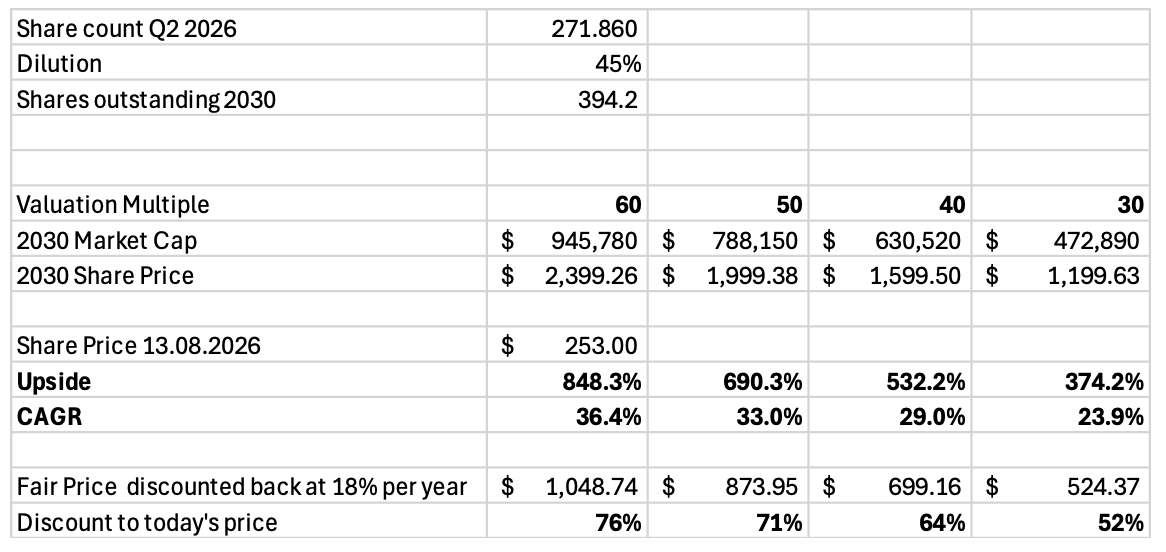
Next, I model dilution of 45% over the next 4.5 years, with the total number of shares outstanding reaching 394.2M.
An exit multiple of 40, and we get a $1600 stock, an upside of 532% from today’s price of $253.
Discounting back 5 years with a 18% discount rate, we get an estimated fair value per share of $699, implying that Nebius share price of $253 could be trading for a 64% discount to its fair value per share.
However, the market would very likely assign a higher multiple to an AI stock such as this if the company delivers the modelled results.
A P/E of 50-60 results in an upside of 690-848%!
I realize that these are very aggressive assumptions, so let’s look at what could go wrong.
1. Demand is not as high as Nebius, McKinsey, Brookfield, and all other experts think. If AI compute supply is higher than the demand, prices could plummet.
2. Competition increases, driving down prices and lowering ARR.
3. There is a lot of debate regarding the 4-6 year depreciation schedule, with many arguing that chip useful lives are much lower. In such a scenario, the deprecation cost of 5 years I modeled could be much higher.
4. Some analysts have voiced concerns regarding the electricity prices. We are entering a stage of AI development where energy access is a key bottleneck, and AI demand might lead to significantly higher prices, possibly leading to lower segment EBITDA margins.
5. Growth could stall if Nebius can’t raise the capital required. Currently, that seems unlikely, but things could change quickly.
6. Geopolitical and trade issues could cause disruptions in the semiconductor supply chain, delaying crucial chip deliveries. If Asian countries that manufacture the data center equipment suffer an energy crisis because of the Iran war, they might be forced to increase prices.
7. OpenAI is the driving force behind the AI revolution. It is very likely that Nebius’ New Jersey capacity sold to Microsoft will go to OpenAI. Recently, they have been signing deals left and right with Nvidia, Oracle, AMD, Broadcom, Corewave, and many more, totaling over $1T. Some have raised concerns of a bubble forming, if they are right, the bursting of this bubble could prove to be catastrophic to Nebius.
However, despite these risks, the revolutionary potential that AI has, and the strong drive and statements from everyone in the AI ecosystem, lead me to believe that Nebius is an incredible opportunity.
Even if costs are much higher than I model, the top-line growth is incredibly impressive!
At P/S of 8, Nebius could be a $200-300B company in 2030.
6. Conclusion
In conclusion, Nebius AI Cloud and AI refinery business is uniquely positioned for an absolutely mindboggling growth in the next decade!
The recent deals with Microsoft and Meta elevate their pedigree in the eyes of investors, bankers, employees, AI start-ups, other Hyperscalers, and other participants of the AI ecosystem.
The new short-term deal strategy and the asset-light models position the company to generate significantly higher earnings than previously estimated.
At the same time, Nebius is doing small bolt-on acquisitions that strengthen the value proposition of its AI Cloud offering. Pure bare metal is not enough to attract high-quality customers, and Nebius is positioning itself to be the best AI cloud for AI start-ups and large organizations.
Moreover, questions regarding how Nebius will fund its aggressive business expansion have been resoundingly answered.
Customers are paying for services that will be delivered in 2027 and 2028 because they are desperate for high-quality compute and AI software, pushing Nebius deferred revenue liability to $6B.
Lastly, the company will have 45W of contracted power by the end of 2026. It could be that my 4.2GW active IT power estimate for 2030 is conservative.
As the valuation model showed, Nebius could be situated to generate over $65B in revenues past 2030. If my estimates regarding segment margins, interest costs, operating expenses, and depreciation are close, we could be looking at a company printing close to $16B in profits.
In such a scenario, Nebius could become a $400-500B company, more than 7x from today!

Here is what my Premium Members can expect:
Portfolio Review - Each month, I will present the portfolio performance and discuss my stock watchlist and my best ideas.
Recent developments.
Unwarranted pullbacks.
Insider activity.
Potential catalysts.
Deep Dives – 8,000+ word detailed analysis of a company, delivered in 3 Parts.
Part 1 – Brief History of the company and its Business Model.
Part 2 – Management, Moats, Competitors, and Risks.
Part 3 – Opportunities, Financial Analysis, and a Valuation Model.
You can expect a comprehensive research report that is educational, interesting, and provides actionable insights!
To see what you can expect, read my Palantir Deep Dive!
Members of the Premium service get access to my library of 15 Deep Dives and to all future Deep Dives, which will be released on semi-monthly basis.
Investment Cases – A short, concise report with actionable insights.
This report is about the size of a single part of a Deep Dive.
Focused Investment Thesis
Main drivers of the Bull Case
Valuation Model
To see what you can expect, read my Oscar Health Investment Case!
Earnings Reviews and Updates – For companies that are of great interest to me and my readers, I will provide regular quarterly or semi-annual updates after earnings reports.
Financial performance
Business Update
New developments
Updated Valuation Model
To see what you can expect, read my Google Q2 2025 Earnings Review!
You can follow me on Social Media below:
X(Twitter): TheRayMyers
YouTube: TheRayMyers
Threads: @global_equity_briefing
LinkedIn: TheRayMyers
Equity Research Report List
Disclaimer: Global Equity Briefing by Ray Myers
The information provided in the “Global Equity Briefing” newsletter is for informational purposes only and does not constitute financial advice, investment recommendations, or an offer or solicitation to buy or sell any securities. Ray Myers, as the author, is not a registered financial advisor, and readers should consult with their own financial advisors before making any investment decisions.
The content presented in this newsletter is based on publicly available information and sources believed to be reliable. However, Ray Myers does not guarantee the accuracy, completeness, or timeliness of the information provided. The author assumes no responsibility or liability for any errors or omissions in the content or for any actions taken in reliance on the information presented.
Readers should be aware that investing involves risks, and past performance is not indicative of future results. The author may or may not hold positions in the companies mentioned in the “Global Equity Briefing” report. Any investment decisions made based on the information in this newsletter are at the sole discretion of the reader, and they assume full responsibility for their own investment activities.
Great quarter and the thesis clearly strengthened. Great analysis. My own model is a bit more conservative, especially on long-term $/MW pricing, asset-light margins and the pace at which contracted power converts into active capacity.
I also prefer to anchor the 2030 valuation more on EBIT and free cash flow, rather than EBITDA, given how important depreciation and financing costs are for this business.