
Nu Q2 2026: Profits, ARPU and Strong Customer Growth.
Stock is up 14% after stellar results, 50% revenue growth and 66% net income growth.

Yesterday Nu Bank reported earnings, and they were, as always, excellent!
Most importantly, it seems the market is no longer selling off. It seems that the FOMO AI trade of selling quality and buying AI could be nearing the end.
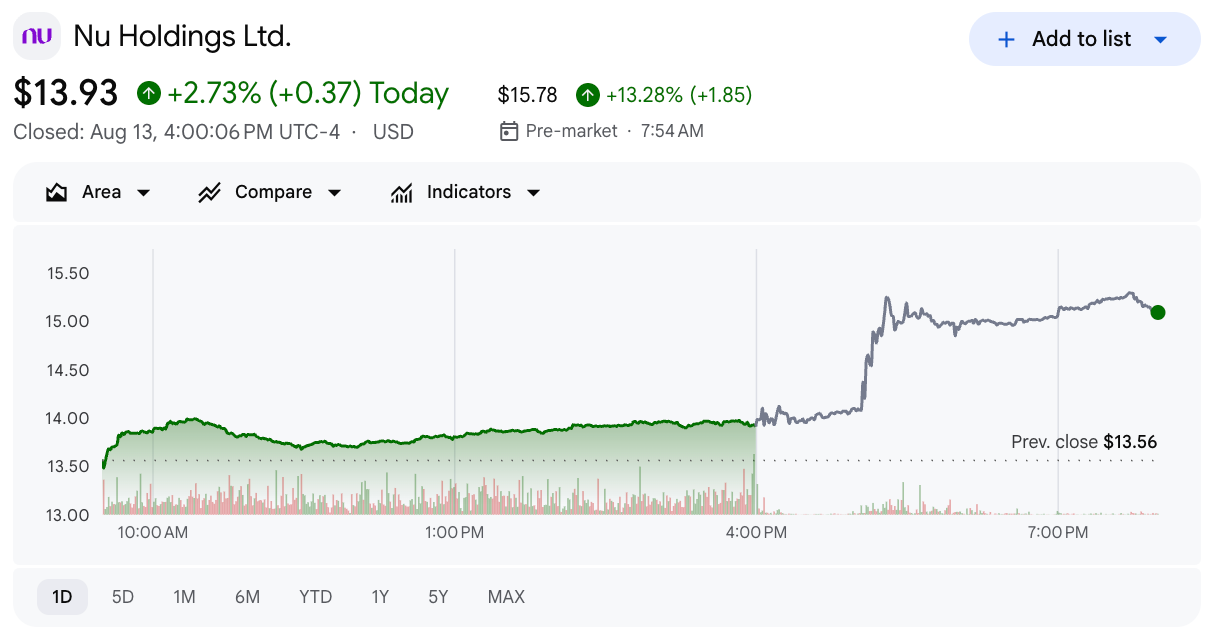
Nu’s stock is now up 13% in after-hours!
The company continues to execute on all its objectives, yet the market is not rewarding it. Last quarter I said that this is because of the AI FOMO trade.
Sell quality to buy AI stocks!
As a result, Nu trades at just 16x FWD P/E.
I find this valuation to be extremely attractive for long-term-minded investors, especially considering Nu posted such strong financial results:
Total revenues $5.5B +50%
Net income $1.06B +66.4%
EPS $0.22+ 65.4%, Beating analyst estimate of $0.19
ARPU $17.1 +40.2%
Cost per ARPU increased from $0.8 to $1 Y/Y.
The total number of customers increased by 3.7M to 138.9M, +13.2%
Let’s look at the quarter in more detail to see what Wall Street liked and what they didn’t.
1. Customer Level Results
2. Brazil
3. Mexico
4. Colombia
5. Deposits and Loan Portfolio
6. Revenue
7. Profitability
8. Conclusion

1. Customer Level Results
Nu continues to gain customers at a decelerating, but nevertheless, very healthy pace.
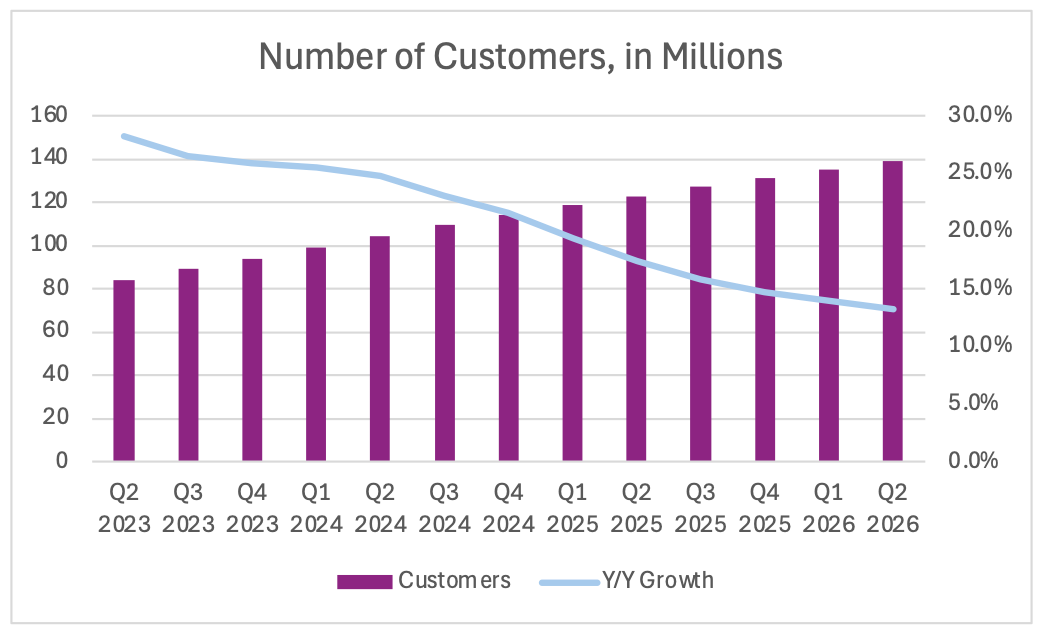
The number of customers grew by 13.2% Y/Y and 2.7% Q/Q to 138.9M, an increase of 3.7M over Q1 2026!
In the above graph you can see how the growth has decreased significantly in the 2 years, this is understandable. You can’t grow customers at 30% per year once you already have over 130M customers.
However, interestingly, the growth rate has plateaued in the last few quarters and appears not to be decreasing as fast as some expected. Simply put, Nu continues to acquire new customers, as the total addressable market is vast.
Moreover, 83% of these customers are monthly active customers, the same as last year. In fact, the activity rate has remained unchanged for 4 years, which is remarkable given the rapid growth.
One could expect a slight decrease in activity rate after expanding into two new countries and adding tens of millions of new customers.
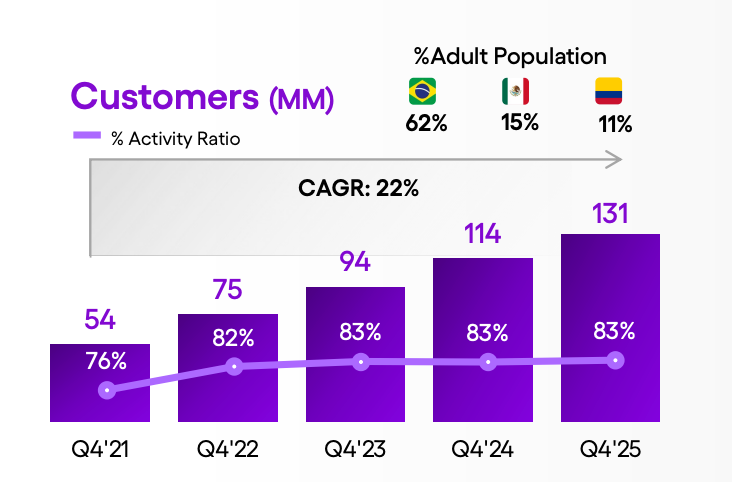
Above we see Nu’s share of adult populations in its core markets as of Q4 2025. They have not included such a slide since then, but it is clear that these ratios have only increased.
62% of Adults in Brazil.
15% in Mexico.
11% in Colombia.
Overall, each active customer generated $17.1 monthly ARPU in Q2 2026, an increase of 40.2% Y/Y, and 7.5% Q/Q!
This is incredible growth.
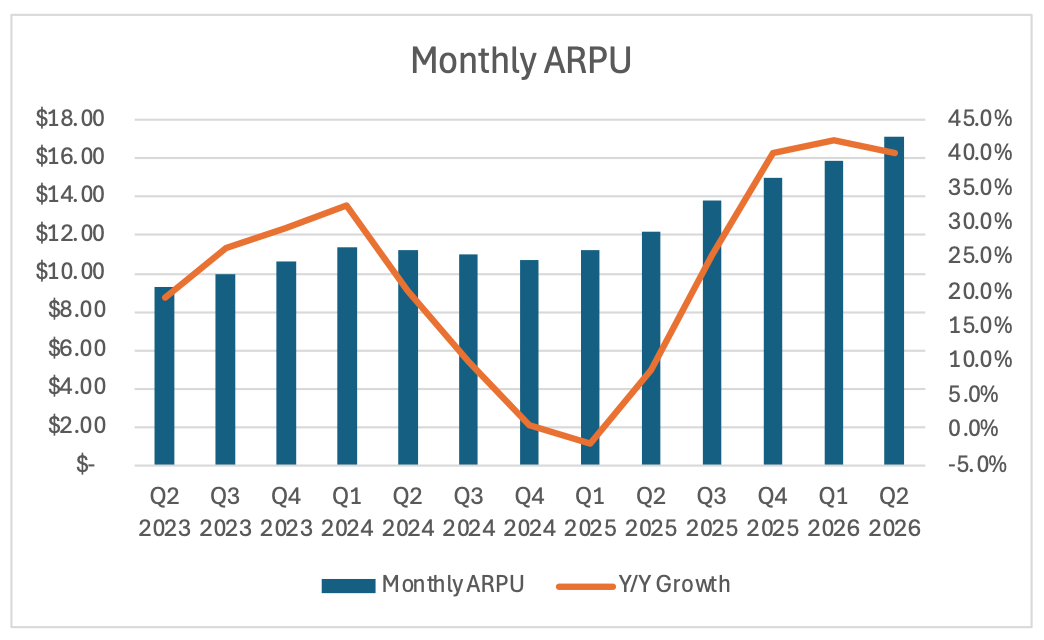
In the graph above, we can see a strong acceleration from Q1 2025, when the company posted a decrease in ARPU by 1.8%. This fall in ARPU caused quite a lot of panic in the Nu investor base, as ARPU growth is a key bull thesis for the company.
This was largely driven by Nu gaining a lot of new, and temporarily under-monetized customers in Mexico and Colombia!
This is what I said last year during the Q1 2025 review:
“As Nu develops Mexico and Colombia, ARPU is likely to increase later in the year, especially as Nu releases new products in Mexico after receiving a full banking license. “ Global Equity Briefing
This quarter, we saw the continuation of that trend as significant growth in both countries directly contributed to the recovery of the ARPU.
On an FX-neutral basis, ARPU actually grew 22% Y/Y, as the company benefited from a weaker USD.
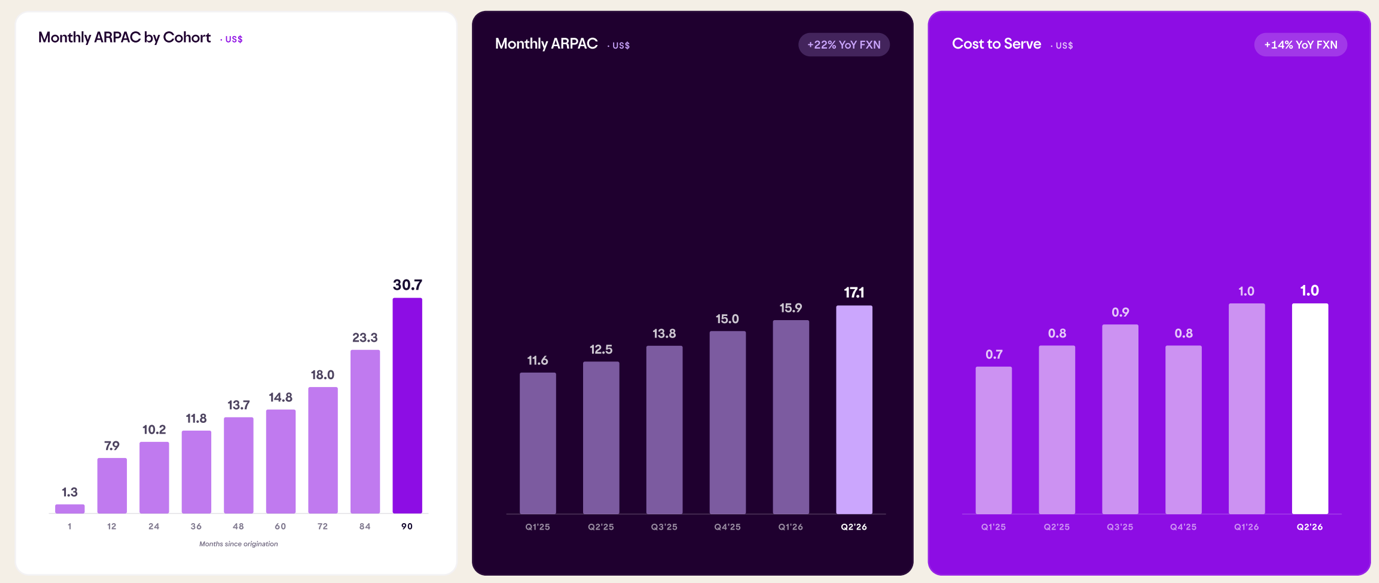
Per the above graph, it takes Nu between 60-72 months to get a new customer to the $15.9 ARPU.
Understanding these customer cohorts is incredibly important as a Nu investor.
“ Then the opportunity is ARPAC... We have gone from $13 to $17. A lot of the incumbent banks, if you look at the ARPAC, they are at $40 to $45... When you look at our oldest cohorts, our customers that have been with us for seven, eight years, they are already in the mid-$20s ARPAC and higher.” David Vélez, CEO, Q2 2026 Earnings Call.
A customer who’s been with Nu for 8 years generates $30.7 in monthly revenues, which is almost double the average Nu customer, 6x the 1-year-old customer, and 4x the 2-year-old customer.
This is because Nu is very good at upselling customers new products.
A customer goes from using a bank account and a debit card in the first year, to a credit card, savings account, children’s account, investment account, insurance, and a personal loan in year 6.
In the last 3 years, Nu acquired 55.2M customers who are, on average, using a few products and generating ARPU below $12, likely the average is around $6-8. In the next 5 years, this cohort will get millions of credit cards, put billions in investment accounts, and buy cars/houses on loan.
So, doing some back-of-the-napkin math, we get 55M people going from $6 ARPU to $30.7 in 5 years, that’s $16.3B in incremental revenue.
That’s about what Nu made in the last 4 quarters. So just by upselling this cohort of users’ existing products, Nu can double its revenues in the next 5 years. We are not even talking about increasing revenues of the current year 5-8 cohorts, about releasing new products, entering new countries, or acquiring users in existing countries.
This company has incredible opportunities for growth!
Meanwhile, the cost to serve an active customer increased by 25% Y/Y, 14% on FXN basis. I will expand in the profitability section on the causes, but in short, Nu is investing and preparing for the next leg of growth.
Despite this increase, if we compare the cost to serve an active customer to ARPU, we see that after just 1 month, the average customer generates about $1.3 in monthly revenues, which is already at break-even in servicing costs!
If we assume a linear growth in ARPU from month 1 to 12, in the first year, an active customer will generate Nu $55.2 in revenue, but it would cost only $12 to service.
This leaves a lot of room for Nu to utilize marketing as organic customer growth slows down when they begin reaching maturity in certain markets.
There is significant potential to increase ARPU.
2. Brazil
Brazil, as Nu’s home and Latin America’s largest country by population and GDP, remains the most important market today.
As of Q2 2026, Nu has 117.9M customers in Brazil, an increase of 9.9% Y/Y.
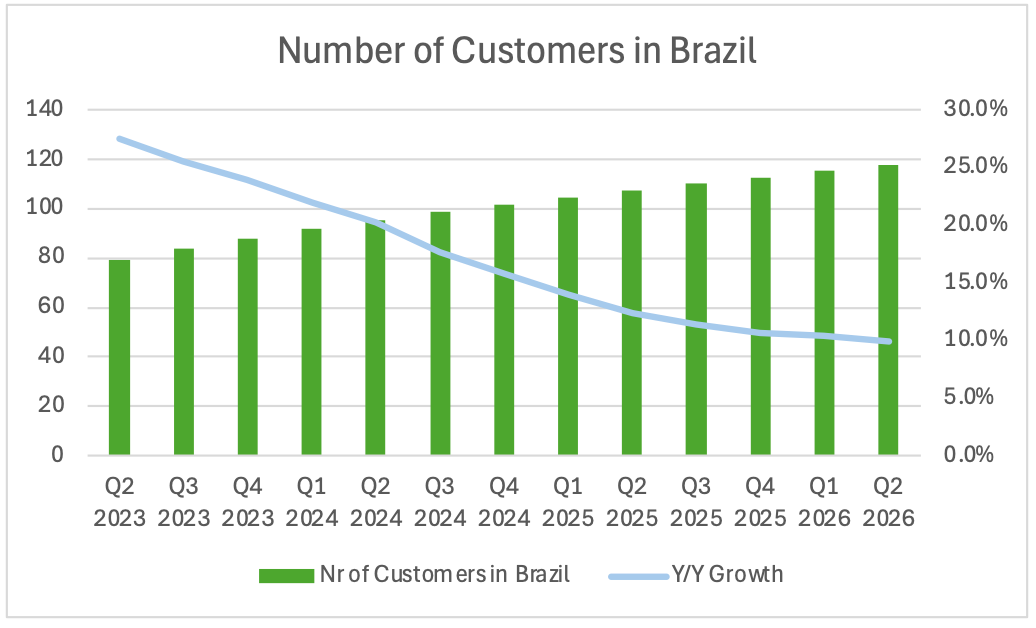
This quarter, Nu added 2.4M customers, a decrease of 400K from the 2.8M it added in Q1 2026.
The decrease in customer growth rate is logical and will likely continue, Nu has already acquired the majority of the adult population and will soon reach maturity. Nevertheless, it is quite remarkable that they can add so many customers in a quarter, despite already having 62% of the adult population as customers.
At such a scale, it is becoming harder and harder to acquire new customers, as realistically, it would be crazy if the share of the adult population surpassed 70%. For a single bank to have 70% of the country as customers would be insane.
Thus, it is quite clear that the focus in the future will shift from user growth to user monetization.
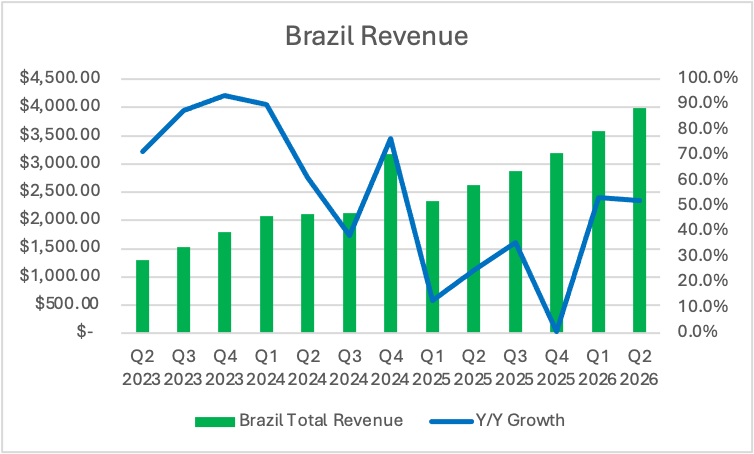
Total revenue in Brazil grew 52.2% Y/Y, to $4B!
Please note that total revenue doesn’t match the sum of the geographic revenue, as some of the corporate HQ revenue is not allocated to a specific geography.
Moving on to deposits, Brazil showed decent growth, attracting $2.7B in new deposits to reach a balance of $36.4B!
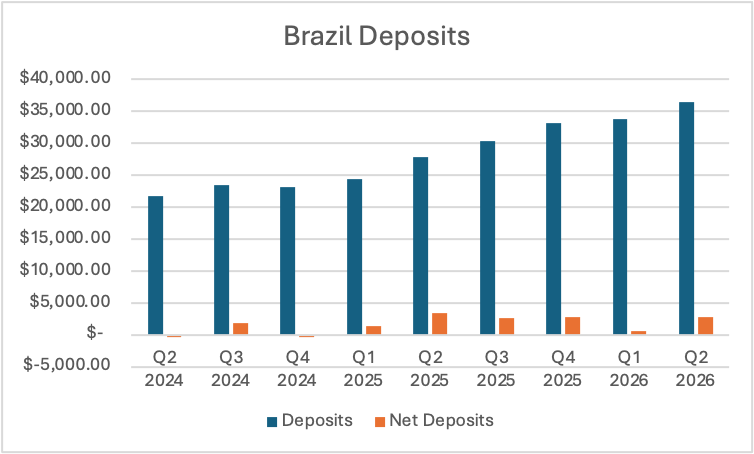
This was an increase of 31% Y/Y and 8% Q/Q, however, net deposits decreased by 21% from $3.4B in Q2 2025.
Nu has a large enough deposit base to fund its loans. So they don’t believe there is a need to be more aggressive with their deposit interest rates to attract more deposits.
They can always increase deposit yields and run promotions if they see that additional capital is required to fund lending.
Unfortunately, Nu did not disclose detailed loan origination statistics for Brazil. My guess is that since expansion in Mexico and Colombia is going steadily, the company wants to emphasize its business as a portfolio of loans, rather than just Brazil.
The Banco Central do Brasil’s interest rate is now at 14% compared to 2.25% in the EU and 3.63% in the US.
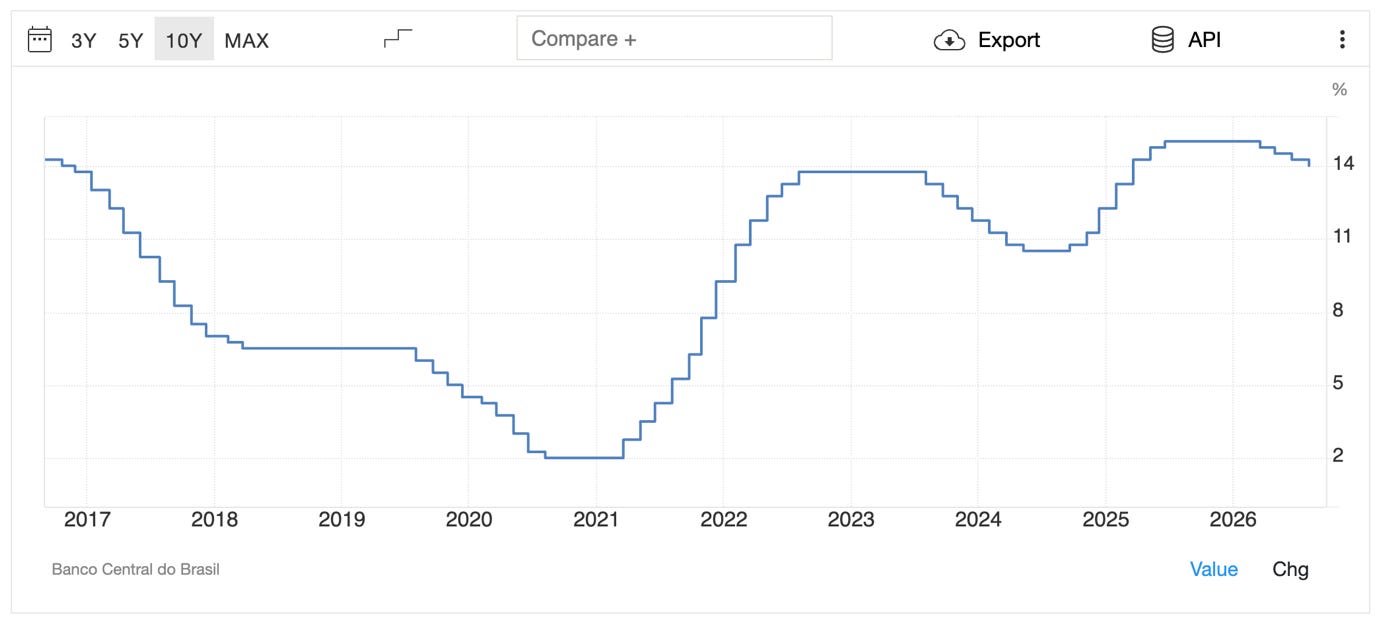
As you can see in the chart above, Brazil’s central bank rate has been above 8% for more than 4 years now.
This is also a key bear case for Nu: “What if interest rates go down, reducing lending spreads?”
Look at the chart above, from 2019 to 2022, interest rates were low, and Nu thrived, and they will thrive if that happens again.
Here is what will happen if interest rates go down:
1. Loan volumes will increase as cheaper loans increase demand. More loans mean more interest income, compensating somewhat for the lower spreads.
2. Lower defaults will reduce losses as cheaper loans lead to fewer customers unable to repay them.
3. Nu will increase fees, driving fee income. Nu fee income has been growing more slowly than net interest income for years. I will expand on this in the revenue section of this report.
4. More transaction income, as low interest rates lead to more transactions.
So lower interest rates would certainly be a headwind for net interest income, but Nu would find other means of filling in the gap, reducing the net loss from lower spreads.
This quarter, the company revealed that they only have a 7% gross profit market share in Brazil, despite having over 62% of the adult population as customers.
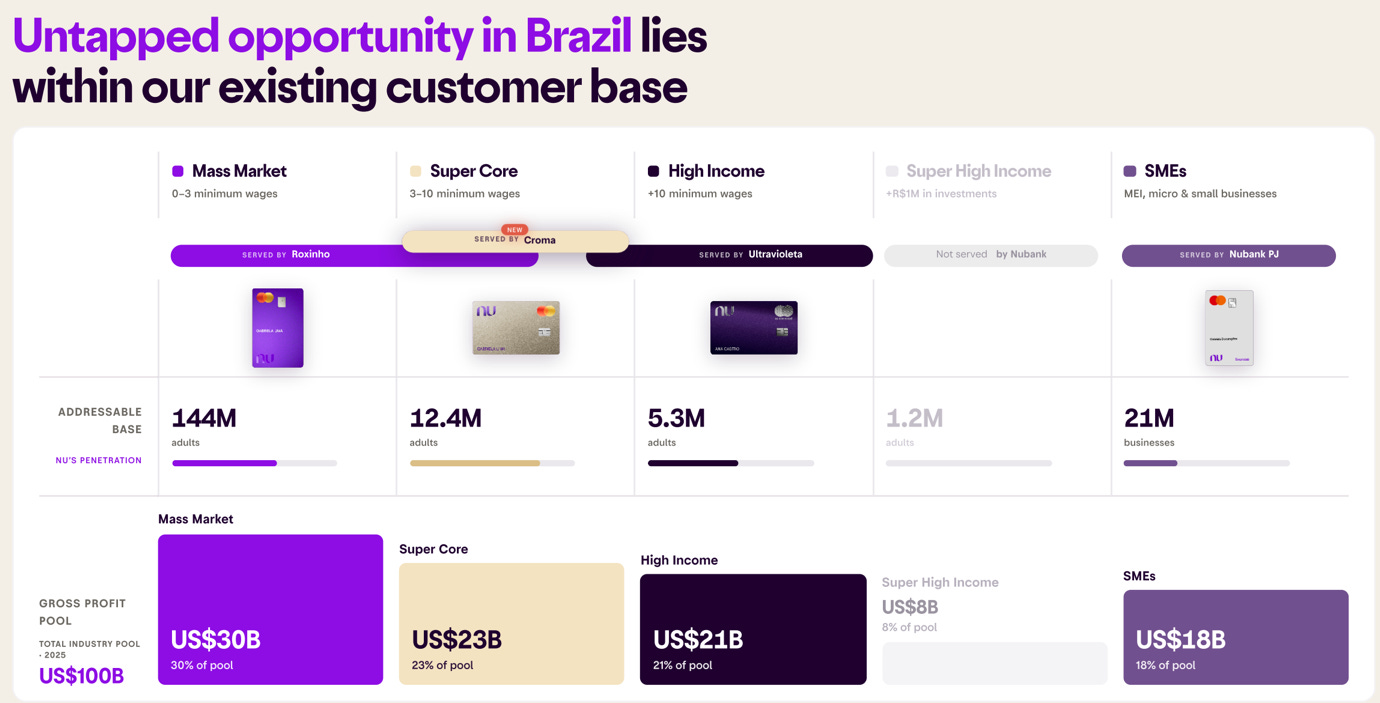
A large share of this industry profit pool is generated by high-income customers, so Nu is working to attract these customers.
“We call this segment super core, and in July, we launched Croma, a subscription-based tier for our super core customers, a segment with an even larger profit pool than high income, and one where we already have significant penetration... I can tell you that we already have three out of five Brazilians in this bracket as customers of Nu... The opportunity is to increase the share of wallet within those three to five Brazilians.” David Vélez, CEO, Q2 2026 Earnings Call
The Nu CEO said that the company is focused on attracting and serving what they describe as “Super Core” segment, which consists of people earning BRL 5-12K per month, about $1-2K. As you can see in the picture above, the company has acquired 12.4M customers in this category, now they can focus on monetising them.
The new Croma offering costs R$39 ($7) per month and comes with:
0.8% universal cashback
5% streaming cashback
Travel & purchase protection and extended warranty
Boosted savings rate, up to 120% of the central bank’s rate
Extra GB’s of data when using NuCell, Nubank’s eSIM offering
The monthly fee is waived for customers with at least R$30,000 ($5,800) invested/saved with Nu or R$4,000 ($800) in monthly credit card spending.
Nu makes money from this card from interchange fees, which are part of merchant transaction fees that go to the credit card issuing banks. The company will also charge interest for any remaining balances. Also, this cohort of customers probably will keep deposits with Nu, which the company will then use to issue loans to other customers.
There is additional potential in high- and super-income categories.
Nu has about 5.3M customers that could be categorized as high income, while they have no super-high-income customers. These 2 categories could be quite important in the future.
3. Mexico
As of Q2 2026, Nu Mexico has 15.8M customers, around 15% of the adult population.
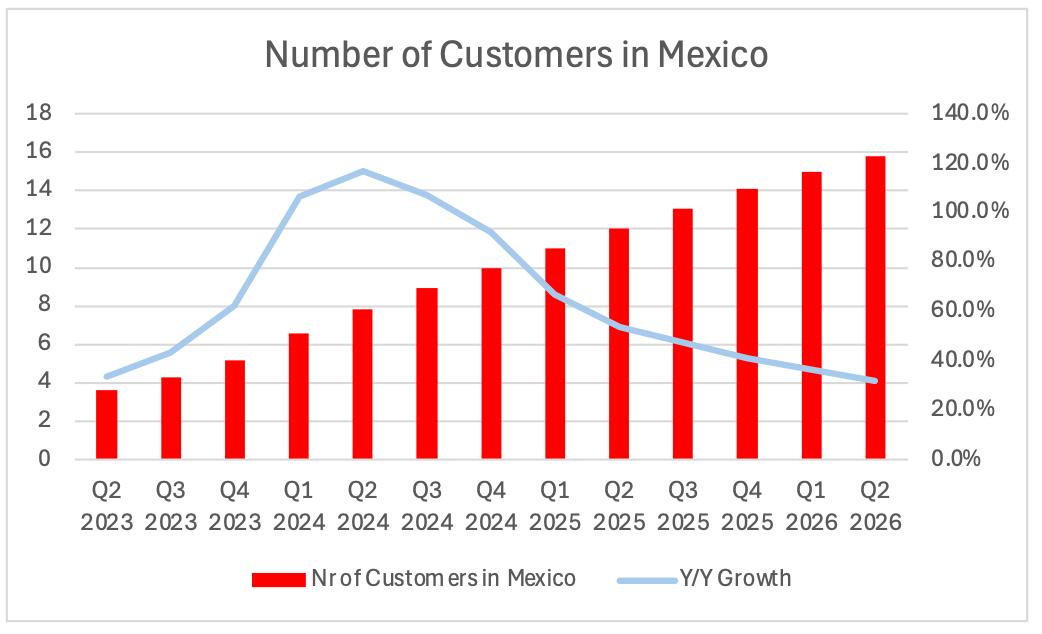
This is an increase of 31.7% Y/Y and 102.6% in just 2 years!
While I doubt that Nu can reach as high a penetration as Brazil’s 60%, I am confident there is still a lot of growth left in Mexico.
A reminder that Nu received a full Mexican banking license just last year. Previously, they operated under a non-bank financial institution license (SOFIPO), which is a special Mexican regulatory framework that allows FinTechs to provide some banking services, but with a lot of limitations.
A full banking license enables Nu to offer more services to its clients. This helps it to attract more customers and increase wallet share with existing customers.
Deposit balance fell to $5.7B, down 15% Y/Y and 3.4% Q/Q.
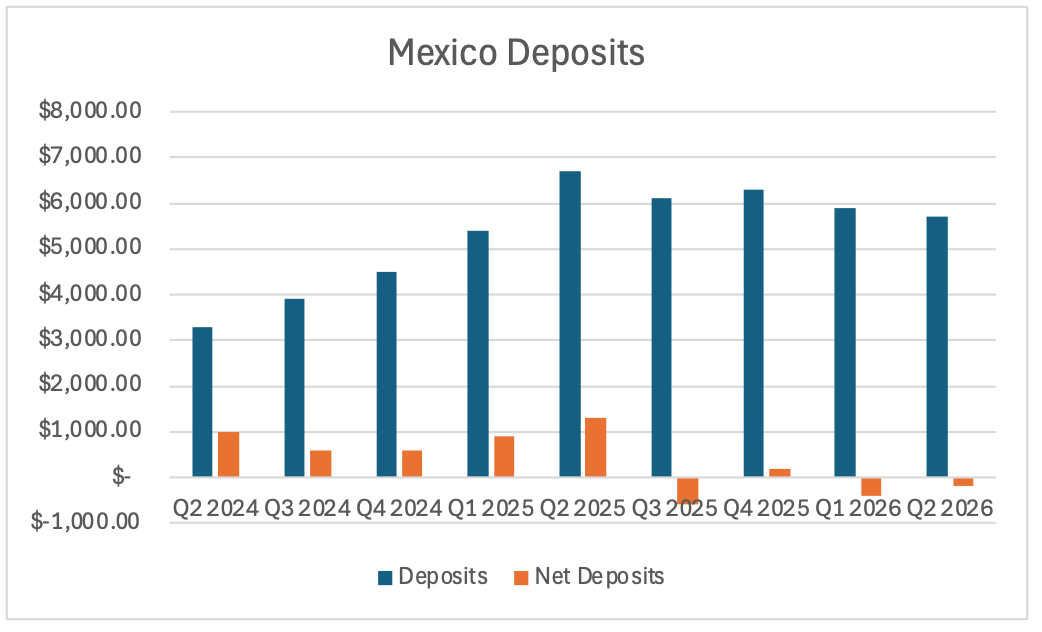
The CFO explained in the earnings call that the big 15% Y/Y decrease in the deposit balance is a deliberate deposit optimization strategy to lower funding costs.
“In Mexico, deposits declined modestly again this quarter, reflecting our ongoing deposit optimization strategy. This continues to improve our cost of funding while maintaining ample liquidity”
“Our objective is not simply to maximize deposits, but to build a resilient funding base that deepens customer relationships, supports profitable growth, and strengthens the long-term economics of the business.”
Rob Livingston, CFO, Q2 2026 Earnings Call.
Simply put, because the Mexican operation already has liquidity to meet its lending objectives, they are intentionally offering lower deposit savings rates. Customers who are searching for the most competitive rate on their deposits are not depositing with Nu.
As a result, their deposit base decreases rather than paying a higher rate to accumulate more cash than they need today.
This was done on purpose to reach profitability in Mexico by reducing the cost of capital.
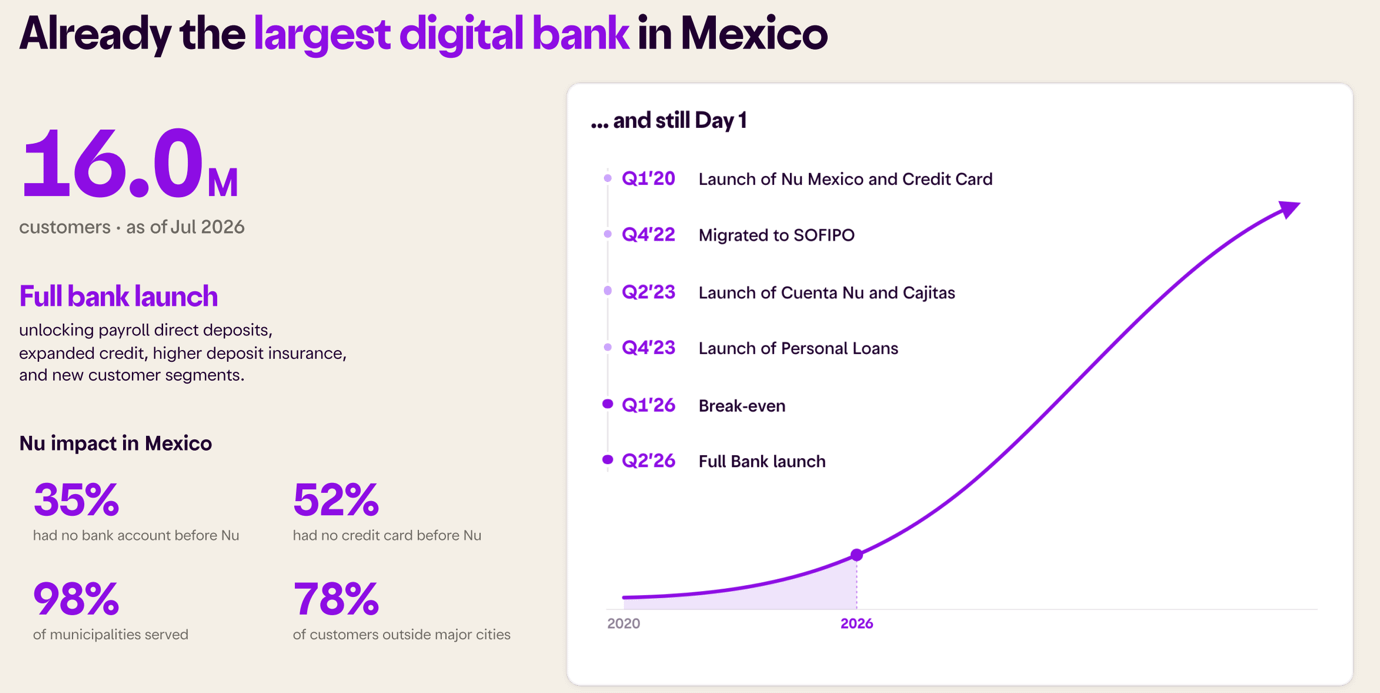
Nu revealed that Mexico is now at break-even level since Q1 2026.
This is why Nu didn’t want to overpay for deposits, as then they would not have been profitable. Now that they are, deposits will likely grow in the second half of the year.
Furthermore, its ability to onboard the underbanked is extremely impressive.
1. 35% of Nu’s Mexican customers didn’t have a bank account before
2. 52% of credit card customers never had one before
3. 78% of customers are outside major cities
The last point is especially telling. Nu is not going after the well-off urban centers that have much higher competition. They are acquiring a large customer base outside the main urban areas. These customers are much cheaper to acquire, as there is less competition for them, as legacy banks don’t want them. However, with the growth of the Mexican manufacturing industry, these areas are likely to become more economically developed in the future. As that happens, Nu will capture a disproportionate share of their business.
Nu’s business strategy is to capture the low-end consumer and then move upmarket, as they are now doing in Brazil with their Super Core products.
When Brazil was at a similar stage of development, with 16.8% of the adult population as customers, their financials were not as strong.
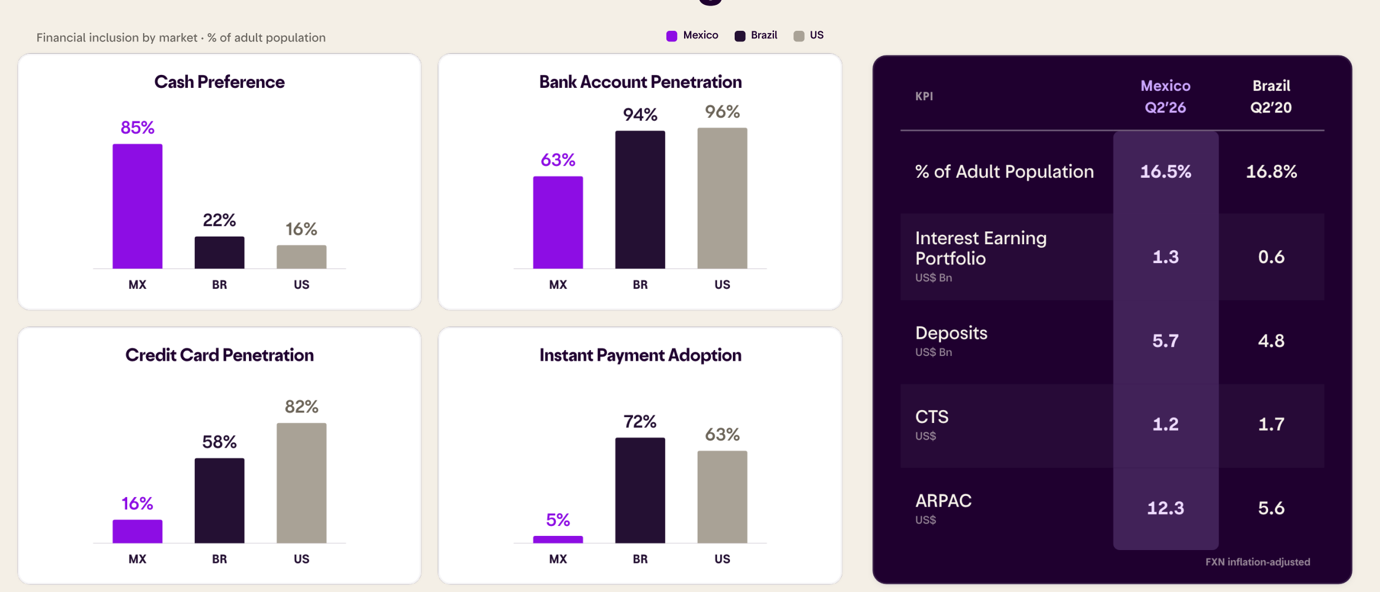
Brazil had $4.8B in customer deposits vs $5.7B in Mexico. This explains Nu’s lack of urgency for growing deposits in Mexico.
Moreover, at similar stages of maturity, the Brazilian ARPU was $5.6 compared to $12.3 in Mexico.
Such results are encouraging considering that in Mexico, still 85% of customers have a preference for cash compared to 22% in Brazil. Also, only 63% of adults have a bank account compared to 94% in Brazil, while only 16% of Mexicans have a credit card compared to 58% in Brazil.
But most importantly, only 5% have access to instant payments, compared to 72% in Brazil.
There are a lot of gaps in the market where Nu can release products to capture market share.
“The cohorts are monetizing earlier. At the same stage, ARPAC in Mexico is $12.3 against $5.6 in Brazil. That reflects higher income per capita, better unit economics in the credit card product, and higher interest-earning balances, all at a lower cost to serve.”
“Our base case for Mexico is a business that could be 60%-70% of Brazil, if digitalization in Mexico happens and a real-time payment system works, it could be as big of Brazil.” David Vélez, CEO, Q2 2026 Earnings Call
Overall, Mexico is still early in its monetization compared to Brazil, but the results are already better.
We can see the results of this in the revenue chart.
Q2 2026 Mexican revenues grew by 79.1% to $314.6M.
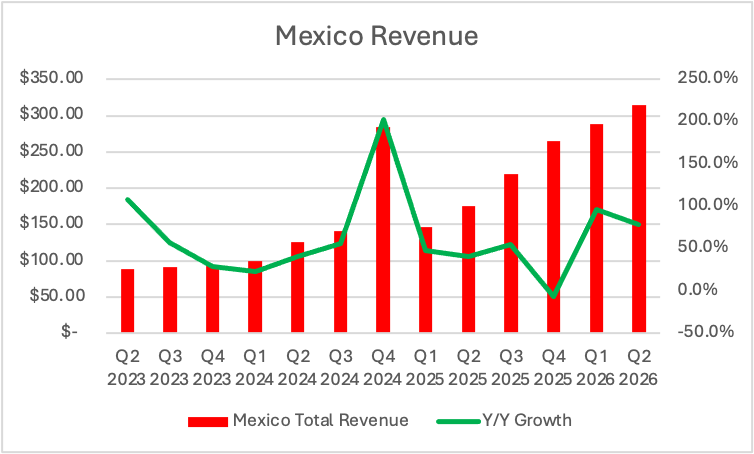
The same as with Brazil revenue, this is an accounting and classification issue. In Q4 2024, a lot of revenue was classified as originating in Mexico and less from the HQ. Ignoring that spike, we see a clear trend line of revenue going up at a steady pace.
4. Colombia
In Q2 2026, Nu Colombia added 600K customers, reaching 5.3M.
This compares favorably to 400K added in Q4 2025 and 500K in Q1 2026.
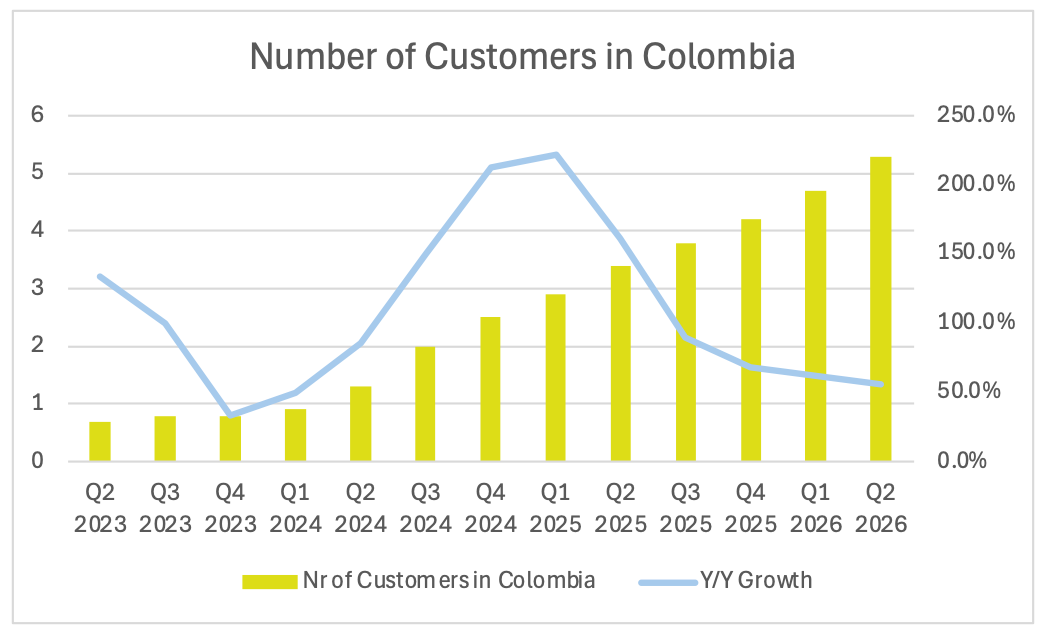
This is an increase of 55.9% Y/Y and 308% in just 2 years!
Nu Colombia has already onboarded 11% of the adult population, quite impressive considering they only began operations 5 years ago.
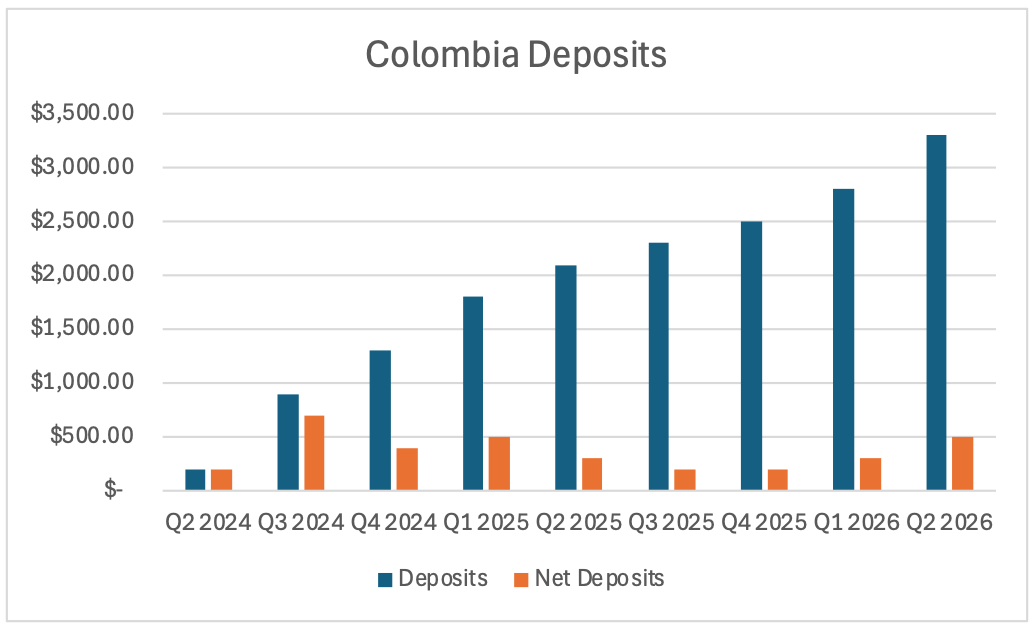
This quarter, Nu Colombia reached $3.3B in deposits, an increase of 57% Y/Y and 17.9% Q/Q!
As we can see in the graph, this is a 10x growth in the deposit base in just a year and a half!
Nu didn’t disclose anything else about Colombia, as the business is still small.
I will be paying close attention to see how Colombia develops. So far, user and deposit growth have been stronger than in Mexico and Brazil at this age in the market.
5. Deposits and Loan Portfolio
Total Nu deposit balance grew 24% Y/Y to $45.3B.
On an FX-neutral basis, deposits grew 6% Y/Y.
Net deposits were $2.9B, which was a 42% Y/Y decrease but a 6x Q/Q increase.
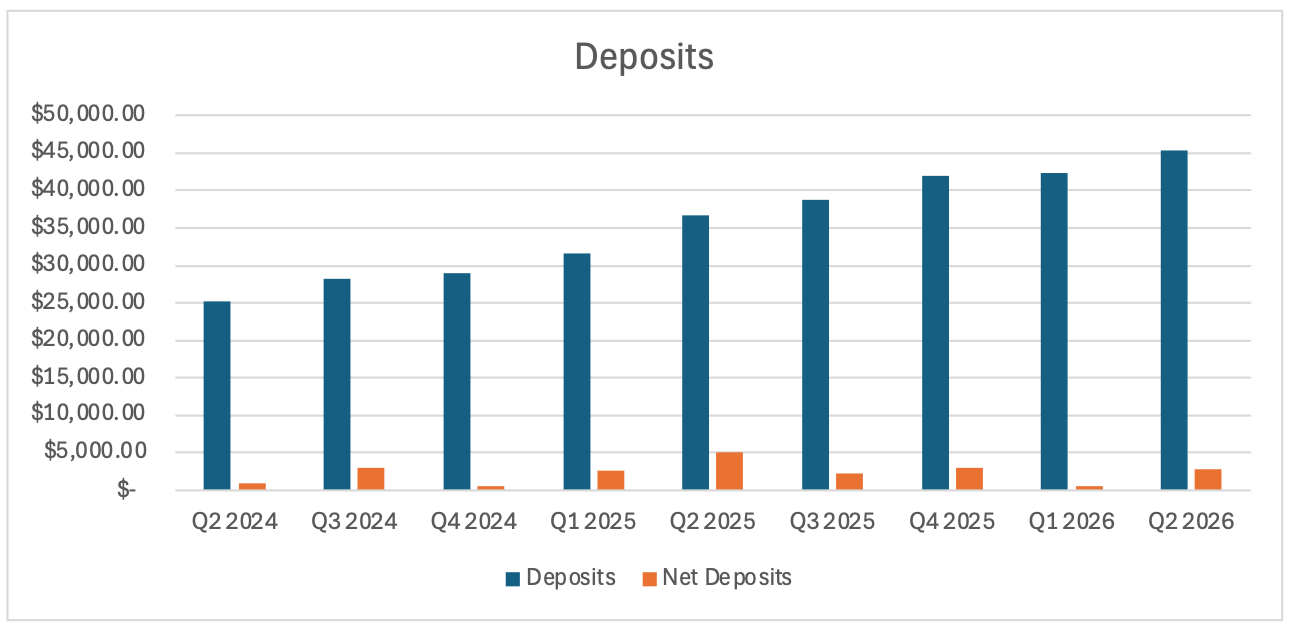
As I already explained in the Brazil and Mexico section, deposit growth was low this quarter due to a focus on lower-cost sources of capital. If Nu needs more capital, they can increase deposit rates.
Nu’s cost of deposits is now at 88% of the interbank exchange rate, down from 91% in Q2 2025. Essentially, Nu is paying its depositors smaller yields than last year, helping the company lower interest costs, thus increasing net interest income.
Banks grow their deposit base for essentially only one reason, to issue more loans to generate interest income.
Total loan portfolio grew 44.8% Y/Y and 37% FXN to $39.4B.
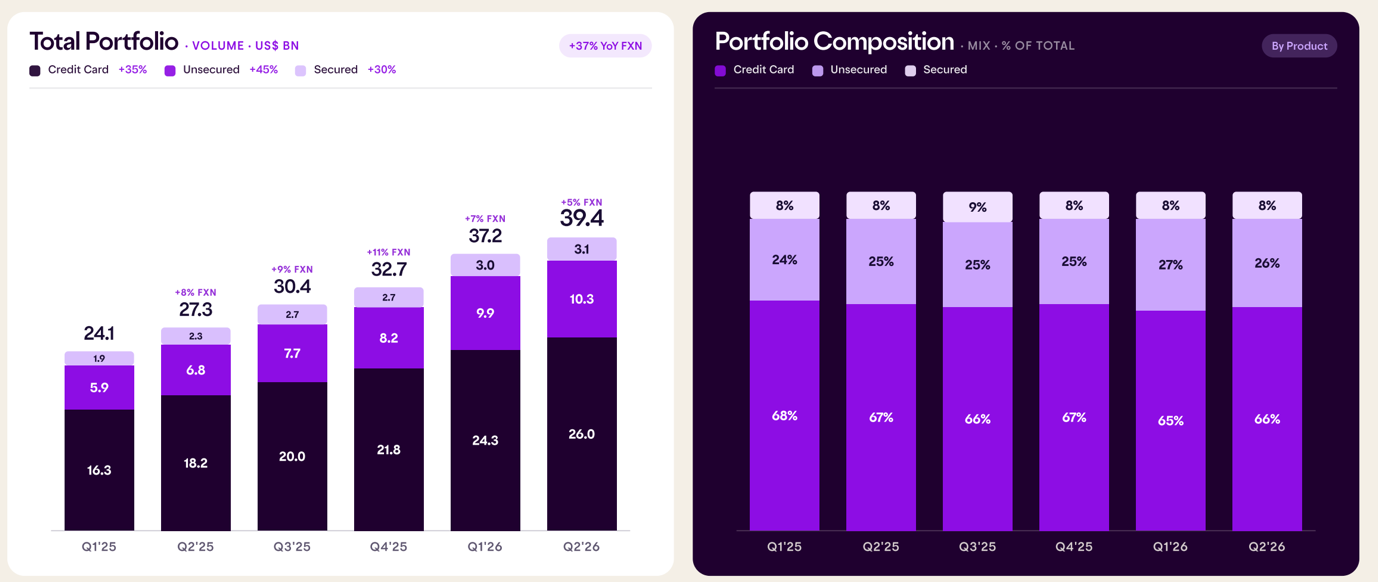
45% FXN growth in unsecured loans was the main contributor to the loan portfolio growth. Meanwhile, the credit card loan share of the portfolio remained around 66%.
While the credit card share is still huge and significant, Nu’s change in the portfolio mix displays Nu’s strategy to originate more diversified, higher-quality, longer-term loans.
This means that Nu is less reliant on revolving credit card balances that are paid off monthly and don’t generate interest.
If we look at Q/Q growth in secured loans, we see that it was just 3%, from $2.3B to $3.1B.
This is quite low growth, as there have been regulatory changes in Brazil. In Q4 2025, there was a 50% decline in new volumes for the secured unemployment fund loans, as the government made changes to regulations.
In Brazil, there is a fund that is designed to help workers in case of unemployment, but there is a way to use that fund as collateral and borrow against it. That was not the intention of the regulator, so they introduced new limitations, making such loans less attractive to borrowers.
But there are new payroll loans in Brazil that are secured by one’s salary that are starting to look more interesting.
“In private payroll, we are accelerating month-over-month. We are slowly getting more comfortable with the product. There’s been a significant progress in how the product is set up in the Brazilian market, the way companies are able to get the collateral, the way the systems are working. As we’ve said many times, we’ve found an asymmetric bet to go too fast, too quickly on a product that had so many question marks. We think we’re getting close to a system that makes a lot of sense, and we are accelerating.” David Vélez, CEO, Q2 2026 Earnings Call
In Brazil, payroll loans (consignado) are deducted automatically from an employee’s salary before the money hits their bank account.
Because repayment is automated and prioritized, these loans carry significantly lower default risk and thus have lower interest rates compared to unsecured loans or credit cards.
While payroll lending to public servants and retirees has long been standardized, the private sector has historically been much harder for fintechs to access due to fragmented employer integrations and operational friction.
However, Brazil has now modernized its infrastructure, integrating data through the systems and streamlining collateral guarantees. This makes it easier, safer, and faster for banks to digitally verify employment, secure repayment collateral, and execute payroll deductions without manual corporate agreements.
The market for these kinds of loans could grow to be massive, as there are tens of millions of private-sector workers in Brazil.
“Ultimately, the lowest cost provider and whoever treats the customer best will win this market. We think we’re extremely well-positioned to be one of the leading players in this market over the next 18 to 24 months.“ David Vélez, CEO, Q2 2026 Earnings Call
Moving on, the quality of their loan portfolio remains stable.
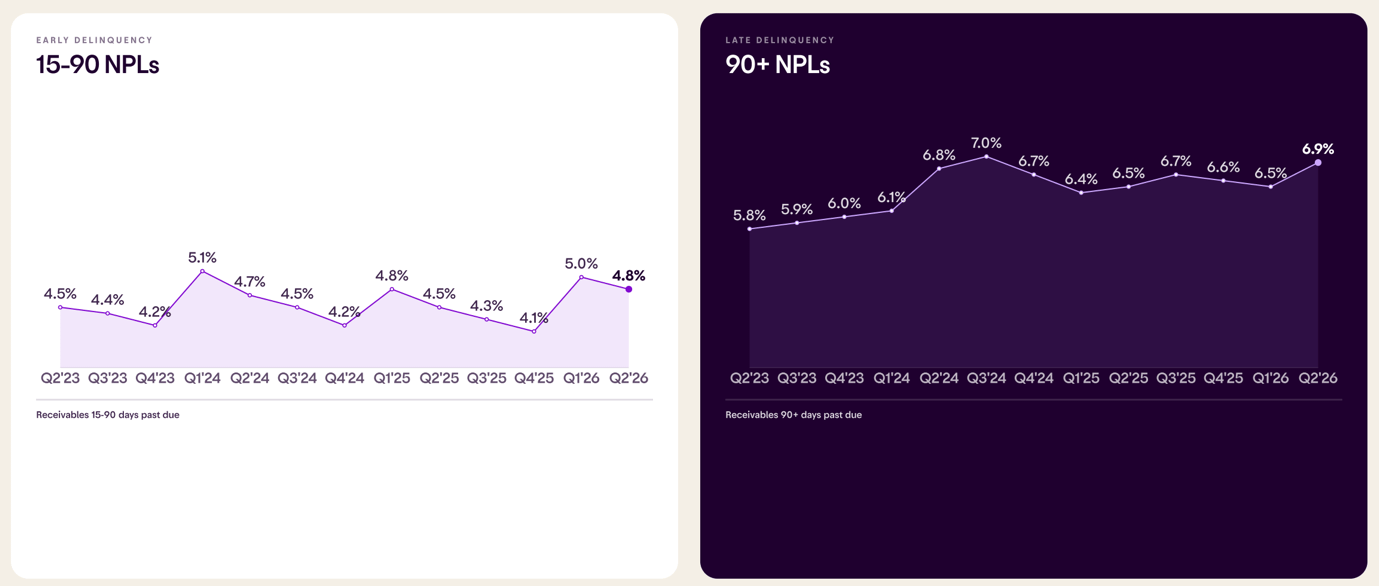
The share of 15-to-90-day nonperforming loans decreased from 5% to 4.8% Q/Q, while increasing slightly from 4.5% in Q2 2025.
90+ day NPL also increased slightly from 6.45 in Q2 2026 to 6.9%.
“90+ delinquencies increased 35 basis points to 6.9%, broadly reflecting the seasonal migration of first quarter early delinquencies into the 90+ bucket. Taken together, these metrics are consistent with the seasonal dynamics we expected and continue to support our view that the underlying quality of the portfolio remains robust.“ Rob Livingston, CFO, Q2 2026 Earnings Call
Nu released this bridge to compare delinquency to Q1 2026.
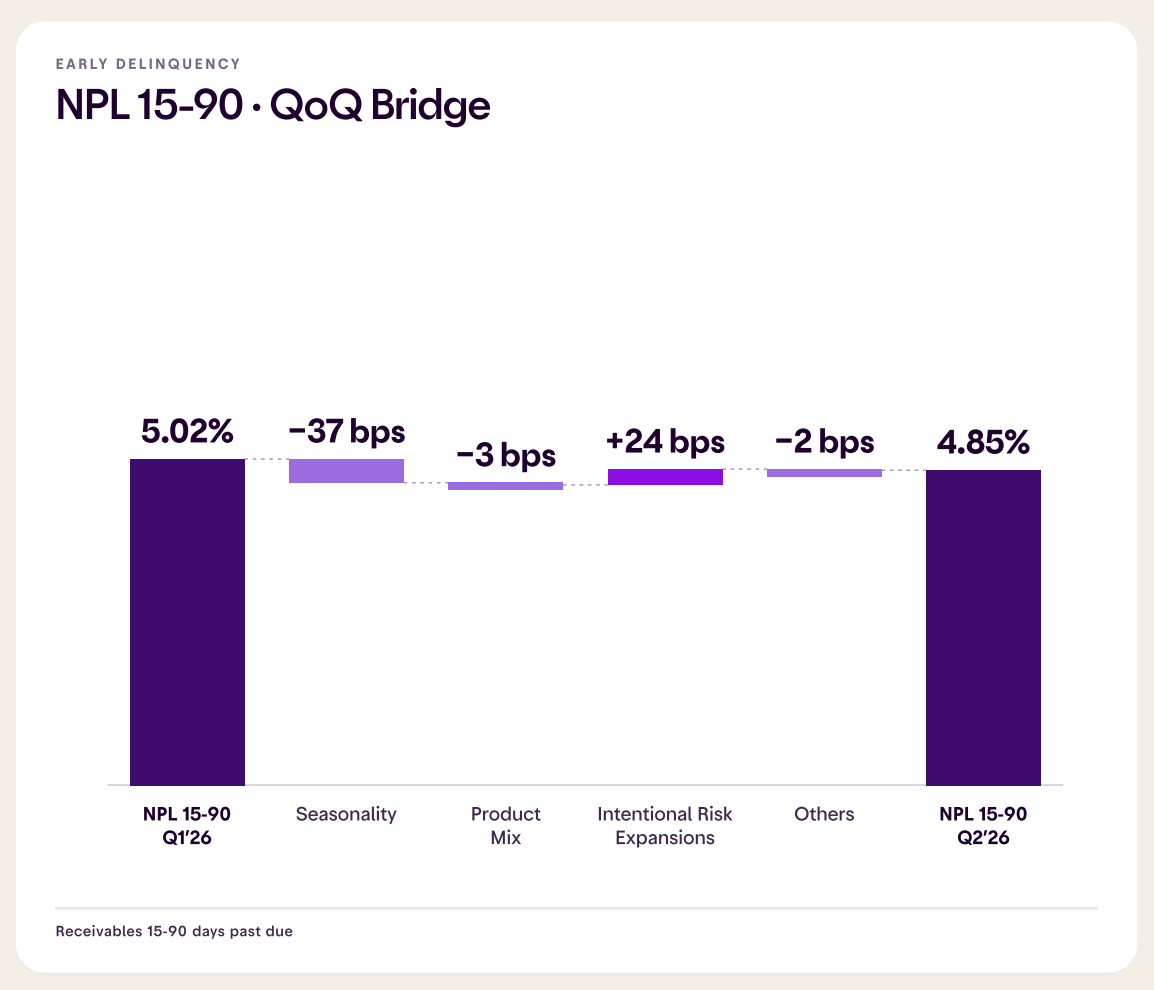
From the 17 basis point decrease in delinquency ratio, 37 bps is the reversal of seasonality, 3 bps relates to a different product mix, while 24 bps are due to intentional risk expansion. Essentially, because the company is growing and issuing more loans in Mexico and Colombia, it’s taking higher defaults as these markets are not as developed as Brazil.
Furthermore, the company’s credit card business is doing much better than other banks in Brazil.
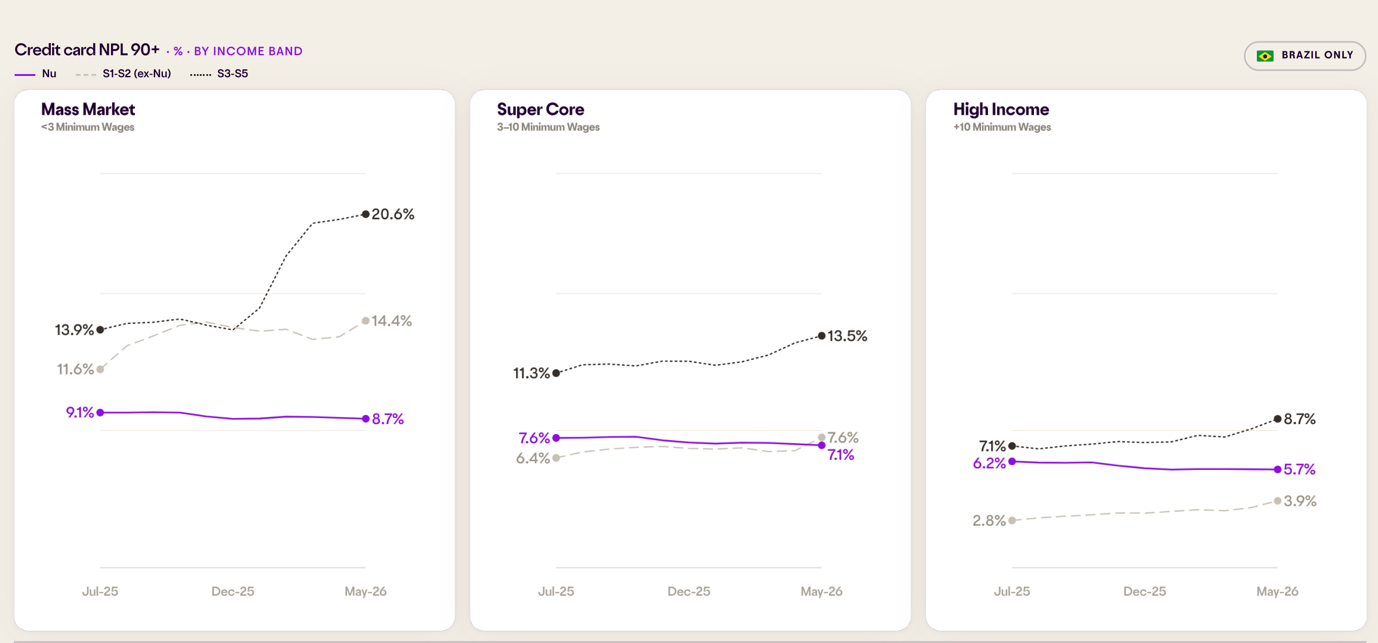
In the mass market segment, the average credit card 90-day NPL is 20.6%, while Nu’s is 8.7%. Only looking at the largest banks in Brazil, we see a 90-day NPL ratio of 14.4%, still much higher than Nu.
This means that Nu is better at managing risk for lower-income consumers than other banks.
However, in the higher-income super core segment, the difference with the biggest banks is much smaller, 7.6% vs 7.1% for Nu.
6. Revenue
Total revenue grew 50% to $5.5B, driven by a 52.7% increase in net interest income and a 39.4% increase in fee income!
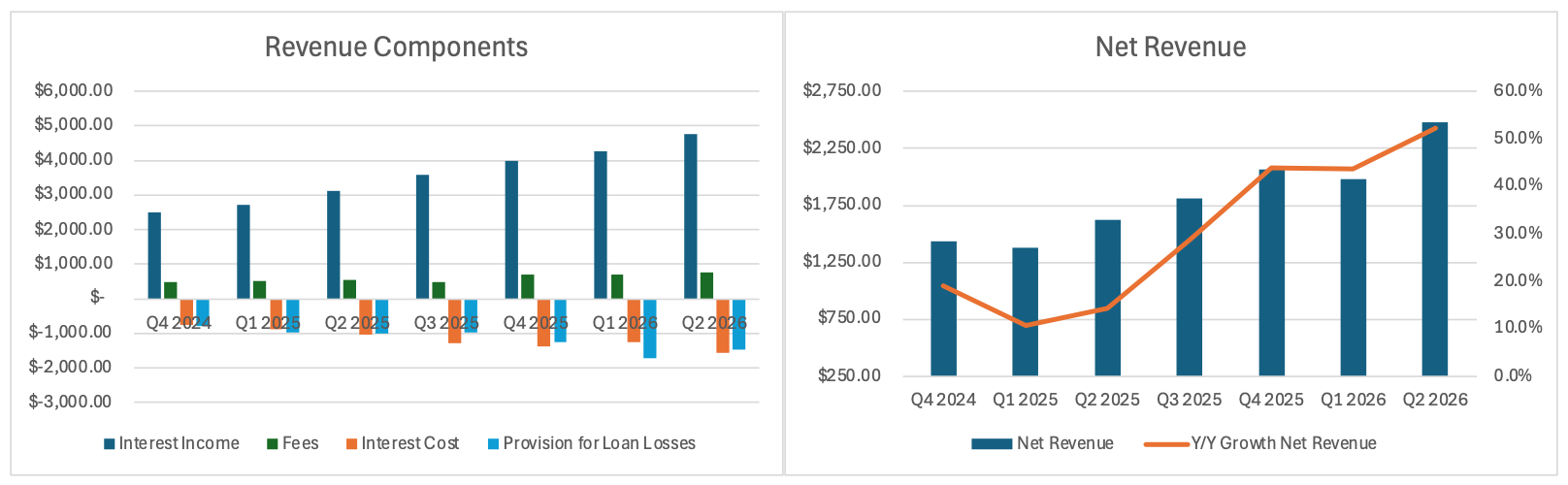
However, net revenue (which I defined as Fees + Interest income – interest cost (NII) – provision for loan losses) grew slightly faster, 52.2% Y/Y to $2.5B.
*(Some have questioned why I do it differently than Nu reports. I do this to for me and to make Nu bank more comparable to other banks. Net revenue is comparable to what Nu calls Gross profit)*
The main causes of this higher growth were a 46.4% increase in provision for loan losses, which was a slower growth rate than the 52.2% net interest income growth
Because of this lower increase in interest costs, the risk-adjusted net interest margin (risk-adjusted NIM) increased from 9.9% in Q2 2025 and 9.5% in Q1 22026 to 12.4% this quarter.
“To your question on net interest margin or risk-adjusted net interest margin for the foreseeable future, we see it as being in the same region as where we are today. We think that it’s sustainable.“ Rob Livingston, CFO, Q2 2026 Earnings Call
As the CFO confirmed, this is not a fluke, the company sees this NIM staying this high in the future.
The interest costs growing more slowly than interest income (51.1% vs 52.2%) was largely due to Nu’s disciplined deposit growth this quarter.
Let’s remember that because of banking regulations, deposits from one country can’t be used for loans in another. This means that Nu must build a new capital base in each country.
Last quarter, the provision for loan losses increased more than the NII (76.4% vs 63.7%) because of strong growth in the overall loan portfolio.
IFRS 9 requires banks to estimate and recognize future loan losses immediately when a loan is issued.
When a bank issues a lot of loans as Nu did, it books high loan loss provisions before it generates any meaningful interest income from these loans. I expected this trend to reverse and it did.
“interest cost has grown faster than interest income for 4 quarters in a row. I think this trend could stabilise now, as the company builds out its deposit base.” Ray Myers, Global Equity Brefing, Nu Q4 2025 Earnings Review
This is exactly what we saw this quarter.
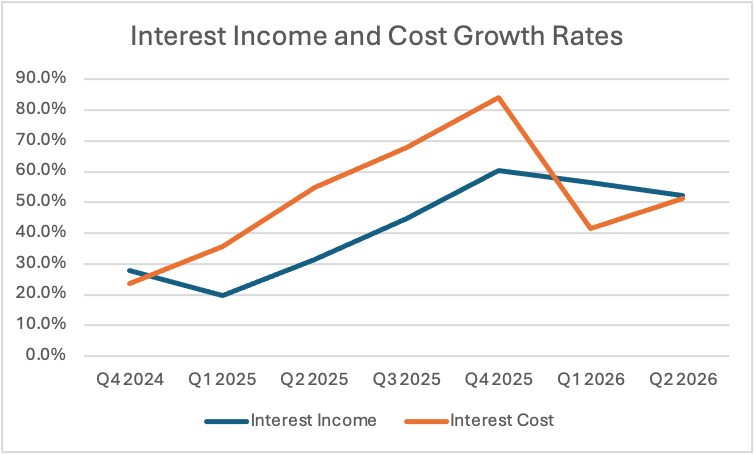
Interest income has grown faster than interest costs for 2 quarts and now, and I expect that to continue in the second half of the year. Unless Nu begins US operations, in which case it will reverse again for a few quarters as Nu builds out its US deposit base.
7. Profitability
In Q2 2026, Nu generated $1.06B in net income, up 66.4% and 49% FXN Y/Y!
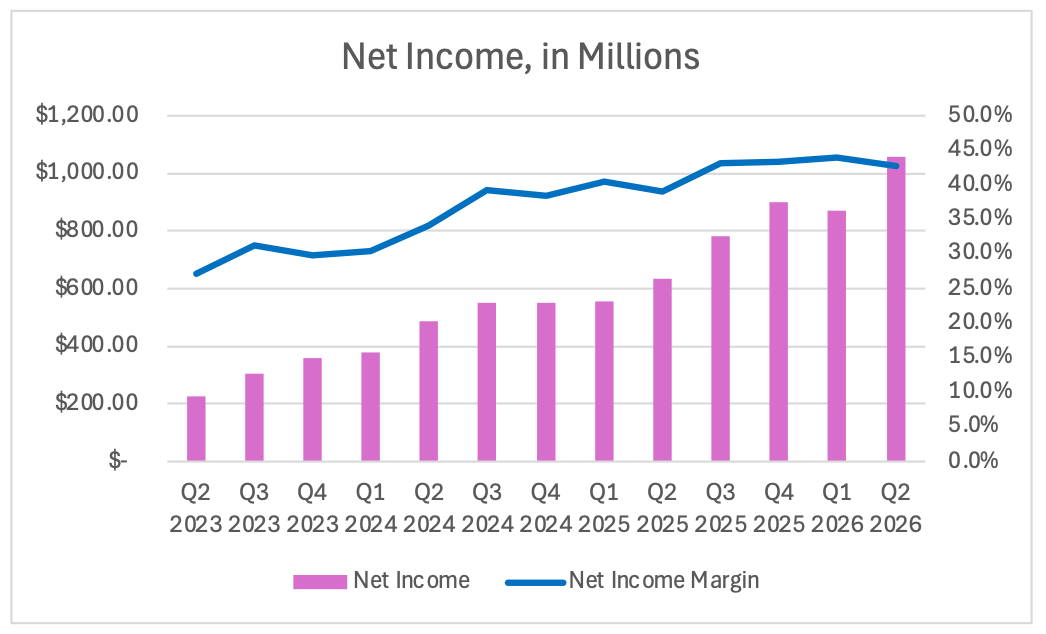
While the chart above shows that Nu is a king of profitability with no signs of slowing down, the net income margin decreased slightly Q/Q from 44% to 42.8%.
ROE, which basically measures a bank’s return from its net assets, increased from 28% in Q2 2025 to 33%.
Most banks can only dream of such a high ROE. This level of profitability can only be possible with incredible operational efficiency.
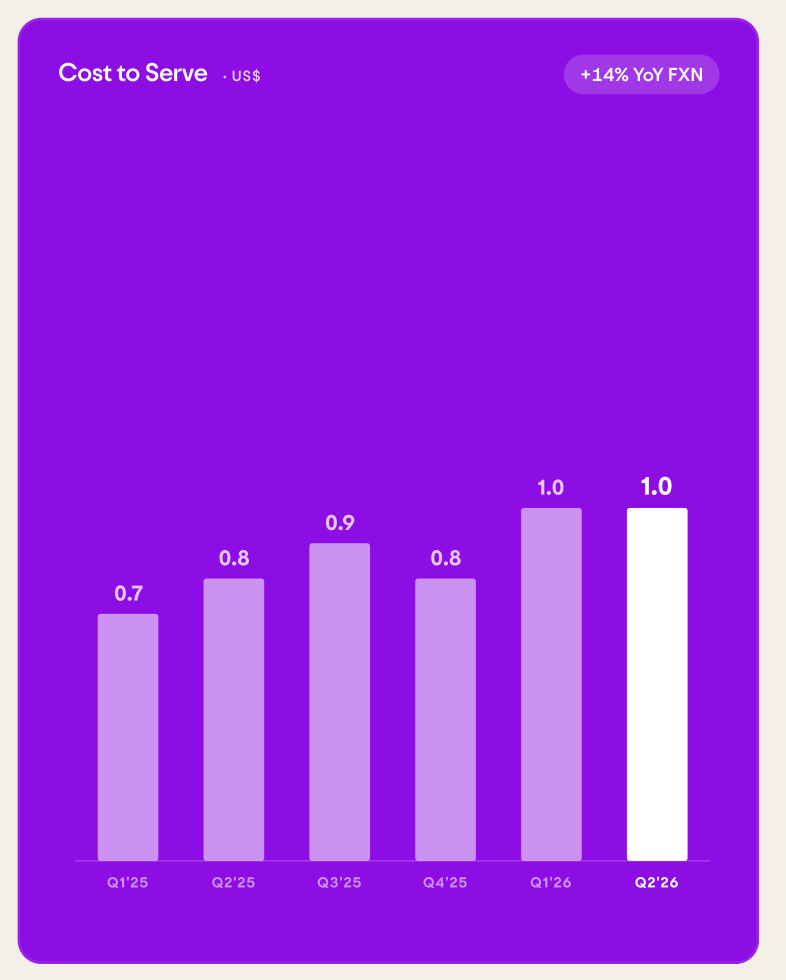
As we already discussed earlier, the cost per active customer increased 14% Y/Y on an FXN basis, but still remains at a low $1.
Another metric to monitor is the efficiency ratio!
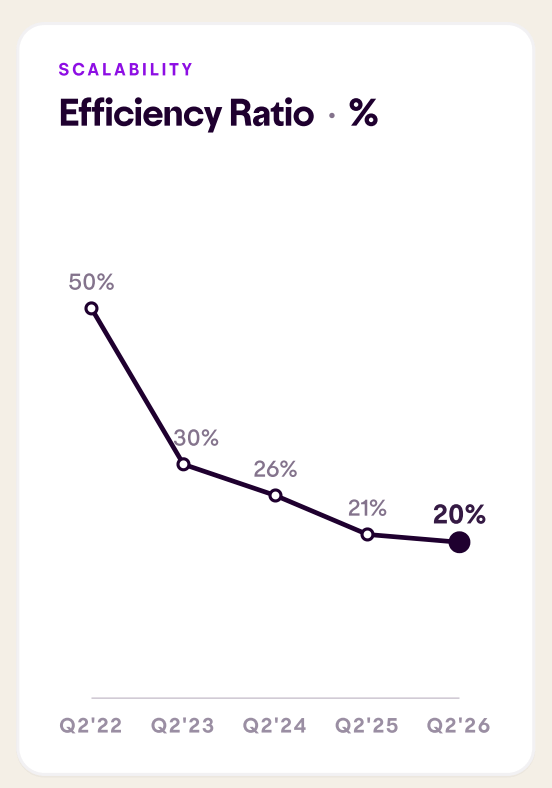
It measures operating expenses as a share of net revenue, and as you can see in the graph above, it has been steadily going down from 26% in Q2 2024 to 20% today.
Nu is better at using technology to serve a large number of customers than possibly any other bank in the world!
Nu’s efficient operating model allows low prices and high profits. This is a potent combo for explosive global growth!
This is how Nu beat the street analyst’s EPS estimate of $0.20 by 1 cent.
This was achieved despite Nu spending heavily to build new products, expand to the US, and implement AI.

Customer support costs grew by 40% to $226M.
SG&A grew by 75.8% to $600M.
Marketing grew by 53.6% to $103M.
Other expenses grew by 69.4% to $201M.
It is actually quite impressive that they were able to grow earnings by so much while growing expenses by 66%. This indicates that there is still so much profit this company can generate, and I don’t think that it will stop at the 43% net income margin.
This is because Nu is currently in a heavy investment period.
They are investing in AI to automate customer support and operations. They are putting AI at the center of the organization, and that is incredibly expensive. It will take some time for efficiencies to appear.

Let’s not forget that Nu just sponsored MLS team Inter Miami, where Messi plays.
They signed a 5-year deal that cost many millions, and it will take time for the company to recoup this investment once they enter the US market.
Overall, Nu delivered another incredible quarter of profit growth.
However, net margin will likely not grow as fast as before, due to the investments that the company must make to grow in the US. But I don’t care much about the few basis point difference in the margin, I care about the absolute dollar EPS growth.
I have high confidence in Nu and this management team.
8. Conclusion
In conclusion, Nu delivered another strong quarter of profit growth.
As I mentioned in the introduction, there is a FOMO trade happening right now in the market. Investors are selling high-quality, non-AI stocks and buying AI. This is clearly a buying opportunity, as Nu now trades at only a P/E of 21.
The AI boom is real, and there are many stocks that are delivering real results and deserve the AI hype. I, for instance, am bullish on a few of them, like Nebius and Micron, but there are many that do not deserve the hype. Some stocks have run over 1,000% this year, and a lot of investors are selling their SaaS and fintech stocks that are down 20-50% to buy photonics small caps.
I don’t believe that this is a profitable trade. Selling quality companies at such depressed levels to buy hype stocks is a recipe for disaster.
I believe that this trade will end soon, as fintechs such as Nu, DLocal, Klarna, and Sofi are trading at unsustainably low valuations.
Companies with strong balance sheets, increasing TAM, and 30-40% topline growth don’t deserve to trade for sub-20 FWD P/E. Eventually, the market will return to wanting profits, as it did in 2022 after the 2021 EV/SaaS bubble burst.
I am investing accordingly.

Here is what my Premium Members can expect:
Portfolio Review - Each month, I will present the portfolio performance and discuss my stock watchlist and my best ideas.
Recent developments.
Unwarranted pullbacks.
Insider activity.
Potential catalysts.
Deep Dives – 8,000+ word detailed analysis of a company, delivered in 3 Parts.
Part 1 – Brief History of the company and its Business Model.
Part 2 – Management, Moats, Competitors, and Risks.
Part 3 – Opportunities, Financial Analysis, and a Valuation Model.
You can expect a comprehensive research report that is educational, interesting, and provides actionable insights!
To see what you can expect, read my Palantir Deep Dive!
Members of the Premium service get access to my library of 15 Deep Dives and to all future Deep Dives, which will be released on semi-monthly basis.
Investment Cases – A short, concise report with actionable insights.
This report is about the size of a single part of a Deep Dive.
Focused Investment Thesis
Main drivers of the Bull Case
Valuation Model
To see what you can expect, read my Oscar Health Investment Case!
Earnings Reviews and Updates – For companies that are of great interest to me and my readers, I will provide regular quarterly or semi-annual updates after earnings reports.
Financial performance
Business Update
New developments
Updated Valuation Model
To see what you can expect, read my Google Q2 2025 Earnings Review!
You can follow me on Social Media below:
X(Twitter): TheRayMyers
YouTube: TheRayMyers
Threads: @global_equity_briefing
LinkedIn: TheRayMyers
Equity Research Report List
Disclaimer: Global Equity Briefing by Ray Myers
The information provided in the “Global Equity Briefing” newsletter is for informational purposes only and does not constitute financial advice, investment recommendations, or an offer or solicitation to buy or sell any securities. Ray Myers, as the author, is not a registered financial advisor, and readers should consult with their own financial advisors before making any investment decisions.
The content presented in this newsletter is based on publicly available information and sources believed to be reliable. However, Ray Myers does not guarantee the accuracy, completeness, or timeliness of the information provided. The author assumes no responsibility or liability for any errors or omissions in the content or for any actions taken in reliance on the information presented.
Readers should be aware that investing involves risks, and past performance is not indicative of future results. The author may or may not hold positions in the companies mentioned in the “Global Equity Briefing” report. Any investment decisions made based on the information in this newsletter are at the sole discretion of the reader, and they assume full responsibility for their own investment activities.