
Sofi Q2 2026: Incredible Cross-Sale vs Stubborn Market!
Stock down 31% YTD, despite accelerating revenue and profit growth.

The reaction to Sofi’s earnings continues to be completely disconnected between what the reality is and what the market perceives it to be.
43% Revenue Growth
44% ADJ EBITDA Growth
50% EPS Growth
Yet the stock was down 9%!
This is especially insane, considering the stock was already down 31% YTD and traded at a FWD P/E of 25 before the earnings.
Find me another stock that is delivering such strong top and bottom-line growth at such a valuation, with such a strong TAM and incredible innovation in the last 3 years.
So why would the market react in such a way to these earnings?
There are a few issues behind this reaction.
1. Deceleration in the Loan Platform Business.
2. Higher effective tax rate.
3. Didn’t increase the earnings guidance.
4. Dilution.
In this Q2 2026 earnings review, I will look at the quarterly performance and analyze all 4 of these reasons to determine their impact on the stock.
Let’s begin!
1. Overall Performance
Revenue $1.22B +43%
ADJ EBITDA $358.8M +44%
Net Income $156.6M +61%
Diluted EPS $0.12 +50%
Tangible Book Value $9.5B +80%
Tangible Book Value per share $7.34 +56%
1.1. Revenue
The company brought in $1.22B in GAAP revenue, which is a 42.7% Y/Y increase from the $854.9M it made in Q2 2025.
This was a huge 9% beat of the $1.12B that Wall Street analysts expected.
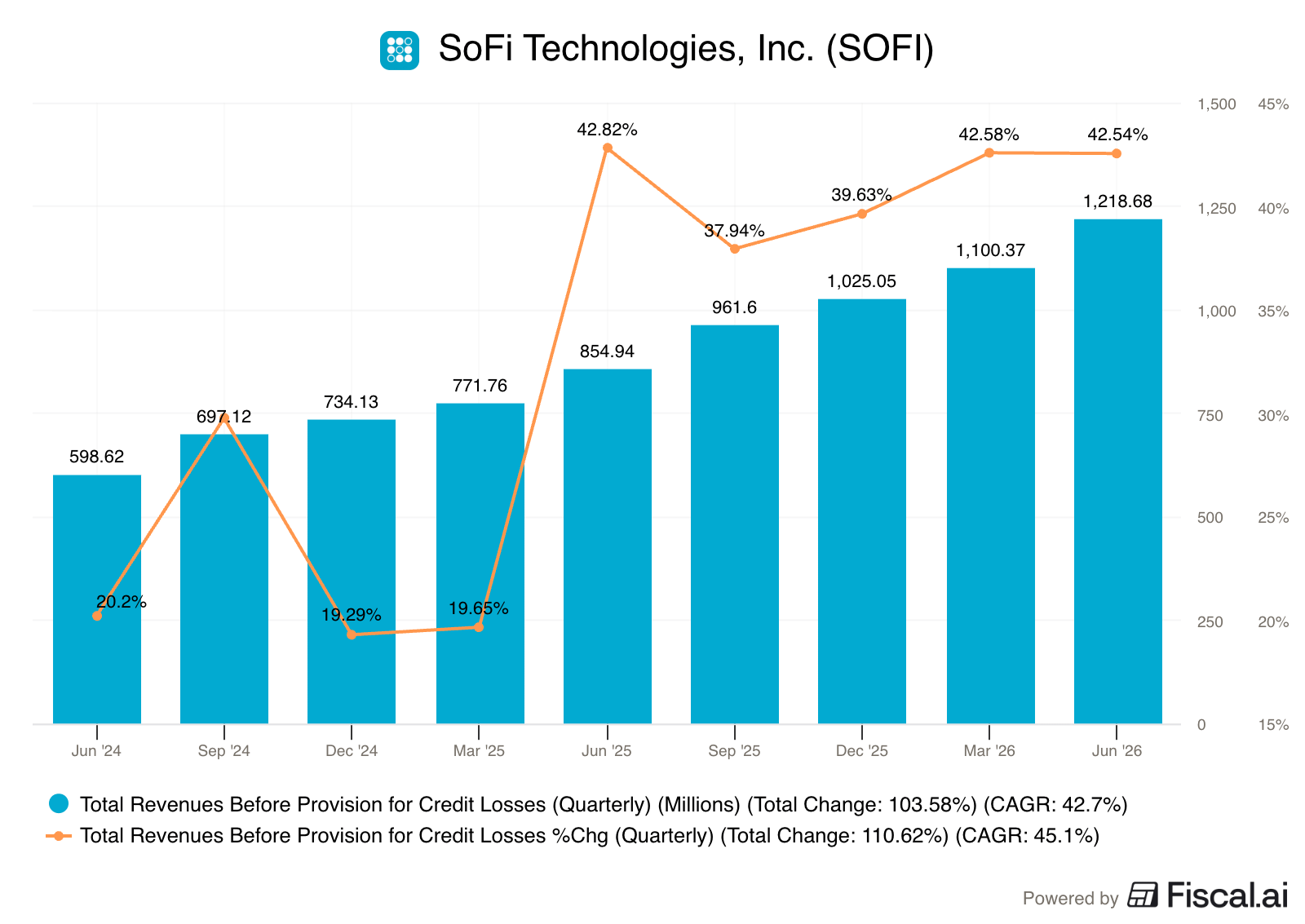
As you can see in the graph above, Sofi demonstrated strong acceleration from the 19.65% growth it had in Q1 of 2025.
This growth is much faster than what legacy banks and other fintechs are seeing right now and is largely driven by the lending business, on which we will expand in a bit.
Last quarter, the company talked about how they are focusing more on growing its own balance sheet and growing the loan book, instead of fee income, and this is reflected in the growth of net interest income and fee-based revenues.
Net Interest Income reached $788M, up 52.2% Y/Y.
Sofi is making more interest income because it is using member deposits to fund its loans, which are cheaper than other ways of funding.
Meanwhile, fee-based revenue reached $430.5M, up 27.7% Y/Y.
This includes revenue from the loan platform business, fees from credit cards and investing.
“When people ask, ‘Why are you putting loans on the balance sheet, why are you not doing everything through Loan Platform Business?’ It’s because we want to make sure we have revenue in the future that’s visible, that can deliver no matter what, and it’s 100% in our control.” Sofi CEO, Anthony Noto, Q2 2026 Earnings Call
Essentially, I am reading this as the company not wanting to become too dependent on the LPB.
LPB is not 100% within their control, as credit investors can easily reduce their funding, and if that happens, Sofi wants to have the balance sheet to be able to replace a meaningful share of that lost funding. So instead of giving all its loans to its credit investor partners, Sofi prefers to issue a lot of loans itself, to build a large balance sheet.
This does not mean that the LPB segment is no longer a priority, and I will expand on it later in this report.
1.2. ADJ EBITDA
ADJ EBITDA is Sofi’s preferred way to track the earnings the business makes from its operations.
In Q2 2026, ADJ EBITDA was $357.8M, which is 44% higher than the $249M made in Q2 2025.
Just like the revenue growth, this is a huge 7.4% beat of the $333M that Wall Street analysts expected.
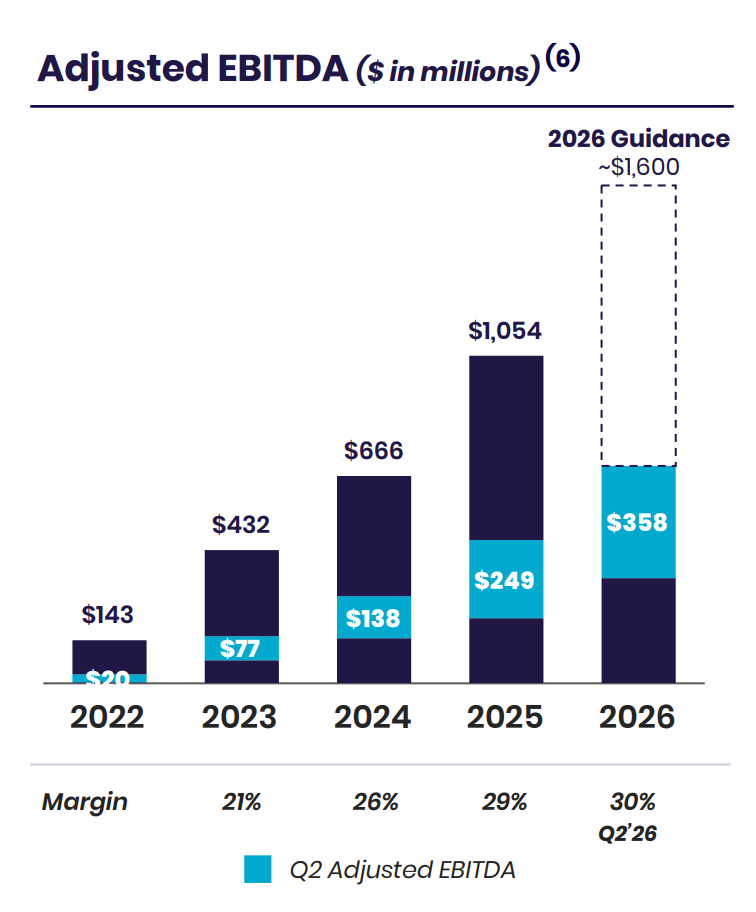
The ADJ EBITDA margin was 30%, showing that the company is getting more efficient with each quarter.
Sofi also emphasizes the Rule of 40 metric, where you sum the growth rate and the profit margin. If the score is above 40, it is considered that the company is achieving a great combination of growth and operating leverage.
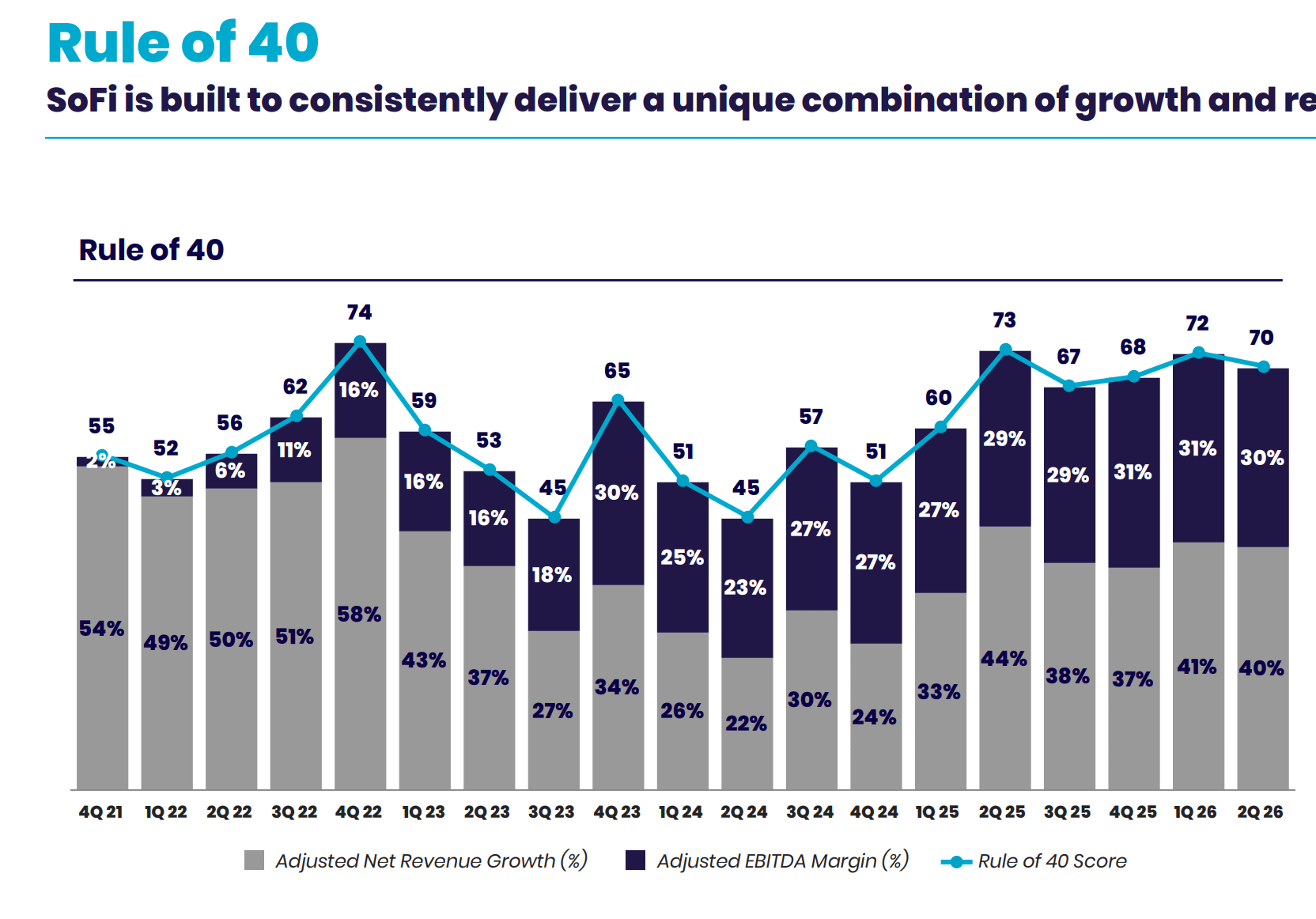
Sofi had a score of 70 in Q2 2026. This was the 19th quarter in a row that Sofi has beaten this goal.
Furthermore, Sofi reported and incremental EBITDA margin of 31% means that for every new dollar of revenue, 31 cents goes straight to profit.
This shows that Sofi’s business model is working as intended. The more members they get, the more profit they make because they don’t have to spend as much to serve each new customer.
1.3. Net Income and EPS
For Q2 2026, GAAP net income was $156.6M, a growth of 61% Y/Y from the $97.3M made in Q2 2025. This resulted in a diluted EPS of $0.12, a 50% Y/Y increase from $0.08.
Wall Street analysts expected Diluted EPS of $0.11, so this was also a massive beat by 9%.
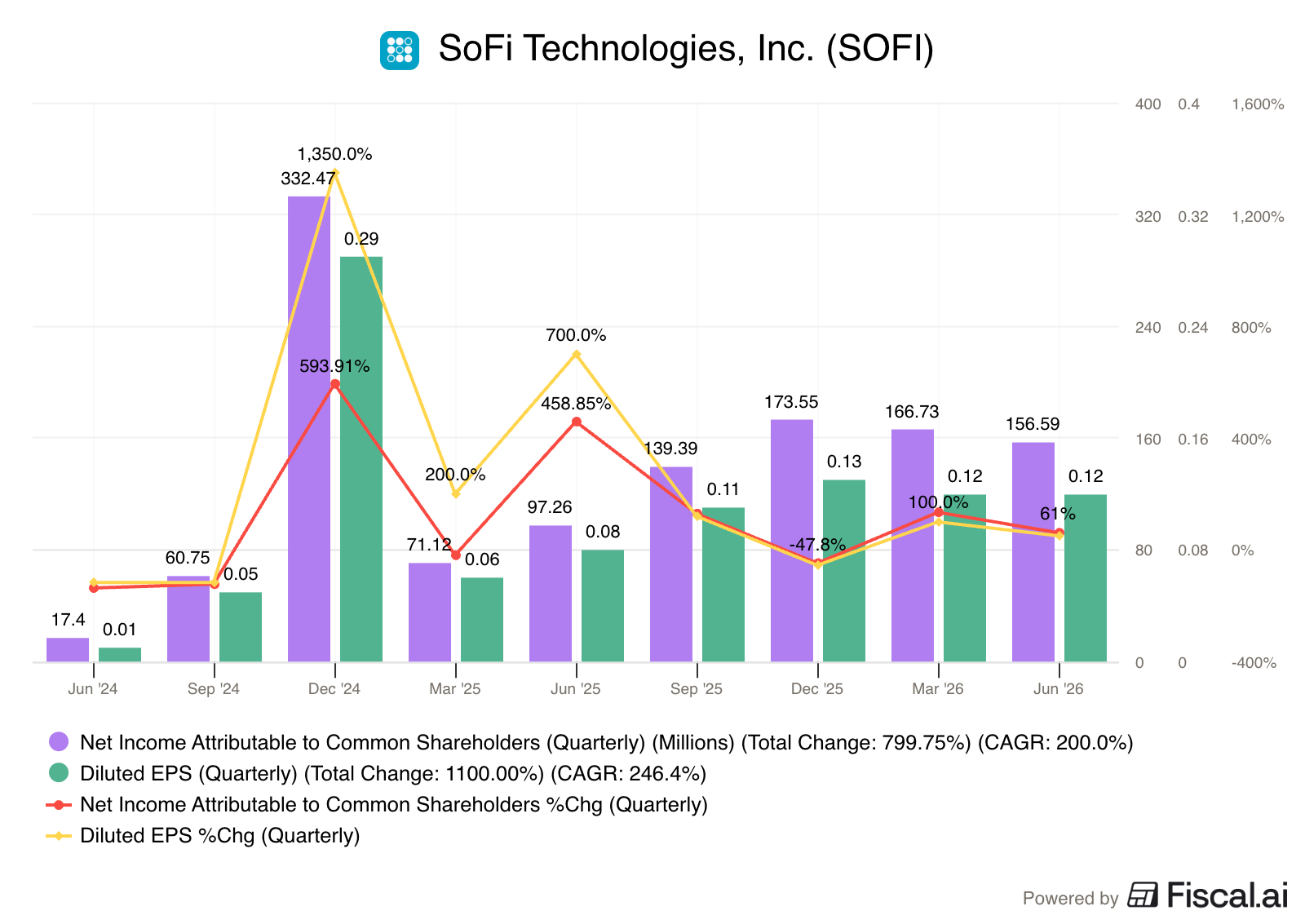
However, EPS growth of 50% was significantly lower than the 61% net income growth.
This is because of Sofi issuing new shares and diluting shareholders, but I will expand on that in a chapter of its own.
The net income margin was 13%, a slight increase from 11% in Q2 2025, but a noticeable decrease from 15% and 17% in the prior two quarters. This was a second quarter in a row of decreasing net income margin, something which has been flagged as a concern by some bears.
However, this was largely caused by a higher effective tax rate in Q2 2026.
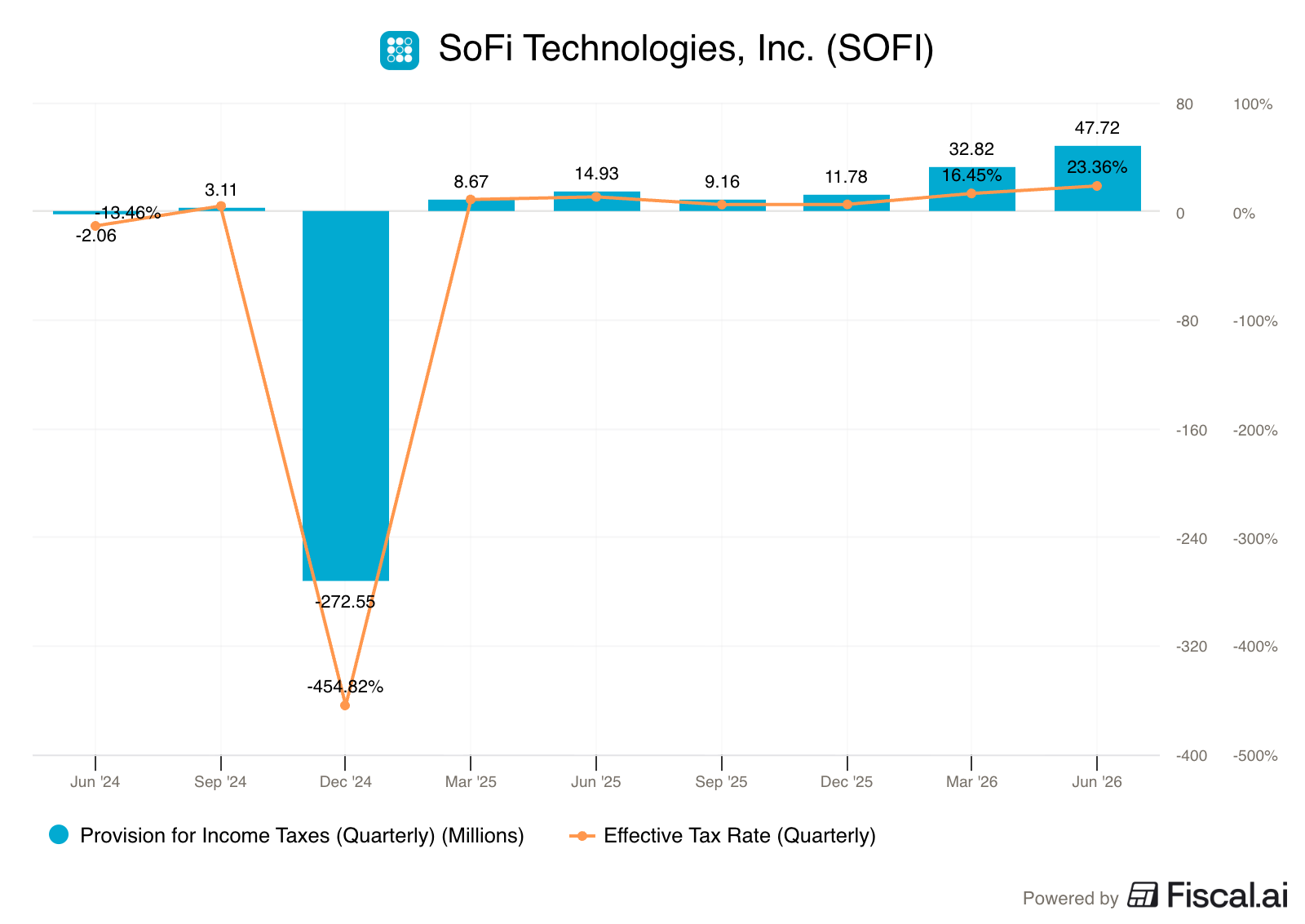
Sofi paid $47.7M in taxes in Q2 2026, which was an effective tax rate of 23.4%, a huge increase from 16.5% and 6.4% in the prior two quarters.
“Our EPS guidance now includes a tax rate of 22%, which is approximately 700 basis points higher than our original guidance.” CFO Chris Lapointe, Q2 2025 Earnings Call
Management reported that the $0.12 EPS would have been higher, if not for the approximately $0.005 negative impact from a higher-than-expected tax rate.
The important read-through is that the higher tax rate isn’t signaling weaker operating performance.
The new 22% 2026 tax-rate guide is driven by the:
1. Normalization of SoFi’s effective tax rate as profitability increases.
2. Less benefit from stock-based-compensation tax deductions.
3. Not a new federal corporate tax hike.
For many years, Sofi was unprofitable, so the company accumulated significant deferred tax assets from those years. The good thing is that the US tax code allows those tax assets to reduce taxes when the company becomes profitable.
In Q4 2024, SoFi released $258M of valuation allowance against these deferred tax assets after concluding those tax assets were likely to be usable. That produced an unusually favorable tax effect in 2024. You see that in the graph above, where in Q4 2024 the company recognised a $273M negative tax provision, which essentially means that it got money from taxes, instead of paying them.
However, today it is consistently profitable, so its tax profile is starting to look like that of a normal profitable corporation.
The federal corporate rate is 21%. That makes management’s new expected 22% effective rate quite logical, as there are some other state/local taxes that the company must pay.
The key question is why did management originally guide for only a mid-teens tax rate in 2026?
This is where stock compensation is very important.
SoFi’s SEC filing says Q1 2026’s effective tax rate was below the 21% rate primarily because of “excess tax benefits from stock compensation.”
This is because when employee stock awards vest at prices above their tax basis, the company can sometimes receive a tax deduction.
That creates an excess tax benefit, reducing the effective tax rate.
For example, let’s say that an employee receives 10,000 restricted stock units worth $10 per share, about $100K in total, that vest over 4 years. US GAAP says that Sofi must record $25,000 a year as costs on its income statement.
However, let’s say that in 2 years the stock has doubled and trades for $20 a share, making the yearly vest worth $50,000, not $25,000.
Per US GAAP accounting rules, Sofi must recognise the original value at the time of issuance as employee expenses, so $25,000, not $50,000 fair market value at the moment the shares vest.
However, the IRS allows the full write-off.
This means that Sofi is allowed to reduce its taxable income by the full $50,000, not the accounting value of $25,000.
The unusual-looking result arises because GAAP accounting locked in a $100,000 grant-date value, whereas tax law looks at the actual taxable compensation when the stock award vests.
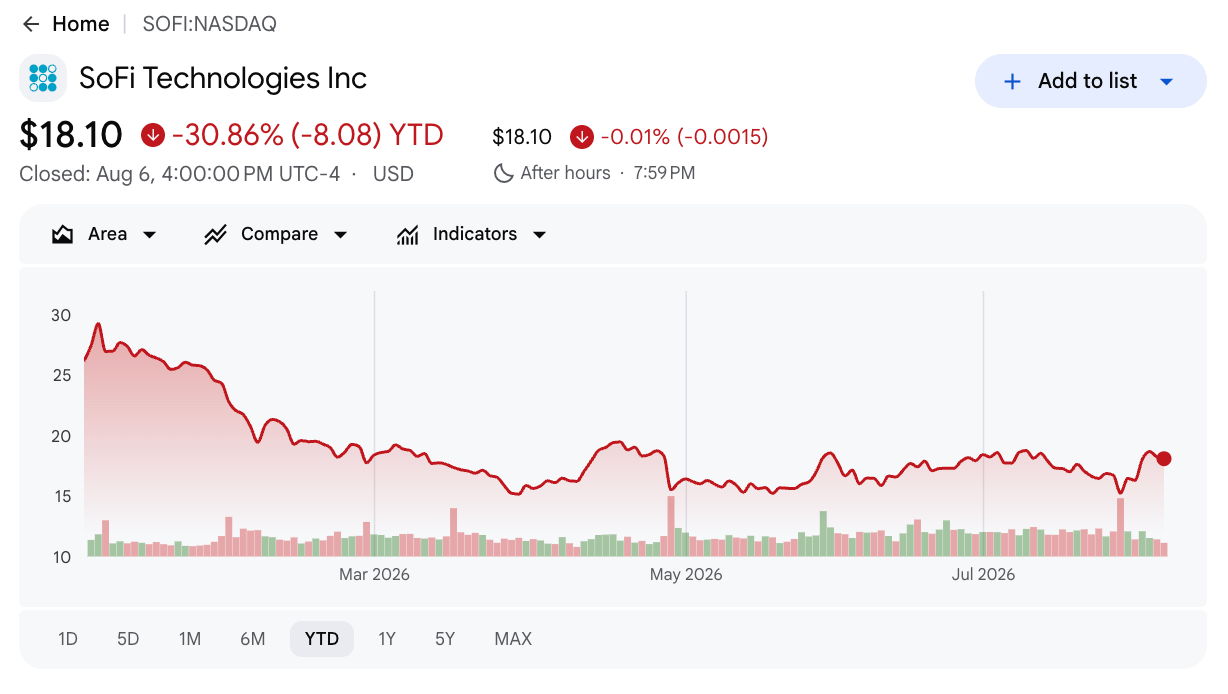
Essentially, because Sofi’s share price has tanked over 30% YTD, fewer RSUs are vesting at a price above what they were issued at.
There are RSUs issued to employees at over $20 that are vesting now, while the stock trades for $18.
Thus, Sofi can’t recognise any benefits from this.
Simply put, because Sofi’s share price has fallen, the company must pay more taxes.
Accounting is hard.
1.4. Guidance
As I mentioned in the introduction, guidance was a slight disappointment.
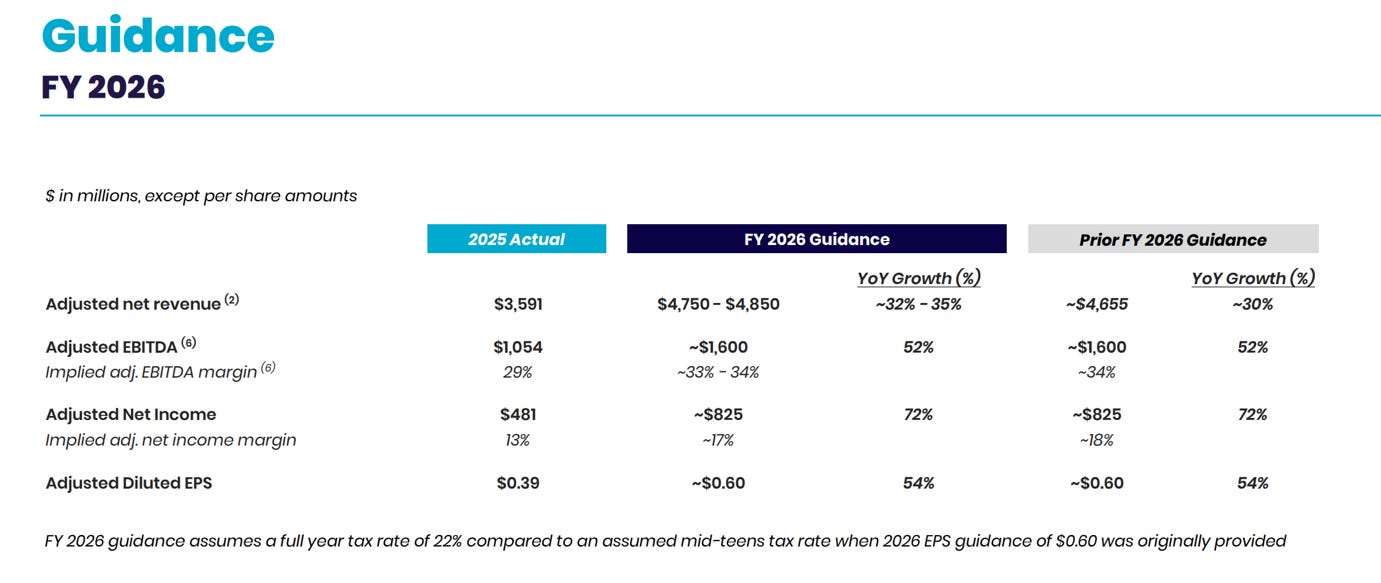
First, Sofi didn’t give Q3 guidance, just giving yearly guidance.
Second, the problem for investors was that Sofi barely raised its full-year 2026 guidance.
They expect about $4.750B to $4.850B in revenue for 2026, delivering revenue growth of 32-35%. This is only a slight $100M increase in revenue from the previous guidance, about 2-3%.
Most importantly, Sofi didn’t increase its profitability guidance of $1.6B ADJ EBITDA and $0.60 ADJ EPS.
“At the same mid-teens tax rate as our original guidance, our new guidance today would have actually been $0.65 in EPS instead of our actual guidance of $0.60 in the EPS.” CFO Chris Lapointe, Q2 2025 Earnings Call
So the effective tax-rate change is costing $0.05 of 2026 EPS, or roughly 8% versus the $0.65 EPS that management says it otherwise would have guided to.
2. Tech Platform
The “AWS of Fintech” bull case is essentially in a coma.
Revenue for the Tech Platform was only $84.5M. This is a 23% drop from the $109.8M it made in Q2 2025.
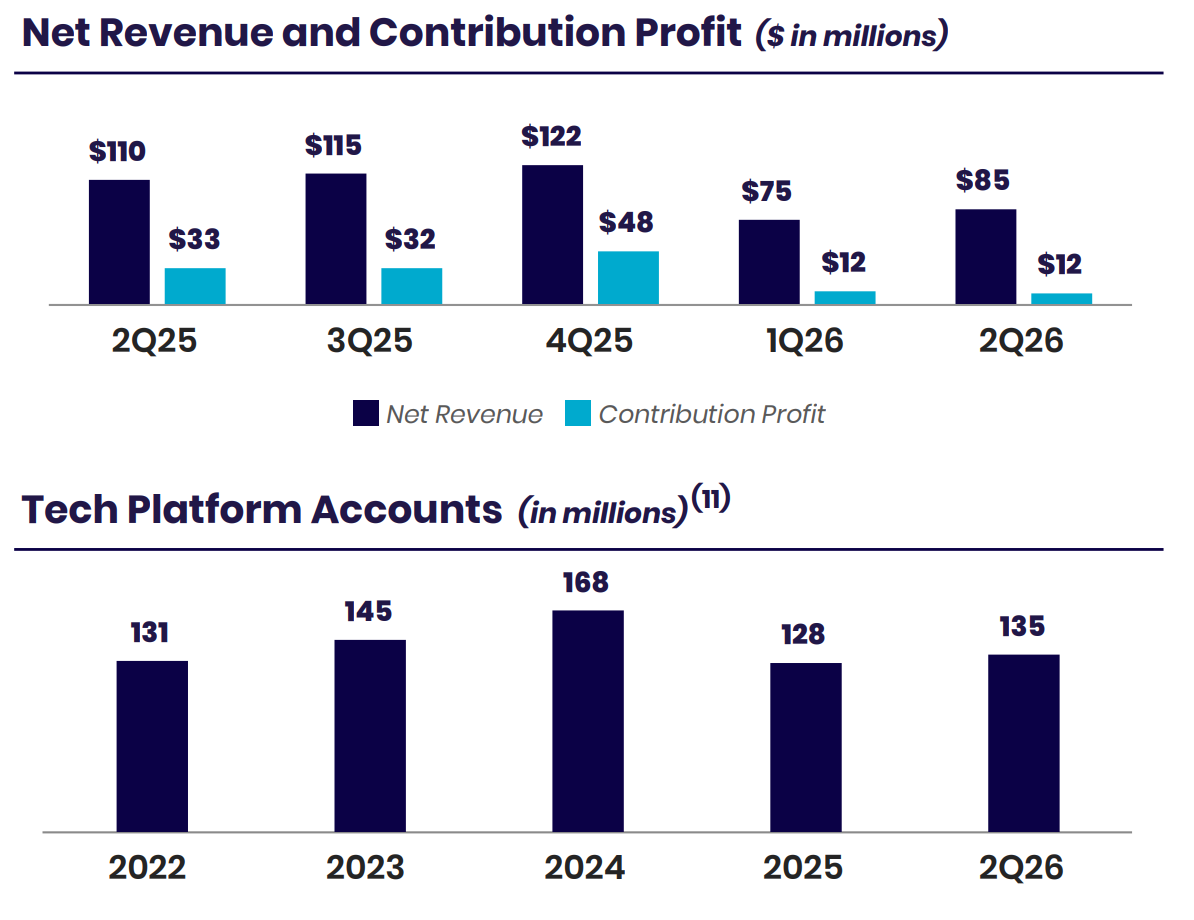
However, it seems we reached the bottom last quarter, with the segment revenues growing by 13% from the $75M it had in Q1 2026. Despite the higher revenues, contribution profit remained at $12M, signaling real issues at the segment.
This part of the company is supposed to be the tech in fintech, providing the backend systems for other banks.
The main reason for this failure was the loss of a very large customer. While Sofi did not name them in every report, it is known to be Chime.
Chime moved its business off Sofi’s platform at the end of 2025, and the loss of that money was felt heavily this quarter.
The number of accounts on the platform also fell 15.8% Y/Y to 135M.
Here we see a slight improvement over Q1 2026, with the company gaining 2M technology platform accounts.
This segment was supposed to be a high-margin business that didn’t need a lot of capital, but right now it is struggling to find its footing. Management says that if you ignore the lost customer, the segment actually grew 12% Y/Y in Q1 2026, but even that is pathetically slow growth.
Because the performance was so bad, Sofi rebranded the whole segment.
It will now be called Sofi Technology Solutions.

They are also changing how they sell the product. Instead of just selling to small fintechs, they are trying to sell to big banks. They have broken the business into four areas:
Processing
Banking Core and Services
Payment Hub
Risk and Fraud
Management hopes this change will help the segment grow by 20% to 25% in the future.
For many bears, the performance of this segment clearly shows that Sofi might just be a bank and not a fast-growing tech company.
Unless the SofiUSD revenue scales and gets reported in this segment, I am skeptical that things can be turned around. We have been hearing one excuse after another for 3 years now.
First, it was because the fintechs didn’t have the budget for upgrades after the 2022 stock market crash.
Then, it was because inflation and high interest rates reduced capex budgets.
Now, it’s because of the Iran War.
The execution in this segment has been poor and extremely disappointing from Anthony Noto and the Sofi team.
It could be that the TAM for this segment is much lower than the company hoped, or that many fintechs and banks don’t want to help fund their competitor.
The earnings release and the call talked surprisingly little about this segment, and there were no questions from the analysts about the terrible performance of this segment.
Essentially, analysts have already written this segment off.
However, Sofi is not. They are working to accelerate growth.
1. Sofi changed the leadership of the segment, hiring Kathleen Pierce-Gilmore as the president. She previously was the VP of Issuer Solutions at Visa.
2. Acquired Peach Finance, a lending and loan servicing infrastructure software company. The exact price has not been disclosed, but it was likely relatively small. This will strengthen Sofi’s tech platform’s offering.
3. Expanding into Big Business Banking.
4. Launching SofiUSD for transaction settlement.
Let’s see what results these new changes deliver next year, its too late to have an impact in 2026.
3. Member and Product Growth
While the technology business is struggling, the banking business is growing incredibly quickly.
Sofi is very good at getting new members and selling them new products.
Sofi calls this the Financial Services Productivity Loop.
The more products a member uses, the more fee and interest income Sofi generates.
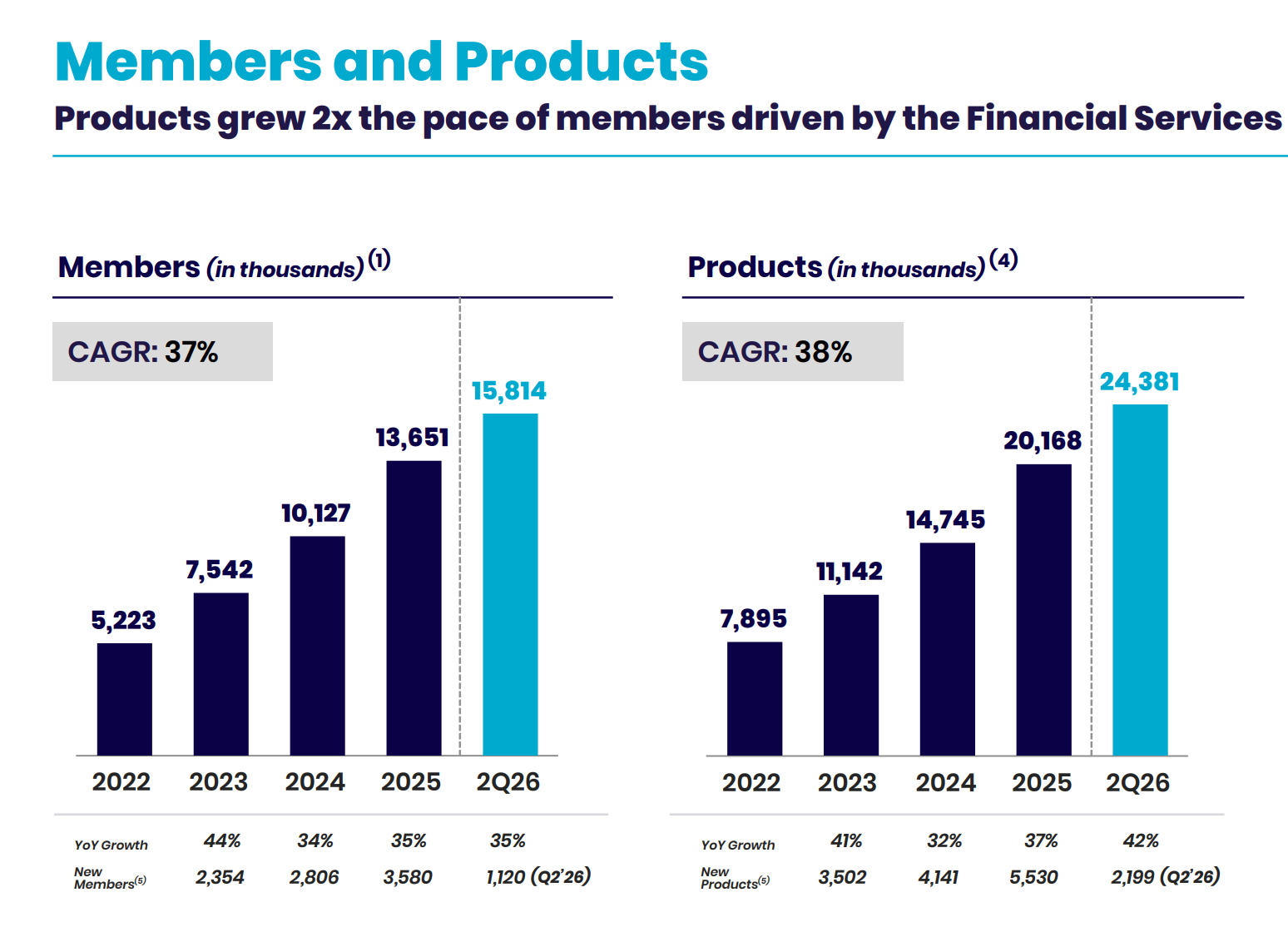
In Q2 2026, Sofi added 1.12M new members. This is a record and brings the total number of members to 15.8M, which is up 35% Y/Y.
It is extremely impressive for a company of this size to keep growing its customer base at such a rapid pace.
The total number of products reached 24.4M, up 42% Y/Y.
This means that the average member has about 1.54 products with Sofi.
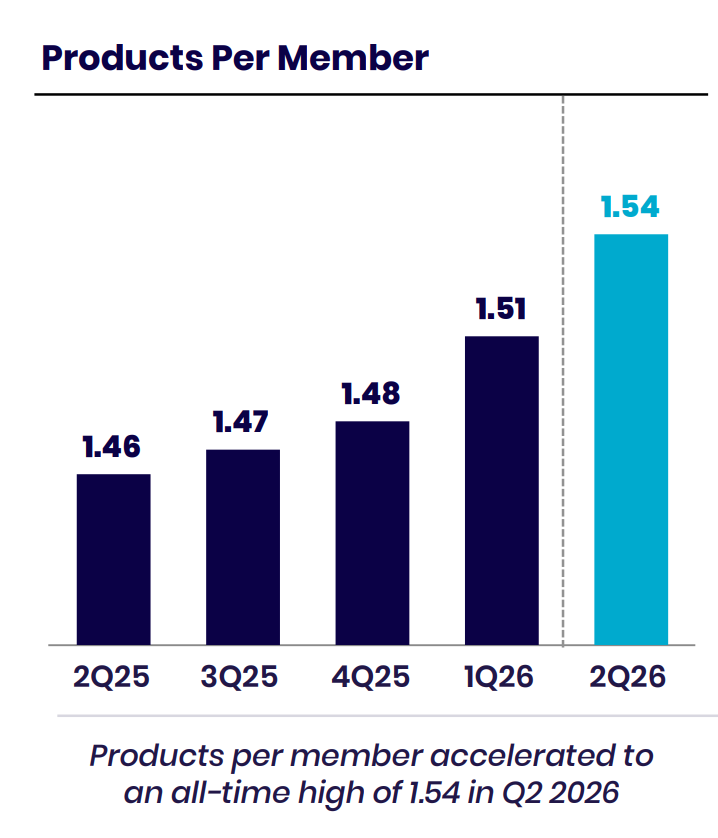
As you can see in the graph above, this is a 5.5% increase from a year ago.
A very important number is the cross-buy rate. This shows how many new products were opened by people who were already members.
In Q2 2026, this was 51%.
This means that more than half of new products used in Q2 2026 came from existing Sofi customers.
Such strong cross-sales are great for Sofi because it’s much cheaper to sell to an existing customer than to find a new one.
Sofi’s brand is also getting much stronger.
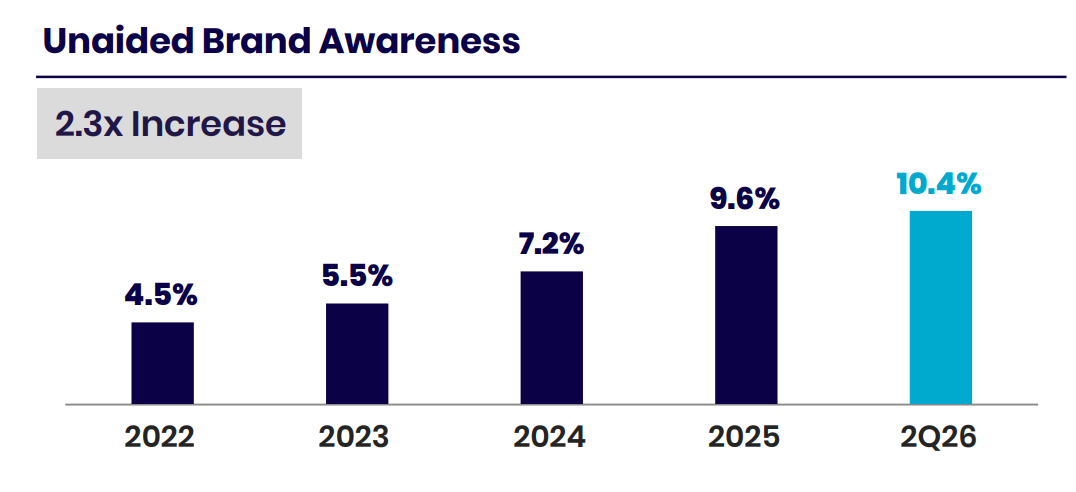
Unaided brand awareness reached 10.4% this quarter. This means that when you ask people to name a bank, 10% of them say Sofi without being prompted.
This is double the level of 2022. Sofi was also named the #1 U.S. Bank by Forbes and ranked #1 for DIY investor satisfaction by J.D. Power.
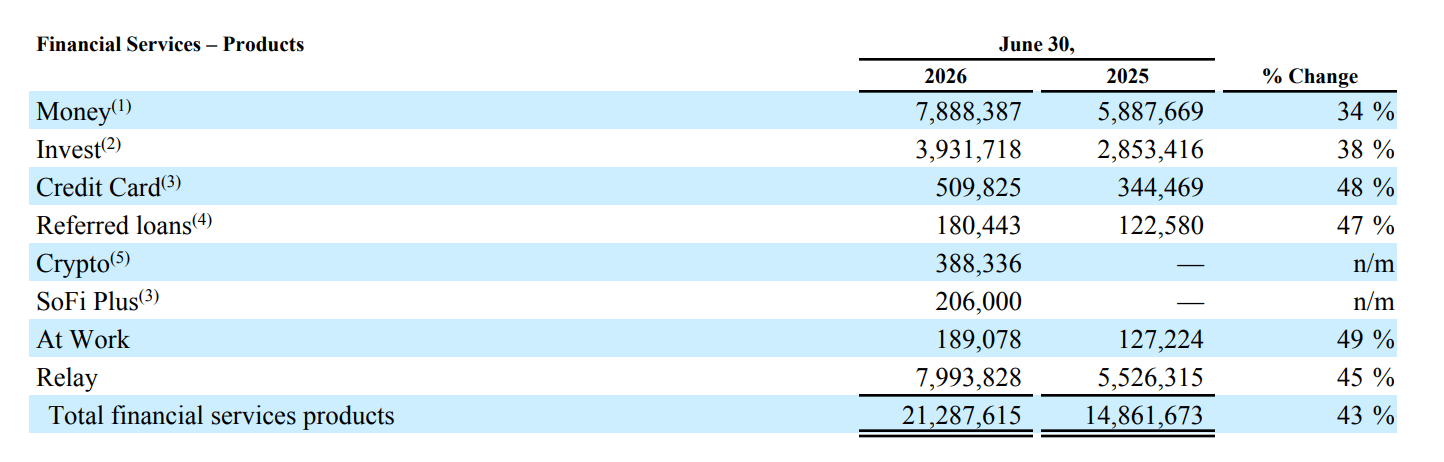
Much of the growth is coming from financial services products like Money and Relay, which grew by 34% and 45% Y/Y.
Also, there was an acceleration in credit card product growth, 48% vs 42% last quarter.
“Let me spend a minute on SoFi Credit Card. We think we’ve cracked the code on efficiently acquiring high-quality credit card members.”
“We’re excited by the trends we are seeing, not only in the back book, which reached profitability, but also our ability to add the right members in this important product.” CEO Anthony Noto, Q2 2026 Earnings Call.
Sofi has struggled with credit cards in the past, but now this segment is profitable, and the company has found a way to acquire quality credit card users.
But interestingly, Crypto products reached 388.3K after launching just in Q4 2025, a 62% Q/Q growth.
This is a really strong growth in a single quarter, especially considering that crypto and growth stocks have not been doing that well since the Iran War.

Meanwhile, lending products also grew by 36%, driven by personal and home loans.
4. Lending
The lending segment is still the biggest part of Sofi’s business, and in Q2 2026, it was running at full speed.
Total loan originations reached $14.8B, +69% Y/Y from the $8.76B originated in Q2 2025 and +21.5% Q/Q from $12.2B in Q1 2026.
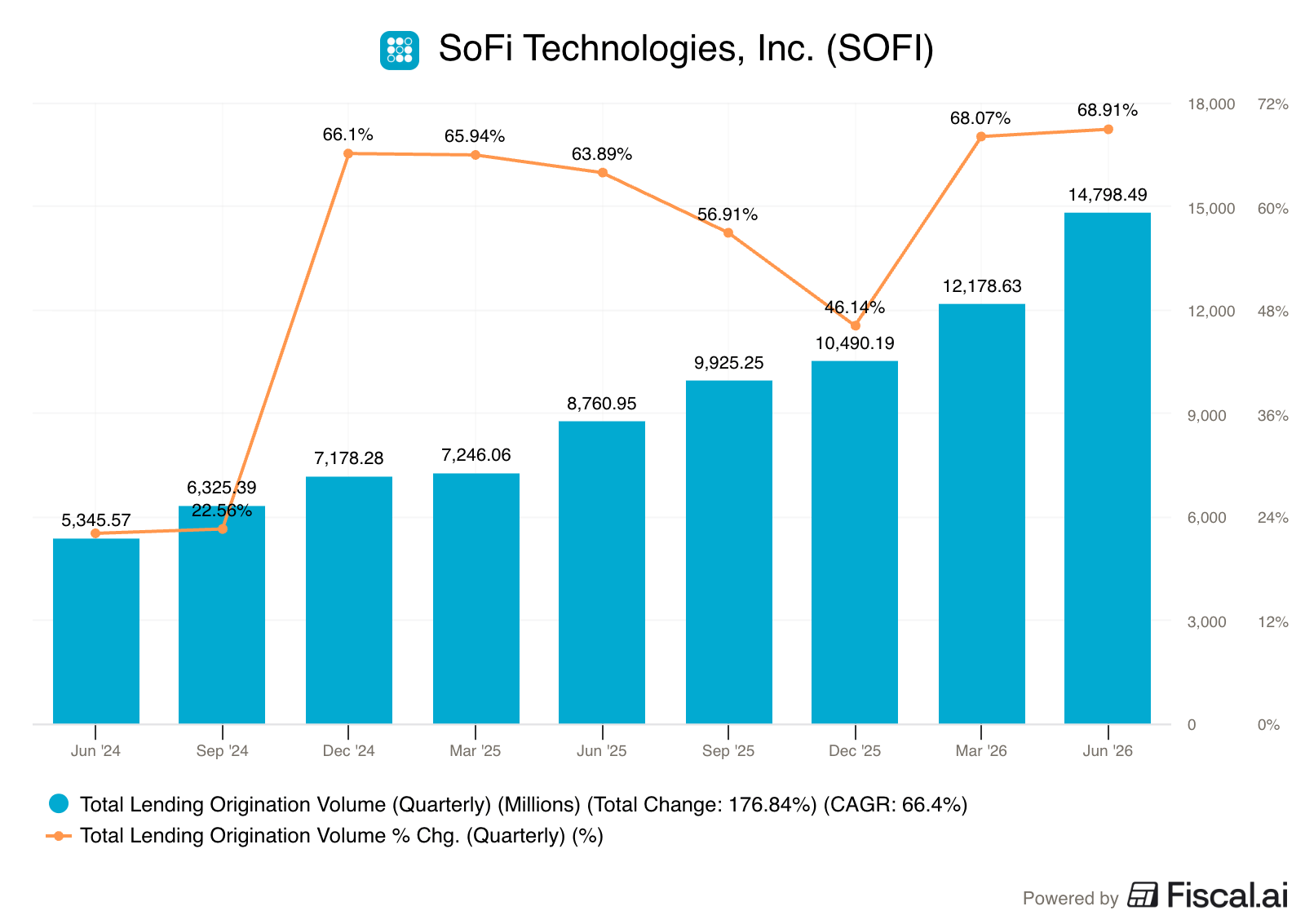
As you can see in the chart above, it was the strongest Y/Y lending growth in 10 quarters and an acceleration from the prior 2 quarters.
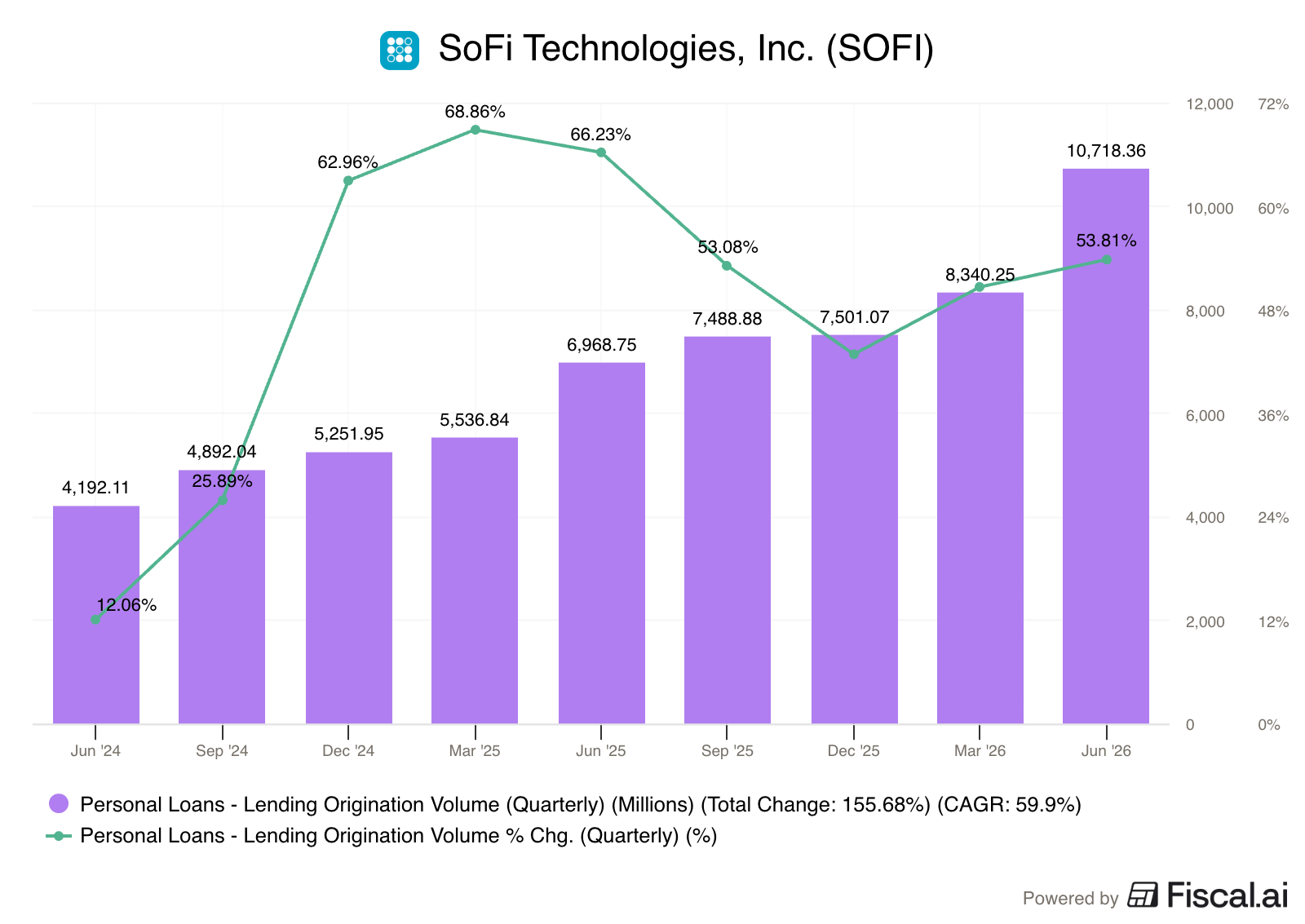
Personal loans were the largest part of this, reaching $10.7B, up 54% Y/Y.
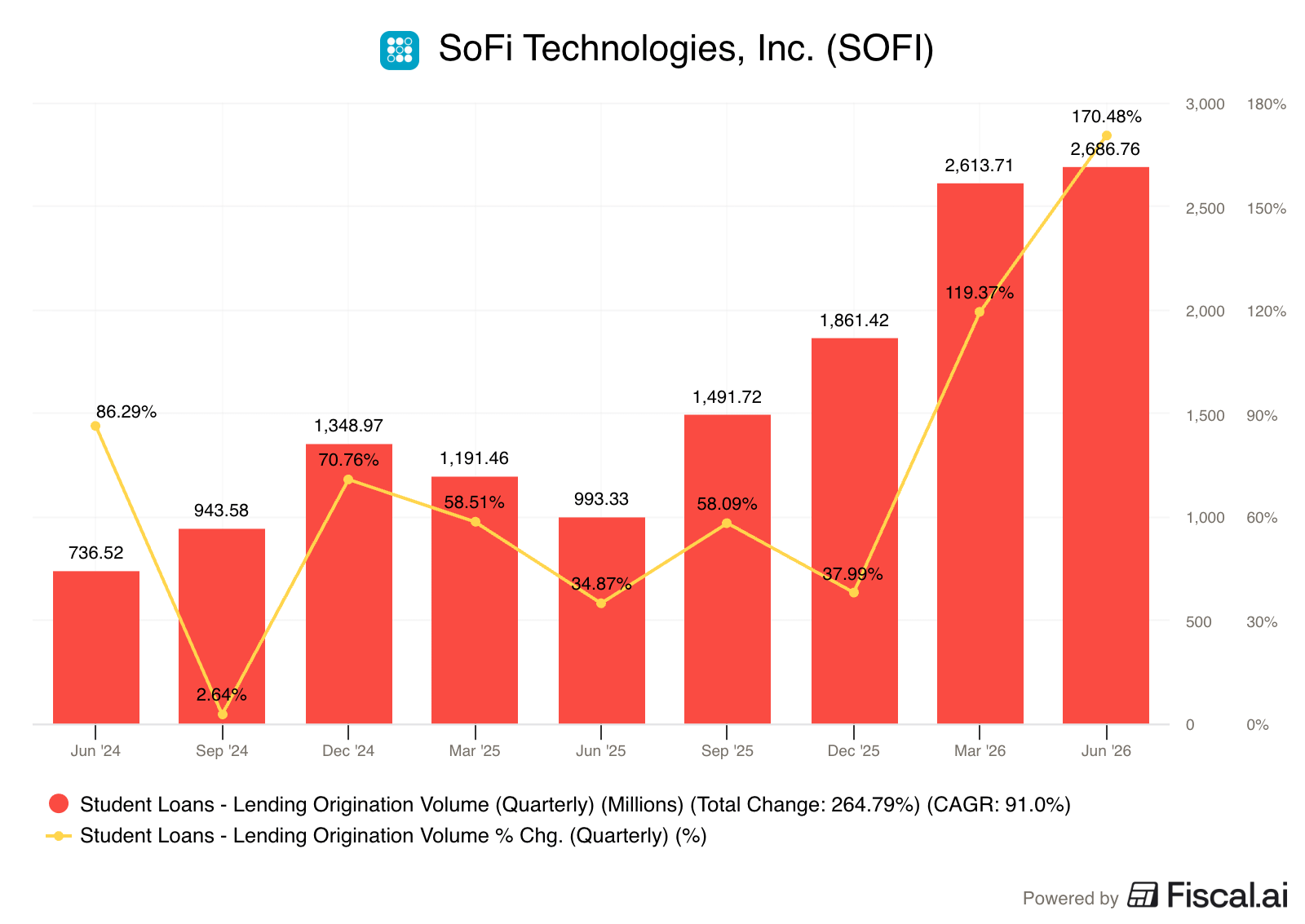
Meanwhile, student loan originations accelerated massively, jumping 170% Y/Y to $2.7B.
This is the result of the Trump administration restarting student loan repayments that the Biden administration stopped during COVID. People are looking to refinance their student debt as they notice higher interest charges hitting their bank accounts.
This is how Sofi acquires high-value customers. By offering affordable loan refinancing, it is acquiring university graduates early in their careers. Then Sofi moves them down in the funnel, upselling them new products, like mortgages, which also saw significant growth this quarter.
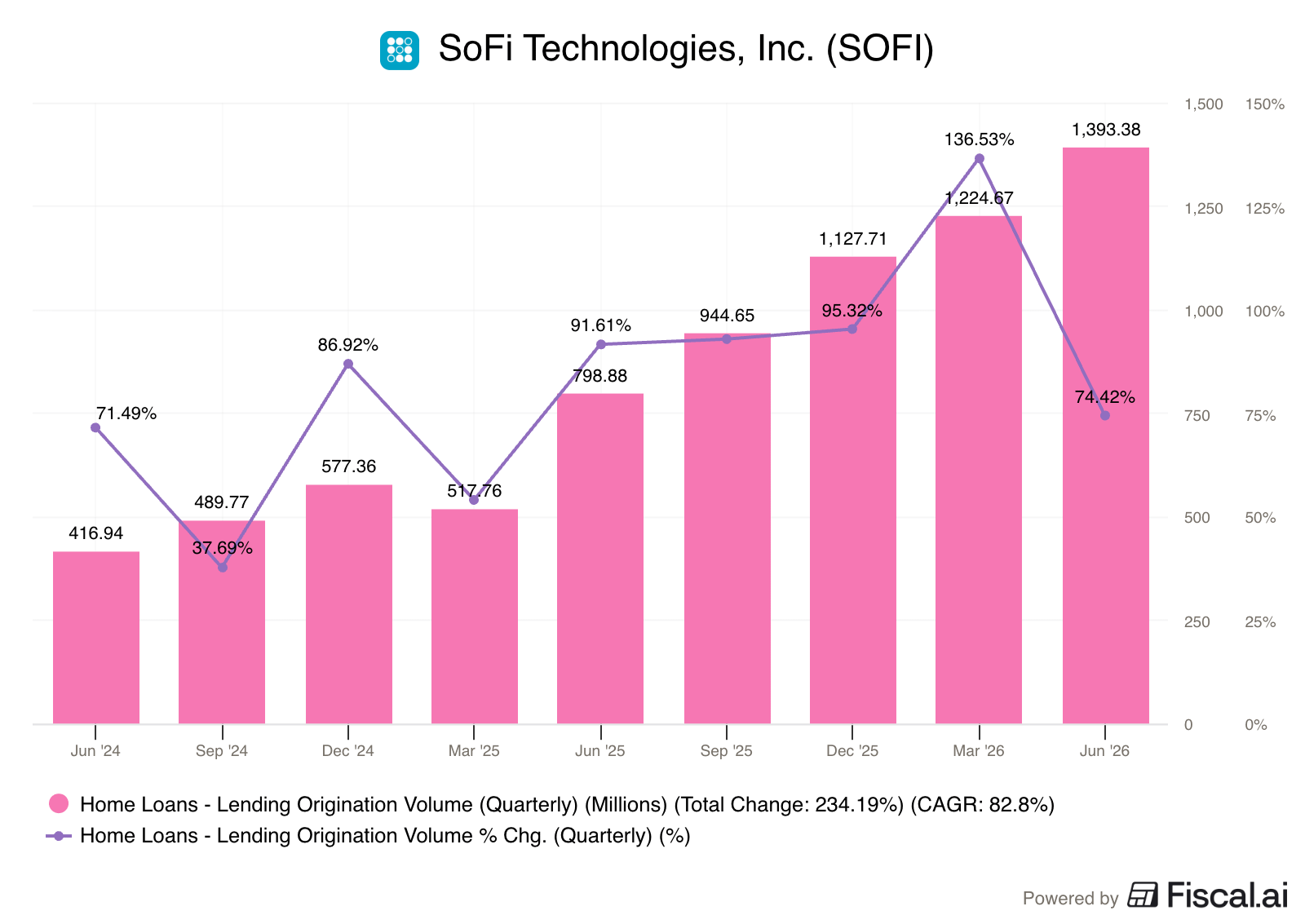
Home loans were up 74.4% Y/Y to $1.4B.
This is an area that the company is increasing its focus on, in preparation for a possible real estate recovery, which could happen if interest rates come down in the US.
A few months ago, Sofi announced its expansion into home equity lines of credit (HELOC). This allows people who own a home to borrow money against the appreciated equity value, even if the mortgage has not been fully paid off. This has become very popular because many people have a lot of equity in their homes as prices have risen in the last decade, but don’t want to sell.
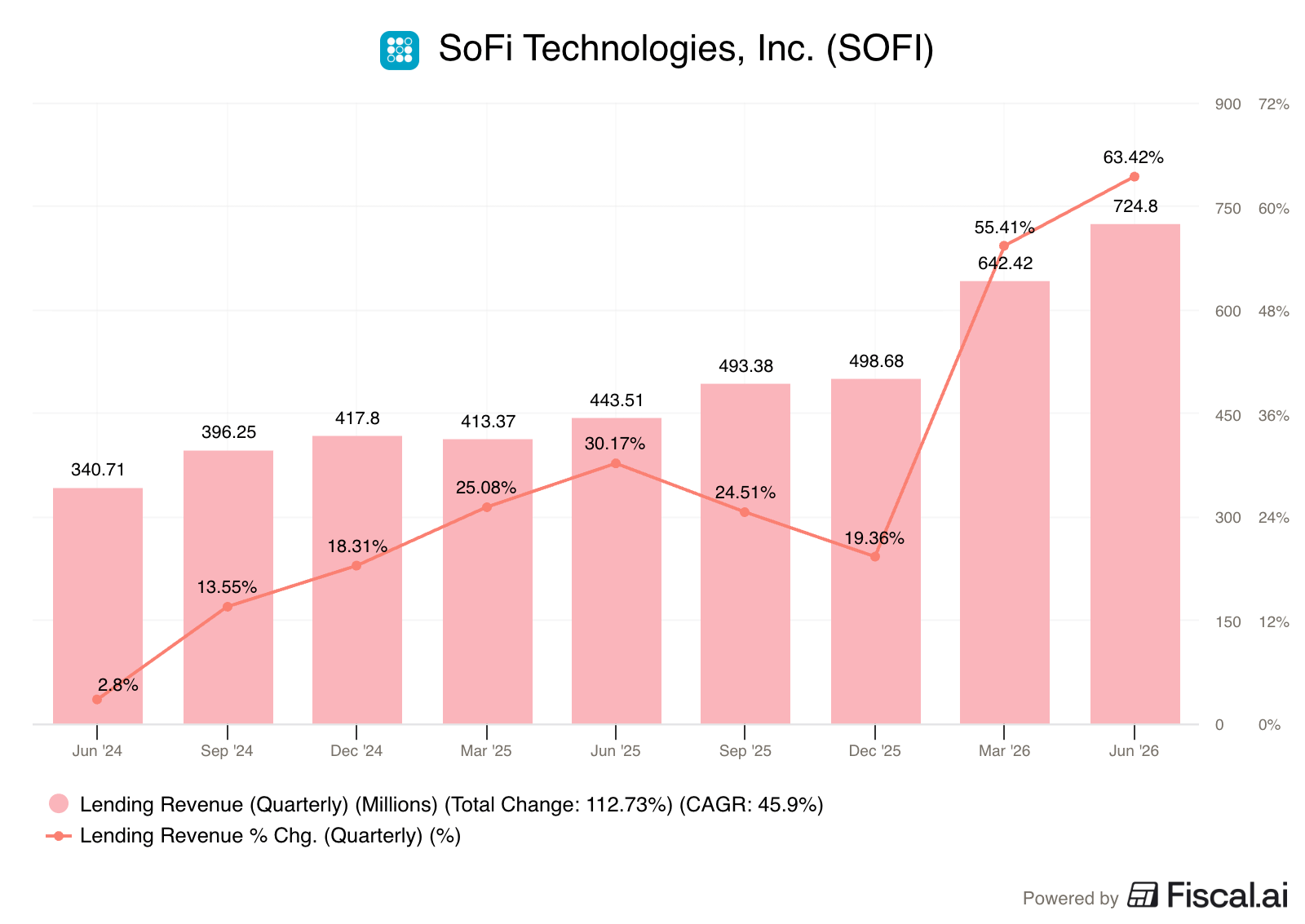
Overall, the revenues of the lending segment grew by 63.4% Y/Y to $724.8M.
In the chart above, you can clearly see that the company delivered strong Q/Q growth as well, growing by 12.8%.
This was the continuation of the lending revenue growth acceleration.
4.1. Loan Platform Business
The loan platform business has been a huge success and the company’s biggest innovation in the last 2 years.
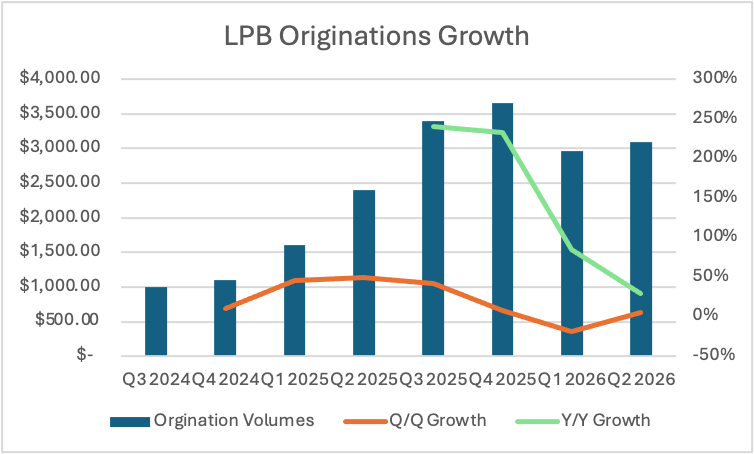
In Q2 2026, Sofi originated $3.1B on behalf of its partners, up 29% Y/Y.
While the growth looks impressive on a Y/Y basis, it was not as strong on a Q/Q basis, as you can see looking at the orange line in the graph above. Originations grew only by 5% sequentially, and this was part of the reason that added to the stock sell-off.
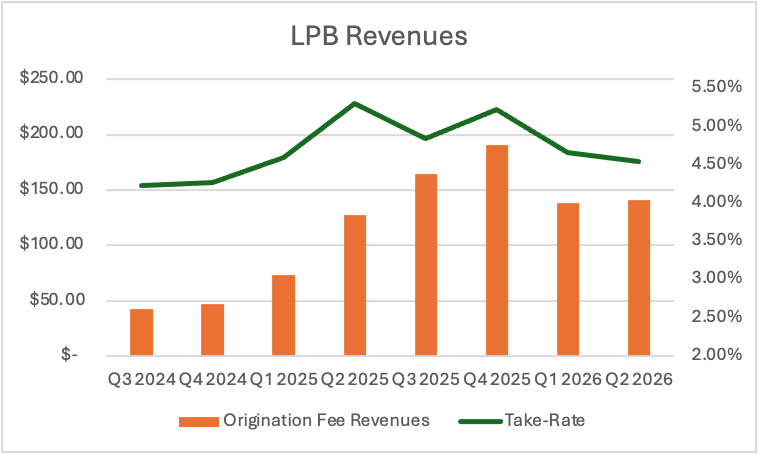
LPB generated $141M in revenues, which was up just 11% Y/Y and a 2% Q/Q. Take-rate also went down from 5.22% in Q4 2025 to 4.5% this quarter.
Sofi CEO Anthony Noto later commented to Bloomberg and Yahoo Finance that this decline was not due to loss of interest from funders, but rather a focus on growing their own loan book. The fact that overall originations grew so strongly, 69% Y/Y and 21.5% Q/Q, gives credence to this explanation.
“During the second quarter, we had significant demand from LPB partners over and above what we decided to fulfill, but we did fill all demand from our contractual commitments and more……
First, we’ve reached an agreement with a new partner, Sixth Street, to invest in personal loans totaling up to $1 billion.
Second, we’ve expanded our offering to include our new SMB loan product and have agreed to terms on a three-year, $3 billion agreement with BasePoint Capital .
Third, we just further expanded our offering to include our home equity loans, with the first loans being transferred in the coming days to a leading global bank…..
So LPB volume is not currently constrained by investor demand.” CFO Chris Lapointe, Q2 2025 Earnings Call
So a 1) a new $1B deal with Sitxth Street, 2) $3B deal with BasePoint and expansion to SMB lending and 3) expansion to home equity with a global bank.
They are clearly working to grow the LPB business, however, they are not in a rush.
Management is deliberately not maximizing LPB volumes. It is using LPB as an “overflow valve” and capital-light complement to balance-sheet lending, while expanding it into new asset classes.
Essentially, I am reading this strategy as the company wanting to capture the best loans itself, instead of giving them to its credit investors.
Also, the company wants to build a strong and large balance sheet, and you can’t do that by simply taking a 5% fee.
4.2. Credit Quality
Credit quality has always been a big topic for Sofi, especially since the short-sellers Muddy Waters recently claimed that Sofi’s loan book is riskier than the company claims.
They alleged that Sofi misstated $312M in debt and that the real charge-off rate for personal loans is 6.1%.
Sofi says these claims are “factually inaccurate and misleading”.
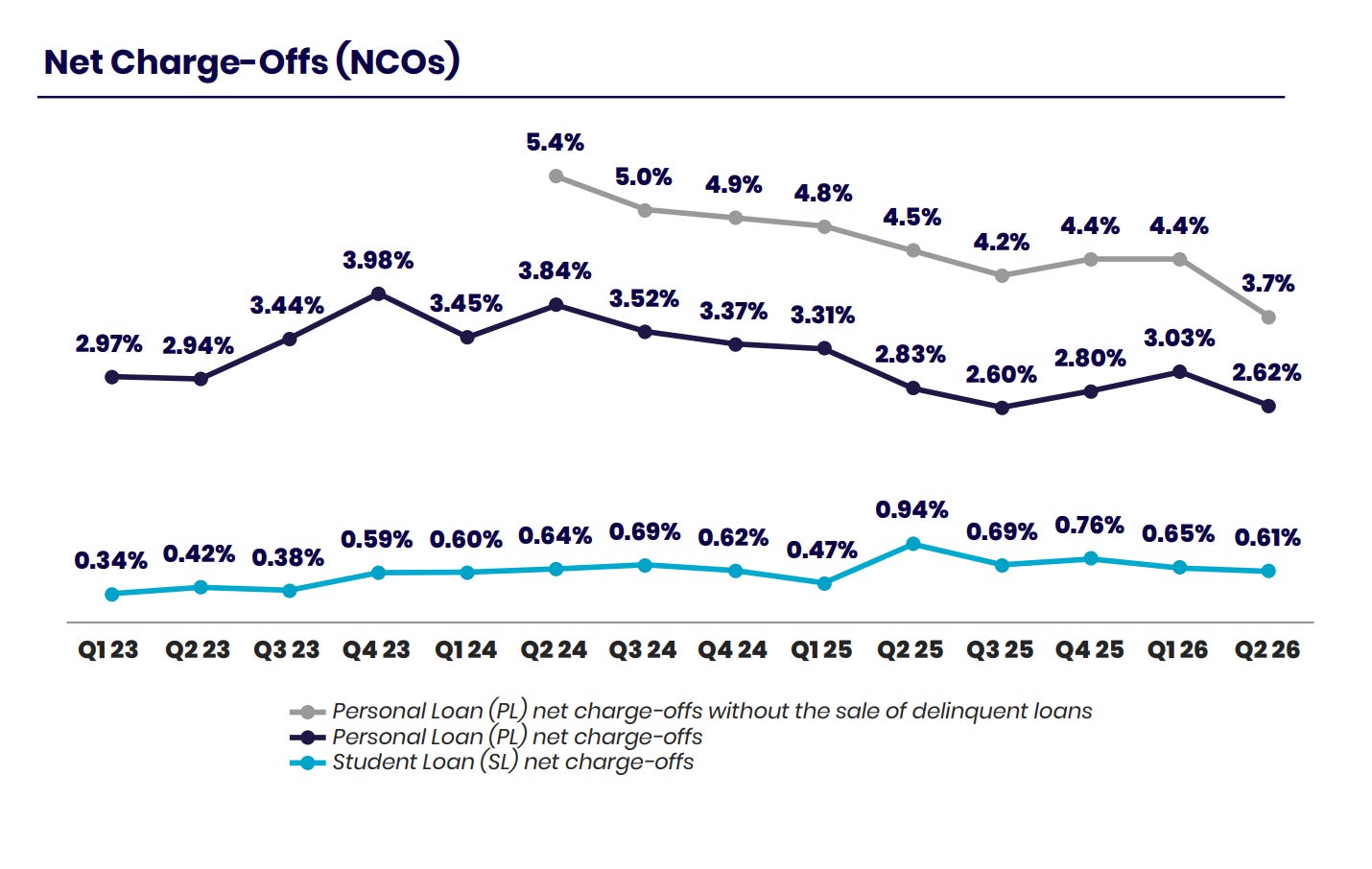
They reported a personal loan net charge-off rate of 2.62% for the quarter. This is down from 3.03% last quarter and down from 2.83% a year ago.
If you include the delinquent loans that Sofi sold, the rate would be 3.7%.
Management says their losses are well within the 7% to 8% range they planned for.
Furthermore, looking at historic loan quality vintages, we see that Sofi loans today are performing much better than the loans the company issued in 2017.
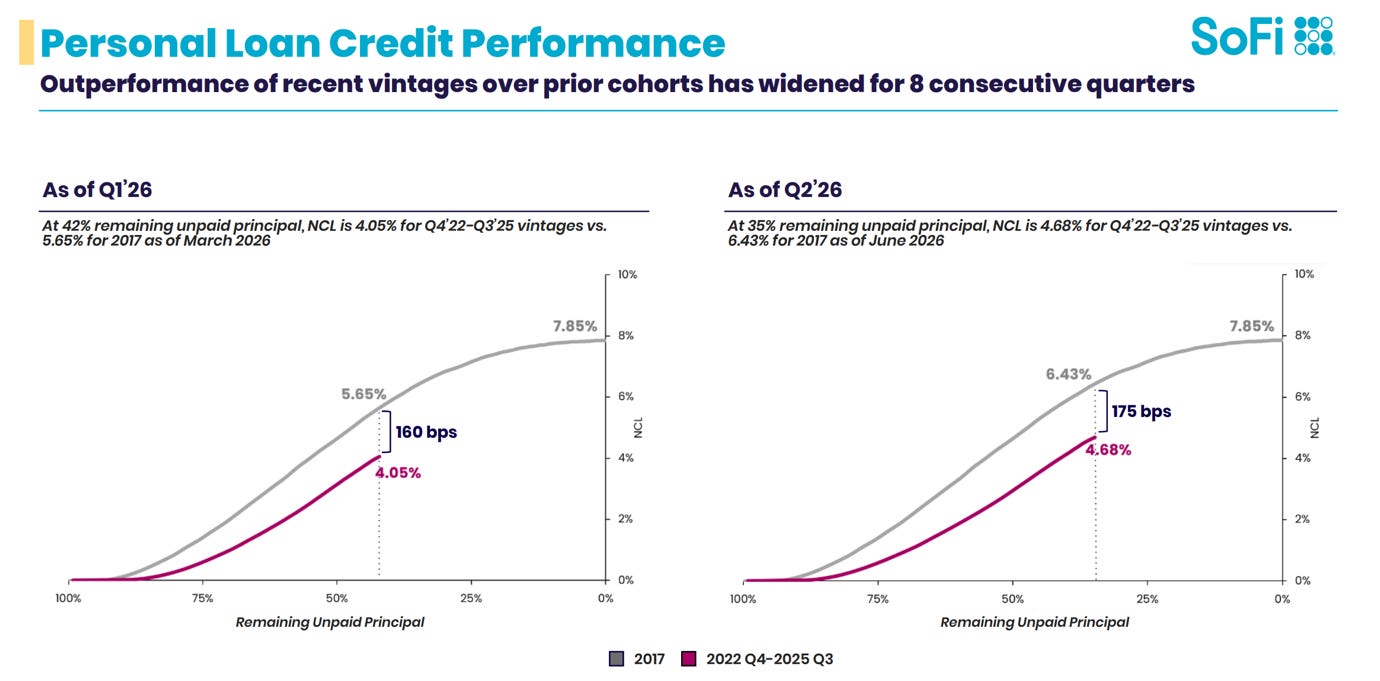
As of Q1 2026, 42% of the unpaid principal remained from issued loans.
4.05% of that was in default, compared to 5.65% at the same maturity for loans issued in 2017, a gap of 160 basis points.
As of Q2 2026, we see that the gap is improving, with 4.68% of loans in default compared to 6.43%, a gap of 175 basis points.
Simply put, Sofi defaults are lower than in 2017, despite issuing multiples more loans, because they are issuing less risky loans to richer people.
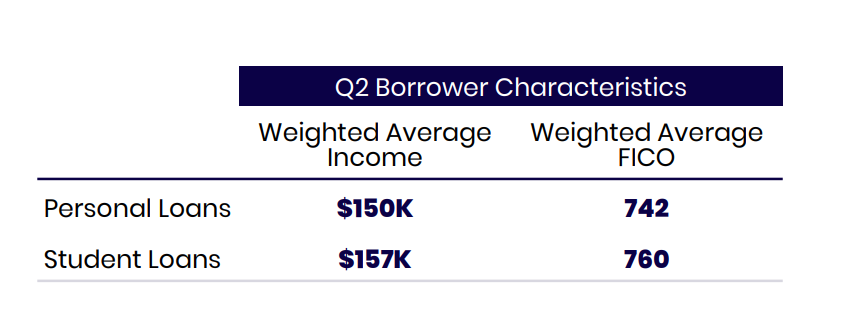
There is nothing to worry about, as the average Sofi personal loan borrower has an income of $150,000 and a credit score of 742. These are very high-quality borrowers. The student loan charge-off rate is even lower at just 0.65%.
Overall, Sofi’s credit performance seems stable, but the market remains nervous because of the short-seller reports.
5. Financial Services
The Financial Services segment Revenue was $466M, up 28.6% Y/Y.
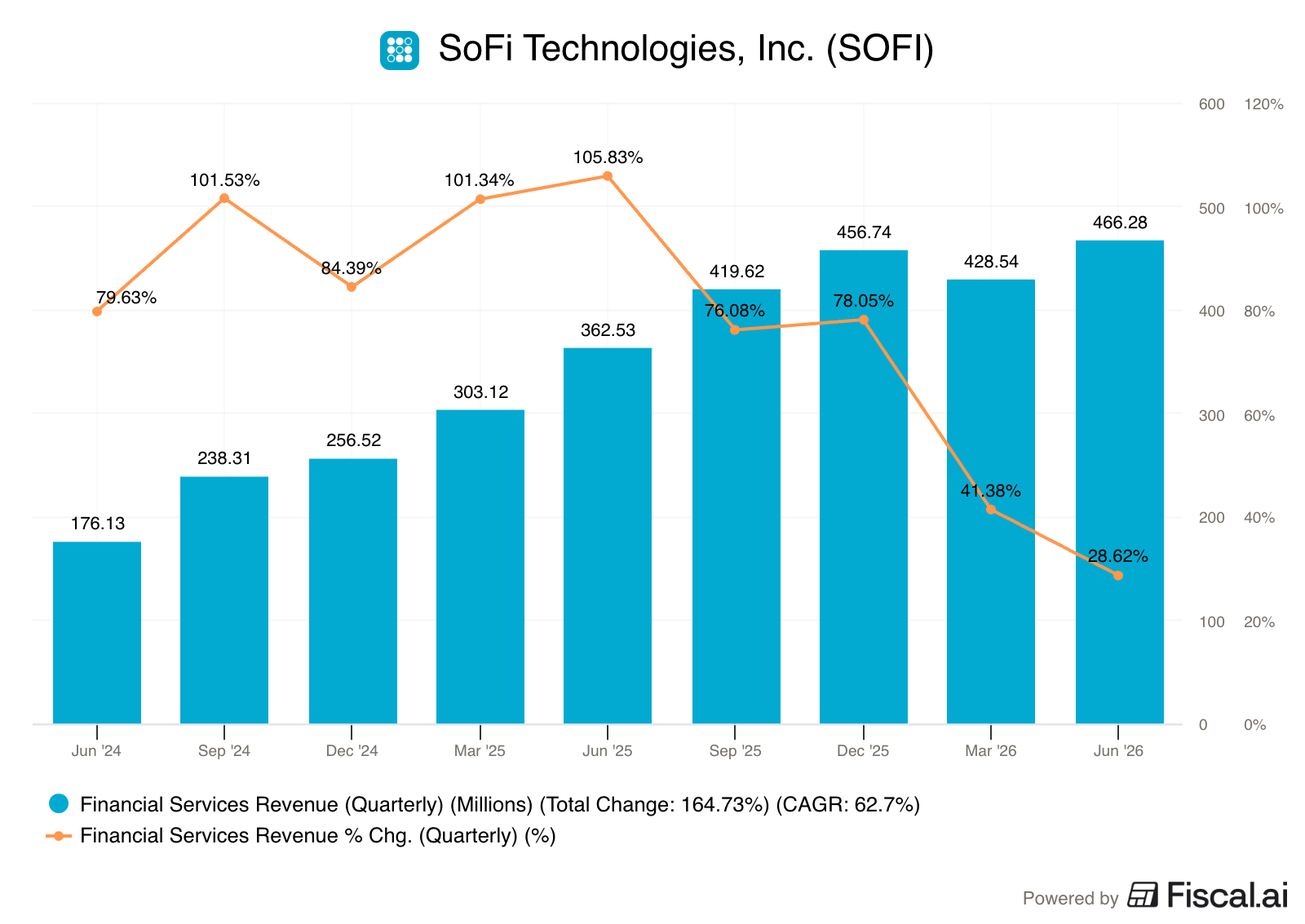
This was a meaningful deceleration, and the worst growth quarter in 9 quarters!
This was one of the reasons the stock sold off, but it doesn’t make much sense to me, as all other segments performed strongly.
I have to note that the LPB revenues are reported here, not part of lending, as lending revenues are where Sofi actually holds the loans on its balance sheet. The $50M decrease in LPB revenues from Q4 2025 was essentially the main reason why this segment decelerated.
6. Dilution
The narrative is that Sofi is a heavily diluting company!
But that is simply not the case, as all dilution needs to be looked at in the context of the financial results delivered.
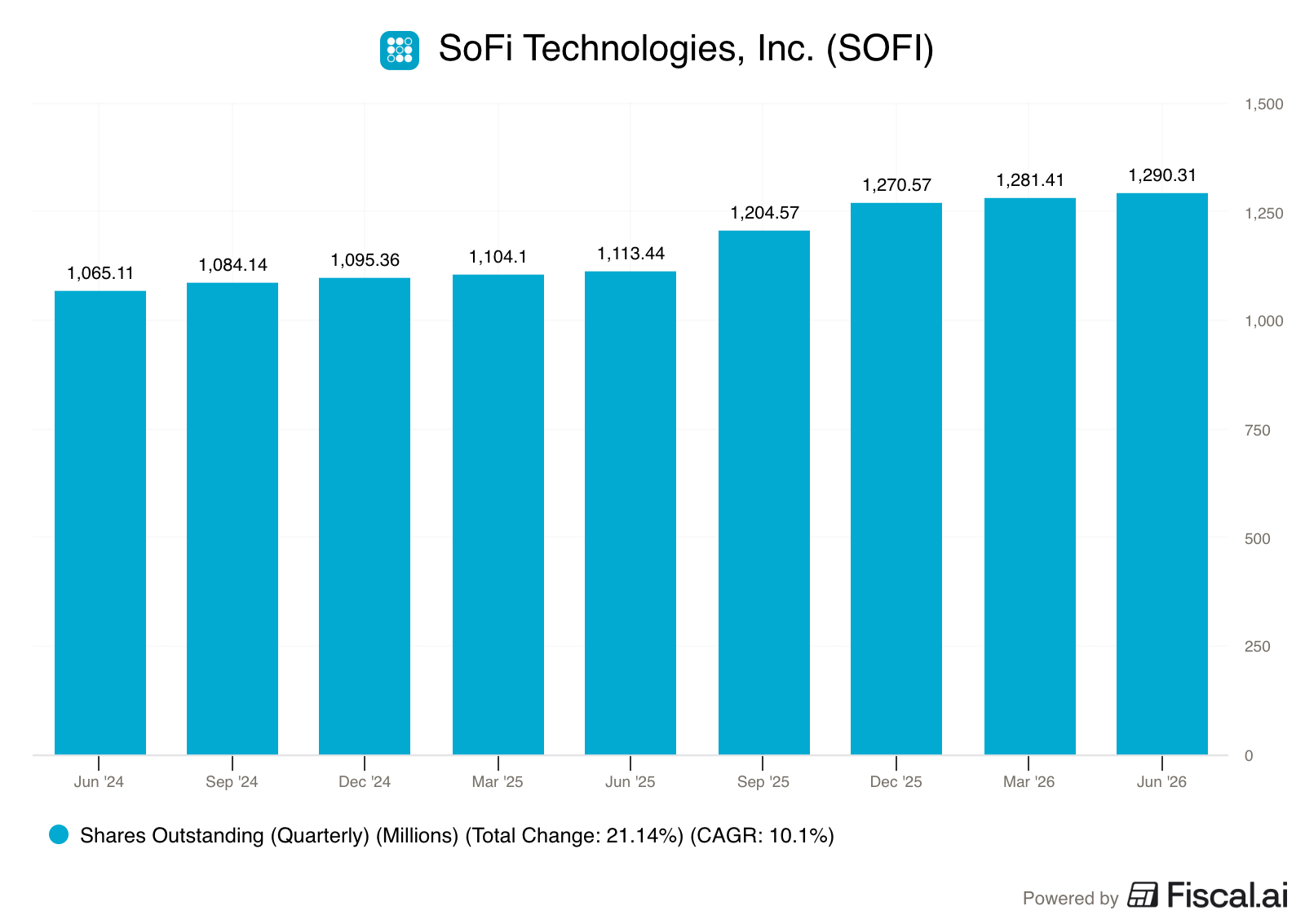
In the last 2 years, Sofi has been steadily increasing the number of shares outstanding by 10% per year.
During this time, revenues have grown by 103.6%, while EPS has exploded from $0.01 to $0.12.
It is clear that Sofi dilution is smart, balanced, with a clear strategy, and most importantly, not financially dilutive.
However, by now, it is also clear that the last 2 dilutions were a strategic mistake, despite it not being a financial mistake.
It’s the only criticism that I see repeated again and again in comments, “Noto diluted,
is a terrible company, dilution is bad”.
I suspect that this dilution was actually the real reason why Muddypants attacked Sofi. They saw that this bear narrative is strong and persistent, and wanted to cash in on it by adding gasoline to it.
There is no objective metric by which Sofi could be a “terrible company”, yet this narrative persists because of the dilution and stock performance.
During the earnings call, they said that these note issuances were not economically dilutive to the EPS. This is because Sofi used the $3B+ it raised to grow the EPS.
Simply put, the EPS is larger today than if they hadn’t diluted, even though the share count is higher.
Here is the real issue, investors don’t care about it.
They only care about the share count going up.
It doesn’t matter what Sofi does with the money, selling stock to raise funds is “bad, full stop” and the market doesn’t want Sofi to do that.
If Sofi had not done these raises, the share price today would be higher, even though the EPS would be lower.
That’s why I am saying that it was a strategic mistake, despite it not being a financial mistake.
However, the management has confirmed that they don’t plan on doing any more equity raises.
“We believe that we can operate comfortably within our target capital range without the need to raise capital under our current operating plan.”
“We’re self-funded through our guidance period and the medium-term operating plan that we’ve laid out. As our profitability continues to improve, our organic capital generation is going to continue to increase as well.” CFO Chris Lapointe, Q2 2026 Earnings Call
The medium-term operating plan is till 2028, so the CFO is saying that they are not planning to issue more equity or convertible notes at least for the next 2 years.
In the long term, Sofi is delivering strong results, releasing new products, and growing EPS.
7. Conclusion
The Q2 2026 report for Sofi shows a company that is doing two very different things.
On one hand, the banking business is a massive success. Members are joining in record numbers, they are using more products, and the company is making a solid profit.
The lending business is also breaking records, despite high interest rates, persistent inflation, and the Iran War.
On the other hand, the technology business is in trouble.
Let’s look at the 4 key reasons I identified at the beginning as the cause for this sell-off.
1. Deceleration in the Loan Platform Business was not because of low demand from credit investors, it was a deliberate move to grow the balance sheet. Sofi is satisfied with the current LPB volumes for personal loans and would rather keep more on their books. LPB volume growth will come more from SMB and home loans.
2. Higher effective tax rate causing the EPS miss was due to the difference in how US GAAP and the IRS look at employee stock-based compensation. Because the share price is lower now, Sofi was not able to offset taxes with the employee stock compensation to the degree that it previously estimated.
3. Didn’t increase the earnings guidance because of this new tax reality.
4. Dilution concern is overblown, with the CFO confirming that they don’t plan to raise money using equity at least for the next 2 years.
Sofi must demonstrate that the LPB deceleration was indeed not because of lower demand from credit investors.
Sofi also has to show that their loans are as safe as they say they are, especially with short-sellers watching every move.
If they can do that, the company could have a much better second half of the year.
But for now, the stock remains very volatile as the market weighs the record growth against the dilution and short-seller reports.

Here is what my Premium Members can expect:
Portfolio Review - Each month, I will present the portfolio performance and discuss my stock watchlist and my best ideas.
Recent developments.
Unwarranted pullbacks.
Insider activity.
Potential catalysts.
Deep Dives – 8,000+ word detailed analysis of a company, delivered in 3 Parts.
Part 1 – Brief History of the company and its Business Model.
Part 2 – Management, Moats, Competitors, and Risks.
Part 3 – Opportunities, Financial Analysis, and a Valuation Model.
You can expect a comprehensive research report that is educational, interesting, and provides actionable insights!
To see what you can expect, read my Palantir Deep Dive!
Members of the Premium service get access to my library of 15 Deep Dives and to all future Deep Dives, which will be released on semi-monthly basis.
Investment Cases – A short, concise report with actionable insights.
This report is about the size of a single part of a Deep Dive.
Focused Investment Thesis
Main drivers of the Bull Case
Valuation Model
To see what you can expect, read my Oscar Health Investment Case!
Earnings Reviews and Updates – For companies that are of great interest to me and my readers, I will provide regular quarterly or semi-annual updates after earnings reports.
Financial performance
Business Update
New developments
Updated Valuation Model
To see what you can expect, read my Google Q2 2025 Earnings Review!
You can follow me on Social Media below:
X(Twitter): TheRayMyers
YouTube: TheRayMyers
Threads: @global_equity_briefing
LinkedIn: TheRayMyers
Equity Research Report List
Disclaimer: Global Equity Briefing by Ray Myers
The information provided in the “Global Equity Briefing” newsletter is for informational purposes only and does not constitute financial advice, investment recommendations, or an offer or solicitation to buy or sell any securities. Ray Myers, as the author, is not a registered financial advisor, and readers should consult with their own financial advisors before making any investment decisions.
The content presented in this newsletter is based on publicly available information and sources believed to be reliable. However, Ray Myers does not guarantee the accuracy, completeness, or timeliness of the information provided. The author assumes no responsibility or liability for any errors or omissions in the content or for any actions taken in reliance on the information presented.
Readers should be aware that investing involves risks, and past performance is not indicative of future results. The author may or may not hold positions in the companies mentioned in the “Global Equity Briefing” report. Any investment decisions made based on the information in this newsletter are at the sole discretion of the reader, and they assume full responsibility for their own investment activities.